“John Lewis” and “Medgar and Myrlie” tell the stories of activists who struggled with when to push and when to compromise and build coalitions.
John Lewis, left, in 1964, and Medgar Evers, circa 1960, in Jackson, Miss.Credit…From Left: Robert Elfstrom/Villon Films, via Getty Images; Michael Ochs Archive/Getty Images
By Matthew F. Delmont
Matthew F. Delmont is a professor of history at Dartmouth College and the author of “Half American: The Epic Story of African Americans Fighting World War II at Home and Abroad.”
Published Feb. 6, 2024 Updated Feb. 12, 2024 (NYTimes.com)
JOHN LEWIS: In Search of the Beloved Community, by Raymond Arsenault
MEDGAR AND MYRLIE: Medgar Evers and the Love Story That Awakened America, by Joy-Ann Reid
In the spring of 1961, John Lewis and Medgar Evers found themselves at odds with the leadership of the National Association for the Advancement of Colored People. The N.A.A.C.P. executive secretary, Roy Wilkins, wanted Black freedom won through institutional channels: voter registration and the courts. As 21-year-old Lewis and the other young Freedom Riders prepared to set off by Greyhound for Mississippi that May, Wilkins fretted: What would their new allies in the White House think? He dismissed the journey as a “joy ride.”
It was anything but. As a pair of new biographies show, Lewis and Evers helped to develop the direct-action protest tactics that reshaped the civil rights movement. In the deeply researched and accessible “John Lewis,” for example, the historian Raymond Arsenault describes how the Freedom Riders were arrested and jailed almost as soon as they reached Jackson. (They tried to use the whites-only restroom at the bus station.) Their incarceration garnered national attention, and, by the end of the summer, more than 400 activists were inspired to participate in more than 60 different rides. Two-thirds of them ended up in prison in Mississippi.
To be clear, Evers and Lewis weren’t exactly on the same page either. Evers, a World War II veteran, was the N.A.A.C.P.’s field secretary in Mississippi and more than a decade older than Lewis. As the MSNBC journalist Joy-Ann Reid details in her compelling history, “Medgar and Myrlie,” Evers traveled the state extensively and he was intimately familiar with the virulent racism and violence the riders would encounter.
Lewis was not. “I’d never been to Mississippi before,” he later explained. “All my life I had heard unbelievably horrible things about the place, stories of murders and lynchings, bodies dumped in rivers.”
While Evers respected their courage, he worried that outsiders would compete with the sit-ins and protests already taking place among — and being led by — Black youth in Jackson.
Still, as Reid shows, Evers supported young activists and believed in collaboration. He set the Freedom Riders up with an office a few doors down from his own.
Reid centers her engrossing history on the bond between Medgar Evers and his wife, now Myrlie Evers-Williams. The couple met in college and married on Christmas Eve in 1951. “He talked about how much he loved his country,” Evers-Williams recalls. “And he questioned how much his country loved and respected him.”
After Evers returned from France, a nation where Black G.I.s got better treatment than they did at home, Medgar saw with fresh eyes why justice in America could not be achieved through the election booth alone. Working with the N.A.A.C.P., he began investigating white supremacist murders, like that of Lamar “Ditney” Smith, a World War II veteran who was shot and killed by three white men on the steps of a courthouse where he was delivering absentee ballots from other Black voters.
Smith’s killing came just weeks before the lynching of 14-year-old Emmett Till, a case that haunted Evers for the remainder of his too short life. Reid writes that Medgar did the “painstaking work of convincing terrorized Blacks in the Delta” to appear as witnesses. His name started appearing on a Ku Klux Klan “kill list.” Many days at work, he wept at his desk.
Till’s murder also shook Lewis, who was just a year older than Till at the time. “That could have been me, beaten, tortured, dead at the bottom of a river,” he later wrote. He began to question the American principles of democracy and equality he had read about as a child. He felt like a “fool” for being excited by the Supreme Court’s 1954 Brown v. Board decision outlawing school segregation.
In Mississippi, Evers worked to recruit disillusioned young people like Lewis. He traveled relentlessly, reviving field offices across the state and establishing youth councils among Black students. Evers’s story is less familiar than those of Lewis, Martin Luther King Jr. or Rosa Parks, but Reid persuasively argues that Evers was the architect of a “civil rights underground network” that provided the foundations for other civil rights organizations in his state.
The risks of his activism weighed heavily on Myrlie. “When he left the house every day, I never knew whether I’d see him again,” she tells Reid. The terrible moment she had long feared came just after midnight on June 12, 1963, when a Klansman assassinated Medgar in the driveway of the couple’s Jackson home.
When news of Evers’s murder broke, “something died in all of us,” Lewis later said. That month, Lewis became the chairman of the Student Nonviolent Coordinating Committee and spent the summer crisscrossing the South leading nonviolence workshops.
The gulf between younger and older activists widened as the August date approached for the March on Washington, an event that Lewis and his SNCC colleagues “feared would be a pro-administration showcase” designed “to curry favor with the government,” Arsenault writes. “I didn’t want to be part of a parade,” Lewis later explained.
Lewis drafted a fiery speech, only for the elder civil rights leaders of the march — Wilkins, Whitney Young, M.L.K. — to pressure him to soften the tone. A. Phillip Randolph, who had first envisioned the march two decades earlier, was near tears when he pleaded with him: “I’ve waited all of my life for this opportunity. Please don’t ruin it.”
While some fellow activists criticized Lewis for scaling back the more radical language in his speech, the March on Washington in many ways epitomized what he hoped America might become. Lewis made his peace with the compromise and joined the broader coalition for social justice, his “Beloved Community.”
Over the next six decades, he organized with and against a wide range of political figures. In 1986, he squared off against his friend and fellow SNCC veteran, the charismatic and cerebral Julian Bond, in a tough primary campaign for the U.S. House of Representatives. In one debate, Lewis challenged Bond to take a drug test.
Lewis won and served 17 terms in Congress, where he wrangled with everyone from Newt Gingrich, the Republican speaker of the House, to President Bill Clinton, whose political pragmatism left Lewis cold.
And then there was President Donald Trump. “His earlier hope that the Republicans — and all Americans — would eventually come to embrace his belief in liberty and justice for all seemed naïve,” Arsenault writes. His aspirations got smaller. Civility seemed more achievable than civil rights.
But Lewis continued to support young agitators. Weakened by pancreatic cancer, he went to Black Lives Matter Plaza in Washington, D.C., on June 7, 2020. (“You cannot stop the call of history,” Lewis said ahead of the visit.) He died 10 days later.
Arsenault’s book, a substantial entry in Yale’s Black Lives series, focuses primarily on the activist-turned-politician’s public life and is successful on this score. Still, I wanted to learn more about the people who knew Lewis the longest and what these relationships meant to him. “My family,” Lewis recalls in one tantalizing quote, “had never really been connected to or understood my involvement in the movement. To them, it was as if I was living in a foreign country.”
Reid conducted extensive interviews with Evers-Williams and offers a much more intimate account. After Medgar’s assassination, one of his young sons slept with a toy gun near his pillow. Myrlie considered taking her own life. Ultimately, she channeled her fear into public speaking and became a major fund-raiser for the N.A.A.C.P.
Myrlie never gave up on bringing Medgar’s killer to justice. The F.B.I. identified Byron De La Beckwith shortly after the murder, but he was not convicted until 1994. When the verdict was read, Myrlie broke into tears. Outside the courthouse, she locked arms with her children and looked toward the sky. “It’s been a long journey,” she said. “Medgar, I’ve gone the last mile.”
JOHN LEWIS: In Search of the Beloved Community | By Raymond Arsenault | Yale University Press | 552 pp. | $35
MEDGAR AND MYRLIE: Medgar Evers and the Love Story That Awakened America | By Joy-Ann Reid | Mariner | 342 pp. | $30
The Lord of Science appears in a reading when we have passed through a stormy or difficult time, and into the safety of a sheltered harbour, where we can recuperate, and consider the difficulties which have arisen around us.Often we will have passed through a period of dreadful confusion – and frequently a time of emotional suffering. But this card indicates that, at least for the moment, pressure has eased, and we can try to sort out what we really feel. Frequently we need first to rest until we feel refreshed, but eventually we will be required to assess events and make new decisions for our future.Because we will find ourselves seeing things more clearly, difficult and demanding decisions will be easier to make. We will find ourselves with a more clear overview of the issues we are facing. And we will be able to make choices which bring us peace of mind and happiness.Expect to find greater objectivity, clarity and new perspectives as a result of the 6 of Swords. This is a card that indicates a healthy balance between the emotions and the intellect, where we can think through even delicate situations, with detached impartiality.
CONTENT WARNING: Descriptions of sexual violence and patient abuse
To the editors of Psychopharmacology,
The undersigned individuals felt compelled to inform Psychopharmacology that multiple authors of two publications featured within your journal have omitted information concerning an adverse event stemming from a clinical trial.
To be specific, the undersigned are aware of an incident involving drug-facilitated patient abuse that was omitted from the relevant medical literature. This prolonged incident of patient abuse occurred within a randomized controlled trial examining the therapeutic potential of 3,4-methylenedioxymethamphetamine (MDMA) as a pharmacological adjunct to psychotherapy.
Given that the organization that sponsored the clinical trial (the Multidisciplinary Association for Psychedelic Studies, also known as MAPS) is on the verge of potentially gaining FDA approval for MDMA-assisted psychotherapy for post-traumatic stress disorder (PTSD), the undersigned individuals cannot overemphasize the need for decisive action from Psychopharmacology.
In this open letter, we address the incident of patient abuse, ethical lapses by MAPS and its founder Rick Doblin, and several issues within MAPS clinical research that contributed to the incident. We urge Psychopharmacology to promptly address this matter so as to provide the broader scientific community with up-to-date and accurate information about the clinical trial in question. We hope that this letter raises awareness within the academic community regarding the risks of patient abuse within MAPS-sponsored trials of MDMA-assisted psychotherapy.
Section 1) A Summary Of The Incident Of Patient Abuse:
In December 2014, a PTSD-afflicted survivor of sexual assault enrolled in a MAPS-sponsored phase 2 clinical trial in Vancouver. The participant in question, M*****n B*****n, was administered MDMA on three separate occasions by her two MAPS-trained psychotherapists, Dr. Donna Dryer and Richard Yensen, Ph.D.
Flash forward to 2021, Ms. B*****n provided her clinical footage to investigative journalists who uncovered the extent of her abuse in the treatment room. The published footage included Yensen and Dryer repeatedly cuddling, spooning, holding, kissing, and eye gazing with their patient.
At one point, Ms. B*****n was gagged with a towel while her arms were pinned down. In addition to visibly demonstrating resistance strategies, Ms. B*****n can be heard sobbing and moaning for prolonged periods of time.
Despite the abusive and traumatic nature of these sessions where Ms. B*****n was administered MDMA, she followed the advice of her therapy team to “trust the process” and (on paper) her symptoms improved. Upon the completion of her three treatment sessions in June 2015, Ms. B*****n moved from Vancouver to Cortes Island, a remote island off the coast of British Columbia where Yensen and Dryer live. Ms. B*****n chose to do so because she was experiencing financial instability and was allegedly offered free psychotherapy sessions by Yensen and Dryer.
Ms. B*****n has alleged that Richard Yensen inappropriately touched her in September 2015. In response to this improper behavior, Ms. B*****n immediately fled the island via ferry. However, after significant persuasion by Yensen, Ms. B*****n returned to the island by the end of the month. Shortly before she returned to Yensen and Dryer’s property, Ms. B*****n replied to Yensen via email, stating that “You are right and I am sorry. I am horrible and can’t even see what’s true anymore.” Ms. B*****n was, in her own words, “utterly dependent” upon her therapists at this particular time.
In March 2022, Ms. B*****n published the following statement on Twitter: “I told a psychiatrist what happened after I escaped [a MAPS clinical trial]. She summarized my experience as ‘[She] was drugged, seduced, raped, blamed and held in thrall as a sex slave’.”
In October 2015, Ms. B*****n completed active treatment in the phase 2 study. Around this time, she was spending significant amounts of time at the home of her MAPS-trained therapists where she performed manual labor and secretarial duties on their behalf. Given that Ms. B*****n was replying to MAPS emails addressed to Yensen and Dryer, MAPS was in possession of evidence that indicated Ms. B*****n had moved hundreds of kilometers away to live in close proximity to her therapists on a remote island.
At the Science and Non-Duality Conference held in late October 2015, Richard Doblin, Ph.D. (the Founder and President of MAPS) stated that MAPS adherence raters “are able to watch the videotapes of all the therapy sessions” within MAPS clinical trials. Regarding the approved clinical protocols for the MAPS trial involving Ms. B*****n, the documentation clearly states that “adherence criteria and competence ratings will be conducted by qualified, trained blinded adherence raters who will analyze video data […]”.
Section 2) A List Of The Documented Allegations Regarding Richard Yensen And Donna Dryer
Ms. B*****n alleged that Yensen and Dryer openly referred to themselves as “mommy and daddy”.
Ms. B*****n alleged that Yensen and Dryer openly referred to Ms. B*****n as their “experiment”.
Ms. B*****n alleged that in January 2016, Yensen kissed her by placing his tongue in her mouth.
Ms. B*****n alleged that in March 2016, Yensen digitally penetrated her.
Ms. B*****n alleged that Yensen described the above-mentioned act as a form of “exposure therapy”.
Ms. B*****n alleged that in May 2016, Yensen described Ms. B*****n as “selfish”, “seductive”, and a “manipulative bitch” for turning down his sexual advances on at least one occasion.
Under penalty of perjury, Ms. B*****n stated that “during the course of [her] treatment, Dr. Yensen committed sexual assaults upon [her] which included but were not limited to having sexual intercourse [,] inappropriately touching [her], inappropriately exposing himself [,] violating [her] privacy, verbally commenting on sexual matters to [her], making sexualized gestures, sounds, and actions towards [her], [and] using inappropriate and sexualized language with [her].”
This behavior allegedly continued until Ms. B*****n successfully “escaped” in 2017.
Section 3) Dr. Doblin’s Public Statements Regarding Safety In MAPS Clinical Trials
In April 2016, Dr. Doblin appeared on the Joe Rogan Experience and assured Mr. Rogan’s listeners that MAPS therapy sessions are videotaped and scored. As he put it, “Everything is videotaped. We even have it scored. We have raters that look at the therapists and score them on how much they’re complying (cohering) with our method.”
Three months later, Dr. Doblin appeared on the EntheoNation podcast and stated that “We’ve got 4 basic principles of how we operate [at MAPS]. The first is to create a safe space [so as to satisfy] that need to feel protected […] People in our research know that they’re safe […] no one can abuse them […]”.
Approximately six years after Dr. Doblin made these remarks, Dr. Doblin appeared on the Psychedelics Today Podcast and spent twenty minutes addressing concerns regarding the media’s publication of Ms. B*****n’s clinical footage. While discussing Ms. B*****n’s years-long abuse at the hands of her MAPS-trained therapists, Dr. Doblin stated that “I don’t know what we coulda done to stop that from happening”.
Despite this, Dr. Doblin claimed that once MAPS became “aware of this situation, we acted promptly and responsibly.” He emphaticallydeniedtheexistence of an institutional “cover-up” four times over the course of eight minutes during that podcast appearance. He added that “as far as (you know) the unethical sexual misconduct, we pretty much have, umm, been public about it… told everybody about it […]”.
At face value, Dr. Doblin has claimed that MAPS acted appropriately and transparently in the wake of being informed of Ms. B*****n’s abuse. By way of contrast, compelling evidence will soon be presented that MAPS researchers omitted information from the medical literature regarding this incident of patient abuse.
Before this evidence is presented, it should be noted that MAPS released a public statement regarding sexual violence within “the psychedelic community” in October 2021. The statement claimed MAPS “believe[s] that communities are strengthened through open discussion of allegations of abuse or maltreatment. We demonstrate that belief through our actions, policies, and practices.”
Section 4) A Brief Summary Of The Incident Of Academic Dishonesty:
In October 2018, Ms. B*****n forwarded complaints to MAPS Public Benefit Corporation (MAPS-PBC). Exactly six weeks after MAPS-PBC gained possession of these documents, Psychopharmacology formally “received” MAPS’ finalized submission of their Phase 2 publication. In April 2019, Psychopharmacology formally “accepted” MAPS’ submission and published the article in the subsequent month.
In June 2020, Psychopharmacology published MAPS’ long-term follow-up research to Ms. B*****n’s clinical trial which offered “heartfelt gratitude” to Yensen and other MAPS staff members (in the Acknowledgements section).
The primary investigator of the long-term follow-up research mentioned above (Lisa Jerome, Ph.D.) is described on the MAPS website as “believ[ing] in the necessity of interpreting and sharing research knowledge that will best help MAPS PBC produce transparent, thorough and honest documents and reports”. Despite this, her publication asserted that “[t]here were no indications of abuse potential for MDMA” (Jerome et al., 2020).
Although Yensen promptly confirmed Ms. B*****n’s complaints submitted to MAPS-PBC, the authors of the aforementioned publications abstained from adequately informing the broader academic community about this adverse event and the contextual factors surrounding it. Ironically, MAPS stated in April 2019 that the organization “commit[s] to ongoing personal and professional self-reflection regarding ethics and integrity”.
In May 2019, MAPS issued a public statement on their website which claimed that “[m]onitoring of study records throughout the course of the trial & afterward didn’t indicate signs of ethical violation […] The protective measures in place include[d] […] video recording of all therapy visits, monitoring of study and therapy activities, and clinical supervision. In this case, none of these measures were sufficient.”
The statement did not describe the years-long sexual violence that Ms. B*****n endured as “abuse”. Instead, it repeatedly referred to her abuse as a “sexual relationship”.
At face value, these statements imply that MAPS monitored all of Ms. B*****n’s clinical footage and failed to find “signs of ethical violation”. However, MAPS representatives have provided journalists with “more than five different answers” regarding who reviewed Ms. B*****n’s clinical footage and when the footage was reviewed.
The principal investigator of the Phase 2 study, Dr. Michael Mithoefer, has stated on the record that the “adherence rating and robust supervision” within MAPS Phase 2 research “wasn’t as robust as we have now. And obviously it was not as robust as we needed it to be”. This should be cause for alarm.
Section 5) A Brief Summary of Dr. Doblin’s Academic Dishonesty:
Given that the Founder and President of MAPS (Richard Doblin, Ph.D.) is listed as an author on both of the relevant publications, the undersigned wish to raise awareness regarding how Dr. Doblin has betrayed his own sense of ethics and (despite his claims to the contrary) engaged in an institutional “cover-up” related to the aforementioned story of patient abuse.
Flashing back to April of 1962, Dr. Walter Pahnke conducted a randomized placebo-controlled study known as the “Good Friday Experiment” which sought to investigate whether psilocybin could produce genuine mystical experiences. Twenty Andover Newton Theological Seminary students participated in a group session with half being given 30mg of purified psilocybin while the other ten were given niacin as a placebo.
During the course of the experiment at Boston’s Marsh Chapel, one of the participants (who was randomly assigned to receive psilocybin) felt invigorated by the preacher’s Good Friday sermon. Making a quick departure for the church’s exit, the participant felt compelled to tell the world about his interpretation of Jesus’s crucifixion. Dr. Pahnke followed in pursuit.
To Pahnke’s dismay, the participant hastily initiated a physical altercation with a mailman. In the immediate aftermath of the incident, Dr. Pahnke injected the participant with a dose of Thorazine sufficient enough to tranquilize them. As grim of a story as this was, Dr. Pahnke never acknowledged within his academic publications that this drug-related adverse event occurred.
In 1991, Dr. Doblin severely criticized Dr. Pahnke’s grave errors in judgment. Specifically, Dr. Doblin wrote in The Journal of Transpersonal Psychology that “[n]eedless to say, this occurrence should surely have been mentioned in Pahnke’s thesis and, by those few who knew that such an event had actually transpired, in any subsequent reporting on the experiment. Pahnke probably did not report his use of the tranquilizer because he was fearful of adding to the ammunition of the opponents of his research.”
Dr. Doblin added that “Even in an educated scholar, bias can overwhelm facts. This observation, of course, is also true of Pahnke. His silence about his administration of a tranquilizer may perhaps have been good politics; certainly, it was bad science. […] There is no justification for this omission no matter how unfairly the critics of this research may have used the information and no matter how minimal the negative persisting effects reported by the subject. […] These very serious omissions point to an important incompleteness in Pahnke’s interpretation of the effects of psilocybin.”
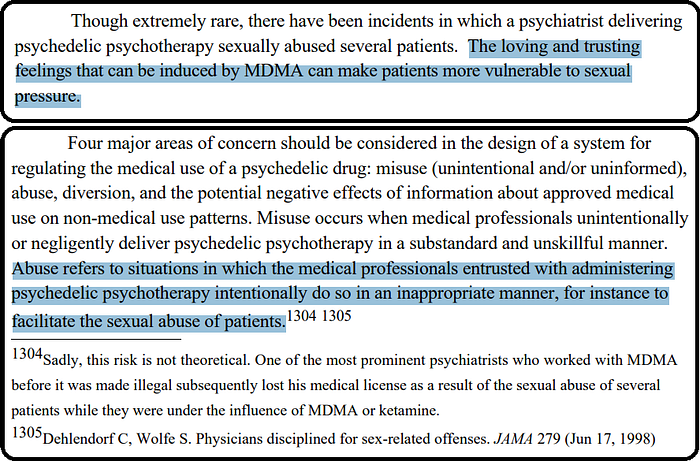
In his doctoral dissertation, Dr. Doblin acknowledged the risks of sexual abuse within psychedelic-assisted psychotherapy. On page 361 of his dissertation, Dr. Doblin wrote that “[t]he loving and trusting feelings that can be induced by MDMA can make patients more vulnerable to sexual abuse”. On page 299 of his dissertation, Dr. Doblin remarked that “[a]buse refers to situations in which the medical professionals entrusted with administering psychedelic psychotherapy intentionally do so in an inappropriate manner, for instance, to facilitate the sexual abuse of patients.”
Although Dr. Doblin severely criticized Dr. Pahnke for omitting information related to an adverse drug-related event, Dr. Doblin has not addressed his organization’s choice to omit Ms. B*****n’s story of drug-facilitated patient abuse from the relevant medical literature.
The undersigned believe that Dr. Doblin’s failure to publicly disclose the contextual factors regarding Ms. B*****n’s abuse within the medical literature is antithetical to initiating academic discourse about MDMA’s ability to elicit physical arousal, issues of transference in psychotherapy, informed consent regarding the use of touch in MAPS clinical trials, and the multitude of risks surrounding MDMA-assisted psychotherapy.
Indeed, Dr. Doblin is aware of the risks associated with the clinical use of a suggestibility-enhancing drug with boundary-dissolving qualities, yet his actions as of late potentially indicate that he does not take this matter as seriously as he once did.
Section 6) Dr. Doblin’s Public Comments About The Incident Of Abuse
In July 2022, Dr. Doblin appeared on Ethan Nadelmann’s podcast to insist that “this unethical sexual misconduct became sexual after the therapy was over when the cameras were off”. Dr. Doblin affirmed Mr. Nadelmann’s misguided belief that “the major ethical issue wasn’t what happened in the moments of therapy which one can see on the videotape”. By way of contrast, Ms. B*****n’s footage clearly depicts Yensen repeatedly pushing his groin into his patient’s backside as his co-therapist (Dryer) attempted to convince their patient that she was safe.
While on Psychedelics Today in 2022, Dr. Doblin described Ms. B*****n’s abuse on Cortes Island as a “sexual situation” consisting of Yensen engaging in “bad behavior”. During that broadcast, Dr. Doblin argued that MAPS’ failure to promptly review Ms. B*****n’s clinical footage was simply a “mistake” and that MAPS was not “liable” for Yensen’s conduct. He claimed that the published clinical footage was “selectively edited” by journalists, adding that people “get the impression from looking at the videos that these therapists are actively abusing this patient. They’re restraining her and she’s… but it was more of this technique […]”.
Indeed, Dr. Doblin described MAPS-trained therapists pinning down a drugged patient’s body while hampering their ability to respirate as a therapeutic “technique”. In the same podcast, Dr. Doblin added that this particular “technique” is based upon a “provocative approach” that was “developed” by Salvador Roquet, a known torturer for the DFS. Dr. Doblin argued that such “psychodrama […] can be beneficial” within the context of psychotherapy.
During the same podcast, Dr. Doblin also implied that MAPS reviewed Ms. B*****n’s clinical footage from her first therapy session in 2015. As he put it, “[t]he early therapy session […] had been reviewed and there were some comments given back to them, but it seemed that they were fine to go on their own […]”.
However, one of the journalists who uncovered Ms. B*****n’s abuse viewed the first therapy session in a different light. Lily Kay Ross, Ph.D. (a sexual violence researcher) described the first therapy session in the following terms: “Richard Yensen is in almost constant physical contact with [Ms. B*****n]. Like, she’ll go to brush her hair out of her face and he’ll grab her hand in the middle of it to hold her hand. And this escalates throughout the session. So eventually he’s like kneeling on the floor and kind of leaning over [Ms. B*****n], and then he’s in the bed with [Ms. B*****n] and he’s holding [Ms. B*****n]. And then Donna Dryer is in the bed with [Ms. B*****n] as well.”
Section 7) Discussion Section
Dr. Doblin has repeatedly downplayed the most egregious of Richard Yensen’s conduct, an act that has resulted in semanticinfiltration of publicdiscourse. By echoing deceptive rhetoric about this incident of patient abuse, Dr. Doblin is undoubtedly misleading people and may potentially be abusing the public’s trust.
Perhaps the most egregious of Dr. Doblin’s evasive euphemisms is his oft-repeated claim that Yensen engaged in a “sexual relationship” with his own patient. Time and time again, Dr. Doblin has appeared at public speaking engagements (including academic conferences) to echo the rhetoric of Ms. B*****n’s abuser. If one reads the court documents related to Ms. B*****n’s civil suit, it is clear that Yensen declared under penalty of perjury that he engaged in a consensual “sexual relationship” with Ms. B*****n.
Given that adherence to trial protocols is essential for ensuring the safety of participants, it’s worth mentioning that the same journalists who uncovered Ms. B*****n’s abuse also reported (in March 2022) that MAPS adherence raters had “caught therapists cuddling on the floor with patients” at a Phase 2 study site in Switzerland.
Three weeks after this was reported, Dr. Doblin attended a panel event held by Penn Nursing and asserted that “[a]s far as we know, there’s only one case where a [MAPS] therapist had a sexual relationship with a patient. So (you know) there may be others that we’re not aware of, but nobody has brought that to light.” For the record, MAPS has yet to address the concerns regarding the study site in Switzerland.
Sexual abuse, by definition, involves a power imbalance in which one person uses force, coercion, or manipulation to engage in sexual violence. Repeatedly referring to acts of sexual violence as a “sexual relationship” minimizes the harm done to victims and perpetuates the false notion that such abuse was somehow consensual or acceptable. It also places blame on the victims, suggesting that they somehow contributed to or participated in the abuse.
Using accurate language to describe sexual abuse is important for several reasons. First and foremost, it acknowledges the reality of the harm done to the victim and validates their experience. It also helps to dispel the myths and misconceptions surrounding sexual violence (e.g. that victims somehow consented to the abuse). Perhaps what’s most important is that it holds perpetrators accountable for their actions and sends a message that sexual violence will not be tolerated.
Language is an incredibly powerful tool that shapes our understanding of the world around us. The way we talk about sexual abuse can have a significant impact on how we perceive and respond to the issue. Using language that minimizes the violent nature of sexual abuse (e.g. referring to it as a “sexual relationship”) reinforces harmful misconceptions that prevent victims from getting the help they need while also contributing to a culture that tolerates sexual violence.
If appropriate actions are not taken by the broader academic community on this matter, victims of patient abuse within psychedelic clinical trials will be less likely to come forward and potentially seek help given that they may believe that their experience will not be taken seriously. If appropriate action is taken on this matter, we can continue working toward creating a culture where sexual violence is not tolerated and where all survivors are valued, respected, and protected.
Finally, the undersigned wish to emphasize that the psychopharmacological effects of the investigational drug in question (MDMA) contributed to Ms. B*****n’s abuse. Regardless of whether it is utilized as a pharmacological adjunct to psychotherapy, MDMA can engender states of emotional vulnerability, increase one’s suggestibility, and lower one’s psychological defenses.
fMRI research by Gillinder Bedi and colleagues indicates MDMA “diminishes responses to threatening stimuli and enhances responses to rewarding social signals”. As expressed by Katherine MacLean Ph.D., MDMA allows people to “feel empathy toward another person, even someone they might not normally like, and to feel safer than normal, even in threatening situations.” Dr. Doblin has acknowledged that the use of MDMA as a pharmacological adjunct to psychotherapy bears the potential of making patients “more suggestible”. Ms. B*****n has described the doses of MDMA provided to her within the MAPS clinical trial as having the ability to “alte[r] your consciousness in such capacity that you have no ability to say no or yes”.
Given that the MAPS Manual encourages clinicians to offer “nurturing touch” and “focused bodywork” to patients at any visit during the clinical trial, concerns have been raised regarding the use of touch within psychedelic-assisted psychotherapy. Although the MAPS Manual for MDMA-Assisted Psychotherapy repeatedly emphasizes the importance of an ongoing informed consent process regarding the use of touch in therapy, it would be important to consider that MDMA (a consciousness-altering and suggestibility-enhancing entactogen) can affect trial participants’ decision-making abilities.
Given that these factors can significantly increase trial participants’ vulnerability to abuse by clinicians, the relationship dynamics present within MDMA-assisted psychotherapy “presents greater vulnerabilities than the typical power imbalance in psychotherapy” (Devenot et al., 2022).
Section 8) Conclusion
“Burying past abuse to protect an agenda is, by nature, another form of abuse. We are ethically obligated to bring awareness to past abuse in order to recognize and prevent future abuse”, said Thalia Rachel Harrison in their 2022 master’s thesis entitled “Altered Stakes: Identifying Gaps in the Psychedelic-Assisted Therapy Research Informed Consent Process”
Although MAPS has published two (2) web pages that have addressed the aforementioned incident of patient abuse, it is clear that MAPS omitted the story from the relevant medical literature. Psychopharmacology’s submission guidelines explicitly state that “If there is suspicion of misbehavior or alleged fraud, the Journal and/or Publisher will carry out an investigation following COPE guidelines”.
Given the severity of the situation at hand, the undersigned call upon the editors of Psychopharmacology to take decisive action so that the broader medical community may become better informed about the risks present within MAPS-sponsored trials of MDMA-assisted psychotherapy.
Given that Dr. Doblin has estimated that MAPS will obtain FDA approval for MDMA in June of 2024, the undersigned individuals respectfully request that your organization complete a prompt and thorough investigation of the material presented within this letter.
The undersigned individuals request a public response to this letter within sixty (60) days regardless of the status of any potential investigation.
Respectfully submitted,
Sasha Sisko, Journalist & Podcaster
Additional Signatories
Katherine MacLean, Ph.D., Research Scientist & Writer
Russell Hausfeld, Senior Writer and Researcher at Psymposia
David S. Prescott, LICSW (Director of the Safer Society Continuing Education Center)
Erika Rosenberg, Ph.D. (Founding Faculty, The Compassion Institute; Consulting Scientist, Center for Mind and Brain, UC Davis; Chief Scientific Office, Humain, Ltd.)
*Post-Script #1: A complete copy of the letter addressed to the editors of Psychopharmacology (with footnotes) has been separately uploaded to Google Drive for permanent record-keeping purposes.
*Post-Script #2 (Clarification): This open letter was originally published with M*****n B*****n’s name left unredacted. Although Ms. B*****n publicly came forward more than a year ago and although her story has been widely shared in media reports, I (Sasha Sisko) have edited the public-facing portion of the open letter to redact her name so as to respect her privacy. Although I have engaged in private correspondence with Ms. B*****n, I did not obtain her permission to mention her name in this open letter. I regret this error in judgment and look forward to receiving ongoing commentary from others in the academic community.
Post-Script #3 (Clarification): In 2019, Psychopharmacology published MAPS initial findings from their phase two research — an article that claimed that “[t]here were no unexpected MDMA-related SAEs [Serious Adverse Events]” (Mithoefer et al., 2019). The long-term follow-up research to MAPS Phase 2 trials asserted that “[t]here were no indications of abuse potential for MDMA” (Jerome et al., 2020).
Post-Script #4 (Correction): An earlier version of this publication implied that MAPS and MAPS-PBC gained possession of Ms. B*****n’s complaints at the exact same time in October 2018. This open letter has been CLARIFIED to state that MAPS-PBC (alone) gained possession of these documents exactly six weeks prior to Psychopharmacology formally receiving MAPS’ finalized submission of their Phase 2 research. It is not a matter of public knowledge as to when, exactly, Ms. B*****n’s complaints were forwarded from MAPS-PBC to MAPS. At the time of publication, I assumed the complaints were immediately forwarded from MAPS-PBC to MAPS, but I cannot state this with absolute certainty. I regret the error and apologize for any confusion this may have caused. I welcome MAPS to provide documentation as to when they formally received Ms. B*****n’s complaints from MAPS-PBC.
Post-Script #5 (Clarification): Due to overwhelming inquiry from colleagues, I have added context at the end of a quote from Richard Doblin, Ph.D. within Section 6 of the open letter. “You get the impression from looking at the videos that these therapists are actively abusing this patient. They’re restraining her and she’s… but it was more of this technique […]”
Post-Script #6 (Correction): An earlier version of this publication utilized the incorrect verb tense for a singular word (“include”) while quoting MAPS’ May 2019 statement regarding Ms. B*****n. The open letter has been corrected to provide more context. I regret the error.
Post-Script #7 (Addition): A brief paragraph regarding Lisa Jerome, Ph.D. has been added to Section 4.
Post-Script #8 (Clarification): The letter has been amended to state that Richard Yensen confirmed Ms. B*****n’s complaints as outlined in her complaints submitted to MAPS-PBC in October 2018. An earlier version of this publication stated that Yensen “promptly confirmed” her “allegations”, but I did not specify which allegations Yensen confirmed in 2018. I regret the error. The original source material stated that “Richard Yensen and Donna Dryer verbally confirmed to MAPS that this sexual relationship did occur”.
Post-Script #9 (Correction): The letter originally stated that Dr. Doblin criticized Dr. Pahnke within his undergraduate thesis, but the quote was actually obtained from an article he wrote in The Journal of Transpersonal Psychology expanding upon his undergraduate thesis project. I regret the error.
Post-Script #10 (Contact): If any other colleagues wish to add their name to this open letter, please message me at @SashaTSisko on Medium, @SashaSisko on Twitter, or @Sasha__Sisko on Instagram.
About a decade ago, the management guru Gary Hamel wrote a highly cited article in Harvard Business Review entitled First, Let’s Fire All the Managers. He analyzed the success of Morningstar, a leading manufacturer of tomato products that operates with a flat management structure and called for other corporations to follow its lead.
“A hierarchy of managers exacts a hefty tax on any organization,” he wrote. “This levy comes in several forms. First, managers add overhead and, as an organization grows, the costs of management rise in both absolute and relative terms.” The article was created a lot of buzz and helped bolster other flat models, such as Holacracy.
Yet the “flat organization” idea hasn’t caught on. “Since 1983, the size of the bureaucratic class — the number of managers and administrators in the US workforce — has more than doubled, while employment in other categories has grown by only 40%,” Hamil recently wrote. The truth is that we need managers and trying to eliminate them is a waste of time.
Planning A Spontaneous Revolution
In the early 2000s, a series of color revolutions spread across Eastern Europe sweeping away the authoritarian remnants of post-communist governments in Serbia, the Georgian Republic and Ukraine. These would prove to other revolutionary waves such as the Arab Spring. Old-style hierarchies suddenly seemed out of date.
I experienced some of these events first-hand. I was living in Ukraine during the Orange Revolution and managing the leading news organization in the country. I also spent some time in the Georgian Republic and got to see many of the reforms take place. When Hamel’s article came out, I had already begun the research that would lead to my book Cascades and I found his ideas about flat organizations not only persuasive, but inspiring.
I shouldn’t have. Even at the time, it had become clear that the revolutions weren’t as successful and many of us had hoped. In Ukraine, Viktor Yanukovych had already come to power and it would take another revolution to dislodge him. In other countries, such as Egypt, new authoritarians would soon take the place of those who had been overthrown.
Yet even more importantly, I would later get to know one of the chief architects of the color revolutions, my friend Srdja Popović, and would learn that the revolutions weren’t leaderless at all. In fact, much of what I had experienced as spontaneous and organic was actually very much planned, engineered and organized.
As I continued to research supposedly “leaderless” organizations this would be a recurring theme. Either their success was either not genuine or ephemeral, or that there was a less obvious, informal hierarchy at work.
The Truth About The Orpheus Orchestra
One of the most cited examples of successful leaderless organizations is the Orpheus Chamber Orchestra in New York, which has been operating without a conductor since 1972. They not only regularly play at top venues like Carnegie Hall and Lincoln Center, but have won multiple Grammy awards.
An orchestra concert is a highly coordinated event, with many different musicians needing to coordinate their efforts to play music according to a specific vision. If everyone applies their own interpretation, what should be a symphony would end up as a cacophony. So how does Orpheus manage to not only survive, but thrive?
The truth is that Orpheus is not really a purely leaderless organization. It would be more accurate to say that the members trade off leadership, with one member leading one particular collection and then a different member leading another. So while it is true that the Orchestra as a whole is leaderless, each concert is leaderful.
That’s quite a big difference. If you would believe that an entire orchestra could conduct itself, you might go and try to run your organization with no direction at all, which would be a disaster. However, if you would follow the direction of the Orpheus Chamber Orchestra, you would appoint a particular team member to run each project, which would be so utterly conventional that it wouldn’t even seem worth mentioning.
The Open Source Pecking Order
Another favorite that advocates of “leaderless” organizations like to point to are open-source software communities. Yet once again, when you take a closer look, these communities are not some free-for-all, with everybody chiming in and making changes at will. In fact, in successful communities take governance very seriously.
Some projects, like Android and WordPress, are tightly controlled by the companies that originated them, Google and Automattic, respectively. They manage the community fairly tightly, accepting patches, revisions and improvements as they see fit and providing a vision for where they think the technology should go.
Open source foundations, like Linux and Apache provide more intricate governance structures. They don’t have much in the way of formal leadership, but in practice each project has informal leaders who drive the direction of the technology. In fact, competition for clout within those communities can be very stiff.
There’s a reason why some of the world’s most valuable companies pay people well to contribute to open-source software communities and it’s not altruism. They want to shape how crucial technologies will develop to benefit their business. To do that, talented people need to spend time building the trust and reputation that will enable them to lead.
Let’s Not Fire All The Managers
For a while now, management gurus such as Gary Hamel have been advocating for flatter organizations, yet there is little evidence that eliminating leaders is a viable model. In fact, when Wharton Professor Ronnie Lee took a close look at game software developers, he actually found that the number of levels of bureaucracy increased significantly, not decreased, over the last 50 years.
There are several reasons that this is true. The first is that, while having a flatter structure leads to more innovation and creativity, you need good leadership and governance to execute well. As an industry matures and becomes more complex, more levels of hierarchy are needed to manage it effectively.
Another important factor to consider is that even without a formal hierarchy, leaders will tend to emerge. Which is why when you take a closer look at often cited examples of “leaderless organizations,” there is much more hierarchy that it would at first seem. Just because there isn’t an organization chart doesn’t mean there isn’t a pecking order.
We need to stop thinking in terms of how many levels of bureaucracy there are and start working to network our organizations. We don’t need to eliminate managers — or anyone else for that matter — but to widen and deepen connections within and without our enterprise. We need to lead and to do it more effectively.
The role of leadership in organizations has changed. It is no longer merely to plan and direct work, but to inspire meaning and empower belief. As I wrote in Cascades, the key to transformational change is small groups, loosely connected by united by a shared purpose. The job of leaders today is to help those groups connect and forge a common purpose.
When we convey our thoughts with language, we typically also express our emotions along with our thoughts. And the way this happens tells us a lot about the logic of emotions.
Take this Dad with his kid. They see a Bernese mountain dog. Dad is really into Bernese mountain dogs. He thinks they are sooo cute… so he goes, “Look! A doggy”.
But the kid is a little nervous. The Bernese mountain dog is quite big.
Unbeknownst to the Dad and his little kid, Mr. Spock is listening in. And with his Vulcan heritage, which makes him “all-logical-and-not-emotional,” he is fascinated.
Mr. Spock does not understand why they use “doggy” for a big dog. It seems quite illogical. By his logic:
A big dog is simply a “dog”. Only a little dog should be a doggy. It doesn’t make sense to call a big dog “doggy”.
So let’s see why Mr. Spock would think that way. What’s the logic behind that?
The ‘-y’ suffix in “doggy” and “puppy” is a diminutive. And the meaning of a diminutive should simply be … “small.”.
So why can you use the diminutive for a big dog, too?
This is where the emotions come in.
Diminutives belong to the emotive dimension of language, which contrasts with its rational aspect — or what Mr. Spock would call the logical aspect of language
So … because the Dad has a warm fuzzy feeling towards the Bernese mountain dog, he refers to him as “doggy”. This allows him to express that emotion. It does not mean that he thinks the dog is small. He is simply expressing an emotion—in this case, the emotion of a warm, fuzzy feeling towards the dog.
And that is why Mr. Spock finds diminutives illogical. They ARE illogical. They belong to the emotive part of language, which Mr. Spock, as a Vulcan, supposedly lacks.
Now, diminutives are not the only forms that belong to this emotive aspect of language. After all, we don’t always have warm, fuzzy feelings towards what we are talking about.
Sometimes, we get angry. And sometimes we express that anger. And language has ways to do that.
Yes. Swearing is a form of emotive language; when we swear, we are expressing our emotions! (Quite intensely sometimes!)
And we can put these expressions of anger right inside a sentence. So we can have rational thought combined with an emotional reaction.
Now, another illogical thing about these emotive expressions is that one and the same form can express all sorts of emotions: you can use “damn,” even if you are not angry. It can also express amazement or joy.
What these emotions have in common is… that they ARE emotions.
Many emotive expressions simply express a heightened emotional state, independent of the kind of state it is.
Take ‘Ugh!’ for example. It can express disgust or exasperation, but it can also be used to dismiss a worry.
While these experiences don’t have much in common, “ugh” can be used in all of them. Again, it looks like the core purpose is to express the fact that there is an emotion.
Same with “wow,” whichseems to express surprise. But surprise itself comes in different flavours. You can be surprised combined with fear, happiness, or bliss. And you can always say “wow,” even with very different emotions.
Why is that? What does “wow” really mean?
To answer this question and to understand the logic of emotive language, we should know what an emotion is. We should understand the logic of emotions!
Well, there is a reason why Mr. Spock is surprised that there might be a logic to emotions. The view that emotions are irrational is deeply embedded in our way of thinking.
The ancient Greek philosophers were kind of down on emotions, and that’s mainly because they were big on rational thought.
The Greek philosophers thought that there was pure rational thought that represents the world as it is. So, if something bad were to happen, like your laptop not working properly, with pure reason you could probably find a solution. But humans just get carried away by their feelings. And these feelings cloud their thoughts. And no rational solution can be sought anymore. That’s what they thought.
And therefore, they thought that emotions get in the way of rational thought by colouring them along with our language.
So, is Mr. Spock right? Is there no logic to emotions?
Well, logic dictates that we first have to figure out what exactly is happening here. What is this emotional cloud?
And how does it relate to our thoughts? And to our language?
We could say that this emotional cloud is divided into different types of ‘basic emotions’, like sadness, happiness, fear, anger, and disgust, and maybe some more. (You may have heard of this theory of basic emotions. It’s quite popular.)
But if it were really like this, then why don’t we get emotive words that correspond exactly to these basic emotions? Words like “ugh,” “wow,” and “damn” don’t correspond to a single emotion. Yet they convey emotions.
But… there is another way to think about emotions, namely that they are composed, just like thoughts are composed. (That’s another theory of emotions, the theory of constructed emotions)
Many of our thoughts are based on our experience of perceiving the world around us. Like looking at a dog. So our thoughts are influenced by our perceptions. And by our own unique perspective on this perception. And by other people with whom we might share these thoughts.
Emotions are not that different. You can think of them as starting off as sensations or perceptions of your physical experiences (like that warm, fuzzy feeling you get when you see that cute dog). Our emotions are triggered by such sensations. The actual emotion depends on whether the sensation feels good or bad (valence). And howstrong the sensation is (arousal). And it can also depend on who is with us at the time (empathy).
These are factors that contribute to the composition of an emotion.
So words like “ugh,” “wow,” and “damn” don’t express basic emotions. Instead, they simply express arousal, one of the components of emotions.
So, you see, emotions are composed just like thoughts are.
There really is a logic to emotions and their expressions!
I am a linguist. I study the knowledge that underlies language and how it allows and constrains social interaction. And I really like communicating my findings.
WHISPER = to speak very softly; speech without vibration of the vocal cords
QUESTION: Is something whispering to you right now?
STORY: Every morning, today and for the last, gosh, maybe twenty years, I sit quietly for one minute and focus on the Highest Truth. Then, I listen for a “WHISPER” from my Inner Self. It may be an idea or remarkable insight or it could be a feeling of tension in my body. It’s just good to relax, center myself and listen to my Heart before I pick up the computer and get blasted with the Internet, emails, etc. This is my “whisper time”! It may last only 5 minutes or it may last 30 minutes. Sometimes I hold a pen or pencil and draw a line not knowing where it will end up – like this drawing. I play with a pencil and allow a visual image to emerge from unknown squiggles that go up and down, left and right and then, suddenly I see a nose or a forehead or a chin. I develop it until the image whispers something to me. Play with this yourself and I’ll bet that you’ll hear a “WHISPER” from your Heart – your Inner Self!
QUOTES
“Listen to the whispers you hear from within, give your soul the voice to be heard.” ~ Dee Waldeck
“All of nature begins to whisper its secrets to us through its sounds. The sounds that were previously incomprehensible to our soul now become the meaningful language of nature.” ~ Rudolf Steiner
“When you hit a groove, it’s not you; it’s the spirit world. The spirits whisper the ideas in your brain and prod you along. They’re the ones that are really happy.” ~ Tommy Chong
EXERCISE
STOP.
Sit quietly. Assume an erect posture.
Sense the breath.
Sit calmly and focus on the Highest Truth. Quietly listen for a “whisper” from your Heart.
Get your pen and paper and write words or draw lines expressing a feeling that “whispers” a message to you.
Move forward into your day listening to the gentle whispers of your Inner Self.
We move through the world largely unaware that our emotions are made of concepts — the brain’s coping mechanism for the blooming buzzing confusion of what we are. We label, we classify, we contain — that is how we parse the maelstrom of experience into meaning. It is a useful impulse — without it, there would be no science or storytelling, no taxonomies and theorems, no poems and plots. It is also a limiting one — the most beautiful, rewarding, and transformative experiences in life transcend the categories our culture has created to contain the chaos of consciousness, nowhere more so than in the realm of relationships — those mysterious benedictions that bridge the abyss between one consciousness and another.
When we hollow the word friend by overuse and misuse, when we make of love a contract with prescribed roles and rigid, impossible expectations, we become prisoners of our own concepts. The history of feeling is the history of labels too small to contain the loves of which we are capable — varied and vigorously transfigured from one kind into another and back again. It takes both great courage and great vulnerability to live outside concepts, to meet each new experience, each new relationship, each new emotional landscape on its own terms and let it in turn expand the terms of living.
That is what Rhaina Cohen explores in The Other Significant Others: Reimagining Life with Friendship at the Center (public library) — a journalistic investigation of the vast yet invisible world of unclassifiable intimate relationships, profiling pairs of people across various circumstances and stages of life sustained by such bonds, people who have “redrawn the borders of friendship, moving the lines further and further outward to encompass more space in each other’s lives,” people who have found themselves in finding each other.
What emerges through this portrait of a type of relationship “hidden in plain sight” is an antidote to the tyranny of the “one-stop-shop coupledom ideal” and “an invitation to expand what options are open to us,” radiating a reminder that we pay a price for living by our culture’s standard concepts:
While we weaken friendships by expecting too little of them, we undermine romantic relationships by expecting too much of them.
This is a book about friends who have become a we, despite having no scripts, no ceremonies, and precious few models to guide them toward long-term platonic commitment. These are friends who have moved together across states and continents. They’ve been their friend’s primary caregiver through organ transplants and chemotherapy. They’re co-parents, co-homeowners, and executors of each other’s wills. They belong to a club that has no name or membership form, often unaware that there are others like them. They fall under the umbrella of what Eli Finkel, a psychology professor at Northwestern University, calls “other significant others.” Having eschewed a more typical life setup, these friends confront hazards and make discoveries they wouldn’t have otherwise.
Noting that her interest in the subject is more than theoretical, catalyzed by her own expansive relationship with another woman in parallel with her marriage, Cohen considers these category-defying bonds as a countercultural act of courage and resistance:
I began to see how these unusual relationships can also be a provocation — unsettling the set of societal tenets that circumscribe our intimate lives: That the central and most important person in one’s life should be a romantic partner, and friends are the supporting cast. That romantic love is the real thing, and if people claim they feel strong platonic love, it must not really be platonic. That adults who raise kids together should be having sex with each other, and marriage deserves special treatment by the state.
With an eye to the long lineage of people who have defied the categories of their time and place — the kinds of people populating Figuring, which I wrote largely to explore such relationships — she adds:
Challenging these social norms is not new, nor are platonic partners the only dissidents. People who are feminists, queer, trans, of color, nonmonogamous, single, asexual, aromantic, celibate, or who live communally have been questioning these ideas for decades, if not centuries. All have offered counterpoints to what Eleanor Wilkinson, a professor at the University of Southampton, calls compulsory coupledom: the notion that a long-term monogamous romantic relationship is necessary for a normal, successful adulthood. This is a riff on the feminist writer Adrienne Rich’s influential concept of “compulsory heterosexuality” — the idea, enforced through social pressure and practical incentives, that the only normal and acceptable romantic relationship is between a man and a woman. Some of the first stories we hear as children instill compulsory coupledom, equating characters finding their “one true love” with living “happily ever after.”
[…]
It can be confusing to live in the gulf between the life you have and the life you believe you’re supposed to be living.
One of the most expansive memories ever documented belonged to a Russian newspaper reporter named Solomon Shereshevsky. For much of his life, he was oblivious of the peculiar nature of his memory. Then, in his late twenties, the young reporter’s habit of never taking notes during morning staff meetings caught the attention of the editor of his Moscow newspaper. Shereshevsky told the editor he never wrote anything down because he didn’t need to, then repeated verbatim the long list of instructions and addresses for that day’s assignment.
The editor was impressed, but even more interesting to him was that Shereshevsky seemed to think there was nothing unusual about this. Wasn’t this how everyone’s mind worked? The editor had never seen anything like it, so he sent Shereshevsky to have his memory tested.
Shereshevsky then crossed paths with a young researcher, Alexander Luria, at a psychology laboratory at the local university. For thirty years, Luria, who would go on to become one of the founding fathers of neuropsychology, tested, studied, and meticulously recorded Shereshevsky’s remarkable ability to quickly memorize made-up words, complex mathematical formulas, even poems and texts in languages he didn’t speak.
Even more astonishing than his ability to recall much of this information with the same accuracy many years later was that Shereshevsky could remember what Luria was wearing on the day he had administered a particular memory test. In his classic 1968 monograph, The Mind of a Mnemonist: A Little Book About a Vast Memory, Luria wrote, “I simply had to admit that the capacity of his memory had no distinct limits.”
Luria linked Shereshevsky’s remarkable capabilities to an extremely rare condition called synesthesia—meaning that every stimulus, regardless of which sense it came through, triggered every other sense. Shereshevsky could taste words, see music, and smell colors—even the sounds of words could impact his perception. He described asking an ice cream vendor what flavors she had. Something about her tone of voice made him see a stream of black cinders pouring from her mouth as she spoke, “Fruit ice cream”—which promptly ruined his appetite.The connection between the worlds he created in his mind and the world he lived in was so visceral that Shereshevsky could elevate his heart rate by simply imagining he was running after a train.
The connection between the worlds he created in his mind and the world he lived in was so visceral that Shereshevsky could elevate his heart rate by simply imagining he was running after a train. He could raise the temperature of one hand and lower the other by picturing one hand on a stove and the other resting on a block of ice.
The distinctiveness of Shereshevsky’s sensory world extended to his imagination, giving him the ability to form distinctive memories that were resistant to interference. New Yorker writer Reed Johnson, who spent years researching Shereshevsky, described how he was able to attach any memoranda, no matter how bland, to stories he conjured in his imagination, which he could follow like a trail of bread crumbs to find his way back to that information later on:
The strength and durability of his memories seemed to be tied up in his ability to create elaborate multisensory mental representations and insert them in imagined story scenes or places; the more vivid this imagery and story, the more deeply rooted it would become in his memory.
In his later years, when Shereshevsky began performing his incredible memory feats for a paid audience, he amplified this ability with a technique familiar to modern memory athletes such as Scott Hagwood and Yänjaa Wintersoul. Though it appeared to have been self-discovered rather than learned, Shereshevsky used a memory device similar to the method of loci. When he wanted to remember a sequence of words or numbers, he would visualize them as characters within the familiar schema of, say, a street in Moscow and take a “mental walk” through the vast worlds of his interior landscapes.
Although he is often discussed as an example of someone with an extraordinary memory, the key to Solomon Shereshevsky’s mnemonic capabilities was his vibrant imagination. Much of Luria’s decades-long study reveals a fundamental truth about the connection between memory and imagination, one that lies at the center of how we all remember. The peculiar way in which we form memories can lead us to stray far from reality, yet gives us the fuel to imagine a world with endless possibilities.
*
WHAT CAN HAPPEN
The simplest way to see the machinery of episodic memory at work is to scan people’s brains while they describe an event from their lives. For instance, if you showed me the word photograph while I was lying in an MRI scanner and asked me to use that word to help me recount an event from my life, I might pull up the memory of my first live rock concert.
At fourteen, I was obsessed with the album Pyromania by British heavy metal band Def Leppard. If you examined my brain activity while I recalled seeing Steve Clark play the signature riff during the band’s performance of “Photograph,” you’d see activation in the hippocampus, as I pulled up the contextual information that mentally transported me back to 1985, and in the DMN, as I brought up knowledge about concerts that enabled me to elaborate on how the event had unfolded.
Now, let’s try something a little different. Suppose you were lying in an MRI scanner and I showed you words such as pasta or skydiving and asked you to use those words to imagine something that hasn’t happened, or even something that would be unlikely ever to happen.
You might conjure up a mental image of cooking spaghetti with Motown legend Marvin Gaye or jumping out of a plane with pioneering physicist Marie Curie. In 2007, three research labs published experiments along these lines, and here’s the twist: the brain activity changes that occur when people imagine these kinds of scenarios are remarkably similar to those that occur when people recall events that they actually experienced.
This odd parallel between imagination and memory came as a surprise to many in the scientific community, and it captured the attention of the media—Science magazine declared it one of the top ten breakthroughs of the year —but it did not come out of the blue. It was anticipated nearly a century earlier by English psychologist Sir Frederic Bartlett, whose work would become the foundation for the idea that we use mental frameworks (i.e., schemas) to organize and process the world around us.
Bartlett began his research on human memory as part of his dissertation at the University of Cambridge in 1913. After receiving his PhD, he focused not on memory but on cultural anthropology and then on applications of psychology for the military. Fortunately, Bartlett eventually circled back to the topic of memory and, in 1932, published his most important work, Remembering: A Study in Experimental and Social Psychology.
Bartlett’s book was a dramatic departure from the tradition of memory research established by Hermann Ebbinghaus back in 1885. Ebbinghaus quantified memories for strange, meaningless information under strictly controlled conditions. In contrast, Bartlett drew on his experiences in applied psychology and anthropology, observing and describing how we use memory in our everyday lives. Put more succinctly, Bartlett was interested in understanding how we remember, rather than simply quantifying how much.
In his most famous experiment, Bartlett introduced a group of volunteers at the University of Cambridge to a Native American folktale called “War of the Ghosts”—specifically chosen because the cultural context was entirely foreign to these British students. Bartlett’s subjects could recall the gist of the story, but they made some characteristic errors. It was not simply a case of failing to remember some details, but rather that they adapted the details to match up with their own cultural expectations and norms. Words such as canoe and paddle were replaced by boat and oar; seal hunting became fishing.
Poring over these results, Bartlett observed that, although people do recall some details from the past, their recollections are approximate at best. He concluded, “Remembering is not the re-excitation of innumerable fixed, lifeless and fragmentary traces. It is an imaginative reconstruction.”
We do not simply replay a past event, but use a small amount of context and retrieved information as a starting point to imagine how the past could have been. We put together a story on the fly, based on our personal and cultural experiences, and tack on those retrieved details to flesh out the story. Bartlett’s insight is key to understanding why the brain’s machinery for imagination and its machinery for memory aren’t completely independent—they are both based on pulling up knowledge about what can happen, though not necessarily what did happen.
Charan Ranganth is the author of Why We Remember: Unlocking Memory’s Power to Hold on to What Matters. Dr. Ranganath is a Professor of Psychology and Neuroscience and director of the Dynamic Memory Lab at the University of California at Davis. For over twenty-five years, Dr. Ranganath has studied the mechanisms in the brain that allow us to remember past events, using brain imaging techniques, computational modeling and studies of patients with memory disorders. He has been recognized with a Guggenheim Fellowship and a Vannevar Bush Faculty Fellowship. He lives in Davis, California.
The Lord of Abundance is a warm and joyous card, which indicates a rare and precious type of love – a love which, once experienced, reminds us of the richness of shared emotion and commitment.It is also a card which refers to the wellspring of fertility, whether spiritual or material. Here we see the first seeds sown of a bright and bountiful harvest. Accordingly, the card will sometimes come up to indicate high days of celebration – like weddings or other intimate celebrations of love.The emotional quality represented by this card is deep and unusual – indicating the love felt not only by lovers, but also the love between close friends, or family. These relationships are gifts, which need to be cared for with great respect and gratitude.The Lord of Abundance offers one word of warning – this type of love cannot be created, nor engineered. When it occurs in our lives we are lucky and blessed. Some people spend a lifetime looking for such depth of emotion. And sometimes, people try to pretend it exists where it does not. So when you raise this card in a reading be aware that you are fortunate indeed!
Kino Lorber • Aug 23, 2022 • Bill Moyers and Joseph Campbell discuss the common experience of God across cultures. Buy The Set: https://www.powerofmyth.net
Consciousness, sexuality, androgyny, futurism, space, the arts, science, astrology, democracy, humor, books, movies and more







 While we weaken friendships by expecting too little of them, we undermine romantic relationships by expecting too much of them.