WORD = a sound that communicates meaning; a written or printed character or combination of characters representing a spoken word; talk; discourse
QUESTION: Do you know the WORDLESS world?
STORY: We all live in a “word-built-world”. What I want to point out is that there is a world that is wordless and it is important for us to connect with it. We all construct our lives by the words we use. Words are openings through which meaning and understanding flows. The word “relationship” means a sense of being related yet individually, we each have unique experiences with our relationships. The word “WORLD” usually means the physical world – and yet each person views it differently. There does come a time in everyone’s life when we need to take a PAUSE and step back from defining our life in words. Try this: Just BE PRESENT and FEEL the WORDLESS ENERGY that is now flowing through your body. Relax and feel this Energy guiding your journey. Life is far more than words can ever express. Also explore a word tool called Translation® that I have used for over 50 years to open up to the ever present Energy of life. Translation® uses words to enter the wordless.
QUOTES
“As we express our gratitude, we must never forget that the highest appreciation is not to utter words, but to live by them.” ~ John F. Kennedy
“I found I could say things with color and shapes that I couldn’t say any other way – things I had no words for.” ~ Georgia O’Keefe
“Words are singularly the most powerful force available to humanity. We can choose to use this force constructively with words of encouragement, or destructively using words of despair. Words have energy and power with the ability to help, to heal, to hinder, to hurt, to harm, to humiliate and to humble.” ~ Yehuda Berg
EXERCISE
STOP.
Sit quietly. Assume an erect posture. Sense the breath.
Sit calmly and just BE PRESENT and FEEL the WORDLESS ENERGY in your body.
See something around you but don’t name or judge it.
Get your pen and paper and write words or draw lines expressing the wordless energy that is flowing through you.
Move forward into your day feeling guided by the Energy of the wordless world.
In 6th century China, a monk named Huike wanted to receive the most powerful teachings he could from Bodhidharma, a Buddhist master from south India. He was rejected.
Bodhidharma took one look into Huike’s mind and decided he wasn’t worth the effort.
Huike then proceeded to chop his own arm off and offer it, as a symbol of his dedication. In that one act, his entire mind’s orientation and potential transformed. He got accepted.
It’s the most extreme case in history — but generally speaking, pursuing spiritual knowledge usually meant you had to sweep the floor of a guru’s ashram for 12 years before so much as a whisper of metaphysical knowledge reached your ear.
When you get something easily, it’s hard to see its preciousness.
If you work for it, as if it’s the central purpose of you having life, you’re bound to never waste it once you receive it.
How many of us have wasted valuable spiritual knowledge?
Our brains are constantly awash with information, some of it sticking, while most of it gets flushed out like pollution.
We usually treat spiritual knowledge the same as regular knowledge. It’s in the same format, written in some of the same places (such as right here) and often competes with our leisure time.
Sometimes, it even becomes fancified ‘self-help’ therapy or intellectual entertainment.
But it’s not your fault. It’s (un-updated) modernity’s.
Details regarding the point and purpose of human consciousness — explored by millions of contemplative explorers across cultures and millennia — is now at our fingertips.
And it’s awakening people from their slumber like no other point in history.
The sheer value of this era can’t be overstated. You have access to things that people just 100 years ago couldn’t even dream of!
The game-changer is that we’re realizing how information, by itself, can’t actually transform us.
It’s what we bring to it that matters. This is why you can spend years reading books, and know nothing about the actual experience of attaining higher awareness.
But that’s not to say books are useless. You just need to figure out how to make their wisdom come alive within you.
The first step to that?
Be like Huike. Offer something equally valuable in return — not an arm, but perhaps your undivided attention. Perhaps some emotional investment. Or maybe just some plain old patience and consistency.
Because nothing valuable ever comes for free, even if freely given.
“In the middle of the journey of our life I found myself within a dark woods where the straight way was lost,” Dante wrote in the Inferno. “The perilous time for the most highly gifted is not youth,” the visionary Elizabeth Peabody cautioned half a millennium later as she considered the art of self-renewal, “the perilous season is middle age.”
In The Middle Passage: From Misery to Meaning in Midlife (public library), Jungian analyst James Hollis offers a torch for turning the perilous darkness of the middle into a pyre of profound transformation — an opportunity, both beautiful and terrifying, to reimagine the patterns of thought, feeling, and behavior acquired in the course of adapting to life’s traumas and demands, and finally inhabit the authentic self beneath the costume of this provisional personality.
Art by Mimmo Paladino for a rare edition of James Joyce’s Ulysses
One has entered the Middle Passage when the demands of the true self press restive and uprising against the acquired persona, eventually colliding to produce untenable psychic ache — a “fearsome clash,” Hollis writes, leaving one “radically stunned into consciousness.” A generation after James Baldwin contemplated how myriad chance events infuse our lives with the illusion of choice, Hollis considers our unexamined conditioning as a root cause of this clash:
Perhaps the first step in making the Middle Passage meaningful is to acknowledge the partiality of the lens we were given by family and culture, and through which we have made our choices and suffered their consequences. If we had been born of another time and place, to different parents who held different values, we would have had an entirely different lens. The lens we received generated a conditional life, which represents not who we are but how we were conditioned to see life and make choices… We succumb to the belief that the way we have grown to see the world is the only way to see it, the right way to see it, and we seldom suspect the conditioned nature of our perception.
Haunting this conditional life are our psychic reflexes — the coping mechanisms developed for the traumas of childhood, which Hollis divides into two basic categories: “the experience of neglect or abandonment” or “the experience of being overwhelmed by life,” each with its particular prognosis. The overwhelmed child may become a passive and accommodating adult prone to codependence, while the abandoned child may spend a lifetime in addictive patterns of attachment searching for a steadfast Other. These unconscious responses adopted by the inner child coalesce into a provisional adult personality still preoccupied with solving the emotional urgencies of early life. Hollis observes:
We all live out, unconsciously, reflexes assembled from the past.
Carl Jung termed such reflexes personal complexes — largely unconscious and emotionally charged reactions operating autonomously. Most of life’s suffering stems from the unexamined workings of these complexes and the conditioned choices they lead us to, which further sever us from our true nature. Hollis writes:
Most of the sense of crisis in midlife is occasioned by the pain of that split. The disparity between the inner sense of self and the acquired personality becomes so great that the suffering can no longer be suppressed or compensated… The person continues to operate out of the old attitudes and strategies, but they are no longer effective. Symptoms of midlife distress are in fact to be welcomed, for they represent not only an instinctually grounded self underneath the acquired personality but a powerful imperative for renewal… In effect, the person one has been is to be replaced by the person to be. The first must die… Such death and rebirth is not an end in itself; it is a passage. It is necessary to go through the Middle Passage to more clearly achieve one’s potential and to earn the vitality and wisdom of mature aging. Thus, the Middle Passage represents a summons from within to move from the provisional life to true adulthood, from the false self to authenticity.
The summons often begins with a call to humility — having failed to bend the universe to our will the way the young imagine they can, we come to recognize our limitations, to confront our disenchantment, to reckon with the collapse of projections and the crushing of hopes. But this reckoning, when conducted with candor and self-compassion, can reward with “the restoration of the person to a humble but dignified relationship to the universe.”
This, Hollis argues, requires shedding the acquired personality of what he terms “first adulthood” — the period from ages twelve to roughly forty, on the other side of which lies the second adulthood of authenticity. Bridging the abyss between the two is the Middle Passage. He writes:
The second adulthood… is only attainable when the provisional identities have been discarded and the false self has died. The pain of such loss may be compensated by the rewards of the new life which follows, but the person in the midst of the Middle Passage may only feel the dying… The good news which follows the death of the first adulthood is that one may reclaim one’s life. There is a second shot at what was left behind in the pristine moments of childhood.
Hollis envisions these shifting identities as a change of axes, moving from the parent-child axis of early life to the ego-world axis of young adulthood to the ego-Self axis of the Middle Passage — a time when “the humbled ego begins the dialogue with the Self.” On the other side of it lies the final axis: “Self-God” or “Self-Cosmos,” embodying philosopher Martin Buber’s recognition that “we live our lives inscrutably included within the streaming mutual life of the universe” — the kind of orientation that led Whitman, who lived with uncommon authenticity and made of it an art, to call himself a “kosmos,” using the spelling Alexander von Humboldt used to denote the interconnectedness of the universe reflected in his pioneering insistence that “in this great chain of causes and effects, no single fact can be considered in isolation.” The fourth axis is precisely this recognition of the Self as a microcosm of the universe — an antidote to the sense of insignificance, alienation, and temporality that void life of meaning. Hollis writes:
This axis is framed by the cosmic mystery which transcends the mystery of individual incarnation. Without some relationship to the cosmic drama, we are constrained to lives of transience, superficiality and aridity. Since the culture most of us have inherited offers little mythic mediation for the placement of self in a larger context, it is all the more imperative that the individual enlarge his or her vision.
These shifting axes are marked by several “sea-changes of the soul,” the most important of which is the withdrawal of projections — those mental figments that “embody what is unclaimed or unknown within ourselves,” born of the tendency to superimpose the unconscious on external objects, nowhere more pronounced than in love: What is so often mistaken for love of another is a projection of the unloved parts of oneself.
Drawing on the work of Jungian psychologist Marie-Louise von Franz, Hollis describes the five stages of projection — a framework strikingly similar to the seven stages of falling in and out of love that Stendhal outlined two centuries ago. Hollis writes:
First, the person is convinced that the inner (that is, unconscious) experience is truly outer. Second, there is a gradual recognition of the discrepancy between the reality and the projected image… Third, one is required to acknowledge this discrepancy. Fourth, one is driven to conclude one was somehow in error originally. And, fifth, one must search for the origin of the projection energy within oneself. This last stage, the search for the meaning of the projection, always involves a search for a greater knowledge of oneself.
The loss of hope that the outer will save us occasions the possibility that we shall have to save ourselves… Life has a way of dissolving projections and one must, amid the disappointment and desolation, begin to take on the responsibility for one’s own life… Only when one has acknowledged the deflation of the hopes and expectations of childhood and accepted direct responsibility for finding meaning for oneself, can the second adulthood begin.
The vast majority of our adult neuroses — a somewhat dated term, coined by a Scottish physician in the late eighteenth century and defined by Carl Jung as “suffering which has not discovered its meaning,” then redefined by Hollis as a “protest of the psyche” against “the split between our nature and our acculturation,” between “what we are and what we are meant to be” — arise from the refusal to acknowledge and let go of projections, for they sustain the persona that protects the person and keep us from turning inward to befriend the untended parts of ourselves, which in turn warp our capacity for intimacy with others. Hollis writes:
We learn through the deflation of the persona world that we have lived provisionally; the integration of inner truths, joyful or unpleasant, is necessary to bring new life and the restoration of purpose.
[…]
The truth about intimate relationships is that they can never be any better than our relationship with ourselves. How we are related to ourselves determines not only the choice of the Other but the quality of the relationship… All relationships… are symptomatic of the state of our inner life, and no relationship can be any better than our relationship to our own unconscious.
It is only when projection falls away that we can truly see the other as they are and not as our need incarnate, as a sovereign soul and not as a designated savior; only then can we live into Iris Murdoch’s splendid definition of love as “the extremely difficult realisation that something other than oneself is real,” and be enriched rather than enraged by this otherness.
Defying the dangerous Romantic ideal of love as the fusion of two souls and echoing Mary Oliver’s tender wisdom on how differences make couples stronger, Hollis writes:
When one has let go of the projections and the great hidden agenda, then one can be enlarged by the otherness of the partner. One plus one does not equal One, as in the fusion model; it equals three — the two as separate beings whose relationship forms a third which obliges them to stretch beyond their individual limitations. Moreover, by relinquishing projections and placing the emphasis on inner growth, one begins to encounter the immensity of one’s own soul. The Other helps us expand the possibilities of the psyche.
[…]
Loving the otherness of the partner is a transcendent event, for one enters the true mystery of relationship in which one is taken to the third place — not you plus me, but we who are more than ourselves with each other.
Ultimately, healthy love requires that we cease expecting of the other what we ought to expect of ourselves. In so returning to ourselves from the realm of projection, we are tasked with finally mapping and traversing the inner landscape of the psyche, with all its treacherous terrain and hidden abysses. Hollis writes:
It takes courage to face one’s emotional states directly and to dialogue with them. But therein lies the key to personal integrity. In the swamplands of the soul there is meaning and the call to enlarge consciousness. To take this on is the greatest responsibility in life… And when we do, the terror is compensated by meaning, by dignity, by purpose.
[…]
Our task at midlife is to be strong enough to relinquish the ego-urgencies of the first half and open ourselves to a greater wonder.
In the remainder of The Middle Passage, Hollis goes on to illustrate these concepts with case studies from literature — from Goethe’s Faust to Dostoyevsky’s Notes from the Underground to Sylvia Plath’s “Daddy” — illuminating how personal complexes and projections play out in everything from parenting to creative practice to love, and how their painful renunciation swings open a portal to the deepest and most redemptive transformation. Complement it with Alain de Botton on the importance of breakdowns and Judith Viorst on the art of letting go, then revisit Ursula K. Le Guin’s magnificent meditation on menopause as rebirth.
The New Moon in Pisces puts us in touch with a need for silence amidst the chaos, or at least the soothing sounds of natural cycles unfolding in expected ways, such as the ocean’s ebb and flow, moving shells and pebbles across the shore. Whilst the sea can be unpredictable, even dangerous in rough weather, it is peaceful on calm days. Whenever we experience a substantial difference in the normal flow, we know peace will eventually return, as we repeat the mantra to ourselves: “This too shall pass.”
Observing both the wonders and terrors of life’s twists and turns, we can seek out the invisible forces behind such developments and access a sense of spiritual power at work. One conclusion might be that it’s not for us to know what each person’s destiny holds, or which spiritual lessons they are working out — but ideally, we will gain a clearer idea of what we need to work toward for ourselves.
Since the New Moon is conjunct Neptune, one lesson revolves around compassion. This can be harder or easier to manage depending on a range of variables, including our own sense of right and wrong, and concern for others’ welfare. If a news story affects us in a deep way, we might consider which aspect is triggering a particular response, especially as Neptune shows us messages conveyed in subtle ways.
This contrasts with Mercury’s recent move into Aries — it’s more of a WYSIWYG variety of planetin-sign combinations. We will have few doubts about what Mercury in Aries wants to say, but we may be unsure as to why we feel jangled up with more Piscean energy in the mix. Perhaps something got under our skin or touched our heart, and we feel irritation or sadness, even if we can’t put our finger on why. We could even be remembering something with ancestral resonance, responding from inherited DNA. We may experience momentary flashes that seem like dreams, details we made up, or bodily sensations such as goosebumps, tingles, or arm hairs standing on end — to name a few possible signals our nervous system might send to our brain.
The New Moon also sextiles Uranus, bringing a surprise, revelation, or different angle on our situation. It happens to also widely conjoin Saturn, which might want to shut down all this Uranian newness and innovation, and bring our Neptune in Pisces observations down to earth, with apparent “realism.” But can we ever really know what is true?
Some phenomena have no discernable logical explanation. I’m reminded of how the electronic scale and digital timer in my kitchen often scale up and down, even without touching them! Replacing old batteries with new ones makes no difference. This activity started a short while after a close friend died, particularly around their funeral date. Perhaps it is some form of spirit-related activity. I’m quite Neptunian (Scorpio rising with Venus), so I could be biased! But I’m also quite Saturnian (in Aquarius), and my mind’s logical areas still try to find rational explanations, such as “the batteries must be oldf” (even the new ones) or “there’s electrical energy in me not properly discharged and it’s acting from a distance.”
Whether any of these potentials are even possible, there are obviously various theories in my brain — but on balance, I like the idea of my friend communicating through digital appliances. I have even tried having “conversations” on that basis, where electronic signals mean something in response to questions I ask out loud. These have proven to be quite meaningful dialogues! So, when Saturn comes along to quash whatever you believe to be true and meaningful, just remember that nobody has the final say on the truth.
This article is from the Mountain Astrologer by Diana McMahon Collis
The Hanged Man is numbered twelve and is depicted as a figure, usually male, hanging upside down from a tree or branch. He often has his hands behind his back, as though tied (though as you can see the Thoth interpretation moves away from this aspect of apparent helpnessness). Usually one leg is tucked behind the other to form a triangle shape. Strangely though, he tends to look quite happy and content with his situation.Not a very popular card, the Hanged Man deals with sacrifice, delays and waiting – and also being bogged down and helplessness. We sacrifice every time we make a choice – reading this web page means you have sacrificed reading the alternatives. Since sacrifice can mean giving up one thing of value for another thing of equal or greater value, this card can easily be seen as representing the natural and normal function of disposing of something that no longer suits its purpose as well as its replacement will.The Hanged Man is totally vulnerable, his attitude is “whatever will be, will be”. He accepts everything that happens with equanimity and courage – he is, after all, simply giving in to his destiny. He can sometimes represent the person who has waited too long, who is perhaps scared to change. We should endure with strength and inner peace, but also be courageous enough to take action when destiny calls.
New Thinking Allowed with Jeffrey Mishlove • Mar 10, 2024 • Edited subtitles for this video are available in English, French, German, Spanish, Italian, Portuguese, Russian, and Swedish. In this interview with Christopher Naughton, Bruce Greyson, M.D. states that nearly 30% of all near-death experiences are accompanied by a “life review,” an examination of all the events in one’s life. They often are experienced with intensive detail, as seen and felt through one’s own perceptions as well as others, without judgment or punishment. Greyson’s story begins in the early 1970s. Long before the term Near Death Experience (NDE) became part of our vocabulary, two figures crossed paths at the University of Virginia that would change everything relating to the yet-unnamed phenomenon. Dr. Raymond Moody, collecting stories of near-death experiences that would eventually be the basis of his groundbreaking best-seller “Life After Life,” became a student of Bruce Greyson, M.D., a psychiatrist and professor at UVA who had collected a few NDE stories of his own. Moody would become a best-selling author on the subject and Greyson would go on to start IANDs (the International Association of Near Death Studies), author the book “After: A Doctor Explores What Near-Death Experiences Reveal about Life and Beyond,” and help formulate what would become the University of Virginia’s Division of Perceptual Studies (DOPS) program. Today Greyson is a Professor Emeritus of Psychiatry and Neurobehavioral Sciences at the University of Virginia. Greyson’s work reveals that NDEs have been reported in various cultures throughout history, indicating that they are not limited to specific religious or cultural beliefs. He also states that NDEs can lead to a transformation and renewal of one’s perspective on life, emphasizing the interconnectedness of all beings. This program was previously recorded for the seminar led by Christopher Naughton “The One Mind: Mind-Blowing Discoveries on the Nature of Life, Death and Consciousness”. For more about future seminars (twice a year) subscribe to his newsletter here https://www.americasnextgreatawakenin… Chapters 00:00 Introduction 02:05 Intersection of Greyson and Moody 04:04 Impact of Near-Death Experiences on Popular Culture 07:53 Greyson’s First Encounter with a NDE 10:35 The Life Review and NDEs 16:06 Watching Loved Ones from the Afterlife 19:05 Scientific Materialism & Consciousness 21:50 Convergence of Belief Systems 27:07 International Association of Near-Death Studies (IANDS) 28:28 Thomas Jefferson, University of Virginia, John Cleese and NDEs
People use “democracy” to refer to our post-World War II liberal order, supposedly superior to all other systems, even though that order often protects military and corporate powers that undermine democracy. jaflippo/Getty Images/iStockphoto
Please don’t save democracy.
If you’re a politician — stop promising to save it.
Just stop trying.
Because you can’t. Democracy isn’t something you save. The sooner we stop talking about saving democracy, the better off democracy will be.
Our mindless recitation of “saving democracy” — everyone from President Joe Biden to Sascha Baron Cohen has pledged its rescue — demonstrates how little we understand about the governing systems that organize our lives.
To start, the words “democracy” and “save” don’t fit together.
Democracy is not a penalty shot saved by a goalkeeper. Democracy is not a dollar saved by putting it in the bank. Democracy is not a file saved in Microsoft Word.
Democracy is not even the migrant saved from drowning in the Rio Grande.
It’s easy to get confused about democracy’s meaning because we use the word “democracy” promiscuously. We use it to refer to things in politics or government with which we agree. We use it to describe the status quo in countries that think of themselves as democracies.
We also use “democracy” to refer to our post-World War II liberal order, supposedly superior to all other systems, even though that order often protects military and corporate powers that undermine democracy. We use “democracy” to mean elections, even though many countries with autocracies stage elections.
After 18 years of convening conversations about democracy around the world, I have found a more useful definition of democracy. Democracy is best understood as four words:
Everyday people governing themselves.
When you think about democracy this way, you realize that democracy isn’t something you save. It’s something you do — with other people. When people in your neighborhood or city or nation are governing themselves — deliberating, making decisions, implementing policies — you are in a democracy.
Thus, democracy is, quite literally, work — and very much a do-it-yourself enterprise. The Christian philosopher G.W. Chesterton observed in “Orthodoxy” that democracy is like writing love letters or blowing one’s nose — something “we want a man to do for himself, even if he does them badly.”
So when you judge whether a particular place counts as democratic, consider democracy as a spectrum, with “everyday people governing themselves” as its most democratic pole.
Soon, you’ll recognize that most democracy exists at the local level, in the smaller entities where it’s easier for everyday people to get together and govern. As Mahatma Gandhi wrote: “True democracy cannot be worked by 20 men sitting at the center. It has to be worked from below, by the people of every village.”
Unfortunately, when asked whether they live in a democracy, people today don’t think of their city, but of their nation-state. They usually answer the question based on whether their national leaders are fairly elected and respect the country’s constitutional norms.
The word “democracy” has become a synonym for a safe destination, the political-economic equivalent of a comfortable sofa where we can lie down and relax. From this sofa conception flows the idea that democracy can be “saved” — from authoritarians or foreign powers or misinformation that might tear us from our sofas.
This sofa perspective is also why peaceful and rich nation-states can call themselves democracies even though they are governed by small numbers of officials, interest groups or billionaires. In our planet’s largest so-called democracies, everyday people can only vote, occasionally, in elections dominated by the same powerful entities running the country.
But real democracy is not a sofa. It’s not cushy. Democracy, at least democracy on the spectrum of “everyday people governing themselves,” is not about voting for one powerful person. It’s about decentralizing decision-making power and handing it to regular people.
For this reason, President Biden’s pledges to preserve and protect democracy — coming from an officeholder with the power to govern by executive order and take military action around the world, without public notice or deliberation — will never be broadly credible.
The task of democracy requires us to get up off our couches. This is the wort of work that involves faith and competition and thus resembles a religion or a sport as much as a system of government. Democracy is maintained through practice; you lose it when you stop showing up. If people stop going to Mass, saying the rosary, and listening to the pope, Catholicism dies. If people stop throwing balls at rounded bats, there is no baseball.
So, if you value democracy, practice it — wherever you can. Let the kids in your local Little League vote to choose the all-stars, instead of the coaches or parents. Let workers and customers make the big decisions at your company. Create assemblies of everyday citizens that write the local ordinances in your city or school district.
And please don’t waste another moment hoping your leaders will save democracy. Get out there and do it yourself.
Joe Mathews is a columnist and democracy editor at Zócalo Public Square, and publisher and founder of the planetary publication Democracy Local.
Joe Mathews is Connecting California columnist and California editor at Zócalo Public Square, an Ideas Exchange that is a project of New America and Arizona State University.
“I know what I’m asking is impossible. But in our time, as in every time, the impossible is the least that one can demand-and one is, after all, emboldened by the spectacle of human history in general, and the American Negro history in particular, for it testifies to nothing less than the perpetual achievement of the impossible.”
James Arthur Baldwin (August 2, 1924 – December 1, 1987) was an American writer and civil rights activist who garnered acclaim for his essays, novels, plays, and poems. His 1953 novel Go Tell It on the Mountain has been ranked among the best English-language novels. Wikipedia
HAND = the body part at the end of the arm of a human, ape, or monkey; assistance or aid especially involving physical effort; skill or ability
QUESTION: Do you pay attention to your hands?
STORY: Our hands are incredible! My hands helped me to make a living for many, many years. (I was a fast typist.) When I was an Art Apprentice for 5 years I learned an amazing drawing skill using my eyes, mind and hands in a whole new way. To express this simply, I softly, gently draw lines expressing what my (Third) eye sees and heart feels as I observe the world before me without judgment or interpretation. Over the years, my hands have developed a little bit of Raynaud’s Disease – probably formed when I sit at a computer resting the lower palm of my hands on the table. A pressure there stops blood flowing to my fingers. It’s not bad but my hands do get cold easily. It is wise for us all to pay attention to our hands. How are your hands? They are so valuable! Love them!
QUOTE
“It is in your hands to create a better world for all who live in it.” ~ Nelson Mandela
“The hand expresses what the heart already knows.” ~ Samuel Mockbee
“A man who works with his hands is a laborer; a man who works with his hands and his brain is a craftsman; but a man who works with his hands and his brain and his heart is an artist.” ~ Louis Nizer
“The final forming of a person’s character lies in their own hands.” ~ Anne Frank
EXERCISE
STOP.
Sit quietly. Assume an erect posture. Sense the breath.
Sit calmly and relax your hands.
Open your hands and look at them.
Get your pen and paper and write words or draw lines expressing what you see in your hands.
Move forward into your day paying attention to your hands and to your ability to handle what comes.
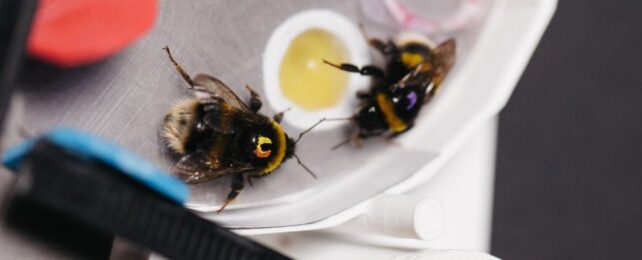
Two bees solving the two-step puzzle. (Queen Mary University of London)
The humble bumblebee is proof that brain size isn’t everything.
This little insect with its wee, seed-sized brain has shown a level of collective intelligence in experiments that scientists thought was wholly unique to humans.
When trained in the lab to open a two-step puzzle box, bumblebees of the species Bombus terrestris could teach the solution to another bee that had never seen the box before.
This naive bee would not have solved the puzzle on its own. To teach the ‘demonstrator’ bees the non-intuitive solution in the first place, researchers had to show them what to do and offer them a reward after the first step to keep them motivated.
“This finding challenges a common opinion in the field: that the capacity to socially learn behaviors that cannot be innovated through individual trial and error is unique to humans,” write the team of researchers based in the United Kingdom and United States.
Humans have a long history of ‘moving the goalposts’ on what sets our species apart from all others.
Some of these cultural behaviors even show signs of refinement and improvement over time. Homing pigeons, for instance, learn from each other and adjust their culture’s flight paths year on year.
An influential way to move the goalposts on human intelligence is to say that humans are unique from other animals because we can learn things from each other that we could not invent independently.
Think of the device you are reading this article on right now. No one human can invent all its parts and mechanics from scratch on their own and in one lifetime. It’s taken decades of work and refinement to get to this advanced stage. Even the very act of reading is a skill that generations of humans have built upon little by little.
Obviously, no animal can put together an iPhone or read an article on animal intelligence. But at a basic level, bumblebees join chimpanzees in “cast[ing] serious doubt on this supposed human exceptionalism,” writes Alex Thornton, an ecologist at the University of Exeter, in a review of the bumblebee research for Nature.
Chimpanzees have large brains and rich cultural lives, but the discovery among bumblebees, Thornton argues, is “all the more remarkable because it focuses not on humanity’s primate cousins, but on… an animal with a brain that is barely 0.0005 percent of the size of a chimpanzee’s.”
The collective intelligence of their hive mind is also not to be dismissed.
To test it, behavioral scientist Alice Bridges from Queen Mary University of London and colleagues housed colonies of bumblebees with a two-step puzzle for a total of 36 or 72 hours over 12 or 24 consecutive days, with no human help.
After all that time, the bees could not figure out how to get to the sugary reward. Bumblebees spend on average about 8 days foraging in their lifetimes, so it’s as if they had up to a third of their lifetime foraging time to work on the puzzle.
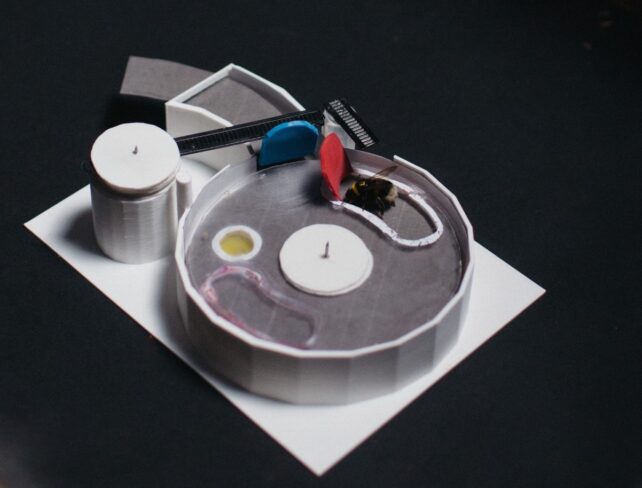
In the image below, you can see the puzzle. The yellow circle contains a drop of sugar under a plastic lid. Bees can get to it by pushing the red tab, but only once the blue tab has been pushed out of the way.
The two-step puzzle box with a bee pushing the red tab. (Queen Mary University of London)
It took a human to painstakingly show them the way, and this was only possible using an extra reward. But once one bee figured it out, they could teach others how to move the two tabs to retrieve a sugary treat.
A similar experiment on chimps was also published recently in Nature Human Behavior. Both the vertebrate and invertebrate case studies showed a sharing of ideas that were exceptionally hard to learn alone.
Of course, this behavior wasn’t observed in the wild. It had to be taught to the bees and chimps first. But the findings leave open the possibility that if there were a rare, once-in-a-lifetime innovator in chimp or bee society – an Einstein among bees – their ideas might stick around in animal culture and be used for generations to come.
Bees’ famous honey waggle dance, pointing out the distance, direction, and quality of sources of food, for instance, is a behavior that was once thought to be purely instinctive, but it now appears to be somewhat shaped by social influences.
In 2017, researchers also trained bumblebees to roll a ball into a goal for a reward. To score, the insects had to learn from each other and remedy their previous mistakes. And so they did.
The newest experiment, Thornton writes, “suggests that the ability to learn from others what cannot be learnt alone should now join tool use, episodic memory (the ability to recall specific past events) and intentional communication in the scrapheap” of explanations for human cognition and culture.




 Perhaps the first step in making the Middle Passage meaningful is to acknowledge the partiality of the lens we were given by family and culture, and through which we have made our choices and suffered their consequences. If we had been born of another time and place, to different parents who held different values, we would have had an entirely different lens. The lens we received generated a conditional life, which represents not who we are but how we were conditioned to see life and make choices… We succumb to the belief that the way we have grown to see the world is the only way to see it, the right way to see it, and we seldom suspect the conditioned nature of our perception.





 Two bees solving the two-step puzzle. (Queen Mary University of London)