“The kingdom of God is within all of us so no matter where we go, we should leave a little bit of heaven behind.”
–Cornel West
Cornel Ronald West (Born June 2, 1953) is an American philosopher, theologist, political activist, social critic, actor, and public intellectual. The grandson of a Baptist minister, West’s primary philosophy focuses on the roles of race, gender, and class struggle in American society. Wikipedia
RobWords • Dec 9, 2023 • Enjoy these weird and wonderful words from me and Susie Dent! And remember that the first 500 people to use my link will receive a one month free trial of Skillshare: https://skl.sh/robwords12231 For this video exploring the most wonderful rare words in English I am joined by my hero, Susie Dent! She’s the star of Dictionary Corner on British TV show Countdown and the UK’s undisputed Queen of Words. In this video she gives us her top 5 wonderful words… and I give mine!
When I have an argument with someone, I’m almost always right. You probably are, too. I know these things because when researchers asked people to reflect on disagreements they’ve had, 82% of them were confident they were usually right.
I’m no math whiz, but something doesn’t add up there.
“Most of us overestimate the accuracy of our beliefs and opinions, often badly, with little consideration of the possibility that we might be wrong,” says Mark Leary, PhD, emeritus professor of psychology and neuroscience at Duke University and the guy who led that research.
Leary is totally right about this. He and other researchers have done experiments, over and over, that reveal the incredible overabundance of unwarranted human confidence.
Sure, we can be a rational, thoughtful, creative species. But evolution has equipped us with an overwhelming propensity to think too highly of our own thoughts, which causes us to get into deep mental grooves and stay there. Right, wrong or otherwise, it’s in our nature to become comfortable in what we think we know, commiserating with like-minded individuals, fearful of who and what we don’t understand, subconsciously unwilling to get out of our mental comfort zone, unable to boldly go beyond the convenient ways of seeing and comprehending the world.
This leads to skewed, misinformed viewpoints and tribal thinking that ultimately pits us against one another. Lean to the left, lean to the right, we just want to fight fight fight. Because we are right and they are wrong.
Extreme confidence in our thought processes may have served us well in some ancient, isolated tribal setting. It’s anything but productive in today’s information-soaked society on this increasingly crowded little planet. Would that our brains could evolve to keep up with the realities of modern existence.
I explained this rigidity of thought in a recent article about the human propensity for lying and gullibility, delving into the science of cognitive bias, by which we readily soak up misleading and even outrageous claims that support our worldview while unwittingly ignoring input that runs counter. This naturally creates myopic, vitriolic disputes rooted in what we falsely believe to be objective truths.
Medium reader Ray Wirth offered an insightful comment on the article: “It’s much easier for us to absorb information that fits our beliefs rather than to shift our beliefs based on new information,” Wirth wrote. “Literature, art, travel, biography, and cross-cultural experiences can shift our thinking and make us more open to seeing the world as it is.”
To see the world as it is, not as we want it to be. That’s wisdom, philosophers tell us. But it’s not easy to be wise.
Wisdom demands we slip the surly bonds of belief and seek objective knowledge and true understanding.
It all starts with good thinking.
Good thinking requires a love of knowledge and an eagerness to learn. But one also has to care about reaching accurate conclusions and having the right beliefs, not just conclusions and beliefs that are comforting or convenient. Good thinking, therefore, also requires a strong dose of intellectual humility.
“Being intellectually humble means being open to the possibility you could be wrong about your beliefs,” explains Eranda Jayawickreme, PhD, a professor of psychology at Wake Forest University. “Without acknowledging the possibility that your current beliefs may be mistaken, you literally can’t learn anything new.”
Intellectual humility is not the same as being generally humble or modest. It pertains specifically to how we think about our knowledge and our cognitive processes. It goes beyond open-mindedness, which does not necessarily involve pondering one’s cognitive limitations.
And intellectual humility does not mean lack of conviction. You and I can argue vehemently about something. We can both be firm in our beliefs, hard-headed as hell. Odds are at least one of us is not 100% right.
“While part of being a good thinker involves recognizing one’s possible ignorance, it also requires an eagerness to learn, curiosity about the world, and a commitment to getting it right,” Jayawickreme wrote last month in The Conversation.
“Intellectual humility is rational in the sense that we can’t all be right in most of our disagreements, we are often irrationally overconfident, and the evidence on which our beliefs and viewpoints are based is often rather flimsy,” Leary writes in the Greater Good Magazine.
Problem is, intellectual humility is inversely proportional to the perceived import or weight of an issue. I might admit to my wife I took a wrong turn on the way to the restaurant (though, c’mon, what does Google Maps really know?) but don’t tread on my dearly held cultural beliefs.
“Although acknowledging the limits of one’s insights might be easy in low-stakes situations, people are less likely to exhibit intellectual humility when the stakes are high,” Jayawickreme and colleagues explained last year in the journal Nature Reviews Psychology. “People are unlikely to act in an intellectually humble manner when motivated by strong convictions or when their political, religious or ethical values seem to be challenged.”
Here’s why intellectual humility is so important:
If we don’t care enough to find the truth, if we don’t acknowledge potential flaws in our belief systems, if we don’t seek experiences that challenge what we think we know — if we don’t think good — then we fail to nurture one of the most important human qualities: empathy.
Empathy is poorly understood by many of us. It’s not about donating to the Red Cross or volunteering at the soup kitchen or visiting an old person in a nursing home. Those are acts of compassion. All well and good. But empathy is a more deeply seated skill and sensibility. It helps us feel compassion and act upon it, but it is much more than that. At its core, empathy involves understanding the feelings and viewpoints of another person so we can consider a situation or a conversation or the individual’s very existence from their perspective.
Empathy is hard! Many of us — particularly men — suck at it. Here’s how one expert put it, based on findings from his research:
“There is a common assumption that people stifle feelings of empathy because they could be depressing or costly, such as making donations to charity,” said C. Daryl Cameron, PhD, a professor of psychology at Penn State University. “But we found that people primarily just don’t want to make the mental effort to feel empathy toward others, even when it involves feeling positive emotions.”
Like most human emotions and abilities, empathy arises through both nature and nurture. We can cultivate it. Science shows that good thinking and intellectual humility are worthy starting points.
“Intellectual humility was associated with higher levels of empathy, gratitude, altruism, benevolence, and universalism, and lower levels of power-seeking,” researchers concluded in a 2015 study published in the Journal of Positive Psychology.
And that’s why getting out of our comfort zone is so vital to the human experience. It stretches the mind and opens us to new ways of looking at ourselves and the world, and developing empathy and compassion for people who are not like us, but who are often a lot more like us than we realize, separated mostly by a gulf of circumstance and the mental hamstring of cognitive bias.
Empathy requires taking a good, hard look at ourselves, acknowledging our foibles and flaws. Practiced with intention, it leads to greater tolerance, better listening skills, more respect for others and, in a collective sense, less acrimony and polarization.
Empathy, in turn, is known to be among the foundation blocks of wisdom.
Wisdom is poorly understood by many of us, too. It’s not a product of age or knowledge. It doesn’t come automatically with experience or education. It certainly isn’t guaranteed by intelligence.
“Wisdom is more about acquiring a deeper understanding about meaning in life, of being able to see how and where you fit into the grander scheme of things and how you can be a better person for yourself and for others,” write co-authors Dilip Jeste, MD, a professor of psychiatry and neuroscience at UC San Diego, and Scott Lafee, in their book Wiser.
Your level of wisdom, Jeste says, is determined by how many of the following characteristics you possess, and to what degree:
Self-reflection: Understand your own thoughts, motivations, and actions.
Prosocial behaviors: Maintain positive social connections and act with compassion, empathy, altruism, and a sense of fairness.
Emotional regulation: Manage negative emotions and stress that can get in the way of decision-making, and lean into positive emotions.
Acceptance of diverse perspectives: Learn about and accept perspectives and value systems outside your own.
Decisiveness: Make decisions in a timely manner with comfort.
Social advising: Give good advice to others.
Spirituality: Connect with yourself, with nature, or with a transcendent entity such as the soul or God.
(As a great starting point toward building empathy on the path to wisdom, my colleague Kathleen Murphy offers some excellent, specific tactics for engaging in productive conversations with family during the holidays, when relationships can be at their most tense.)
I grew up in a small town that engendered, at least for me, narrow-minded beliefs. It’s shocking how uninformed my views and convictions were as a young adult. I went away to college, but dropped out and moved back to my hometown to work in the family business. It was a wonderful experience. No regrets. But in my late 20s, I quit that great job with a clear and prosperous future and went back to school to pursue the mediocre pay offered by a career in journalism.
That led me to the most mind-expanding year of my life.
I lived and studied in Europe, learning a new language and immersing myself in entirely foreign cultures while traveling throughout the continent and to Russia. The experience radically altered my worldview. I woke up to how little I knew about what I thought I knew. I came back with a much greater appreciation for how alike we all are, despite superficial differences in appearance, education, work, culture or beliefs. Don’t get me wrong. I’m still stubborn in my beliefs, but less so.
If I could wave a wand and improve the lives of young Americans and the destiny of this country, I would have every high school student spend a semester abroad in a distinctly different culture, or otherwise get way out of their comfort zones, geographically, socially and politically. Seeing the world, any little part of it, actually living somewhere else, meeting the people, getting beyond the hotels and the tourist spots and the fancy restaurants to see life as it really is, in all its glory and gloomy reality, is a profoundly life-altering experience.
Short of my fantasy for all, any of us can choose to be more intellectually humble.
We can change the channel or otherwise tune out the drumbeat of narrow-minded, polarized partisan bickering. We can read more history, learn more about other cultures, seek to understand people who disagree with us — not just grasp their argument, but understand where they’re coming from and what led them to the particular set of beliefs. Often we’ll find it’s totally logical, based on their upbringing, education, or other life influences. Does that make them wrong? Does that make us right?
I’ll admit to still being stuck in my ways of thinking as much as the next idiot. I believe certain things not because I’ve been there, done that, not because I’ve walked in those shoes, but simply because I’ve listened to and accepted certain facts and narratives, avoided and ignored others.
I’m human. Most of us are. This is how our brains work.
While my travels and my college education might foster some intellectual humility that affords a bit of wisdom, I’m 100% confident that such an outcome is far from assured.
“On one hand, the more people learn, the more they see how much they do not know and come to realize that knowledge is exceptionally complicated, nuanced, and endless,” Leary, the Duke University professor, points out. “On the other hand, the more people learn, the more justifiably confident they become in the areas in which they develop expertise.”
And if we wish to be a little wiser and improve our human relationships, the only thing we should not have confidence in is confidence itself.
Thanks for your support, which makes my reporting and writing possible. To make your days better, check out my book: Make Sleep Your Superpower. And if you’re a writer, sign up for my Writer’s Guide newsletter.
For the psychologist Carl Jung the modern condition is not one inherently different from that of our far past. However it is one we are forced to interpret differently. He says:
I recall a professor of philosophy who once consulted me about his cancer phobia . He suffered from a compulsive conviction that he had a malignant tumor , although nothing of the kind was ever found in dozens of X-ray pictures. “Oh . I know there is nothing.’ “ he would say. “but there might be something. “ What was it that produced this idea ? It obviously came from a fear that wasn’t installed by conscious deliberation . The morbid thought suddenly overcame him. and it had a power of its own that he could not control . It was far more difficult for this educated man to make an admission of this kind than it would have been for a primitive to say that he was plagued by a ghost. The malign influence of evil spirits is at least an admissible hypothesis in a primitive culture , but it is a shattering experience for a civilized person to admit that his troubles are nothing more than a foolish prank of the imagination . The primitive phenomenon of obsession has not vanished : it is the same as ever, it is only interpreted in a different and more obnoxious way. (Jung, Man and His Symbols)
For Jung much of the modern world, by refusing to partake in the symbols that might allow us to understand our unconscious minds, means we find ourselves paralysed by an inability to properly relate to the parts of our minds not superficially accessible to us.
Indeed as the world has been increasingly literalised we have come to believe that aspects of our minds, emotions, instincts, behaviours are either transparent to us or else are or in time will be transparent the investigation of the physical sciences. We might observe that in the age of hyper-technology forms such as social media cause us to become even more driven by impulse and self-projection. Jung again says in Man and His symbols:
What we call civilized consciousness has steadily separated itself from the basic instincts. But these instincts have not disappeared. They have merely lost their contact with our consciousness and are thus forced to assert themselves in an indirect fashion. This may be by means of physical symptoms in the case of a neurosis, or by means of incidents of various kinds, such as unaccountable moods, unexpected forgetfulness, or mistakes in speech. A man likes to believe that he is the master of his soul. But as long as he is unable to control his moods and emotions, or to be conscious of the myriad secret ways in which unconscious factors insinuate themselves into his arrangements and decisions, he is certainly not his own master.
Yet for Jung the solution lies in his own psychological work. Much of Man and His Symbols focuses on the importance of things such as dream interpretation, and the understanding of the unconscious psyche through Jung’s schema of mythology and psychology. Myths and dreams both have an importance in Jung’s work.
Yet some problems arise for anyone who tries to make coherent sense of Jung’s body of writings. Some of his observations have become integrated into modern language (such as introvert/extrovert) but many have largely been rejected or are seen as too mystical for science to take seriously. At times Jung’s reliance on his own dream interpretations seems to border on the superstitious, and his assimilating of all religious and mythic traditions into his own scheme mean a heavy reliance lies upon his own ability to winnow and interpret. As profound as some of his observations may be Jung is the centre of his own religion. So what can we learn from Jung’s observations at the very cusp of the modern world?
Perhaps we can learn the obvious but disregarded idea that stories, myths and images relate us to ourselves in a way that is as useful as anything else. While there is some use in understanding ourselves physically, seeking psychological wholeness involves a wider comprehension of ourselves as selves in a narrative and symbolic world.
We might consider this from the perspective of the problem of perception. When we look at a table we see a table, but no physical analysis can understand how this is so. There are no “table atoms”, just atoms, nor is there some constituent substance that makes a table partake in table-ness and so make it in some sense the same in kind as any other table. We interpret the world in forms that have their own meaning, and a belief that these forms can be reduced to some underlying reality that is more real than the forms themselves leaves us no nearer properly understanding them. The current approach of much modern neuroscience and philosophy is to use words like “illusion” or “epiphenomenon”, or to use language such as Anil Seth in his Ted Talk titled “Your brain hallucinates your conscious reality”.
Yet we find unavoidably as Jung has pointed out that metaphors and stories have a kind of truth we lose if we simplify them to mechanistic explanations. Even if it were true that the brain “hallucinates” reality, however contradictory such a phrase may be, it leaves us no closer to understanding ourselves, let alone finding a path to wholeness. To consider Jung’s earlier comparison between a person haunted by a ghost and a person who has some neurosis they know is neurosis but seem to in some sense not have control over themselves, we see the same problem manifesting itself. Sometimes we have not gained anything by refusing to call a table a table.
You could argue in many ways Jung tried to create a psychological religion, one that synthesised myth into his own Scheme and turned them into his own psychological heuristics. Perhaps this in itself could be argued to be a kind of reductionism, one that does not allow us to see the context of religious ideas. But Jung like many other great thinkers and philosophers of the pre-hypermodern age foresaw many of the profound problems we ourselves now have to find a path beyond.
Let’s Talk Religion • Dec 5, 2023 • This year we are celebrating the Christmas season by reading the amazing advent sermons of the german mystic philosopher Meister Eckhart. There are three more sermons coming after this one.
This image of the Andromeda Galaxy, also known as Messier 31, is Jeffrey Mishlove’s very first photograph of a deep space object. This spiral galaxy, located about 2 million light years away, is the companion to our Milky Way. This image is a composite of 172 individual, 5 second exposures – for a total exposure time of just over 14 minutes. You can also see two satellite galaxies in this image. The diameter of Andromeda is about 152,000 light years making it somewhat larger than the Milky Way. Jeffrey made this image with a 4″ refracting telescope.
As the cofounder of Google DeepMind, Shane Legg is driving one of the greatest transformations in history: the development of artificial general intelligence (AGI). He envisions a system with human-like intelligence that would be exponentially smarter than today’s AI, with limitless possibilities and applications. In conversation with head of TED Chris Anderson, Legg explores the evolution of AGI, what the world might look like when it arrives — and how to ensure it’s built safely…SHOW MORE
After a long career in journalism and publishing, Chris Anderson became the curator of the TED Conference in 2002 and has developed it as a platform for identifying and disseminating ideas worth spreading.
This talk was presented at an official TED conference. TED’s editors chose to feature it for you.
New Thinking • Dec 8, 2023 This video is a special release from the original Thinking Allowed series that ran on public television from 1986 until 2002. It was recorded in about 1988. It will remain public for only one week. Robert Frager, Ph.D., is past president of the Association for Transpersonal Psychology and the founder of the Institute of Transpersonal Psychology. Here he shares his wide experience as a student and participant in diverse spiritual traditions. These include yoga in India in the school of Paramahansa Yogananda, Sufism within a 300-year-old Turkish Sufi order, and Aikido in Japan under the tutelage of Osensei, the system’s founder. Now you can watch all of the programs from the original Thinking Allowed Video Collection, hosted by Jeffrey Mishlove. Subscribe to the new Streaming Channel (https://thinkingallowed.vhx.tv/) and watch more than 350 programs now, with more, previously unreleased titles added weekly. Free month of the classic Thinking Allowed streaming channel for New Thinking Allowed subscribers only. Use code THINKFREELY.
Try to ignore the name of the political party they are part of. But just look at how they function as a group.
They call this a forum, not a debate. But whatever you call it, I’ve never seen candidates for the same job working together so harmoniously at such a high political level.
They don’t talk over each other. For the most part, they support each other. They are not even given time limits, but seem to sense when they have said enough.
Wouldn’t it be wonderful if the participants in a political debate were complementing each other rather than tearing each other apart? Wouldn’t it be wonderful if the winner of a political debate was the one who was considered to be the most supportive and cooperative rather than the one who was perceived to be the most dominant?
I think this Democratic “Not a Debate” Debate is a breakthrough in how political debates are done, and should be a template for how all political debates are done in the future.
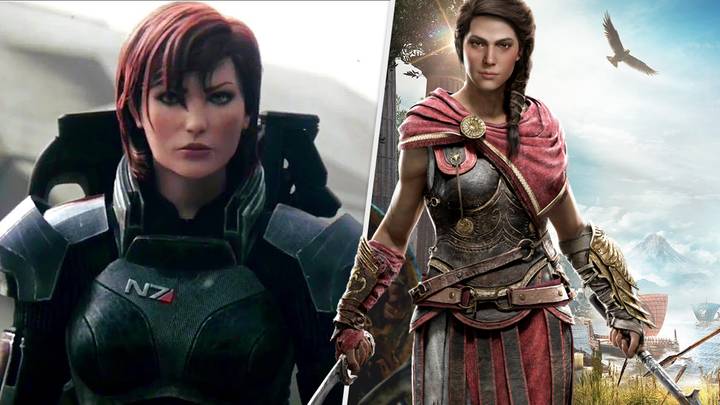
According to a fascinating new study, one in three male gamers will always choose to play as a female character when given the option in a video game.
New research compiled by Quantic Foundry (thanks, TheGamer) finds that just 29% of males would go for the likes of Kassandra over Alexios in Assassin’s Creed Odyssey, or female Shephard over male Shephard in Mass Effect. This is compared to less than one in ten female gamers picking male characters if given the choice.
Personally, I’d typically choose female wherever possible. A lot of the time it’s because I find it to be the more interesting choice! Maybe I prefer the female voice actor (as is the case in Assassin’s Creed Odyssey and Mass Effect), or maybe I just want a change of pace from the last several decades of games where the default option is a grizzled white dude.
Whatever the case, 48% of male respondents said they’d preferred playing as characters of the same gender. That’s a staggering contrast to the female participants: 76% said they preferred to play as a woman, with 9% going for male when given a choice. Again, I’d assume a large part of this is because women aren’t exactly showered with opportunities to play as other women – at least they haven’t been, historically speaking.
GTA 6 Official Trailer
The researchers posit that some men may choose to play as a female because they find the characters more attractive when compared to male avatars. They also suggest that video games in which you can choose to be a man or a woman give men a safer space to explore their own relationship with gender norms and push the boundaries on their own terms.
Non-binary players and characters were also included in the study, with non-binary gamers opting to play as non-binary characters where possible. Of course, there’s still a massive lack of non-binary representation in video games right now, with most character creators offering up plain male/female options.
In these instances, 33% of non-binary respondents would choose female, and 10% male.
Consciousness, sexuality, androgyny, futurism, space, the arts, science, astrology, democracy, humor, books, movies and more