
Tim Ferriss • Nov 4, 2019 Watch the full interview with Dr. Gabor Maté here: • Dr. Gabor Maté on Trauma, Addiction, … SUBSCRIBE: http://bit.ly/1dSzTkW
Buddha on knowing how your suffering came to be

UN General Assembly Votes Overwhelmingly to Demand a Gaza Cease-Fire
20h ago
Nick Wadhams, Bloomberg News (bnnbloomberg.ca)
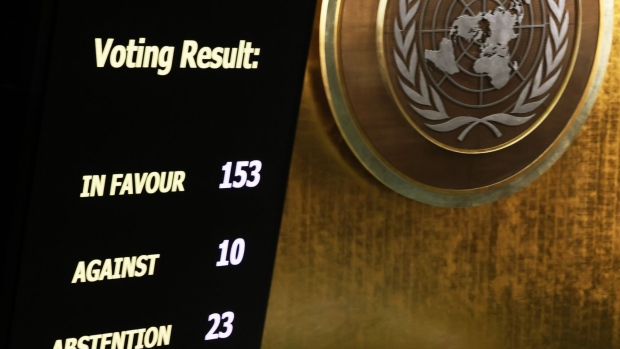
NEW YORK, NEW YORK – DECEMBER 12: The results of a draft resolution vote are seen on a screen as the UN General Assembly holds an emergency special session on the Israel-Hamas war at the United Nations headquarters on December 12, 2023 in New York City. The General Assembly resumed its 45th plenary meeting after Egypt and Mauritania invoked Resolution 377, known as “Uniting for Peace,” to demand an immediate humanitarian ceasefire in the two-month-long war between Israel and Hamas after the U.S. vetoed a similar vote in the Security Council. Assembly resolutions are non-binding and could be ignored by Israel even if there is overwhelming support for a ceasefire. The death toll in Gaza has passed 18,000 from Israel’s offensive after the Oct. 7 attack by Hamas that Israel says killed 1,200 people and saw 240 people taken hostage. (Photo by Michael M. Santiago/Getty Images) Photographer: Michael M. Santiago/Getty Images , Photographer: Michael M. Santiago/Getty Images
(Bloomberg) — The United Nations General Assembly voted overwhelmingly to demand a cease-fire in the Gaza Strip, underscoring a sharp shift in sentiment that’s left Israel and the US increasingly isolated over the military campaign to destroy Hamas.
The General Assembly adopted the non-binding resolution by a vote of 153 to 10, with 23 nations abstaining. The Czech Republic and Austria were the only two European Union nations that voted against the resolution. The resolution demanded an immediate humanitarian cease-fire and an immediate release of all hostages.
Last week, the US vetoed a Security Council resolution that would have called for a cease-fire to the war, which began after Hamas fighters attacked Israel on Oct. 7, killed some 1,200 people and took 240 more hostage. Israeli forces responded with a punishing military campaign that the Hamas-run Health Ministry says has killed some 18,000 people. The US doesn’t have veto power in the larger General Assembly.
Biden Says Netanyahu Must ‘Change’ or Will Lose Global Support
In a General Assembly vote in October, 120 nations voted in favor of a resolution calling for a cease-fire between Israel and Hamas, which is designated a terrorist organization by the US and the European Union. Twelve countries joined the US and Israel in voting against it, while 45 abstained.
President Joe Biden acknowledged earlier Tuesday that world opinion was moving against Israeli Prime Minister Benjamin Netanyahu. While Israel continues to have the backing of the US and key allies in Europe, “they’re starting to lose that support,” Biden said.
©2023 Bloomberg L.P.
Aware: Glimpses of Consciousness
Area 23a • Aug 4, 2021 WWW.AREA23A.COM/AWARE NOW AVAILABLE ON VIDEO ON DEMAND (Apple TV, Amazon, GooglePlay) and WORLDWIDE VIRTUAL THEATER featuring exclusive q&as One Night for Consciousness Q&A Live post-screening discussion features Jack Kornfield, Author, and Buddhist Teacher; Directors Frauke Sandig & Eric Black; Roland Griffiths, Ph.D., Director, Center for Psychedelic and Consciousness Research; Monica Gagliano, Professor of Plant Behavior & Cognition, University of Sydney, and other special guests. Global Live Stream (European Premiere) Q&A Live post-screening discussion with Directors Frauke Sandig & Eric Black; Roland Griffiths, Ph.D., Director, Center for Psychedelic and Consciousness Research; Monica Gagliano, Professor of Plant Behavior & Cognition, University of Sydney; and Dr. med. Andrea Jungaberle Medical Director OVID Clinics I Co-founder of MIND Foundation. Moderator: Amir Giles, Co-Director, Psychedelic Society. 100% Fresh on Rotten Tomatoes! “The most moving and beautiful depiction of deep understanding of consciousness and of who we are that I have seen depicted through film.” -Jack Kornfield, author and Buddhist teacher “Stirs feelings of awe and wonder, humility and connection. A remarkable film.” – Valerie Kalfrin, Alliance of Women Film Journalists “Consciousness-elevating food for thought.” – Michael Rechtschaffen, Los Angeles Times “Stunningly Deep, Wise and Visually Arresting, the most Mind-Blowing Film the Maui Film Festival has presented in Twenty Years! -Barry Rivers Maui Film Festival Founder/Director WINNER OF THE FEATURE COMPETITION JURY PRIZE, 2021 ILLUMINATE FILM FESTIVAL TAKE A THOUGHT-PROVOKING, MIND-BLOWING CINEMATIC JOURNEY INTO THE OCEAN OF CONSCIOUSNESS. What is consciousness? Is it in all living beings? What happens when we die? Why do we seem to be hardwired for mystical experience? Aware follows six brilliant researchers who approach our greatest mysteries from radically different viewpoints. High-tech brain research and Eastern meditation, psychedelics, and the consciousness of plants help us see the world anew, challenge our beliefs, and maybe even initiate our own journey into the unknown. Cast: Roland Griffiths, the renowned Johns Hopkins University psychedelics researcher, plant biologist Monica Gagliano, Christof Koch, Chief Scientist of the Allen Institute for Brain Science, the famed Tibetan Buddhist monks, Matthieu Ricard and Mingyur Rinpoche, and acclaimed author, Richard Boothby. AWARE is the second in the trilogy following Heart of Sky, Heart of Earth, selected for over 100 international film festivals. AWARE is the winner of the Feature Competition Jury Prize at the Illuminate Film Festival and is currently shortlisted for the LOLA, the German Academy Awards. Directed by Frauke Sandig and Eric Black Website: https://aware-film.com/ Facebook: / awaremovie
Hidden Trauma
Can We Tap Into Creation’s Original Consciousness?
But what is consciousness? Where is it located? And what does an understanding of it mean? Particularly the larger or “non-typical,” “cosmic,” or “special” types of consciousness?

DEC 12, 2023 (wisdomschool.com)
A few months ago, The New York Times ran an article about a conference in New York examining a perennial question: “What is consciousness (and where does it come from)?” Carl Zimmer, the author of the Times piece, opens it with:
“On a muggy June night in Greenwich Village, more than 800 neuroscientists, philosophers and curious members of the public packed into an auditorium. They came for the first results of an ambitious investigation into a profound question: What is consciousness?”
Almost universally, people throughout history report that experiencing expanded consciousness lets them shed their fear of death and more fully embrace life. And, of course, we use consciousness constantly to simply get through life: you’re using your consciousness to read these words and give them meaning.
But what is consciousness? Where is it located? And what does an understanding of it mean? Particularly the larger or “non-typical,” “cosmic,” or “special” types of consciousness?
Most people have had at least one experience of expanded or universal consciousness in their lives. I had one when I was around six years old, laying in a hammock in my parents’ back yard. Another was in my early 20s, while meditating during a snowstorm that I wrote about in my autobiography, The Prophet’s Way. Suddenly you’re hit or overwhelmed by a feeling of being both at total peace and “at one” with everything in creation.
My mom told me stories of her experiencing what she thought was “cosmic consciousness” when she nearly died giving birth to my youngest brother. Millions of people — including me when I was a teenager — have also had these sorts of experiences while taking psychedelic drugs.
Between the development of AI and ongoing debates about the existence or non-existence of free will, a vigorous discussion about the origins and nature of consciousness is on the tongues of millions.
But, what is consciousness? Where does it come from and what is it made of? Is it just the product of very complex wiring, be it in a computer or a brain? Or is there something much, much larger going on here?
We all pretty much know what matter and energy are. Matter is stuff, the hard, physical reality all around us, from solids to liquids to gasses and other forms of matter that only exist in stars or distant space (plasma, black holes, etc.). Energy, on the other hand, is radiated through space or matter: the forms we know the best are light, sound, heat, and kinetic energy (movement).
Albert Einstein revolutionized the world of physics (and, I’d argue, metaphysics) when, in 1905, he laid out his theory of relativity and proposed that all matter is, in fact, made up of condensed or slowed-down energy (my terms, not his). The amount of energy that it took to make a particular bit of matter, in fact, is easily calculated by the handy formula of E=MC2: the Energy that makes up an object is equal to the Mass of that object times the Speed of Light (C) squared.
The amount of energy that, at the beginning of time, condensed to form the elements that make up the screen or paper on which you’re reading these words, for example, is knowable by simply multiplying its weight (mass) times 8.98755179 × 10¹⁶. If you can figure out a way to dissolve the atomic bonds that hold the elements that make up what you’re looking at, the energy that will be released will always conform to that formula (minus the leftover mass from the explosion or radioactive disintegration).
In this regard, it’s possible to argue that the entire universe is made up not of matter but of energy in various states. Some is free or loose energy, floating around and lighting or heating or X-raying up the rest of creation; some is “condensed” or slowed-down energy that’s locked in atoms and subatomic particles that make up the physical world we see.
Matter, in other words, is like ice cubes floating in water: it seems different from the stuff it’s made of, but the only difference is its level of “free” or “bound” energy. When you remove energy from liquid or gaseous water by cooling it, it eventually changes state to a solid known as ice. (It’s an imperfect analogy, but will work for this example.)
Ice cubes, then, are just water in a different state. Similarly, all matter is just energy in another state.
But what is energy?
Light, for example, is a form of energy we have specific sensors to detect (our eyes) and oscillates from around 430 trillion hertz or cycles-per-second, which we detect as “red,” to 750 trillion hertz, which we perceive as violet. When such energy oscillates slightly more slowly then visible light, we call it “heat” or “infra-red.” When it oscillates slightly faster, we call it “ultraviolet” light that we can’t see but will do a job on our skin if exposed for long periods of time.
But what is light made of? And every other form of energy in the known universe? And, if we knew the answer to that question, does that mean that all matter is made of the same stuff? And — most important — what does that have to do with consciousness?
While light can exhibit a wave-like nature (and the frequency of those waves is measurable), it can also behave like particles. The famous “double-slit experiment” shows that light is both waves and particles; we call those particle-like packets of light photons. Red photons of light, for example, carry about 1.8 electron volts (eV) of energy, while each blue photon carries about 3.1 eV of measurable energy.
So the forms of energy we can perceive or even measure are themselves apparently made up of something even more subtle. And if we could figure out what that primordial substance (for lack of a better word) is and measure or detect it, we’d find that the entire physical universe — all matter and all energy — is made up of that stuff.
It fills everything because it has slowed down to various frequencies to become everything. Slowed down a bit to specific frequencies, we call it energy in various forms. Slowed down even more, we call it matter. But, like the H2O that makes up water vapor, liquid water, and ice, it’s all the same stuff, one single “substance” or essence or primal energy.
But what is that?
New fields of scientific inquiry have emerged to ask just this question. The ones I find most fascinating are panpsychism, cosmopsychism, and the psychological ether theory.
With subtle differences in terms and meaning, these three concepts all broadly posit that the most subtle energy in the universe — the stuff, everything that we can see or feel — is made of is purely consciousness itself.
Galileo was largely quoting Democritus (who lived 2000 years before him) when he argued that the qualities of the “real world” are rooted in our perception of them rather than any objective reality:
“[T]astes, odors, colors, and so on are no more than mere names so far as the object in which we place them is concerned, and that they reside only in the consciousness. Hence if the living creature were removed, all these qualities would be wiped away and annihilated.”
So, if everything in the entire known universe is made out of consciousness, how is it that some complex neural networks are capable of expressing consciousness? For that matter, what is consciousness itself?
I’m most fond of the computer versus radio analogy.
Our brains are arguably computing machines and are capable of receiving data, processing it, achieving conclusions about its meaning, and then acting on them. Setting aside the very real debate about the existence of free will (that will be another article), what this implies is that we’re very much predictable and relatively machine-like because, generally, we make decisions and take actions based on the data available to us.
But what about those things that are not explicable? How is it that some people report having achieved — or tuned into — a state of consciousness that they describe as “enlightenment” made up of bliss and some sort of universal awareness?
For this, I turn to the radio analogy.
We’re all constantly surrounded by uncountable numbers of radio waves, ranging from those created on Earth to those arriving from deep space and our sun. Our brains aren’t capable of tuning into those waves — of detecting that form of energy — but we’ve learned how to build devices that can and we call them radios.
By organizing a set of transistors, capacitors, resistors, and inductors in a particular configuration, we’re capable of selectively tuning in specific frequencies and thus listening to particular radio waves while excluding others.
So, what if the most basic, subtle, original form of energy in the universe is consciousness, and the “first” form of consciousness — that slowed down in a zillion ways to become everything we know as the physical universe — was what we call “bliss” or “love”?
What if when a parent — of any species — sees its offspring, that feeling they have isn’t just biologically determined by hormones and thought but is actually a “tuning” of the brain and nervous system to that primal form of energy that the entire universe is made of?
And what if neural networks work just as well at vast macro levels as they do at the relatively micro level of our brains and nervous systems? Imagine if you could shrink down to the size of a single blood cell and could then float through your own brain, looking at the connections of neurons, dendrites, and synapses. It might look something like this:
Credit: NASA/NCSA University of Illinois Visualization by Frank Summers, Space Telescope Science Institute, Simulation by Martin White and Lars Hernquist, Harvard University
That visual, though, was created by scientists affiliated with NASA, the University of Illinois, and Harvard University and each dot is an entire galaxy — each galaxy is made up of between 10 million and a trillion stars — and the lines connecting them are pathways of matter organized by the gravity of the galaxies. It shows only a tiny fractional slice of the known universe: about 134 megaparsecs or 437 million light-years.
If our brains are matter organized in a way that lets them both process data like a computer and tune into the subtlest energies of the universe like a radio, consider the possibility that the entire known universe can do the same.
That’s it’s both holding and expressing consciousness. That this is the primordial energy/consciousness soup from which each of us came and back into which each of us will one day dissolve.
In other words, consciousness is not something that emerges when physical systems like brains or nervous systems are organized in a way to facilitate it: it’s instead a fundamental feature — the raw material, if you will — of the entire universe and everything in creation, including us.
As physicist David Bohm wrote in 1968:
“That which we experience as mind…will in a natural way ultimately reach the level of the wavefunction and of the ‘dance’ of the particles. There is no unbridgeable gap or barrier between any of these levels. … It is implied that, in some sense, a rudimentary consciousness is present even at the level of particle physics.”
Sir Arthur Eddington wrote, in The Nature of the Physical World:
“The stuff of the world is mind-stuff,” and, “The universe is of the nature of a thought or sensation in a Universal Mind.”
As the late physicist Freeman Dyson wrote in his brilliant book Disturbing the Universe:
“The laws [of physics] leave a place for mind in the description of every molecule… In other words, mind is already inherent in every electron, and the processes of human consciousness differ only in degree and not in kind…”
All of which gives some urgency to the question: What happens when a computer is developed that is more complex — more capable of tuning into other frequencies of consciousness (to use the radio analogy) — than the human brain? If consciousness is everywhere and in everything, what would keep a computer from developing its own consciousness?
Might we one day see computers working to re-organize their own systems the way yogis fine-tune their minds and bodies to tune into universal bliss?
The entire field of panpsychism — which goes back (at least) to the ancient Greeks — is in a huge flux, with various branches and divisions separating out depending on exactly how the theory is expressed and how far down the logic train scientists and philosophers are willing to go.
But, at the very least, it gives us a starting point for an inner exploration of the universe, for our meditation and prayer time, for ideas about the possibility and timelessness of our own fleeting existence on this little planet in an obscure corner of the Milky Way galaxy.
And, perhaps, everything in the universe is suffused with a rich form of the creator’s/creation’s original consciousness and meaning that, with the right effort, we can occasionally tap into.
Do you have a sense of destiny?

Do you feel that you were meant to do great things?
Lillian deWaters tells us in The Finished Kingdom that the Kingdom is finished.
So, if the Kingdom is finished, what is there left to do?
Be.
So being is primary and doing will follow automatically.
And what prevents us from being?
Seeming.
Seeming is what our senses tell us. Seeming is what our personal history insists on.
But underneath seeming is being: universal, eternal, infinite, indestructible and great.
It takes daily work to get there, but being is our destiny.
–Mike Zonta, BB editor
Twenty-first Century Mysticism with Ronnie Pontiac

Sagittarius New Moon, December 12, 2023

Wendy Cicchetti
Sagittarius New Moon
The New Moon in Sagittarius opens up a cornucopia of opportunities to recognize our needs and desires and find greater ways to meet them. In the daily schedule of life, there’s often a battle between needs and desires, which may or may not parallel one another. What we wish to do and what ought to be done don’t always match exactly, so we often have to compromise on one or both sides. But with a New Moon we have a chance to realign and get everything coordinated, at least for a short while.
This is rather like lining up runners at the start of a race; everyone has an equal chance to reach the finish line. How the run works out individually will depend on a range of criteria: fitness, motivation, hydration, and so on. The same is true for what the Sun and Moon represent for us, since they both sit at the same degree of Sagittarius. One stellar personality may gradually outshine the other as time moves on. But now, we have a choice as to whether these aspects of ourselves move in tandem.
Where the Sun and Moon might represent other people in our lives — especially in the areas of our own natal chart that they rule — we may witness a greater rapport. It could mean that plans and arrangements easily come together because everyone is in agreement. Or a Sagittarian theme of travel may help to lift the gaze to a higher purpose, perhaps by focusing on a vacation, joint adventure, or pilgrimage. In one way or another, a special kind of unity carries us forward.
The New Moon period is often a time of limited vision too, simply because we only have a glimpse of how the fuller picture might look. The powers of faith and imagination are important now. Even if only a flicker of possibility is shown to us through a dream, flash of insight, or memory, it might be enough to start building something upon for the future.
Neptune squares the Sun and Moon, adding to this shadowy, unclear effect. Even so, there’s hope and potential within any cloudy, amoeba-like mass that sits before us! Our human brains are designed to pick out faces within random patterns, and so we may be reminded of someone, or shown a picture of somebody we will later meet. Our psychic and intuitive antennae are strong and can help us chart a path that might otherwise seem entirely freeform.
A further theme of this New Moon surrounds uncertainty about decisions where we feel we don’t quite know enough about someone or something. It’s a bit like wondering what gift to buy that person who has kindly invited you to their big-number birthday, yet whom you only know in a limited way. But the Moon is disposited by Jupiter in Taurus, which suggests that the foundations for the right choice are in place. For instance, you might know that the person enjoys going on walks in the countryside, in which case a book relating to that theme might be just the thing. Or you know they’re keen on relaxation, in which case sources of guidance on mindfulness or other calming techniques could be ideal.
The Moon forms a trine to both Chiron and the North Node in Aries. Working together, they hint at the potential for greater healing and growth soon to come. The cue from Aries is to be brave and enter our challenge zone rather than just stay within a comfortable realm. Accessing the new opens fresh doorways and opportunities as we have the courage to explore further.
This article is from the Mountain Astrologer by Diana McMahon Collis
Word-Built World: gavroche
A.Word.A.Daywith Anu Garg

Les Gavroches, 1907, Sculpture: Antonio Sciortino
There’s one category of words I can never get enough of: eponyms, the name-dropping words. An eponym is a word coined after someone, from Greek epi- (upon) + -onym (name). It’s a tiny capsule of history that captures some defining attribute of a person, real or fictional.
For an example from real life, consider Charles Boycott. Picture an English land agent in Ireland, always keen on collecting rent, poor harvest or not. His rent-collecting led to him being, well, boycotted. Tenant farmers and their workers refused to harvest crops; local shopkeepers would not serve him. Talk about your name sticking around for the wrong reasons!
In fiction, Charles Dickens’s characters are so memorable that they’ve jumped out of the pages and into our vocab. The best known among them is Scrooge, the poster boy for penny-pinching! Talk about a character with lots of interest.
This week we’ll feature five eponyms coined after people from the real world, literature, and mythology.
Who in today’s world has that eponym-worthy spark? It could be your quirky neighbor, a celebrity, someone in your family, or even a historical figure making a comeback. Spill the beans on our website or email us at words@wordsmith.org. As always, include your location (city, state).
Gavroche
MEANING: noun: A street urchin.
ETYMOLOGY: After Gavroche, a boy in the 1862 novel Les Misérables by Victor Hugo. Earliest documented use: 1876.