“If the cask is to hold the wine, its water must first be poured out.“ — Meister Eckhart (1260–1327)
Eckhart von Hochheim OP, commonly known as Meister Eckhart, Master Eckhart or Eckehart, claimed original name Johannes Eckhart, was a German Catholic theologian, philosopher and mystic, born near Gotha in the Landgraviate of Thuringia in the Holy Roman Empire. Wikipedia
No Spiritual Surrender: Indigenous Anarchy in Defense of the Sacred is a searing anti-colonial analysis rooted in frontline experience. Klee Benally (Diné) unrelentingly agitates against colonial politics towards Indigenous autonomy and total liberation of Nahasdzáán (Mother Earth).
Since its launch in 2018, NASA’s Parker Solar Probe has inched closer to the sun with each passing year, shedding light on key solar processes. By the end of 2024, it will have set a new record by grazing our star from a distance of just over 6 million kilometres, delving deep into its scorching outer layers.
One of the most audacious missions in the history of space exploration, the Parker Solar Probe is the first spacecraft to have flown through the sun’s outer atmosphere, known to scientists as the corona. It is set to break new ground in late December by covering 96% of the distance separating our planet from its fiery star.
In doing so, Parker will hit speeds of around 700,000 km/h (or 435,000 mph), enough to fly from New York to Tokyo in one minute – making it the fastest human-made craft in history. It will achieve such velocity by swinging around Venus, using the planet’s gravity to tighten its orbit around the sun and acquire extra speed.
“This will be a monumental achievement for all humanity. This is equivalent to the Moon landing of 1969,” said Parker project scientist Dr Nour Raouafi of Johns Hopkins University, in an interview with the BBC. “We are basically almost landing on a star.”
Into the furnace
Parker’s mission is to make repeated passes of the sun, drawing ever closer to the star as it travels through its outer atmosphere – which, paradoxically, is 300 times hotter than its actual surface. That means weathering unimaginable conditions, including temperatures of close to 1,400 degrees Celsius and solar winds charged with high-energy particles.
The trick for Parker is to make rapid dives into this hellscape, relying on its blistering speed and a thick heat shield made of carbon composite. The shield protects an array of instruments that measure charged particles and magnetic fluctuations, capturing both images and sounds.
In 2020, recordings made close to the star provided the first sound clips of the solar wind – a stream of high-energy particles that flows continuously from the sun.
Forecasting solar storms
The mission’s aim is to gain a better understanding of solar activity and to shed light on the many mysteries surrounding the corona, where temperatures can reach a million degrees Celsius and above – compared with just 6,000C at the sun’s surface. Scientists hope data collected by Parker will help understand why the sun’s outer atmosphere is so much hotter than its surface.
The corona is also where the solar wind is generated and sometimes whipped up into solar “flares” and “storms”, potentially disrupting our planet’s magnetic field, degrading communications and posing health risks to astronauts. Ultimately, Parker’s findings could pave the way for a space weather service capable of forecasting and tracking such events.
The probe’s end-of-year voyage will mark its best chance of acquiring a greater understanding of key solar processes. It will also be its last: beyond December, the probe’s orbit will no longer allow it to swing around Venus, effectively precluding an even closer encounter with the sun.
In mid-October, a few days after the attack on Israel, a friend sent me a text from a rabbi. She said she couldn’t look away from the horror on the news but felt completely numb. She was struggling to feel even the tiniest bit useful: “What can I even do?”
Many people are feeling similarly defeated, and many others are outraged by the political inaction that ensues. A Muslim colleague of mine said she was appalled to see so much indifference to the atrocities and innocent lives lost in Gaza and Israel. How could anyone just go on as if nothing had happened?
A common conclusion is that people just don’t care. But inaction isn’t always caused by apathy. It can also be the product of empathy. More specifically, it can be the result of what psychologists call empathic distress: hurting for others while feeling unable to help.
I felt it intensely this fall, as violence escalated abroad and anger echoed across the United States. Helpless as a teacher, unsure of how to protect my students from hostility and hate. Useless as a psychologist and writer, finding words too empty to offer any hope. Powerless as a parent, searching for ways to reassure my kids that the world is a safe place and most people are good. Soon I found myself avoiding the news altogether and changing the subject when war came up. Understanding how empathy can immobilize us like that is a critical step for helping others — and ourselves.
Empathic distress explains why many people have checked out in the wake of these tragedies. The small gestures they could make seem like an exercise in futility. Giving to charity feels like a drop in the ocean. Posting on social media is poking a hornet’s nest. Having concluded that nothing they do will make a difference, they start to become indifferent.
The symptoms of empathic distress were originally diagnosed in health care, with nurses and doctors who appeared to become insensitive to the pain of their patients. Early researchers labeled it compassion fatigue and described it as the cost of caring. The theory was that seeing so much suffering is a form of vicarious trauma that depletes us until we no longer have enough energy to care.
But when two neuroscientists, Olga Klimecki and Tania Singer, reviewed the evidence, they discovered that “compassion fatigue” is a misnomer. Caring itself is not costly. What drains people is not merely witnessing others’ pain but feeling incapable of alleviating it. In times of sustained anguish, empathy is a recipe for more distress, and in some cases even depression. What we need instead is compassion.
Although they’re often used interchangeably, empathy and compassion aren’t the same. Empathy absorbs others’ emotions as your own: “I’m hurting for you.” Compassion focuses your action on their emotions: “I see that you’re hurting, and I’m here for you.”
That’s a big difference. “Empathy is biased,” the psychologist Paul Bloom writes. It’s something we usually reserve for our own group, and in that sense, it can even be “a powerful force for war and atrocity.”
Another difference is that empathy makes us ache. Neuroscientists can see it in brain scans. Dr. Klimecki, Dr. Singer and their colleagues trained people to empathize by trying to feel other people’s pain. When the participants saw someone suffering, it activated a neural network that would light up if they themselves were in pain. It hurt. And when people can’t help, they escape the pain by withdrawing.
To combat this, the Klimecki and Singer team taught their participants to respond with compassion rather than empathy — focusing not on sharing others’ pain but on noticing their feelings and offering comfort. A different neural network lit up, one associated with affiliation and social connection. This is why a growing body of evidence suggests that compassion is healthier for you and kinder to others than empathy: When you see others in pain, instead of causing you to get overloaded and retreat, compassion motivates you to reach out and help.
In the midst of the recent turmoil on college campuses, I got an email out of the blue from an old friend named Sarah. Recognizing the impact on me and my students, she wrote: “Nothing more to say really than I just wanted to send along a big big hug. And just a reminder that I love you and your family so very much.” She added, “If I can ever be an ear to talk to, I am all in.” It warmed my heart to know that she was thinking of us.
The most basic form of compassion is not assuaging distress but acknowledging it. When we can’t make people feel better, we can still make a difference by making them feel seen. And in my research, I’ve found that being helpful has a secondary benefit: It’s an antidote to feeling helpless.
To figure out who needs your support after something terrible happens, the psychologist Susan Silk suggests picturing a dart board, with the people closest to the trauma in the bull’s-eye and those more peripherally affected in the outer rings.
The victims of violence in Israel and Gaza are in the center ring. Their immediate family members and closest friends are in the ring surrounding them. The local community is in the next ring, followed by people in other communities who share an identity or affiliation with them. Once you’ve figured out where you belong on the dart board, look for support from people outside your ring, and offer it to people closer to the center.
Even if people aren’t personally in the line of fire, attacks targeting members of a specific group can shatter a whole population’s sense of security. This is how many Muslims are feeling in reaction to the horrific shooting of three Palestinian students in Vermont. It’s how many Jews are feeling amid vile expressions of antisemitism. And it’s what leaves many people around them frozen in empathic distress, at a loss for how to help.
If you notice that people in your life seem disengaged around an issue that matters to you, it’s worth considering whose pain they might be carrying. Instead of demanding that they do more, it may be time to show them compassion — and help them find compassion for themselves, too.
Your small gesture of kindness won’t end the crisis in the Middle East, but it can help someone else. And that can give you the strength to help more.
That’s why I’m writing this article. It’s not because I feel your pain. It’s because I see your pain, just as others saw mine and reached out to me. It helped.
Adam Grant, a contributing Opinion writer, is an organizational psychologist at the Wharton School of the University of Pennsylvania. He is the author of “Hidden Potential” and “Think Again,” and the host of the TED podcast “Re: Thinking.”
The Times is committed to publishing a diversity of letters to the editor. We’d like to hear what you think about this or any of our articles. Here are some tips. And here’s our email: letters@nytimes.com.
The Lord of Wealth talks not only about material wealth and its appropriate use, but about the inner wealth and resources that we all have. This is a card that teaches us that the harvest we gather in our lives is the end result of all that we have put into living – and more importantly, how we have used the riches at our disposal.We make our own realities with every thought, every deed, every wish. And when we direct our energies positively we shall arrive – as a perfectly natural consequence – at the Ten of Disks. Of course, if we direct our energies negatively we’ll find ourselves with the Ten of Wands, or the Ten of Swords – neither of which are happy cards!There is a warning connected to this card though. When we have created sufficient wealth to make ourselves comfortable and contented, if we have a surplus, then we must make that surplus work. We cannot expect energy to flow freely in our lives if we hoard it, and try to hang on to it. This is as pointless as trying to save up the breeze so that it will blow on a stuffy day! There are some things in life you cannot clutch tight in the hand without crushing their value out of them.If this card comes up in an everyday reading, it re-assures that financial and material matters are proceeding well, and that there is no cause for concern.If it comes up in a more spiritually based reading, then we need to be applying the underlying principles to our lives – so in this case, we need to be letting our inner wealth show, in order to manifest that into our lives.
Remembering some of the artists, innovators and thinkers we lost in the past year.
DEC. 22, 2023 (NYtimes.com)
Sally Kempton with Swami Muktananda in the mid-1970s. Benno Friedman
Sally Kempton, born 1943
She was a feminist journalist covering the counterculture — then gave it all up to follow a guru.
By Sasha Weiss
In 1970, Sally Kempton published an article in Esquire that was the talk of the New York literary world. Since the 1960s, Kempton had been writing sardonic dispatches from the underground scene for The Village Voice, describing in one an antic show by the Velvet Underground at Andy Warhol’s bar. She was an elegant, wiry blonde, a sharp-tongued chain-smoker and, according to one friend, an “object of erotic obsession” for many men. So when her essay came out — with its furious, tormented account of growing up as a young woman trained to be pleasing to men and deny her own intellect, it piqued interest.
The essay’s tone is at once superior and pained; for many women at the time, it captured their contradictory feelings. “Once during my senior year in high school I let a boy rape me (that is not, whatever you may think, a contradiction in terms),” Kempton wrote. “Afterward I ran away down the stairs while he followed, shouting apologies which became more and more abject as he realized that my revulsion was genuine, and I felt an exhilaration which I clearly recognized as triumph. By letting him abuse me I had won the right to tell him I hated him; I had won the right to hurt him.”
Unsparing toward herself, she reserved her most cutting observations for the men closest to her. She described how her father, the renowned journalist Murray Kempton, had molded her like Pygmalion to soothe his own fragile ego. She charged her husband, Harrison Starr, a film producer, with thoughtlessly putting his career before hers. At night, she fantasized about smashing his head in with a frying pan. She didn’t dare, not because she was afraid of hurting him but because “I was afraid that if I cracked his head with a frying pan he would leave me.” Kempton’s marriage ended soon after. Her father was ultimately more forgiving, but the tensions between them simmered for years.
With a new boyfriend, Kempton began experimenting with LSD and meditation, seeking relief from persistent anxiety. A few years after the Esquire essay was published, she walked into a room where Swami Muktananda, an Indian master of Siddha yoga who was just bringing his practice to the United States, was leading a meditation. As soon as Kempton entered his presence, she later wrote, “I opened my eyes to a world scintillating with love and meaning.” She dropped everything to join Muktananda (who was also called Baba, meaning “Father”) on his tour across the country, took vows of poverty and celibacy, became a vegetarian and meditated for hours each day. She began living in the guru’s ashrams in upstate New York and in India, where she stayed in a dormitory with 40 other women, her few belongings stowed under her bed. Among the New York literary set, Kempton’s monastic turn was a source of wonder and occasional derision.
After years of rigorous training, Kempton was initiated as a monk, was given the name Durgananda (which means bliss of the divine mother) and began dressing in red from head to toe. She stayed on for decades — during which Muktananda’s organization became a multimillion-dollar enterprise — teaching, editing the guru’s books and, after he died, supporting his female successor.
A longtime friend, the writer Sara Davidson, interviewed her in 2001 and found Kempton unchanged in certain aspects from the sophisticated woman with the wicked sense of humor whom she remembered. But Kempton had a new equanimity and a palpable sense of joy — what she described as the “juicy, vibrant feeling” that was her primary state of being. When Davidson expressed her surprise that Kempton would surrender herself so thoroughly to the authority of a male guru, Kempton replied that she, too, had considered this: Was she running away from her problems by handing power to someone outside herself? But she eventually realized that her relationship with Baba allowed her to tap into the great love that undergirded all life. “I wasn’t in a state of surrender,” she told Davidson. “I was practicing surrender.”
Her devotion to her guru was complete. When Muktananda was accused of sexual misconduct toward female acolytes, Kempton stood by him, dismissing the accusations as “laughable” and “ridiculous” in a 1994 New Yorker investigation. (Muktananda did not publicly deny the claims.) In later interviews, Kempton was more circumspect, saying she really couldn’t know what happened. She was also close friends with, and publicly defended, Marc Gafni, a charismatic teacher who was dogged throughout his career by accusations of sexual misconduct. An ordained rabbi, he was renounced in 2015 by more than 100 leaders of the Jewish community and founded a center for spirituality, where Kempton taught. (Gafni says the claims were false, the result of a smear campaign.) When I asked her brother David Kempton about her capacity to accept Gafni, he told me that Kempton held a very broad spiritual perspective, believing that “everything is ultimately a manifestation of the divine in some way.” That didn’t mean that everything was good, he explained, but she was holding “the complexity of the world and all its realities and at the same time holding a space of compassion and love.”
Worldliness and transcendence, desire and mastery of desire: These were some of the paradoxes of meditative practice that Kempton wrote about and embodied. She was the author of several books, one of which, “Meditation for the Love of It,” is considered a classic guide. Her writing on meditation has the snap and intimacy of her early journalism, but all archness has been scrubbed away, and what’s left is a voice that is curious and confiding. “Meditation is like any other intimate relationship: It requires patience, commitment and deep tolerance,” she writes. “Just as our encounters with others can be wondrous but also baffling, scary and even irritating, our encounters with the self have their own moods and flavors.”
In the early 2000s, Kempton left the ashram. She was ready to rejoin the world and resume her old name. She became a beloved meditation teacher for tens of thousands of students. “She took the discipline and depth of ashram life and brought it to yoga studios across the U.S. and Europe,” Tara Judelle, a former student of Kempton’s and a spiritual teacher, told me. “She was like Jacques Cousteau of the meditative world.” In a video on her YouTube channel, Kempton sits in her Carmel Valley, Calif., home, talking in a stream about her ardent striving for self-knowledge, a striking woman with graying hair and twinkling eyes. She is witty and accessible, even when speaking about inner mysteries. “I’m really interested,” she says, smiling, with no trace of her old irony, “in full enlightenment.”
Sasha Weiss is a deputy editor for the magazine. She has written about Janet Malcolm’s unsparing journalism, Justin Peck’s choreography and Judy Chicago’s feminist art.
“The Dark Night of the Soul,” a spiritual classic with homoerotic overtones, was written by 16th-century Spanish mystic Saint John of the Cross, also known as San Juan de la Cruz. His feast day is Dec. 14. It always near the winter solstice, the longest night of the year in the northern hemisphere.
Like some other mystics, John of the Cross (1542-1591) used the metaphor of erotic love to describe his relationship with Christ. Since Jesus was born male, his poetry inevitably celebrates same-sex love. Christian tradition tries to make this kind of poetry into heterosexual eroticism by considering the soul and the church to be female while God is male.
John of the Cross wrote mystical poetry
John was born into a family that was “converso,” descendants of Jewish converts to Catholicism. His father was disinherited for marrying his mother, Catalina, an orphan from a lower class. Their poverty worsened after his father died when John was three years old. The situation became so bad that his older brother died of malnutrition and John’s growth was stunted by rickets. His adult height was less than five feet tall.
John of the Cross spent most if not all of his life in al-Andalus, a region of Spain and much of the Iberian Peninsula that was ruled by Muslims (or Moors) from the 8th to 15th centuries. A controversial theory suggests that his mystical imagery was influenced by Islam, particularly the Sufi esoteric traditions pioneered by Rumi. Al-Andalus was a center of business, culture and religious tolerance where Christians, Jews and Muslims lived side by side.
O night that can unite A lover and loved one, A lover and loved one moved in unison.
And on my flowering breast Which I had kept for him and him alone He slept as I caressed And loved him for my own.
(The whole poem is reprinted in the original Spanish and in English at the end of this post). John, a Carmelite friar who worked with Theresa of Avila, wrote these beautiful verses while imprisoned in a latrine for trying to reform the church.
“The Dark Night of the Soul” is open to various interpretations, but is usually considered to be a metaphor of the soul’s journey to union with God. The concept has also been borrowed by the ecology movement for discussions of “the dark night of the earth’s soul.”
John of the Cross also used same-sex imagery to describe divine love in “The Spiritual Canticle.” He wrote, “The love Jonathan bore for David was so intimate that it knitted his soul to David’s. If the love of one man for another was that strong, what will be the tie caused through the soul’s love for God, the Bridegroom?” Likewise he wrote about the “delightful wounds” that his soul experiences in encounters with the Beloved in “The Living Flame of Love.”
[This profile was attacked in the article “An Act of Spiritual Malfeasance Against St. John of the Cross” at the traditional Catholic website CatholicStand.com., which accused author Kittredge Cherry of “the mortal sin of cultural appropriation” and threatened “excommunication from progressives.” Discussion on her Facebook page has more than 100 thoughtful and supportive comments.]
Writers explore John of the Cross from gay and queer viewpoints
Writings by John of the Cross are the basis of a controversial 2022 queer theology book with a Latinx lens: “Queer God de Amor” by Miguel H. Diaz. It was finally released in September 2022 by Fordham University Press after being cancelled at the last minute in June by a different Catholic press.
The scholarly book looks at the human-divine bond using the metaphor of sexual relationship from writings by John of the Cross. Highlighting the idea of God as lover, Diaz retrieves a preferential option for human sexuality and outs God from heteronormative closets. His hermeneutic takes seriously the lived experiences of LGBTQ+ people and builds on the “indecent theology” of Marcella Altaus-Reid. John of the Cross lived in Spain and wrote in Spanish, but English-language readers mostly know his work through British translators and interpreters. Diaz recontextualizes him by directly examining his Spanish texts and life in Spain. The author is a former US ambassador to the Vatican and holds the John Courtney Murray Chair in Public Service at Loyola University in Chicago.
Toby Johnson, ex-monk, gay spirituality author and activist, connects the Dark Night of the Soul with gay consciousness in his writings. Johnson summed up his understanding for Q Spirit:
“John of the Cross is a wonderful example of homoerotic spirituality. Andrew Harvey places him high in his collection of ‘Gay Mystics.’ The image in the poem ‘On A Dark Night’ is of becoming one with Christ in the experience of making love with a strange man in a park late at night–and waking to find they are lying in a field of lilies. This is the idea that shows up in ‘Les Miserables’ in the lyrics: ‘To love another person is to see the Face of God.’ John of the Cross, as an icon/archetype of spirituality, is about seeing God in unexpected places and struggling with contradictions in order to arrive at seeing beyond contradictions. A very queer way to arrive at being one with God.”
He fleshes out this idea in a full essay at TobyJohnson.com.
“Love’s Urgent Longings: St John of the Cross” by Christopher Hinkle explores sexuality and gender as a chapter in the 2007 book “Queer Theology: Rethinking the Western Body,” edited by Gerard Loughlin.
Other gay writers who explore the queer dimensions of John of the Cross include Terence Weldon. he explains why John of the Cross is important for LGBTQ people of faith at the Queer Spirituality Blog.
John of the Cross in art
In the icon at the top of this post, Brother Robert Lentz shows John with the living flames that he described in this poetry. The inscription by his head puts his name in Arabic to honor the Arabic heritage that John may have received from his mother. Prints are available from Amazon and Trinity Stores.
Detail from “Intimacy with Christ 3” by Richard Stott
Richard Stott, a Methodist minister and art therapist in England, created three large paintings based on “The Dark Night of the Soul.” The triptych is called “Intimacy with Christ.”
“Juan de la Cruz” was sketched with light pastels on black paper as dark as the night of the soul by Tobias Haller, an iconographer, author, composer, and retired vicar of Saint James Episcopal Church in the Bronx, still assisting at a parish in Baltimore, Maryland. It also shows Jesus on the cross shown from high above, based on a drawing by John of the Cross himself. That sketch became the basis of the famous 1951 painting “Christ of Saint John of the Cross” by surrealist Salvador Dali.
Haller is the author of “Reasonable and Holy: Engaging Same-Sexuality.” Haller enjoys expanding the diversity of icons available by creating icons of LGBTQ people and other progressive holy figures as well as traditional saints. He and his spouse were united in a church wedding more than 30 years ago and a civil ceremony after same-sex marriage became legal in New York.
John of the Cross and the Song of Songs
In an unusual icon, John of the Cross is surrounded by scenes from the Song of Songs (also known as Song of Solomon), the book of the Bible that celebrates erotic love. It is located at the Church of the Carmelite Friars (Iglesia de los Padres Carmelitas) in Segovia, Spain. The saint’s remains are enshrined there. The icon was made on commission by the Carmelite Monastery of nuns in Harissa, Lebanon.
Icon of John of the Cross at the Church of the Carmelite Friars in Segovia, Spain (Photo by Kevin Elphick)
“A typical icon will have a central image of the saint (like this one) and the smaller images framing it will be of events from the saint’s life. In this icon however, the framing images are of the Maiden from the Song of Songs and her Beloved! Effectively, the icon communicates to the viewer that John is the Maiden of the Canticle and invites the viewer to join him in this role,” says Kevin Elphick, a Franciscan scholar who studies the ways that saints cross gender boundaries. He photographed the original icon in its church home while retracing the footsteps of John of the Cross on a trip to Spain in 2015.
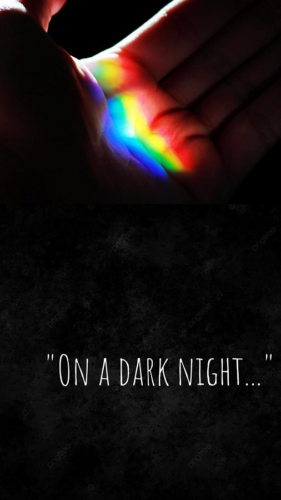
“On a Dark Night…” by Después De Zaqueo Menor illustrates the first line of the poem in a common English translation.
1. One dark night, fired with love’s urgent longings – ah, the sheer grace! – I went out unseen, my house being now all stilled.
2. In darkness, and secure, by the secret ladder, disguised, – ah, the sheer grace! – in darkness and concealment, my house being now all stilled.
3. On that glad night, in secret, for no one saw me, nor did I look at anything, with no other light or guide than the one that burned in my heart.
4. This guided me more surely than the light of noon to where he was awaiting me – him I knew so well – there in a place where no one appeared.
5. O guiding night! O night more lovely than the dawn! O night that has united the Lover with his beloved, transforming the beloved in her Lover.
6. Upon my flowering breast which I kept wholly for him alone, there he lay sleeping, and I caressing him there in a breeze from the fanning cedars.
7. When the breeze blew from the turret, as I parted his hair, it wounded my neck with its gentle hand, suspending all my senses.
8. I abandoned and forgot myself, laying my face on my Beloved; all things ceased; I went out from myself, leaving my cares forgotten among the lilies. From: THE COLLECTED WORKS OF ST. JOHN OF THE CROSS, translated by Kieran Kavanaugh, OCD, and Otilio Rodriguez, OCD, revised edition (1991). Copyright 1991 ICS Publications.
La noche oscura del alma
(original Spanish) por San Juan de la Cruz
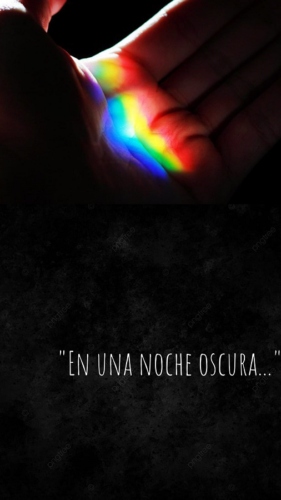
“En una noche oscura…” by Después De Zaqueo Menor illustrates the first line of the poem in the original Spanish.
1. En una noche oscura, con ansias, en amores inflamada, ¡oh dichosa ventura!, salí sin ser notada, estando ya mi casa sosegada;
2. a escuras y segura por la secreta escala, disfrazada, ¡oh dichosa ventura!, a escuras y encelada, estando ya mi casa sosegada;
3. en la noche dichosa, en secreto, que naide me veía ni yo miraba cisa, sin otra luz y guía sino la que en el corazón ardía.
4. Aquesta me guiaba más cierto que la luz del mediodía adonde me esperaba quien yo bien me sabía en parte donde naide parecía.
5. ¡Oh noche que guiaste! ¡oh noche amable más que la alborada!; ¡oh noche que juntaste, Amado con amada, amada en el Amado transformada!
6. En mi pecho florido, que entero para él solo se guardaba, allí quedó dormido, y yo le regalaba, y el ventalle de cedros aire daba.
7. El aire del almena, cuando yo sus cabellos esparcía, con su mano serena en mi cuello hería, y todos mis sentidos suspendía.
8. Quedéme y olvidéme, el rostro recliné sobre el Amado; cesó todo y dejéme, dejando mi cuidado entre las azucenas olvidado.
John of the Cross in poetry
John of the Cross inspired a poem in the “Queer Psalter,” a work-in-progress by Jim Wise, a queer poet based in Indiana. His poetry has been published widely, including in a previous post at Qspirit.net.
His poem “John of the Cross” combines sacred homoerotic longing for Christ with an affirmation of the holiness of gay love and sexuality. It is printed here in full:
John of the Cross
by Jim Wise
He was a true believer, but a Queer one. He wanted Christ as a lover or not at all.
No gentle antiseptic Jesus would do. He would settle for nothing less than flesh. A wafer was a tease. When he tasted Christ, he wanted to taste desert and sweat. When he prayed, he wanted to stink of heat and sand.
He wanted Christ, the Divine Top, to fill him up with God, and Christ, the Divine Bottom, a god begging to be filled up with our humanity. He wanted a Christ who would bind his hands with rosary beads before pushing him down to teach him the mystery of the Kingdom of Heaven.
Cruising was his act of pure devotion, for if God could be a Galilean peasant, God could be anyone.
He knew – To cry out a lover’s name is to scream the unknown hidden name of God.
___ Top image credit: “St. John of the Cross” by Brother Robert Lentz, OFM, trinitystores.com
___ This post is part of the LGBTQ Saints series by Kittredge Cherry. Traditional and alternative saints, people in the Bible, LGBTQ martyrs, authors, theologians, religious leaders, artists, deities and other figures of special interest to lesbian, gay, bisexual and transgender and queer (LGBTQ) people and our allies are covered.
This article was originally published on Q Spirit in December 2016, was expanded with new material over time, and was most recently updated on Dec. 14, 2023.
Kittredge Cherry is a lesbian Christian author who writes regularly about LGBTQ spirituality.She holds degrees in religion, journalism and art history.She was ordained by Metropolitan Community Churches and served as its national ecumenical officer, advocating for LGBTQ rights at the National Council of Churches and World Council of Churches.
There are moments in life when we are reminded that we are unfinished, that the story we have been telling ourselves about who we are and where our life leads is yet unwritten. Such moments come most readily at the beginning of something new.
To begin anything — a new practice, a new project, a new love — is to cast upon yourself a spell against stagnation. Beginnings are notation for the symphony of the possible in us. They ask us to break the pattern of our lives and reconfigure it afresh — something that can only be done with great courage and great tenderness, for no territory of life exposes both our power and our vulnerability more brightly than a beginning.
One of English artist Margaret C. Cook’s illustrations for a rare 1913 edition of Walt Whitman’s of Leaves of Grass. (Available as a print.)
He begins by telescoping into deep time, reminding us that we are but a small and new part of something ancient and immense — a vast totality that holds us in our incompleteness, in our existential loneliness, in the vulnerability of our self-creation:
There are days when Conamara is wreathed in blue Tuscan light. The mountains seem to waver as though they were huge dark ships on a distant voyage. I love to climb up into the silence of these vast autonomous structures. What seems like a pinnacled summit from beneath becomes a level plateau when you arrive there. Born in a red explosion of ascending fire, the granite lies cold, barely marked by the millions of years of rain and wind. On this primeval ground I feel I have entered into a pristine permanence, a continuity here that knew the wind hundreds of millions of years before a human face ever felt it.
When we arrive into the world, we enter this ancient sequence. All our beginnings happen within this continuity. Beginnings often frighten us because they seem like lonely voyages into the unknown. Yet, in truth, no beginning is empty or isolated. We seem to think that beginning is setting out from a lonely point along some line of direction into the unknown. This is not the case. Shelter and energy come alive when a beginning is embraced… We are never as alone in our beginnings as it might seem at the time. A beginning is ultimately an invitation to open toward the gifts and growth that are stored up for us. To refuse to begin can be an act of great self-neglect.
[…]
Our very life here depends directly on continuous acts of beginning.
Wanderer above the Sea of Fog (Der Wanderer über dem Nebelmeer) by Caspar David Friedrich, circa 1817. (Available as a print and as stationery cards.)
Perhaps the art of harvesting the secret riches of our lives is best achieved when we place profound trust in the act of beginning. Risk might be our greatest ally. To live a truly creative life, we always need to cast a critical look at where we presently are, attempting always to discern where we have become stagnant and where new beginning might be ripening. There can be no growth if we do not remain open and vulnerable to what is new and different. I have never seen anyone take a risk for growth that was not rewarded a thousand times over.
And yet we are homeostasis machines, our very organism oriented toward maintaining the status quo of comfort and predictability, which every beginning inevitably disrupts with its fulcrum of change and its brunt of uncertainty. O’Donohue considers what it takes to override our creaturely reflex for habituation:
Sometimes the greatest challenge is to actually begin; there is something deep in us that conspires with what wants to remain within safe boundaries and stay the same… Sometimes a period of preparation is necessary, where the idea of the beginning can gestate and refine itself; yet quite often we unnecessarily postpone and equivocate when we should simply take the risk and leap into a new beginning.
He renders the vulnerability and redemption of that leap in a poem — a kind of self-blessing to consecrate the courage of beginning:
FOR A NEW BEGINNING by John O’Donohue
In out-of-the-way places of the heart, Where your thoughts never think to wander, This beginning has been quietly forming, Waiting until you were ready to emerge.
For a long time it has watched your desire, Feeling the emptiness growing inside you, Noticing how you willed yourself on, Still unable to leave what you had outgrown.
It watched you play with the seduction of safety And the gray promises that sameness whispered, Heard the waves of turmoil rise and relent, Wondered would you always live like this.
Then the delight, when your courage kindled, And out you stepped onto new ground, Your eyes young again with energy and dream, A path of plenitude opening before you.
Though your destination is not yet clear You can trust the promise of this opening; Unfurl yourself into the grace of beginning That is at one with your life’s desire.
Awaken your spirit to adventure; Hold nothing back, learn to find ease in risk; Soon you will be home in a new rhythm, For your soul senses the world that awaits you.
Art by Sophie Blackall from Things to Look Forward to — an illustrated celebration of living with presence in uncertain times.
Sometimes — in fact, often — beginnings are tucked into endings. In consonance with his philosopher-poet friend David Whyte’s poignant reflection on ending love and beginning love, O’Donohue writes:
Often when something is ending we discover within it the spore of new beginning, and a whole new train of possibility is in motion before we even realize it. When the heart is ready for a fresh beginning, unforeseen things can emerge. And in a sense, this is exactly what a beginning does. It is an opening for surprises. Surrounding the intention and the act of beginning, there are always exciting possibilities.
Paying attention to those portals of possibility is both an act of self-respect and a reverence of life:
Part of the art of living wisely is to learn to recognize and attend to such profound openings in one’s life.
Essentia Foun • Dec 31, 2023 Our brains do not produce consciousness, they ‘filter’ it and consciousness is related to the higher dimensions in string theory. In this thought provoking conversation, distinguished Professor of mathematics and astronomy Bernard Carr explains his theory of consciousness and psi-phenomena. 00:00 Introduction 05:02 How did you get involved with parapsychology? 09:41 Bernard on trying to weigh a soul… 13:50 Is psychical research science? 16:03 The Enfield poltergeist claim 25:59 Are Psi phenomena real? 26:58 On the importance of true skepticism 28:55 Where are we in studying these phenomena scientifically? 34:44 Is having a scientific background a hindrance or a help when it comes to studying these phenomena? 38:55 In what sense are most scientists not ‘believing’ the phenomena? 43:54 On a post materialist science 44:38 How does your notion of time relate to psi phenomena? 53:16 What is the relationship between time and consciousness? 1:01:10 Is time real? 1:04:20 What is the specious presence? 1:06:38 You might argue planet earth is conscious 1:09:16 On the experience of time when falling 1:11:56 When the specious present seems to expand 1:15:51 How does the concept of the specious present explain certain psychic phenomena? 1:19:11 Natalia on the slowing down of time when falling off a mountain 1:23:17 Bernard on the movies Inception and Interstellar 1:24:44 Is time just a dial on our dashboard of perception? 1:27:25 When you either experience an eternal now or an eternal always… 1:28:00 On experiencing the transcendence of space and time 1:30:07 How do you interact with the world when you are in a different specious present? 1:32:53 How athletes are successful due to a specious present that is slowed down 1:33:58 What if our specious present is expanding? 1:37:02 Bernards view on the fine tuning problem 1:41:11 On the multiverse 1:42:47 Is there something before the Big Bang? 1:47:34 Hawking’s theory about the origin of time 1:50:59 There must be a genesis of the universe right? 1:52:06 God and the Big Bang 1:54:44 What is consciousness to you? 1:57:12 Are there actually ‘laws’ of physics? 2:01:32 Is a final theory possible? 2:05:08 How to fit consciousness -per definition the first person experience- into science which is about the third person experience? 2:11:16 How to make a new physics that accommodates consciousness testable?
J.W. Dunne (1866-1949) was an accomplished English aeronautical engineer and a designer of Britian’s early military aircraft. His An Experiment with Time, first published in 1927, sparked a great deal of scientific interest in–and controversy about–his new model of multidimensional time.
A series of strange, troubling precognitive dreams (including a vision of the then future catastrophic eruption of Mt. Pelee on the island of Martininque in 1902) led Dunne to re-evaluate the meaning and significance of dreams. Could dreams be a blend of memories of past and future events? What was most upsetting about his dreams was that they contradicted the accepted model of time as a series of events flowing only one way: into the future. What if time wasn’t like that at all?
All of this prompted Dunne to think about time in an entirely new way. To do this, Dunne made, as he put it,”an extremely cautious” investigation in a “rather novel direction.” He wanted to outline a provable way of accounting for multiple dimensions and precognition, that is, seeing events before they happen. The result was a challenging scientific theory of the “Infinite Regress,” in which time, consciousness, and the universe are seen as serial, existing in four dimensions.
Astonishingly, Dunne’s proposed model of time accounts for many of life’s mysteries: the nature and purpose of dreams, how prophecy works, the immortality of the soul, and the existence of the all-seeing “general observer,” the “Witness” behind consciousness (what is now commonly called the Higher Self).
Here in print again is the book English playwright and novelist J.B. Priestley called “one of the most fascinating, most curious, and perhaps the most important books of this age.”
(Goodreads.com)
Consciousness, sexuality, androgyny, futurism, space, the arts, science, astrology, democracy, humor, books, movies and more










 There are days when Conamara is wreathed in blue Tuscan light. The mountains seem to waver as though they were huge dark ships on a distant voyage. I love to climb up into the silence of these vast autonomous structures. What seems like a pinnacled summit from beneath becomes a level plateau when you arrive there. Born in a red explosion of ascending fire, the granite lies cold, barely marked by the millions of years of rain and wind. On this primeval ground I feel I have entered into a pristine permanence, a continuity here that knew the wind hundreds of millions of years before a human face ever felt it.


