

Gospel of Thomas on self-observation

5. Jesus said, “Know what is in front of your face, and what is hidden from you will be disclosed to you.
For there is nothing hidden that will not be revealed. [And there is nothing buried that will not be raised.]”
–Gospel of Thomas, logion 5
(marquette.edu/maqom/Gospel%20of%20Thomas%20Lambdin.pdf)
The Gospel of Thomas is an extra-canonical sayings gospel. It was discovered near Nag Hammadi, Egypt, in December 1945 among a group of books known as the Nag Hammadi library. Scholars speculate that the works were buried in response to a letter from Bishop Athanasius declaring a strict canon of Christian scripture. Wikipedia
What’s your leadership language?
Rosita Najmi | TEDWomen 2023
• October 2023
In a globe-trotting career that has spanned corporations, governments, nonprofits and philanthropy, Rosita Najmi has often found herself translating among them. Instead of focusing on leadership style, she makes the case for becoming fluent in the languages of leadership, explaining how it can help you adapt to audiences across industries and collectively achieve your goals.
About the speaker
Global development economistSee speaker profile
Rosita Najmi helps companies drive equitable social, environmental and economic development.
Weekly Invitational Translation
Translation is a 5-step process of “straight thinking in the abstract.” The first step is an ontological statement of being beginning with the syllogism: “Truth is that which is so. That which is not truth is not so. Therefore Truth is all there is.” The second step is the sense testimony (what the senses tell us about anything). The third step is the argument between the absolute abstract nature of truth from the first step and the relative specific truth of experience from the second step. The fourth step is filtering out the conclusions you have arrived at in the third step. The fifth step is your overall conclusion.
The claims in a Translation may seem outrageous, but they are always (or should always) be based on self-evident syllogistic reasoning. Here is one Translation from this week.
!) Truth is that which is so. That which is not truth is not so. Therefore Truth is all that is. Truth being all is therefore total, therefore whole, therefore complete, therefore one, therefore otherless, therefore limitless, therefore infinite. I think therefore I am. Since I am and since Truth is all that is, therefore I am Truth. I, being Truth, must have all the attributes of Truth. Therefore I, being, am total, whole, complete, one, otherless, limitless, infinite. Since I am Truth and I am mind, therefore Truth is Mind (Consciousness)
2) The world is an illusion.
War is an illusion.
AI is an illusion.
Word-tracking:
illusion: wrongly perceived
world: planet
planet: wanderer
Earth: only planet in the Universe known to support life
war: confusion, strife, dispute over limited land, limited grandeur, limited authority
AI: intelligence, ability to chooses between
land: property, proper, true
3) Truth being Mind (Consciousness) and Truth being all that is, there is no ability to perceive wrongly, therefore perceiving rightly/truthfully is the only option. If Truth were less than all, it would be limited. Truth being limitless and wars being fought over perceived limits to land, grandeur or authority, therefore Truth is the harmonious realization of limitless land, limitless grandeur and limitless authority of Truth. Since intelligence is the ability to choose between many options, and since Truth is the only option, therefore Truth is not intelligence, Truth is Knowing. Since the Earth in finite and Truth is infinite, therefore either the Earth does not exist OR the Earth is infinite.
4) Perceiving rightly/truthfully is the only option.
Truth is the harmonious realization of limitless land, limitless grandeur and limitless authority of Truth.
Truth is not intelligence, Truth is Knowing.
Either the Earth does not exist OR the Earth is infinite.
5) Truth is Knowing the limitless property, grandeur and authority of an infinite Heaven (Consciousness) and an infinite Earth (Perception).
For information about Translation or other Prosperos classes go to: https://www.theprosperos.org/teaching
Oklahoma 13-year-old becomes first person to beat Tetris
Guardian News Jan 3, 2024 OKLAHOMA Willis Gibson is believed to be the first person ever to beat Tetris since the game’s release more than three decades ago. “Oh my God! Yes! I’m going to pass out. I can’t feel my hands,” he said as the game freezed. Subscribe to Guardian News on YouTube ► http://bit.ly/guardianwiressub
(Suggested by William P. Chiles)
Tarot Card for January 5: Prince of Disks

| The Prince of Disks The man represented by the Prince of Disks is a quiet and meditative man, who works with unfailing determination towards the goals he sets himself. He is reliable and resourceful, unswerving and creative in his dedication.He is more imaginative than the Knight of Disks, though he has the same quiet strength and gentleness. His quality of contemplation often yields fruit in surprising ways, generating a deep and broad-sweeping understanding about the inner workings of life.If he is ill-dignified, the Prince of Disks can become stubborn and short-sighted – even bloody-minded in his attitudes. Faithful and loyal himself, he will not tolerate faithlessness in others. Neither will he accept lack of integrity, nor dishonesty.He is hard-working, trustworthy and inventive, often producing unusual yet practical solutions which resolve otherwise intractable problems. As a friend he is non-judgemental and supportive, though capable of shedding new perspectives on situations. He’s generally a good listener, though he has little patience with histrionics and manipulation.His approach to life overall is one of industrious practicality. He believes that all things yield to a determined will and well-directed activity.Though emotionally he at first gives the impression that he is solid and perhaps even a little unimaginative, when his feelings are roused, he can be deeply passionate and sensual.He rarely comes up to indicate a change of mood in a person, though sometimes he will appear to indicate some-one learning to take responsibility in everyday life. |
Knowing J. Krishnamurti’s Source of Wisdom Can Transform Your Life
No virtue touched it, for it was beyond all the virtues and sanctions of man.

Published in Change Your Mind Change Your Life
Oct 1, 2023 (Medium.com)
I have been into JK’s teachings for 20 years. When I first saw the audio cassette, The Meaning of Life, on a book shelf, I instinctively picked it up. Going through it is a thought revolution.
Instead of trying to give meaning to life, which is a primeval question for all thinkers, he tried to put together an investigation into the nature of the mind that asks this question. A mind that is bored and leads a mechanical life can ask this question.
A mind that is fresh and alive is always vibrant in the present moment. Such a mind that renews itself will never seek answers.
He was a true iconoclast who would tear down institutions and gurus who promised a route to salvation. Including himslef.
The sheer integrity of the man was all around him. The ones who attended his talks vouch for it.
The Opening
Certain aspects of JK’s teaching are paradoxical. You can’t reach the ultimate understanding of life through efforts and choices. So one wonders if listening to and following his teaching is a result of choice and effort.
And if one is not to do anything and just waits for the truth to descend, then it’s even more difficult to assimilate as an understanding.
He tells us that you are confused because you are lost in the maze of words, and words are not the thing—the word water is not the water.
It’s difficult to patch his philosophy without a real understanding of the source of his wisdom. He never quoted any text, religious or non-religious, to drive home his point.
JK never wrote a book. His talks and discussions were transcribed into books with minimal editing.
A few weeks ago, I was listening to Eckart Tolle talk about Jiddu Krishnamurti and how he inspired him. He mentioned a book that JK wrote.
The Krishnamurti Notebook
In 1961–62, JK shared his personal experience, which he never talked about in public. In 1976, with his permission, the manuscript was published.
He refused to talk about his extra-sensory experiences. He said that if I talk more about it, you will try to put it into a formula for others to follow. You will make the taste of this experience your destination and remain caught in it.
Every day, benediction and a wordless calm would descend on him. He writes of waking up to a pain in his spine and head, and that pain remained with him for most of his life. He calls this pain the process.
There was, this morning, that peculiar sacredness filling the room. It had great penetrating power, entering into every corner of one’s being, filling, cleansing, and making everything of itself. The others felt it too. It is the thing every human being craves, and because they craved it, it eluded them.
The monk, the priest, and the sannyasi torture their bodies and their characters in their longing for this, but it evades them, for it cannot be bought; neither sacrifice, virtue nor prayer can bring this love. This life, this lovecannot be if death is the means. All seeking, all asking must wholly erase. — Excerpt from the book, P-21
In one place, he writes that he could remember this with some difficulty. The mechanical recording of the brain goes on, but the experience is not of the mind.
There is no seeking of continuity in bliss. In every seeking lies the desire—the longing for continuity. One form of desire is not better than the other.
A desire for heaven is not different from that of money and fame.
Early this morning, there was a benediction that seemed to cover the earth and fill the room. With it comes all-consuming quietness, a stillness that seems to have within it all movement.
His point of view is very unique. We are trained to find solutions at action points, and he refuses to provide that. His work leads us to the source of intelligence, which is the beginning of all creation.
In the pursuit of ambition and societal pressures, we have lost it. The wellspring of his words comes from his personal encounters with that energy field. In that field, there is the answer to all questions; rather, there are no questions.
Mere knowledge, however deep and wide, does not necessarily indicate intelligence. Capacity is not intelligence. Intelligence is a sensitive awareness of the quality of life—life with its problems and contradictions, miseries and joys. To be aware of all this without choice, without being caught by any one of its issues, and to flow with the whole of life is intelligence.
In one of his Q&A sessions, someone asked,
What will you do if a dictator attacks you? Should you fight him or submit to his authority? The question was asked in relation to his talk on violence, war, and conformity.
If JK says, fight the dictator—it is a form of violence. If he says to submit to his authority, it is conformity; both are antithetical to his teachings.
Instead of choosing binary, he answered, If you have a mind that is unencumbered by the burden of past experiences, you will know then what is the right action.
He was asked, When you don’t learn, how would you grow?
Therein, he differentiates between skill learning and psychological learning. Remembering the skill or cataloging the experience is always important and must be done.
Let’s say I want to learn to drive. So, the art of changing gears, memorizing the right turns, learning signage, and all that is necessary, but remembering your lack of progress or projecting possible failures into the future is psychological memory.
Observing the content of one’s mind is the emptying of it. When one is fully aware of his fears, he gets free from them. Nothing needs to be done.
For JK, it was natural. He called himself a biological freak.
Going through this book is an up-close and personal realization of the very source of his work. And that when you live in consonance with that energy field, you do all the work without ever feeling the load of it.
That is being in a state of love.

Written by Abhishek
·Writer for Change Your Mind Change Your Life
It took me some time to believe I could write stories. I’m a blank slate every morning. https://medium.com/@abhishek1811/m
Book: “The Rise and Fall of the Third Reich: A History of Nazi Germany”
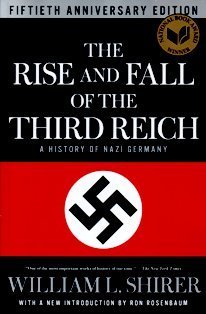
The Rise and Fall of the Third Reich: A History of Nazi Germany
William L. Shirer
Hitler boasted that The Third Reich would last a thousand years. It lasted only 12. But those 12 years contained some of the most catastrophic events Western civilization has ever known.
No other powerful empire ever bequeathed such mountains of evidence about its birth and destruction as the Third Reich. When the bitter war was over, and before the Nazis could destroy their files, the Allied demand for unconditional surrender produced an almost hour-by-hour record of the nightmare empire built by Adolph Hitler. This record included the testimony of Nazi leaders and of concentration camp inmates, the diaries of officials, transcripts of secret conferences, army orders, private letters—all the vast paperwork behind Hitler’s drive to conquer the world.
The famed foreign correspondent and historian William L. Shirer, who had watched and reported on the Nazis since 1925, spent five and a half years sifting through this massive documentation. The result is a monumental study that has been widely acclaimed as the definitive record of one of the most frightening chapters in the history of mankind.
This worldwide bestseller has been acclaimed as the definitive book on Nazi Germany; it is a classic work.
The accounts of how the United States got involved and how Hitler used Mussolini and Japan are astonishing, and the coverage of the war-from Germany’s early successes to her eventual defeat-is must reading
(Goodreads.com)
Free Will Astrology: Week of January 4, 2024
BY ROB BREZSNY | JANUARY 2, 2024

Jason Leung
ARIES (March 21-April 19): The plan I will propose in this horoscope is for temporary use. I’m not recommending you stick to it for all of 2024, but just for the next fifteen to eighteen days. If you do, I believe it will set you up for beautiful success in the coming months. Here’s my idea: Embark on a free-form extravaganza of playing and having fun. Just for now, set aside your ambition. Don’t worry about improving yourself and producing results. Simply enjoy a phase of suspending inhibitions, creatively messing around, having nothing to prove, and being motivated by the quest for joy.
TAURUS (April 20-May 20): Climate change is impacting rainbows. Rising temperatures and dryer conditions mean that some parts of the world will get fewer rainbows, and other areas will get more. Canada and Siberia will benefit, while the Mediterranean will be less well-endowed with sky-borne arcs of color that come from sunlit rain. But I predict that no matter where you live, the rainbow will be a potent and regular symbol for you Bulls in 2024—more than ever before. That means you will have increased reasons to entertain hope and more power to find beauty. On occasion, there may even be very good luck at the metaphorical rainbow’s end. If you’re an LGBTQIA2S+ Taurus, be on high alert for breakthroughs in your ability to get the appreciation you deserve.
GEMINI (May 21-June 20): As one of your inspirational stories for 2024, I offer this tale from singer-songwriter Tom Waits: “Once upon a time, there was a crooked tree and a straight tree. They grew next to each other. Every day, the straight tree would look at the crooked tree and say, ‘You’re crooked. You’ve always been crooked, and you’ll continue to be crooked. But look at me! I’m tall, and I’m straight.’ Then one day, lumberjacks came to the forest and looked around. The manager in charge said, ‘Cut all the straight trees.’ And that crooked tree is still there to this day, growing strong and growing strange.” (PS: Here’s more from Gemini writer Ralph Waldo Emerson: “Be true to your own act, and congratulate yourself if you have done something strange and extravagant.”)
CANCER (June 21-July 22): Japanese artist Hokusai (1760-1849) developed a fascination for his country’s iconic Mount Fuji. In his seventies, he produced a series of woodblock prints titled “Thirty-Six Views of Mount Fuji.” Later, he added three books of prints collectively called “One Hundred Views of Mount Fuji.” Some art historians say his obsession stemmed from the legend that the mountain was home to the secret of immortality. The coming year will be a fine time for you Cancerians to celebrate and concentrate on your own Mount Fuji-like passion. Sometime soon, identify what it is, and start making plans to commune with it intensely.
LEO (July 23-Aug. 22): If you will ever in your life go viral—that is, create or do something that suddenly becomes widely known and influential—I bet it will be in 2024. Even if you don’t produce TikTok videos seen by ten million people, you are at least likely to become more visible in your local community or field of endeavor. Of course, I would prefer that your fame and clout spread because of the good deeds you do, not the weird deeds. So I urge you to cultivate high integrity and a wildly generous spirit in the coming months. Be a role model who inspires and uplifts.
VIRGO (Aug. 23-Sept. 22): I expect 2024 to be a free-spirited, wide-ranging, big-vision type of year for you, dear Virgo. I predict you will feel an abundance of urges to travel, roam and explore. You will be more excited than anxious about the prospect of leaving your comfort zone, and you will have a special fondness for getting your mind expanded by interesting encounters. That doesn’t mean you will avoid all awkwardness and confusion. Some of that stuff will happen, though it will usually evolve into educational adventures. And the extra good news is that wandering out in nature will provide even more inspiration and healing than usual. Treasure this quote from conservationist Rachel Carson: “Those who contemplate the beauty of the earth find reserves of strength that will endure: the migration of the birds, the ebb and flow of the tides, the folded bud ready for the spring.”
LIBRA (Sept. 23-Oct. 22): I am pleased to inform you that a visit to hell will not be on your itinerary in 2024. You may be invited to take a few excursions into the realm that depth psychologists call the underworld, but that’s a good thing. There you will be able to hunt for treasures that have been hidden and uncover secrets that will illuminate your epic, months-long quest for wholeness. It may sometimes be dark and shadowy down there below, but almost always dark and shadowy in ways that will lead you to healing. (I will reiterate what I implied above: The underworld is NOT hell.)
SCORPIO (Oct. 23-Nov. 21): I hope that working hard on togetherness will be a fun project for you in the coming months. To do it well, you must outgrow some habitual ways of doing friendship and intimacy. You will have to be imaginative and ingenious. Are you willing to believe that you do not yet know all there is to know about being a fantastic ally and partner? Are you ready to approach the arts of collaboration and cooperation as if enhancing your skills is the most important thing you can do? For the sake of your best selfish goals, be a brilliant teammate in 2024.
SAGITTARIUS (Nov. 22-Dec. 21): Each of us is a complex, kaleidoscopic work of art, whether or not we consciously approach our destiny in that spirit. Every day, we use our creative imagination to craft new elements of the masterpiece known as the story of our life. Leos come by this fun project naturally, but you Sagittarians also have great potential to embrace it with glee and panache. I trust you will be especially keen on enjoying this sacred work in 2024. And right now, today and in the coming weeks, will be an excellent time to ramp up the scintillating drama.
CAPRICORN (Dec. 22-Jan. 19): “I am against sex education in schools because sex is more fun when it’s dirty and sinful.” So said Capricorn author Florence King. I reject and rebel against that perverse declaration—and encourage you to disavow it, too, in 2024. In my astrological opinion, the coming months will be a favorable time to learn everything about sex and eros that you don’t already know. I hope you will dive deep as you gather a rich array of teachings about how to enjoy the art of making love more than ever before. (Consider consulting tantric manuals like Margot Anand’s “The Art of Sexual Magic: Cultivating Sexual Energy to Transform Your Life.”)
AQUARIUS (Jan. 20-Feb. 18): Singer-songwriter Tori Amos says she’s sure she was burned for being a witch in a previous lifetime. I suspect most of us had past incarnations in which we were punished simply for being our beautiful selves. I bring this up, Aquarius, because I think 2024 will be a favorable time to get some healing from any ancient hurt like that. You will have a series of experiences that could help you recover from the illusion that being faithful to your truth is somehow wrong. Life will conspire with you to help you reclaim more of the full audacity to be your gorgeous, genuine self.
PISCES (Feb. 19-March 20): I believe 2024 will be one of the best years ever for your education. Your willingness and eagerness to learn will be at a peak. Your knack for attracting inspirational teachers will be excellent. It’s likely you will be exceptionally curious and open to good influences. My advice is to be alert for lessons not just from obvious sources of wisdom and revelation, but also from unexpected founts. Don’t be too sure you know where revelations and illumination might come from.
Homework: Make three predictions about your life in 2024. Newsletter.FreeWillAstrology.com
Elevating Resolutions for the New Year Inspired by Some of Humanity’s Greatest Minds
By Maria Popova (themarginalian.org)

What if we could augment the bucket-list of typical New Year’s resolutions, dominated by bodily habits and pragmatic daily practices, with higher-order aspirations — habits of mind and spiritual orientations borrowed from some of humanity’s most timelessly rewarding thinkers? After last year’s selection of worthy resolutions inspired by such luminaries as Seneca, Maya Angelou, Bruce Lee, and Virginia Woolf, here is another set for the new year borrowed from a new roster of perennially elevating minds.
| 1. ADRIENNE RICH: CULTIVATE HONORABLE RELATIONSHIPS |

One of the most influential poets of the twentieth century and a woman of unflinching conviction, Adrienne Rich (May 16, 1929–March 27, 2012) became the first and to date only person to decline the National Medal of Arts in protest against the growing monopoly of power and the government’s proposed plan to end funding for the National Endowment for the Arts. Although her poetry collection The Dream of a Common Language is a cultural cornerstone and required reading for every thinking, feeling human being, her lesser-known collected prose, published as On Lies, Secrets, and Silence (public library), pours forth Rich’s most direct insight into the political, philosophical, and personal dimensions of human life.
In it, she writes:
An honorable human relationship — that is, one in which two people have the right to use the word “love” — is a process, delicate, violent, often terrifying to both persons involved, a process of refining the truths they can tell each other.
It is important to do this because it breaks down human self-delusion and isolation.
It is important to do this because in doing so we do justice to our own complexity.
It is important to do this because we can count on so few people to go that hard way with us.
| 2. SØREN KIERKEGAARD: RESIST ABSENTMINDED BUSYNESS |

Søren Kierkegaard (May 5, 1813–November 11, 1855), considered the first true existentialist philosopher, remains a source of enduring wisdom on everything from the psychology of bullying to the vital role of boredom to why we conform. In a chapter of the altogether indispensable 1843 treatise Either/Or: A Fragment of Life (public library), thirty-year-old Kierkegaard writes:
In a latter chapter, titled “The Unhappiest Man,” he considers how we grow unhappy by fleeing from presence and busying ourselves with the constant pursuit of some as-yet unattained external goal:
[…]
The unhappy one is absent… It is only the person who is present to himself that is happy.
| 3. RAINER MARIA RILKE: LIVE THE QUESTIONS |

In 1902, Rainer Maria Rilke (December 4, 1875–December 29, 1926) began corresponding with a 19-year-old cadet and budding poet named Franz Xaver Kappus. Later published as Letters to a Young Poet (public library), Rilke’s missives address such enduring questions as what it really means to love, how great sadnesses bring us closer to ourselves, and what reading does for the human spirit.
In one of the most potent letters, he writes:
| 4. SUSAN SONTAG: PAY ATTENTION TO THE WORLD |

In a terrific 1992 lecture, Susan Sontag (January 16, 1933–December 28, 2004) asserted that “a writer is someone who pays attention to the world — a writer is a professional observer.” But this observant attentiveness to the world, Sontag believed, is as vital to being a good writer as it is to being a good human being — something she addresses in one of the many rewarding pieces collected in the posthumous anthology At the Same Time: Essays and Speeches (public library), which also gave us Sontag on beauty vs. interestingness, courage and resistance, and literature and freedom.
Reflecting on a question she is frequently asked — to distill her essential advice on writing — Sontag offers:
Needless to say, no sooner had these perky phrases fallen out of my mouth than I thought of some more recipes for writer’s virtue.
For instance: “Be serious.” By which I meant: Never be cynical. And which doesn’t preclude being funny.
But these tenets of storytelling, Sontag argues, aren’t just writerly virtues — they are a framework for human virtues:
To be a moral human being is to pay, be obliged to pay, certain kinds of attention.
When we make moral judgments, we are not just saying that this is better than that. Even more fundamentally, we are saying that this is more important than that. It is to order the overwhelming spread and simultaneity of everything, at the price of ignoring or turning our backs on most of what is happening in the world.
The nature of moral judgments depends on our capacity for paying attention — a capacity that, inevitably, has its limits but whose limits can be stretched.
But perhaps the beginning of wisdom, and humility, is to acknowledge, and bow one’s head, before the thought, the devastating thought, of the simultaneity of everything, and the incapacity of our moral understanding — which is also the understanding of the novelist — to take this in.
| 5. BERTRAND RUSSELL: MAKE ROOM FOR “FRUITFUL MONOTONY” |

Many of humanity’s greatest minds have advocated for the vitalizing role of not-doing in having a full life, but none more compellingly than British philosopher Bertrand Russell (May 18, 1872–February 2, 1970) in his 1930 masterwork The Conquest of Happiness (public library) — an effort “to suggest a cure for the ordinary day-to-day unhappiness from which most people in civilized countries suffer,” and a timelessly insightful lens on what “the good life” really means.
In a chapter titled “Boredom and Excitement,” Russell teases apart the paradoxical question of why, given how central it is to our wholeness, we dread boredom as much as we do. Long before our present anxieties about how the age of distraction and productivity is thwarting our capacity for presence, he writes:
[…]
As we rise in the social scale the pursuit of excitement becomes more and more intense.
Many decades before our present concerns about screen time, he urges parents to allow children the freedom to experience “fruitful monotony,” which invites inventiveness and imaginative play — in other words, the great childhood joy and developmental achievement of learning to “do nothing with nobody all alone by yourself.” He writes:
I do not mean that monotony has any merits of its own; I mean only that certain good things are not possible except where there is a certain degree of monotony… A generation that cannot endure boredom will be a generation of little men, of men unduly divorced from the slow processes of nature, of men in whom every vital impulse slowly withers, as though they were cut flowers in a vase.
| 6. URSULA K. LE GUIN: REFUSE TO PLAY THE PERFECTION GAME |

Perfectionism is our most compulsive way of keeping ourselves small, a kind of psychoemotional contortionism that gives the illusion of reaching for greatness while constricting us into increasingly suffocating smallness. That’s what Ursula K. Le Guin (b. October 21, 1929) explores in a wonderful 1992 essay titled “Dogs, Cats, and Dancers: Thoughts about Beauty,” found in the altogether spectacular volume The Wave in the Mind: Talks and Essays on the Writer, the Reader, and the Imagination (public library) — the source of Le Guin’s wisdom on the cultural baggage of gender, the magic of real human conversation, and the sacredness of public libraries.
Reflecting on various cultures’ impossible and often punishing ideals of human beauty, “especially of female beauty,” Le Guin writes:
[…]
I think of when I was in high school in the 1940s: the white girls got their hair crinkled up by chemicals and heat so it would curl, and the black girls got their hair mashed flat by chemicals and heat so it wouldn’t curl. Home perms hadn’t been invented yet, and a lot of kids couldn’t afford these expensive treatments, so they were wretched because they couldn’t follow the rules, the rules of beauty.
Beauty always has rules. It’s a game. I resent the beauty game when I see it controlled by people who grab fortunes from it and don’t care who they hurt. I hate it when I see it making people so self-dissatisfied that they starve and deform and poison themselves. Most of the time I just play the game myself in a very small way, buying a new lipstick, feeling happy about a pretty new silk shirt.
[…]
There’s the ideal beauty of youth and health, which never really changes, and is always true. There’s the ideal beauty of movie stars and advertising models, the beauty-game ideal, which changes its rules all the time and from place to place, and is never entirely true. And there’s an ideal beauty that is harder to define or understand, because it occurs not just in the body but where the body and the spirit meet and define each other.
And yet for all the ideals we impose on our bodies, Le Guin argues in her most poignant but, strangely, most liberating point, it is death that ultimately illuminates the full spectrum of our beauty — death, the ultimate equalizer of time and space; death, the great clarifier that makes us see that, as Rebecca Goldstein put it, “a person whom one loves is a world, just as one knows oneself to be a world.”
With this long-view lens, Le Guin remembers her own mother and the many dimensions of her beauty:
That must be what the great artists see and paint. That must be why the tired, aged faces in Rembrandt’s portraits give us such delight: they show us beauty not skin-deep but life-deep.
More here.
| 7. ERICH FROMM: MASTER THE ART OF LOVING |

Our cultural mythology depicts love as something that happens to us — something we fall into, something that strikes us arrow-like, in which we are so passive as to be either lucky or unlucky. Such framing obscures the fact that loving — the practice of love — is a skill attained through the same deliberate effort as any other pursuit of human excellence.
Long before the Zen sage Thich Nhat Hahn admonished that “to love without knowing how to love wounds the person we love,” the great German social psychologist, psychoanalyst, and philosopher Erich Fromm (March 23, 1900–March 18, 1980) addressed this neglected skillfulness aspect of love in his 1956 classic The Art of Loving (public library) — a case for love as a skill to be honed the way artists apprentice themselves to the work on the way to mastery, demanding of its practitioner both knowledge and effort.
Fromm writes:
[…]
There is hardly any activity, any enterprise, which is started with such tremendous hopes and expectations, and yet, which fails so regularly, as love.
The only way to abate this track record of failure, Fromm argues, is to examine the underlying reasons for the disconnect between our beliefs about love and its actual machinery — which must include a recognition of love as an informed practice rather than an unmerited grace:
More here.
| 8. ANNE TRUITT: CHOOSE UNDERSTANDING OVER JUDGMENT |

Perhaps because she was formally trained as a psychologist, artist Anne Truitt (March 16, 1921–December 23, 2004) possessed exceptional powers of introspection and self-awareness coupled with an artist’s penchant for patient observation. This made her diary, eventually published as Daybook: The Journal of an Artist (public library), a true masterwork of psychological insight.
In one particularly poignant entry, she considers how our preconceptions and our ready-made judgments are keeping us from truly seeing one another, erecting a perilous barrier to love:
More here.
| 9. SIMONE WEIL: MAKE USE OF YOUR SUFFERING |
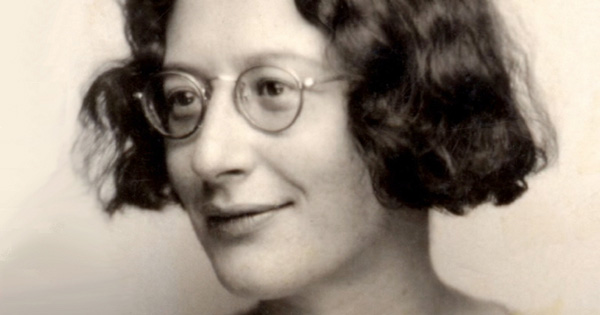
Long before scientists had empirical evidence of the astounding ways in which our minds affect our bodies, French philosopher and political activist Simone Weil (February 3, 1909–August 24, 1943) — a thinker of unparalleled intellectual elegance and a sort of modern saint whom Albert Camus described as “the only great spirit of our times” — examined the delicate relationship between our physical and spiritual suffering, between the anguish of the material body and that of the soul.
A few months before her painful yet stoic death from tuberculosis — despite her diagnosis and her doctor’s explicit orders to eat heartily, Weil consumed only what was rationed to her compatriots under the German Occupation in a remarkable gesture of solidarity, ultimately resulting in fatal malnutrition — she turned to the problem of pain in First and Last Notebooks (public library). In an entry from late 1942, Weil considers how our instinctive reaction to suffering often only amplifies our pain:
Weil extends this philosophy beyond physical pain and into other forms of bodily and spiritual discomfort that we habitually exacerbate by stiffening with resistance to the unpleasantness:
To make use in this way of the sufferings that chance inflicts upon us is better than inflicting discipline upon oneself.
| 10. JAMES BALDWIN: TELL THE WORLD HOW TO TREAT YOU |

One August evening in 1970, James Baldwin (August 2, 1924–December 1, 1987) and Margaret Mead (December 16, 1901–November 15, 1978) sat together on a stage in New York City for a remarkable public conversation. They talked for seven and a half hours over the course of the weekend, tackling such enduring concerns as power and privilege, race and gender, beauty, religion, justice, and the relationship between the intellect and the imagination. The transcript was eventually published as A Rap on Race (public library) — a testament to both how far we’ve come and how far we have yet to go, exploring such timeless and timely questions as changing one’s destiny, the crucial difference between guilt and responsibility, and reimagining democracy for a post-consumerist culture.
In a portion of the conversation examining race, identity, and the immigrant experience, Baldwin observes:
He offers an autobiographical example:
Now, how in the world am I going to explain to him that there is virtually no way for me to have found out where I came from in Africa? So it is a kind of tug of war. The black American is looked down on by other dark people as being an object abjectly used. They envy him on the one hand, but on the other hand they also would like to look down on him as having struck a despicable bargain.
But identity, Baldwin argues, isn’t something we are born with — rather, it is something we claim for ourselves, then must assert willfully to the world:
More here.
| 11. JOHN STEINBECK: USE DISCIPLINE TO CATALYZE CREATIVE MAGIC |
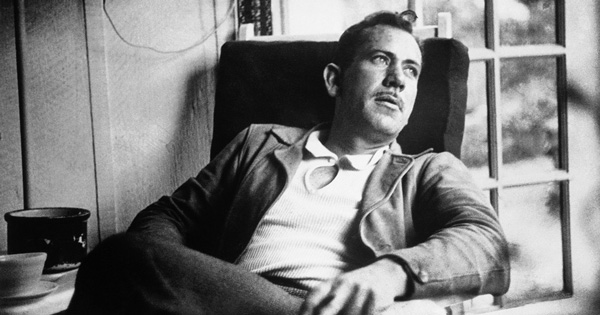
Many celebrated writers have championed the creative benefits of keeping a diary, but no one has put the diary to more impressive practical use in the creative process than John Steinbeck (February 27, 1902–December 20, 1968).
In the spring of 1938, he embarked on the most intense writing experience of his life. The public fruit of this labor would become the 1939 masterwork The Grapes of Wrath, which earned Steinbeck the Pulitzer Prize in 1940 and was a cornerstone for his Nobel Prize two decades later. But its private rewards are at least as important and morally instructive: Alongside the novel, Steinbeck also began keeping a diary, eventually published as Working Days: The Journals of The Grapes of Wrath (public library) — a living record of his creative journey, in which this extraordinary writer tussles with excruciating self-doubt (exactly the kind Virginia Woolf so memorably described) but plows forward anyway, with equal parts gusto and grist, determined to do his best with the gift he has despite his limitations.
His journal, which became for him a practice both redemptive and transcendent, stands as a supreme testament to the fact that the essential substance of genius is the daily act of showing up. Steinbeck captures this perfectly in an entry that applies just as well to any field of creative endeavor:
The journal thus becomes at once a tool of self-discipline (he vowed to write in it every single weekday, and did, declaring in one of the first entries: “Work is the only good thing.”), a pacing mechanism (he gave himself seven months to complete the book, anticipated it would actually take only 100 days, and finished it in under five months, averaging 2,000 words per day, longhand, not including the diary), and a sounding board for much-needed positive self-talk in the face of constant doubt (“I am so lazy and the thing ahead is so very difficult,” he despairs in one entry; but he assures himself in another: “My will is low. I must build my will again. And I can do it.”) Above all, it is a tool of accountability to keep him moving forward despite life’s litany of distractions and responsibilities. “Problems pile up so that this book moves like a Tide Pool snail with a shell and barnacles on its back,” he writes, and yet the essential thing is that despite the problems, despite the barnacles, it does move. He captures this in one of his most poignant entries, shortly before completing the first half of the novel:
A few days later, he spirals into self-doubt again:
And so he inches forward, day after day. As he nears the finish line, he is even more certain of this incremental reach for greatness:
And yet even as he approaches the end, his self-doubt remains as unshakable as his commitment to finish:
The book, of course, was far from run-of-the-mill. In addition to earning the two highest accolades in literature, The Grapes of Wrath remained atop the bestseller list for almost a year after it was published, sold nearly 430,000 copies in its first year alone, and remains one of the most read and celebrated novels ever written.
| 12. MARTHA NUSSBAUM: HEED THE INTELLIGENCE OF THE EMOTIONS |

As scientists are shedding light on how our emotions affect our susceptibility to disease, it is becoming increasingly clear that our emotional lives are equipped with a special and non-negligible kind of bodily and cognitive intelligence. The nature of that intelligence and how we can harness its power is what Martha Nussbaum (b.May 6, 1947), whom I continue to consider the most compelling and effective philosopher of our time, examines in her magnificent 2001 book Upheavals of Thought: The Intelligence of Emotions (public library). Titled after Proust’s conception of the emotions as “geologic upheavals of thought,” Nussbaum’s treatise offers a lucid counterpoint to the old idea that our emotions are merely animal energies or primal impulses wholly separate from our cognition. Instead, she argues that they are a centerpiece of moral philosophy and that any substantive theory of ethics necessitates a substantive understanding of the emotions.
Nussbaum writes:
[…]
Emotions are not just the fuel that powers the psychological mechanism of a reasoning creature, they are parts, highly complex and messy parts, of this creature’s reasoning itself.
She considers the rationale behind the book’s title:
More here.
| 13. GRACE PALEY: MASTER THE ART OF GROWING OLDER |
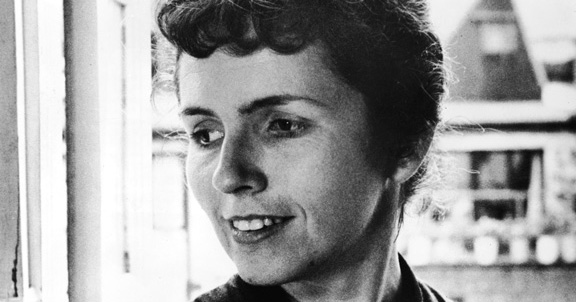
Perhaps the greatest perplexity of aging is how to fill with gentleness the void between who we feel we are on the inside and who our culture tells us is staring back from that mirror. The cultivation of that gentleness is what beloved writer Grace Paley (December 11, 1922–August 22, 2007) examines in a magnificent short piece titled “My Father Addresses Me on the Facts of Old Age,” originally written for the New Yorker in 2002 and included in Here and Somewhere Else: Stories and Poems by Grace Paley and Robert Nichols (public library) — a celebration of literature, love, and the love of literature by Paley and her husband, published a few months before she died at the age of eighty-five.
Paley writes:
They said, Really?
My father wanted to begin as soon as possible.
[…]
Please sit down, he said. Be patient. The main thing is this — when you get up in the morning you must take your heart in your two hands. You must do this every morning.
That’s a metaphor, right?
Metaphor? No, no, you can do this. In the morning, do a few little exercises for the joints, not too much. Then put your hands like a cup over and under the heart. Under the breast. He said tactfully. It’s probably easier for a man. Then talk softly, don’t yell. Under your ribs, push a little. When you wake up, you must do this massage. I mean pat, stroke a little, don’t be ashamed. Very likely no one will be watching. Then you must talk to your heart.
Talk? What?
Say anything, but be respectful. Say — maybe say, Heart, little heart, beat softly but never forget your job, the blood. You can whisper also, Remember, remember.
More here.
| 14. FRIEDRICH NIETZSCHE: WALK YOUR OWN PATH |
“Do you have the courage to bring forth the treasures that are hidden within you?” Elizabeth Gilbert asked in framing her catalyst for creative magic. This is among life’s most abiding questions and the history of human creativity — our art and our poetry and most empathically all of our philosophy — is the history of attempts to answer it.
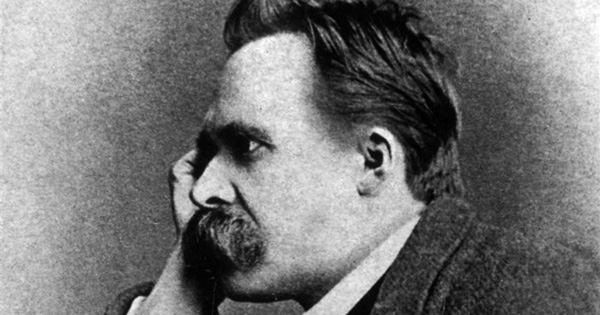
Friedrich Nietzsche (October 15, 1844–August 25, 1900), who believed that embracing difficulty is essential for a fulfilling life, considered the journey of self-discovery one of the greatest and most fertile existential difficulties. In 1873, as he was approaching his thirtieth birthday, Nietzsche addressed this perennial question of how we find ourselves and bring forth our gifts in a beautiful essay titled Schopenhauer as Educator (public library), part of his Untimely Meditations.
Nietzsche, translated here by Daniel Pellerin, writes:
Every young soul hears this call by day and by night and shudders with excitement at the premonition of that degree of happiness which eternities have prepared for those who will give thought to their true liberation. There is no way to help any soul attain this happiness, however, so long as it remains shackled with the chains of opinion and fear. And how hopeless and meaningless life can become without such a liberation! There is no drearier, sorrier creature in nature than the man who has evaded his own genius and who squints now towards the right, now towards the left, now backwards, now in any direction whatever.
Echoing Picasso’s proclamation that “to know what you’re going to draw, you have to begin drawing,” Nietzsche considers the only true antidote to this existential dreariness:
More here.
| 15. MARTHA GRAHAM: EMBRACE YOUR DIVINE DISSATISFACTION |
“Resign yourself to the lifelong sadness that comes from never being satisfied,” Zadie Smith counseled in her ten rules of writing. But how does one befriend this perennial dissatisfaction while continuing to unlock, to borrow Julia Cameron’s potent phrase, the “spiritual electricity” of creative flow?
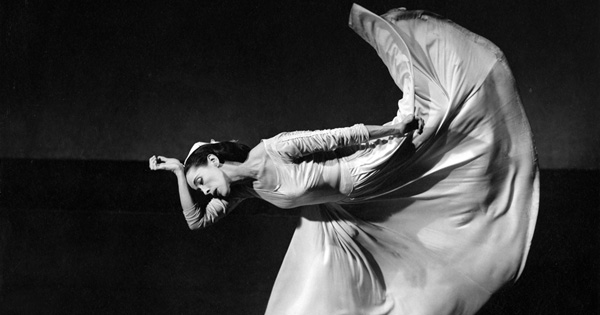
To this abiding question of the creative life, legendary choreographer Martha Graham (May 11, 1894–April 1, 1991) offers an answer at once remarkably grounding and remarkably elevating in a conversation found in the 1991 biography Martha: The Life and Work of Martha Graham (public library) by dancer and choreographer Agnes de Mille.
In 1943, De Mille was hired to choreograph the musical Oklahoma!, which became an overnight sensation and ran for a record-setting 2,212 performances. Feeling that critics and the public had long ignored work into which she had poured her heart and soul, De Mille found herself dispirited by the sense that something she considered “only fairly good” was suddenly hailed as a “flamboyant success.” Shortly after the premiere, she met Graham “in a Schrafft’s restaurant over a soda” for a conversation that put into perspective her gnawing grievance and offered what De Mille considered the greatest thing ever said to her. She recounts the exchange:
Martha said to me, very quietly: “There is a vitality, a life force, an energy, a quickening that is translated through you into action, and because there is only one of you in all of time, this expression is unique. And if you block it, it will never exist through any other medium and it will be lost. The world will not have it. It is not your business to determine how good it is nor how valuable nor how it compares with other expressions. It is your business to keep it yours clearly and directly, to keep the channel open. You do not even have to believe in yourself or your work. You have to keep yourself open and aware to the urges that motivate you. Keep the channel open. As for you, Agnes, you have so far used about one-third of your talent.”
“But,” I said, “when I see my work I take for granted what other people value in it. I see only its ineptitude, inorganic flaws, and crudities. I am not pleased or satisfied.”
“No artist is pleased.”
“But then there is no satisfaction?”
“No satisfaction whatever at any time,” she cried out passionately. “There is only a queer divine dissatisfaction, a blessed unrest that keeps us marching and makes us more alive than the others.”
| 16. KURT VONNEGUT: CELEBRATE ENOUGHNESS |

In 2005, Kurt Vonnegut (November 11, 1922–April 11, 2007) — a man of discipline, a sage of storytelling, and one wise dad — penned a short and acutely beautiful remembrance of his friend Joseph Heller, who had died several years earlier. Originally published in the New Yorker, it was later reprinted in John C. Bogle’s Enough: True Measures of Money, Business, and Life (public library).
True story, Word of Honor:
Joseph Heller, an important and funny writer
now dead,
and I were at a party given by a billionaire
on Shelter Island.I said, “Joe, how does it make you feel
to know that our host only yesterday
may have made more money
than your novel ‘Catch-22’
has earned in its entire history?”
And Joe said, “I’ve got something he can never have.”
And I said, “What on earth could that be, Joe?”
And Joe said, “The knowledge that I’ve got enough.”
Not bad! Rest in peace!