by Peter Wong on January 8, 2024 (BeyondChron.org)
Seeing and watching the best films in a particular year doesn’t necessarily mean seeing the same films as other film writers and agreeing 100% with their assessments (e.g. “Past Lives”). But it does mean juggling timing, interest, and a willingness to explore that makes the search for candidates for year’s end consideration so enjoyable.
Take “Eo” and “No Bears.” Both films got shown at the Roxie in January 2023, yet they’d already earned critical plaudits elsewhere back in 2022. Or consider such highly publicized films as “Oppenheimer” and “Killers Of The Flower Moon.” This writer had to give both films a reluctant pass thanks to deadline dooms and other scheduling concerns.
This 2023 film roundup offers a mix of art film and Hollywood blockbuster, and this writer’s hope of piquing readers’ interest to try some of the lesser known titles on these lists.
Documentaries
This writer’s choice for 2023’s best documentary is Denise Zmekhol’s “Skin Of Glass.” The film’s odd title happens to be the popular nickname for the magnificent gleaming Edificio Wilton Paes de Almeida, thanks to its innovative use of glass as a core part of its architecture. How this symbol of Brazil’s future wound up as a memorial to a nation’s lost dreams got poignantly recounted by Zmekhol. The director was the daughter of Roger Zmekhol, the architect who designed the building. Yet it is by following the Skin Of Glass’ public history that the director finds her way to confronting both lingering wounds from her broken relationship with her father and the historical legacy of a dictatorship that corrupted the Skin of Glass’ promise.
Honorable Mention for 2023’s best documentary is Kaouther Ben Hania’s stunning “Four Daughters.” Subjects Tunisian single mother Olfa Hamrouni and her four daughters lived an economically hardscrabble yet emotionally close existence in a sexist society. But even the bonds of sisters combined with the bonds of mother and daughters couldn’t protect them from the tragedy that befell their family. Hania’s wrenching blend of documentary and narrative stunned as an example of cinema as therapy. The film mixed both talk therapy’s “nonjudgmental ear” and therapeutic role play via actresses playing Olfa and the two lost radicalized sisters.
The Mission–Bay Area filmmakers Amanda McBaine and Jesse Moss’ film delved beneath missionary John Chau’s highly publicized death to question the mentalities and institutions that contributed to his demise. While sympathizing with Chau’s zeal for adventure, the directors questioned the history of missionary work’s supposed altruism. What worthwhile aid is actually given to indigenous peoples by missionaries? Or are the real beneficiaries the missionaries who encounter allegedly “uncorrupted” societies?
The March On Rome–Mark Cousins’ timely and chilling film deconstructed the world’s first political propaganda film, which wasn’t “Triumph Of The Will.” Cousins’ granular analysis of Umberto Paradisi’s “A Noi (To Us)” shows how duplicitous editing and repurposed footage turned a Black Shirt march from a real-life political disaster into a triumphant celebration of rising Italian fascism. The director also reams societal complicity in enabling fascism, whether it’s forgetting a soccer stadium once hosted fascist rallies or the New York Times not trying to atone for shamefully supporting Mussolini in its pages.
Chop And Steele–Most Fun Documentary of 2023 honors goes to Ben Steinbauer and Berndt Mader’s endearing portrait of a pair of prankster friends. The pranksters, Found Footage Film Festival founders Nick Prueher and Joe Pickett, trick several unsuspecting morning TV shows with a joke strongman duo act. Seriously unamused Gray Television media conglomerate’s lawsuit catalyzes the pranksters to start examining whether they should pursue a more “practical” means of making a living. Their personal revelations would come through a combination of unexpected meetings and the coronavirus lockdown.
Kokomo City–Black trans woman sex workers may be low on the cultural respect totem pole. But D. Smith’s energetic directorial debut makes its four sex worker subjects from Atlanta and New York City intriguing on their own terms. Subjects Daniella Carter, Koko Da Doll, Liyah Mitchelll, and Dominique Silver don’t regret their line of work. In fact, they demand and earn viewer respect for being unapologetically who they are and dealing with problems outside the typical office job, such as dealing with a client who’s brought a gun to his appointment.
Taylor Mac’s 24 Decade History Of Popular Music–This concert film from Rob Epstein and Jeffrey Friedman may be a cinematic tasting menu of Taylor Mac’s original literal 24 hour performance art event. Yet it thrillingly distills the MacArthur Fellowship winner’s performances of some of the 246 songs popular in the United States from 1776-2016 to “create a radical fairyness ritual.” In more mundane terms, Mac’s event turns the jukebox musical into a gloriously queer questioning of American history’s racist and capitalist roots.
Finding The Money–Why does money exist? And why does the U.S. government need to “borrow” money when it can print its own money? Modern Monetary Theory (MMT) answers these two questions and their implications. Maren Poitras’ fascinating cinematic primer on MMT explains the theory using lay terms and forgotten historical tidbits such as how the U.S. government’s financing of its World War II efforts showed MMT in action. Can this film inspire viewers to push for MMT use to solve such present day challenges as global warming?
Ask Any Buddy—For viewers who regard such things as glory holes and cruising on the piers as abstractions from a forgotten time, Elizabeth Purchell’s compilation film turns supposed fictions into the stuff of gay popular history. Her raw source material consists of excerpts from 125 works of gay male pornography from the 1960s to the 1980s. Artfully spliced together, these excerpts create an ur-chronicle of a day in the life of a pre-AIDS era gay man. From visiting a gay bar to the beauty of a gay hookup in an abandoned pier, what “respectable” society of the period called squalid acts became quiet acts of defiance. Worth it just for the glory hole graffito “Edith Head Gives Great Wardrobe.”
Onlookers—If Laos boasts a tourist dependent economy, why are the country’s foreign visitors uninterested in engaging with Laos on its own terms? Kimi Takesue’s quietly observational documentary captures that disconnect in such sights as visitors checking out Buddhist temple exteriors for interesting selfie backgrounds. Takesue also challenges her film’s viewers to do what the foreign tourists won’t and notice and react to the scenes of Laotian everyday life she captures on camera.
Honorable Mentions–Motel Drive, Time Bomb Y2K, Satan Wants You, Stamped From The Beginning, Copa 71
Features
This writer calls Yorgos Lanthimos’ wonderfully outrageous “Poor Things” 2023’s best feature film. Emma Stone holds the whole enterprise together with her memorable performance as Bella Baxter, the Frankenstein’s creature whose coming of age on an initially sexually-charged Grand Tour eventually leads to the type of female personal freedom GQP scolds cannot tolerate. Add into the mix Willem Dafoe’s wonderful turn (even beneath prosthetics) as the Dr. Frankenstein, Mark Ruffalo’s hilarious performance as a sexist creep, an unforgettably weird music score by Jerskin Fendrix, fisheye lenses lending the film’s events a surrealistic air, and the visual allure of a strange steampunkish world. The result: a unique and enjoyable modern classic.
Honorable mention goes to Todd Haynes’ fascinating drama “May December,” which was inspired by the Mary Kay Letourneau scandal. But the film’s examination of the impulse to understand the causes behind extreme human behavior and the limits of such attempts at discernment are entirely its own. Actress Elizabeth Berry (Natalie Portman)’s in-person research of Gracie Atherton-Yoo (Julianne Moore as the Letourneau character) may be prep work for her film portrayal of the notorious woman. Yet what truly motivates Elizabeth, Gracie, and Gracie’s husband Joe becomes the bigger question. Whether it’s empathy for regrettable actions or long-term unhappiness needing to be confronted, Haynes’ film leaves to the viewer the final responsibility of assembling its disparate emotional pieces.
Passages–Ira Sachs’ compelling drama fascinatingly centers on an anti-hero whose mercurial sexual fluidity brings heartache to those he claims to love. What does film director Tomas’ affair with the schoolteacher Agathe say about the state of his marriage to the self-effacing Martin? If Tomas is acting on his discovery that he’s bisexual, why won’t he allow Martin to end the marriage and forge a new life for himself? Is Agathe truly Tomas’ lover or his instrument for playing power games with Martin? Sachs’ ambiguous story matches the emotional uncertainties its central trio work under.
Eo–Jerzy Skolimowski’s Cannes Jury Prize-winning tale of the wanderings of the titular donkey through modern Europe may have been inspired by Robert Bresson’s classic film “Au Hasard Balthazar.” But the director’s memorable strobe light opening to the film establishes “Eo” as its own creature. The viewer empathizes with this four-legged generally silent witness to humanity’s capacities for kindness and cruelty. If angry soccer fans viciously beating the titular donkey to within an inch of his life doesn’t move the viewer, this might not be the film for them.
No Bears–Jafar Panahi’s latest film goes beyond being a cinematic middle finger to Iranian government repression. Its “see, I’m not directing a film or stepping out of Iran” setup pales in importance next to viewer curiosity about the import of the film’s title. While that meaning will not be spoiled here, it can be said its two main stories reflect facets of what the title references. In one story, the politically persecuted Bakhtiar and Zara seek an additional fake passport so they can escape Iran together. In the other, a fictional Panahi gets unwillingly entangled in Gozal and Solduz’s efforts to secretly elope from their rural village. Panahi may not do commercially cheerful entertainments, but his films honestly limn life’s emotional complexities.
The Boy And The Heron–Hayao Miyazaki’s possibly last film mixes together mundane human tragedy with universe-shaking fantasy. 12-year-old Mahito has lost his mother in a World War II bombing raid, yet is still too grief-stricken to accept his stepmother despite her being the spitting image of his deceased parent. But the boy must pursue the stepmother when she possibly disappears into a mysterious tower where time, space, and even other dimensions are bent in unexpected ways. The mysterious structure winds up being a metaphor for the director’s ambivalence about ending his creative career. Miyazaki also deserves plaudits for playing down the political aspects of the story’s time frame.
Past Lives–If some relationships are fated to occur, are there other relationships fated to be near misses? That question hangs over the relationship between classmates Na Young (later Nora Moon) and Hae Sung, the protagonists of Celine Song’s strong semi-autobiographical debut. Over a 24 year period, the duo are swept into and out of each other’s lives by such occurrences as emigration to Canada or involvement in other relationships. Do their divergent life paths make them practical strangers to each other when they finally meet again in the flesh?
Song’s answer may not be as clear cut as a viewer may expect.
Barbie–Greta Gerwig began blitzing viewer expectations by not turning this film starring the titular doll into a feature-length commercial. In following Barbie’s navigating the gulf between her boundless world of endless possibility and the restrictive lives Real World women endure under Patriarchy’s yoke, the results happily caused real-life right wing culture warriors to display publicly embarrassing degrees of immaturity. The rest of us were greatly amused by memorable performances from Margot Robbie as Stereotypical Barbie, Ryan Gosling as Barbie’s himbo Ken, and a show-stealing turn by Kate McKinnon as Weird Barbie.
Bottoms–Once untalented high-school lesbian PJ (a deliberately overage Rachel Sennott) gets punched in the face, Emma Seligman’s outrageous comedy shows anything’s insanely possible after PJ sets up a so-called women’s self-defense club with best friend Josie (Ayo Edebiri, also hilariously overage). Whether it’s a student with a previously undisclosed working knowledge of bomb-making to an insanely violent finale, the two friends’ use of the club to score with the school’s hot cheerleaders turns out to be the film’s most mundane plotline.
R.M.N.–The meaning of Cristian Mungiu’s newest drama comes from understanding its title happens to be the Romanian acronym for what English speakers refer to as MRI. But in this case, the “patient” receiving a brain scan happens to be a rural Romanian village whose inhabitants display contradictory thinking patterns. Resenting being treated as garbage by their foreign employers doesn’t make the villagers more sympathetic to the Sri Lankans brought in to work at the local bakery. Nor do the villagers’ desire for EU economic revitalization mean a willingness to embrace EU cultural values. Bakery plant manager Csilla’s desire to be the village’s cultural bridge to the future soon collides with the immobility of long-standing prejudices.
Showing Up—Kelly Reichardt’s newest collaboration with Michelle Williams reminds viewers that even in the art world, class differences exist. Lizzy (Williams) is an art world lower class everywoman juggling time for sculpting with an ironically frustrating day job at an arts college, a frenemy artist landlord who doesn’t prioritize fixing Lizzy’s hot water heater, and such family dramas as her father’s freeloading friends and a probably mentally ill brother. Reichardt’s empathy for someone whose plate of responsibilities often threaten to overwhelm her creative urges makes this an enjoyable if minor work.
Asteroid City–A documentary about and a performance of playwright Conrad Earp’s “Asteroid City” provides the framework for Wes Anderson’s newest mix of absurdism and poignancy. Its look may nod to both the Golden Age of Television and its period’s New York theater scene. Yet its failure to fully account for Cold War paranoia or societal sexual repression does prove jarring in spots. Still, the film’s historical-ish missteps are outweighed by its plethora of inspired absurdities such as the brainy teenagers’ memory game, a vending machine dispensing land titles, and a backstage spin out of theatrical reality.
Spider-Man: Across The Spider-verse–Joaquim Dos Santos, Justin K. Thompson, and Kemp Powers delivered both the year’s most satisfying superhero movie (even if it ends on a cliffhanger) and the year’s best use of the multiverse. Viewers met such memorable alternate Spider-people as Spider-Man India and Spider-Punk. Familiar superhero tropes such as joke villain turning deadly and several variations on the same origin story get mixed with dynamic animation differentiating the alternate worlds visited in the film. Most importantly, this film knew when to wow viewers with action and when to be bemused by the characters enjoying being Spider-people.
Blue Jean–Georgia Oakley’s powerful period drama set during Thatcher’s reign as Britain’s Prime Minister is a study of a woman caught between a sociopolitical rock and hard place. On one hand, the closet may be lesbian secondary school girls’ PE teacher Jean’s alternative to unemployment. But the pending homophobic government law known as Section 28 will make Jean’s life more constricting. On the other hand, her cautious closeted behavior starts turning off punkish girlfriend Viv and leaves new student and baby gay Lois open to homophobic bullying. Oakley’s film sympathizes with Jean’s situation yet refuses to write off her position as hopeless.
Polite Society–Nida Manzoor shows how to hilariously ream the “follow your dream” trope in this action comedy centered on two close sisters’ possibly changing relationship. Is wannabe artist Lena’s decision to marry rich and eligible Salim genuine or unaddressed frustration? Younger sister (and wannabe movie stuntwoman) Ria’s determination to stop her sister’s marriage for the sake of sisterhood and dreams will entertain viewers with berserk martial arts fights, beauty treatment torture, and even some video game nods.
Honorable Mentions–In Front Of Your Face, Elemental, They Shot The Piano Player, The First Slam Dunk, Hippo, Terrestrial Verses, A Thousand And One
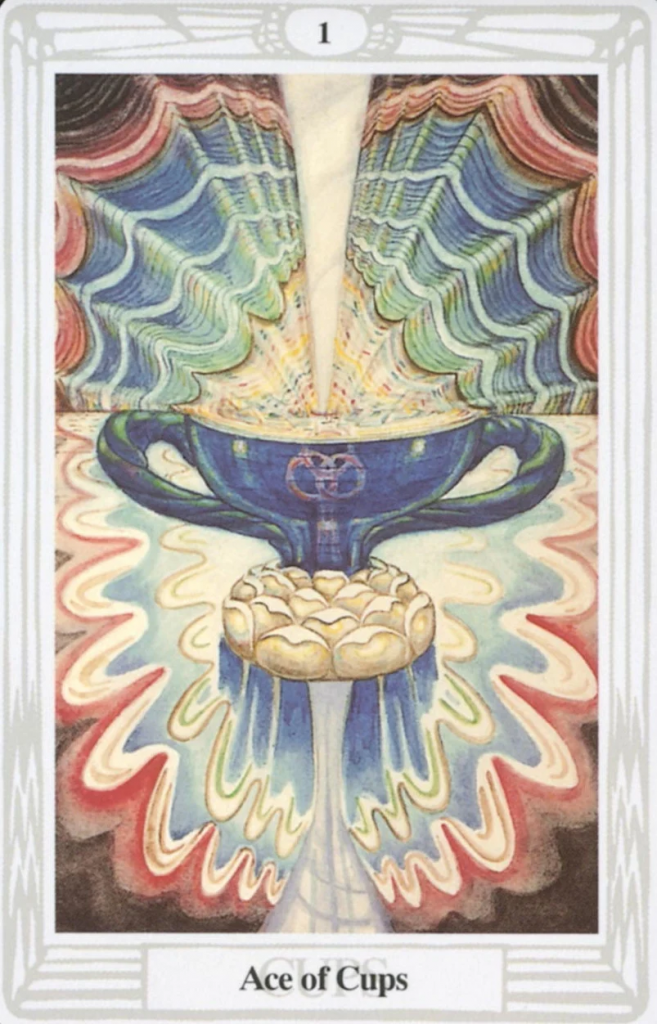
The Ace of Cups represents the beginning of love, fertility and creativity. It is a card to inspire confidence and happiness. When it turns up a reading of an everyday nature it can indicate the start of a loving relationship (of either the romantic or friendship variety); it can represent the beginning of a project in which a great deal of loving energy is invested (rather like the beginning of angelpaths); or sometimes it can reveal conception – the beginning of a new life.If you are looking at the Ace of Cups indicating a new relationship, then there will also be people cards up. If it is a romantic relationship, expect to see other good Cups, and perhaps the Lovers. Friendship will be more indicated by Wand type good cards.The beginning of a project will normally have something like the Star or the Priestess, and Disks around it. These will help you to determine the viability of the project.Pregnancy will usually come up with other cards which also indicate pregnancy Princess of Disks, Ace of Wands, and possibly the Empress.But at a spiritual level the Ace of Cups is even more important. The chalice depicted on most versions of this card is taken to be the Holy Grail, or in pagan terms, the Cauldron of Kerridwyn – source of inspiration and granter of wishes and dreams.In this interpretation of the card then, we are examining a major spiritual step forward – a period where the deepest and most heartfelt spiritual desires of the querent come to the surface, and may be identified and pursued.When this card comes up with the Hierophant, The Sun,The Moon or sometimes with Death, we must see ourselves as entering into a major transformational period from which we will emerge totally changed by the power of the Universe. During periods such as these we touch the very essence of spiritual power, and hopefully, we succeed in growing toward it, and allowing a little more of its light within us.
New Thinking Allowed with Jeffrey Mishlove Streamed live on Jan 7, 2024 Daniel Sheehan is author of The People’s Advocate: The Life and Legal History of America’s Most Fearless Public Interest Lawyer. For the last half century he has been involved in some of the most famous public legal cases (such as the New York Times publication of the Pentagon Papers). During the period, he has also been active in the community seeking public disclosure of government secrets regarding UFOs – and has also provided legal representation for public figures in the UFO field, such as Dr. John Mack at Harvard University. He is founder of the New Paradigm Institute. His website is https://newparadigmproject.org.
A certain wealthy man visited the rabbi’s house while traveling through town. He was astounded by the stark simplicity of his home and furnishings. When he commented on this, Chafetz Chaim remarked that given the size of his suitcase, his guest also lacked belongings. The man exclaimed, “What’s the comparison, I’m on a temporary journey and take only what’s necessary for my trip. But I’m heading home to a mansion replete with a multitude of rooms and furnishings!” To this the rabbi replied, “I too am only passing through and fear being weighed down by too much baggage. But I look forward to such a homecoming as you describe!”
Author Unknown
AN OPPORTUNITY FOR DAILY REFLECTION BROUGHT TO YOU BY THE SCHOOL OF PRACTICAL PHILOSOPHY
My introduction into the world of Afghanistan’s Sufism began in 2015, over lunch with my friend Rohullah, the director of a research institute in Kabul. I had been working in Afghanistan in various sectors from government to nongovernmental jobs, and had returned to explore topics for a PhD that I had embarked on, a year prior.
I asked what had happened to Afghanistan’s Sufis. Were they all gone? Afghanistan had, after all, once been the cradle of mystic interpretations of Islam, the place of origin of Mawlana Jalaluddin Balkhi, known in the West as Rumi. Had the Sufis disappeared in the exodus precipitated by successive wars that had engulfed Afghanistan since the late 1970s? Or had they been replaced by more radical and austere forms of Islam, as some analysts speculated? Rohullah laughed. ‘They are still here,’ he said. ‘You foreigners just don’t ask about them. All you care about is gender, counter-insurgency and nation-building.’
Any cursory look through titles in bookstores or newspaper headlines on Afghanistan substantiated Rohullah’s insight: Western policymakers, journalists and most researchers tended to nurture the kinds of knowledge about Afghanistan that informed policy, and for that purpose Sufis were not particularly useful. But even when searching regionally for literature on Afghanistan’s Sufis, all I could find were texts on the historical prevalence and importance of Sufis, though nothing about their present-day lives and struggles.
On occasion, Sufism still burst onto the public stage, for instance in 2016 when Iran and Turkey tried to claim the Masnawi Ma’navi, Rumi’s magnus opus, as their joint cultural heritage (the poet died in Konya, in present-day Turkey, in 1273 – and wrote in Persian, a language spoken in both Iran and Afghanistan). Western scholars and pundits barely took notice but, in Afghanistan, public intellectuals such as the poet laureate and Sufi poetry teacher Haidari Wujodi argued that ‘Maulana belongs to present-day Afghanistan and yesterday’s Khorasan. It is the responsibility of the Afghan government to take swift action about it to protect our heritage.’ An online petition decried the attempt to lay claim to Afghanistan’s cultural legacy while the Ministry of Foreign Affairs held talks with UNESCO over the perceived slight. And Atta Mohammad Noor, the then governor of the northern province of Balkh where Mawlana’s family originated, penned a letter to the UN condemning Iran and Turkey’s ‘imperialistic’ attempts to appropriate Rumi and disregard Balkh as the esteemed poet’s ‘motherland’.
This ‘diplomatic frenzy’, as Radio Free Europe/Radio Liberty called it, revealed Afghan pride in Sufism and that it still has the power to spark intense debate. Sufis in Afghanistan never really fit into Western narratives about the Taliban or the war and occupation. So, Sufism was ignored. The chaotic US military evacuation in 2021 and the sweeping Taliban takeover, with all the scenes of suffering and human rights abuses that followed, have made it even more difficult to imagine an Afghanistan where Sufi scholars debate the finer points of Islamic ontology and poets ruminate on the infinite ways to lose oneself in the beauty of God’s creation. It requires a real stretch to remember that Sufism, in its multifaceted incarnations, has been a central thread in the tapestry of Afghanistan’s historical, artistic, educational and political life. Sufi traditions were once so influential in royal courts that kings extended patronage to poets and Islamic figurative artists who illuminated manuscripts, weaving Sufi literary motifs into exquisite paintings. Some historians, such as Waleed Ziad, even go as far as to say that Sufi orders that were firmly rooted in what later became Afghanistan built their own ‘hidden caliphate’, creating networks throughout the Middle East, Central and South Asia.
These chapters remind us that Afghanistan’s history transcends the geopolitical tumult of the present, tracing back to a rich heritage of spiritual and artistic expression. The history of centres of Sufi learning, such as the Pahlawan Sufi lodge in an old part of Kabul, starts in this different time: in the 18th century, the capital shifted from southern Kandahar to the mountain-crested city of Kabul, a migration that ushered in a wave of cultural and spiritual transformation. Among those embarking on this northward journey was a man named Sufi Sher Mohammad and his son Mir Mohammad. Sufi Sher earned the sobriquet of Pahlawan, or ‘wrestler’, a testament to his reputed superhuman fighting prowess. But, also, a name to praise that he fought for the powerless. In the heart of Kabul, they built the Khanaqah Pahlawan, or the Lodge of the Wrestler, in a district fittingly named Asheqan-o-Arefan, a place where lovers and mystics, the seekers of gnosis, congregated in their pursuit of divine wisdom. Here, seekers assembled for weekly meditative zikr (literally, ‘remembrance of God’) rituals and spiritual advancement through reading and learning.
In the modern era, Sufism continued to play a central role in Islamic thought and practice in Afghanistan until at least the last quarter of the 20th century. Sufi poetry was not a fringe phenomenon but a mainstream approach to teaching Islam in Afghanistan’s madrasas. Alongside the Quran and Hadith, students learned poetic exegeses based on the compilations of Rumi, Saadi and Hafiz. ‘In the past, there was oral knowledge on how to understand, recite and sing poetry,’ an Afghan friend told me. ‘Until the Soviet time, [in addition to the Quran,] the mosques were also teaching poetry, through collections such as Panj Ganj … Now there is only learning by heart, no analysis.’
The Soviet occupation of Afghanistan, my friend pointed out, was a time of radical change and violence on multiple levels. Fighting and destruction sent many Afghans into neighbouring countries, while ideas about what constituted Islamic authority shifted during the jihad, fought against the backdrop of the Cold War.
Khanaqah Pahlawan’s spiritual lineage stretches back centuries but the structure of the Kabul lodge itself bears the scars of its journey through Afghanistan’s recent history. During one visit in 2018, Haji Tamim, the custodian, told me: ‘We had to rebuild the roof and upper floor two times,’ explaining how they were hit by rockets that had shaken the lodge’s foundations. ‘Then the mujahidin came,’ he continued. ‘They looted and burned everything that was in here. They took out all the dishes and all the stuff from the mosque [on the first floor] and from the khanaqah [lodge]. They took even the carpet from the mosque!’ In the era of the civil war, when various mujahidin factions fought each other, the khanaqah often found itself on the precipice of violence, its serenity disrupted by war.
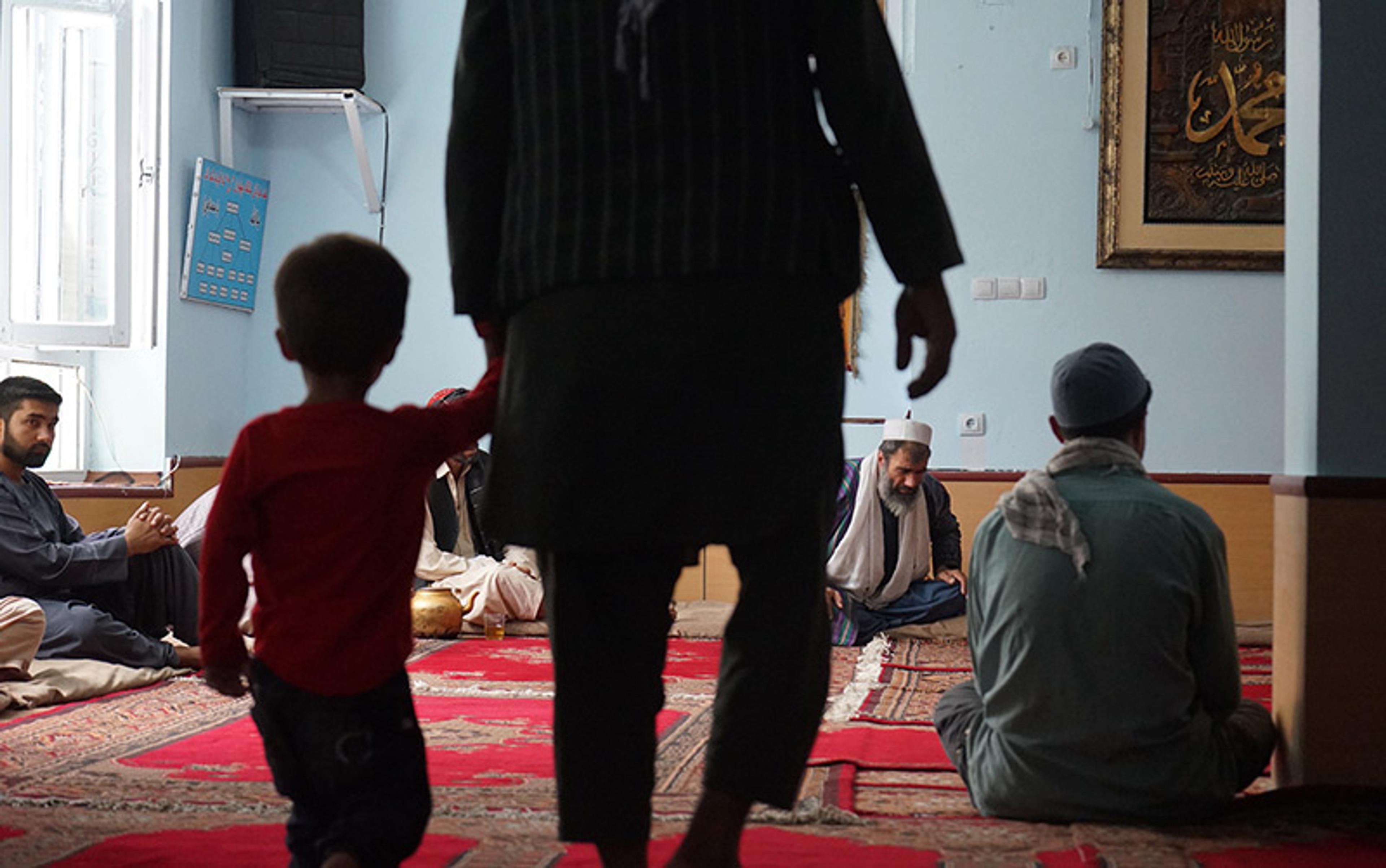
The Sufi community sometimes chose to congregate instead in a mosque in another part of Kabul, where they continued their zikr sessions and spiritual studies. When they were finally able to return in the 1990s, the community came together to repair the damaged khanaqah. An extensive network of students and regular visitors pitched in financially and with labour to reconstruct the building. Sufis in Kabul use the khanaqah for meetings and celebrations, for rituals as well as a community space for studying poetry, hagiographic compendia and philosophy. Without any state support, Sufi religious networks coalesced, repaired and rejuvenated as best as they could.
This could have been the end of the Sufi lodge, its leadership starting new lives abroad
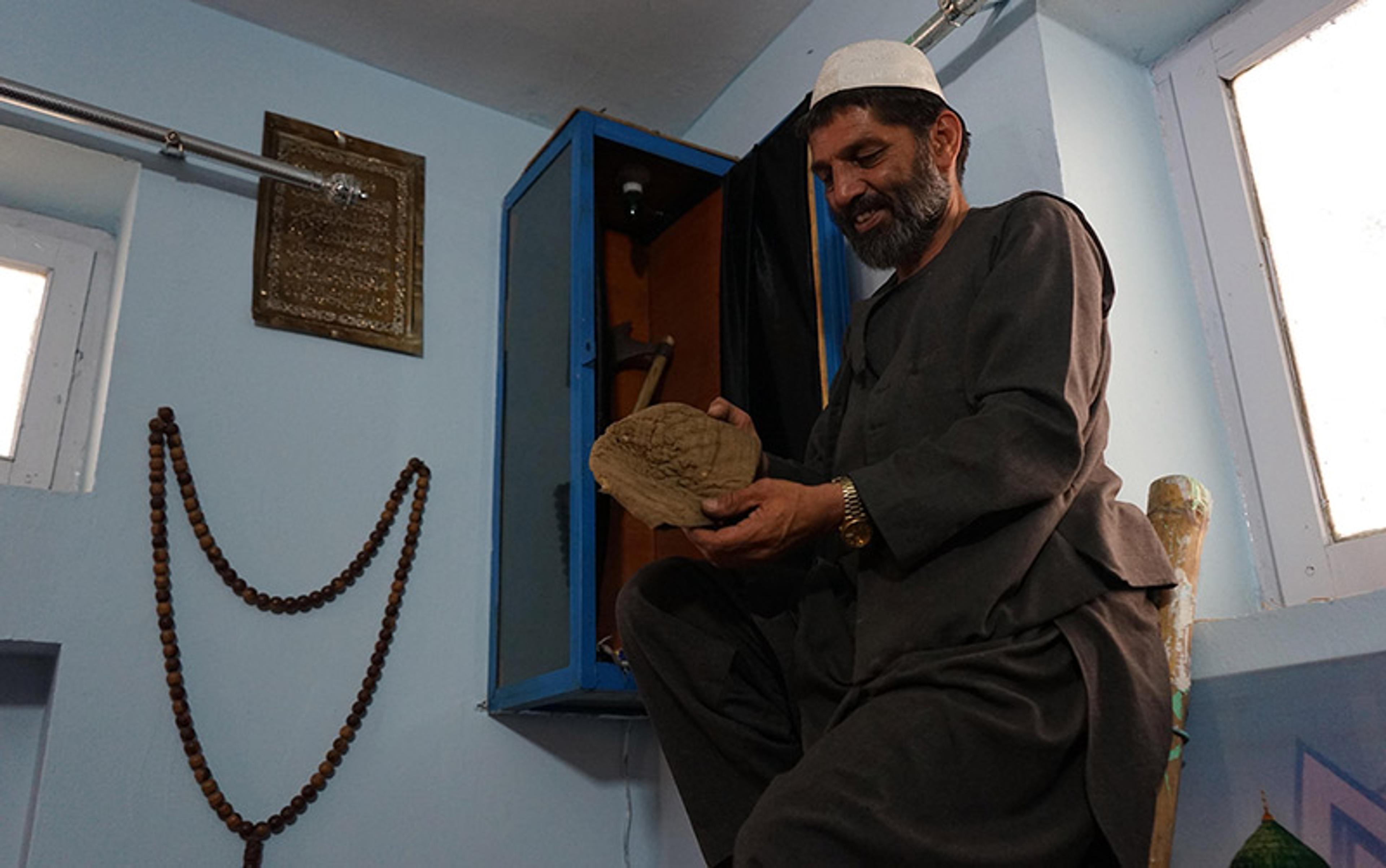
As I walked through the principal congregational chamber on the second floor, an elongated rectangular space adorned with richly patterned red carpets, illuminated by a cluster of chandeliers, Haji Tamim led me to a dark-blue metal cabinet tucked away in the room’s corner. He unlocked the cabinet and, with reverence, began retrieving a collection of relics. The first, a wooden walking stick, had once been the steadfast companion of Pahlawan Sahib, the founder of the khanaqah, more than two centuries earlier. As Haji Tamim cradled the staff, he told the history of each item.
Haji Tamim displaying the cap that belonged to Haji Ahmad Jan. Khanaqah Pahlawan, Kabul, 2018
They included a cap that had belonged to Haji Ahmad Jan, a respected teacher, whose prospects were bound to the tumultuous era of Hafizullah Amin, when the Communist coup of 1978 set in motion a harrowing, year-long campaign of ideological cleansing to assert control over religious education. In this brief yet catastrophic period, the estimated tally of the disappeared ranged between 50,000 and 100,000. Intellectuals who dared to critique the government, liberal thinkers, Maoists, religious scholars as well as those arbitrarily swept up in the purges found themselves ensnared in a web of persecutions. Even the devoted disciples and revered teachers of Sufi orders were not spared this repression, Haji Tamim recounted, his voice lowering. ‘Haji Ahmad Jan was the one leading the khanaqah. They came and dragged him outside and arrested him. When they manhandled him, he lost his cap. It fell to the floor. He never came back.’
The persecution of religious teachers by the People’s Democratic Party of Afghanistan (PDPA) ultimately led to the most enduring transformations, including unlikely alliances that would guarantee the safety of the lodge and its members. These cherished relics symbolise not only the foundation of the khanaqah but also a turning point, marked by the Communist regime’s oppression, which forced the family that had been its steadfast guardians into exile. The teacher was arrested, and so were other members of the Pahlawan family who were detained for several years. At the time, one could never know whether an arrest would lead to an eventual release or disappearance. The Pahlawan family made the decision to leave Afghanistan for good – first to Pakistan, then India, before settling in the United States and Germany. This could have been the end of the Sufi lodge, its leadership starting new lives abroad, students dispersing to other places of learning or giving up their path altogether. But the family struck a deal with a quiet, unassuming mullah from another part of town: he would become the pir of the order, guarding the lodge and leading the community. Thus began the leadership of Haji Saiqal, the unlikely leader of Kabul’s Pahlawan Sufi community.
When Haji Saiqal went from the threshold of his mosque out into the streets in Kabul’s Microrayon district, dashing first through wide boulevards and turning into winding alleyways on his way to the reverent confines of the Khanaqah Pahlawan, he crossed multiple spaces and boundaries. At the mosque, the plainly dressed old man with his well-groomed white beard, signature flawless pirhan tumban and a modest turban on his balding head was the keeper of the Law, the imam who, five times a day, led prayers for a neighbourhood of believers. On Fridays, he delivered a sermon expounding the message of the Quran and the Hadiths. At the lodge of the Pahlawan Sufi community, Haji Saiqal was the keeper of a place of spiritual knowledge his followers believe brought them closer to God’s divine presence. Moving from one role to the other, from mullah to Sufi guide (pir) and back again, was as much – perhaps more – a spiritual transition.
This double role was also almost unheard of in the reporting on Afghanistan. In recent times, mullahs have become, perhaps unfairly, a disreputable class of Islamic leader, in both the East and the West. In its most basic sense, a mullah is an educated Muslim trained in Islamic theology and sacred law, holding an official post in a mosque as an imam. But this term embodies a wide spectrum of attributes, from esteemed community leader to rigid dogmatist to bumbling object of ridicule. Mullahs are believed to hold the potential to rouse fervent crowds or even frenzied mobs, particularly when their Friday sermons delve into politically charged terrain. Since the Taliban takeover of Afghanistan in 2021, and its theocratic precursor in Iran in 1979, the geopolitical influence that ruling mullahs can wield has been a cause for both regional concern and strategic interest. But they can also be the butt of jokes, as with Mullah Nasruddin – a satirical character in the trope of the wise fool, well known in regional folklore from the Balkans to China; at times witty, at other times wise, he dispenses pedagogical humour that criticises the powerful and humbles the listener.
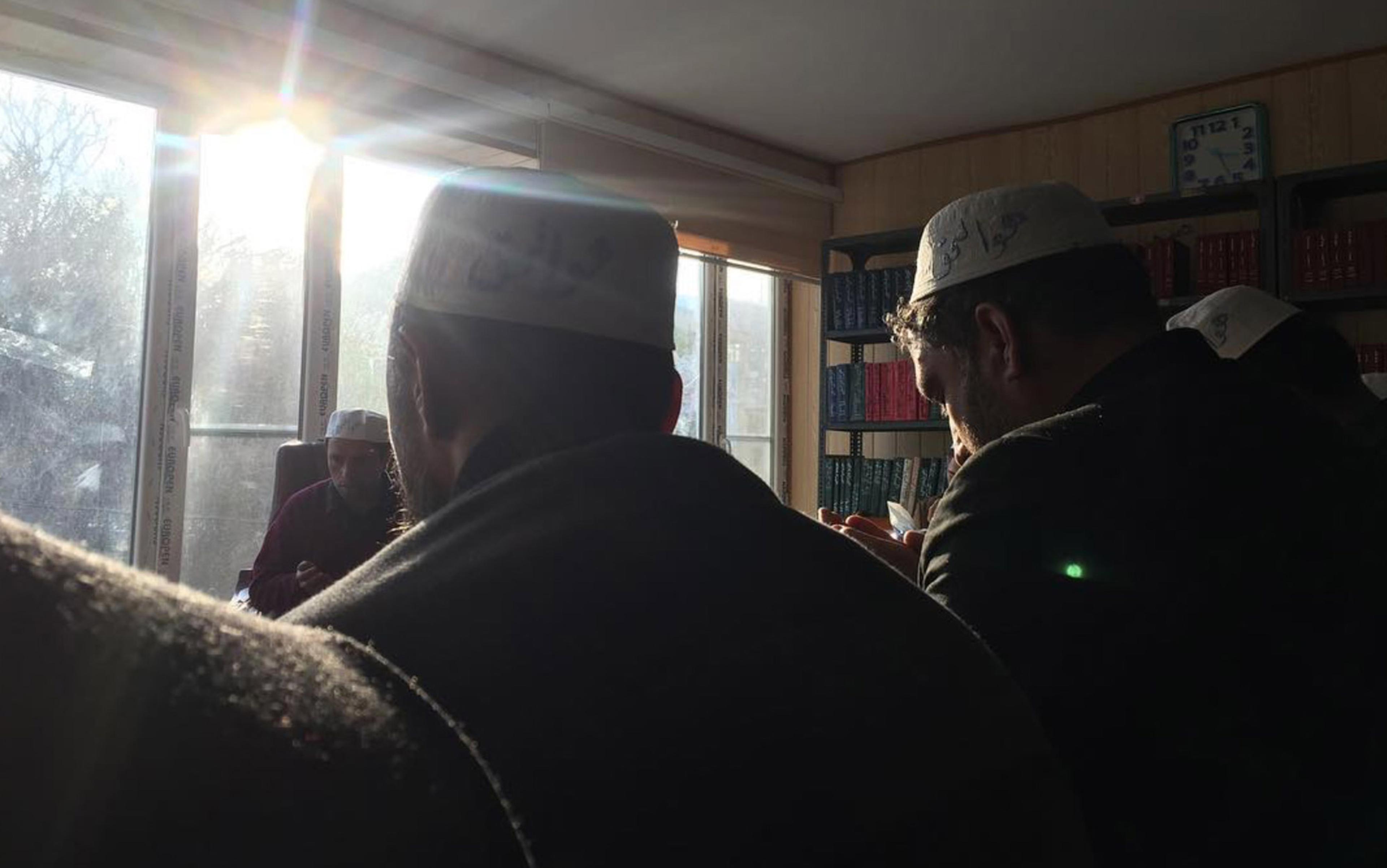
Zikr meeting at Khanaqah Pahlawan, August 2021
Regardless of where they fall on the spectrum – whether respected, reviled or ridiculed – mullahs are often portrayed as the antithesis of Sufis. Yet in Afghanistan, supposedly the embodiment of all that is wrong with ‘mullah Islam’, there was Haji Saiqal, occupying both roles with relative ease. How was it possible that a mullah, putatively antagonistic to Sufi thought and practice, could become a Sufi leader, the head of a revered and storied khanaqah in the heart of Kabul, taking on the mantle of both esoteric knowledge and protector of the Pahlawan Sufi community?
Sufism and Islam were separated and located within different – and antagonistic – personas
For historians of Islam, Haji Saiqal’s dual position is not so surprising. Many traditional scholars (ulama) throughout history have simultaneously inhabited the role of legal experts and Sufi thinkers, leaders and guides, including al-Ghazali, Abdullah Ansari and Rumi himself. However, at the time when Haji Saiqal was chosen as leader, the changes during Afghanistan’s civil war widened a conceptual rift between what is perceived by many as a Sufi Islam that stands in stark contrast to a legalistic ‘mullah Islam’, a rift that remains to the present day.
The rift has its origins in colonial and Orientalist literature, which divided Islam between a perceived legalistic Islam in contrast to mystic Sufism as an individual, liberal pursuit. One example of this division is the writing of the early colonial envoy Mountstuart Elphinstone (1779-1859), who describes three categories of religious functionaries: the ‘moollahs’, the ‘holy men’ (sayyids, dervishes, faqirs and qalandars) and the ‘Soofees’, whom he considers a minority sect of philosophers. Setting aside the misrepresentation of Sufism as a sect, Elphinstone saw mullahs and Sufis as diametrically opposed enemies in the religious field. Sufism and Islam were separated and located within different roles: the alim who studies the Islamic sciences, in contrast with the Sufi who sees beyond them. Ignoring the reality of a dual orientation of scholar and mystic in a single person, Sufism and Islam were separated and located within different – and antagonistic – personas.
Not only was Islam split in two (legalistic vs mystic), but Sufism was also divided: Sufism as philosophy – the high art and literature of mystic poetry – in contrast to living, contemporary Sufi pirs who were often seen as flawed, or even charlatans. As the anthropologist Katherine Ewing sketched out in 2020 in her overview of the politics of representing Sufism, the living ‘holy men’ were studied and carefully managed by colonial administrators. In contrast, Sufi mystic poetry and literature were to be deciphered by Orientalist scholars. Rather than seeing these various forms as belonging to a varied spectrum of belief, they were located in mutually exclusive roles and personas.
These conceptual splits also played a part in the allocation of religious authority during the decades of war in Afghanistan. Before the onset of the conflict, traditional claims to religious authority were based on religious knowledge, clerical training or Sufi lineages. The problem for Islamist party leaders who rose to prominence during the anti-Soviet jihad was that they lacked all of these credentials. Islamism developed in Afghanistan’s urban university milieu in the 1950s and ’60s, and most leaders of Afghanistan’s emerging Islamist parties, all based across the border in Peshawar, were university-educated men with no traditional religious training or pedigree. Instead, they legitimised their claims to leadership with the fact that they were the first to initiate jihad against the PDPA government in Kabul and had access to weapons and money through the assistance of Pakistan and other foreign powers, including the US and Saudi Arabia.
In an environment of both raw destruction and more fine-grained societal change, in which the external performance of piety was linked either to a position within the war as a mujahidin or as a recognisable authority through title and position, Haji Saiqal proved to be the right man for the moment in two key ways: first, his position and training as a mullah; and, second, his personal pragmatism in dealing with expectations of powerbrokers. His position as a low-level cleric made him recognisable to mujahidin commanders and Taliban officials as a respectable, though nonthreatening, conservative religious scholar, someone whose official position in his mosque they recognised and whose rank would mark him out in a way as ‘one of them’ – a rightful member of religiously legitimated authority. He could face officials when they came for visits to check what was going on at the khanaqah, and he could present an image of respectability by asserting that ritual practices were situated within the strictures of Islamic law.
The neighbourhood mosque that Haji Saiqal led in the Soviet-built neighbourhood of Microrayon seemed to be a physical manifestation of this adeptness at social camouflage. The simple concrete building, rectangular walls, empty halls and plain red carpets were a far cry from the dazzling tiles, arches and impressively constructed domes of Islamic architecture in Central Asia and the Persianate world. I had somehow expected a more outwardly beautified place as the seat of a Sufi leader. But, here, Haji Saiqal did not wear that mantle, donning instead the garb of a humble neighbourhood mullah. The mosque, it turned out, was a repurposed depot and distribution centre where Afghans once came to redeem their food stamps during the PDPA government in the late 1970s and ’80s. Later, it became one of the 94,000 estimated unregistered mosques in Afghanistan. The environment that Haji Saiqal had chosen as his base for teaching and preaching was inconspicuous – one mosque among many, one mullah among hundreds.
The choice of Haji Saiqal as leader of the Pahlawan community was a stroke of navigational genius. The powerbrokers who took control of Kabul in the 1990s – whether mujahidin or later Taliban – were focused on the outward compliance of conduct and representative titles that met their expectations for religious credentials; Haji Saiqal checked all of those boxes. For the Sufi family of the Pahlawan lodge and their followers, however, he was chosen for his character and deeds. They had seen him growing up, from the time when he was a young boy who sometimes joined his father on his visits to the Khanaqah Pahlawan for zikr. This knowledge of Haji Saiqal’s inner state trumped his outward credentials when the community decided to whom to entrust the future of the khanaqah.
Haji Saiqal, the mullah and the pir, becomes a symbol of the creative adaptation
For his part, Haji Saiqal demonstrated a canny ability to manage the volatile environment. He could, when needed, appeal to the Taliban’s morality police from the Ministry for the Promotion of Virtue and the Prevention of Vice with his deep knowledge of Sharia. He could just as expertly administer to the needs of the Sufi community. When varying ministers made moves to shut down the Sufi lodge, he drew on his network of madrasa students and their connections to various Taliban officials to keep the doors of the khanaqah open. He led the community into the 21st century, caring for the modernisation of the Sufi lodge in the coming two decades under the coalition governments, until new changes within the governmental set-up were afoot.
When I last visited the Sufi lodge in the winter of 2022, the Taliban had not only taken over Afghanistan, but had also closed all Sufi lodges nationwide after a bomb had struck within another Sufi lodge in Kabul in April – in the same place where Haji Saiqal had originally received his ijaza (authorisation for transmitting knowledge). Not only were the lodges closed but so too were religious foundations in which Sufi scholars were teaching weekly Masnawi classes. The official reason was the same in all instances: the danger of attacks (presumably by the Islamic State’s Afghanistan affiliate, although none of the attacks on Sufi places had been officially claimed by them). One of the Sufi alims in Kabul opined that the Taliban had used the attack as a convenient excuse to close the lodges because they were in reality against Sufism, arguing that, if the Taliban had been concerned for the wellbeing of Sufi affiliates, they would have given the lodges additional security personnel rather than completely shutting them down. After all, why would they want to shut down a place that offered support, spiritual edification, a warm meal and tea, all the manifestation of community self-help at a time when Afghanistan was hard hit by an economic depression and many families were sliding into poverty?
Haji Saiqal would not see these changes – he passed away from a tumour two years before the Taliban took over. Just like in years past, internal transitions within the lodge took place alongside the more overt political changes within Afghanistan. After many deliberations within the community both in Afghanistan and its diaspora, the calm seller of mobile phone cables Haji Tamim, who had been the guardian of the Sufi lodge for decades together with Haji Saiqal, took on the leadership.
The story of how Haji Saiqal and Haji Tamim cared for the Sufi lodge in old Kabul is only one of many. Once we shift our gaze from the capital to other cities, from Kandahar to Herat, Bamiyan to Badakhshan, we find others, maybe not a mullah and a mobile phone-cable seller, maybe this time calligraphers and booksellers, university professors and shopkeepers, who hide books, rebuild community centres and shrines, or who argue with authorities. As the places and persons change, so do their adaptive strategies in dealing with violence and repression. What stays the same is their lives within a centuries-long history of Sufis in Afghanistan, immersed in literature, art, belief, philosophy and worship. Following the Sufi lodge’s trajectory backward in time, through Afghanistan’s recent history of war and instability and the Pahlawan community’s struggles to sustain its traditions, leads us to a place where we begin to see Afghans very differently, not as victims in need of saving but as active agents in preserving Afghanistan’s rich and varied cultural heritage. From this perspective, Haji Saiqal, the mullah and the pir, becomes a symbol of the creative adaptation – an ethos that his successor has taken on as well.
Haji Tamim shrugged when I asked him about the lodge’s closure. ‘The khanaqahs have been here before I was born, and they will exist long after we are gone.’ In his view, governments came and went, but Sufi groups endured – sometimes by simply outliving them, sometimes through engagement and clever navigation. Governments or rulers and their laws could change, but Sufis would not stop gathering.
The Star (or Daughter of the Firmament) is numbered seventeen and is probably the most optimistic and beautiful card in the deck. A beautiful young woman, often naked, is depicted pouring water from a jug into the ground or into a pool by her feet. There are stars in the sky above her.Stars have long been seen as symbols of hope, regeneration, vision and new life. When this card appears, you know somehow that life is just about to become easier and brighter. Life’s forces combine to assist rather than hinder.Here is the truth about our power – we can join the solid earth of material existence with the flowing waters of spirit and create within ourselves a Universe. We have removed self-criticism and concentrated instead on our skills and strengths. When we regard ourselves with love, humour, tenderness and sympathy, we access the God and Goddess within and we are transformed.”Every man and woman is a star” A. Crowley
Consciousness, sexuality, androgyny, futurism, space, the arts, science, astrology, democracy, humor, books, movies and more