By Eric Branch Jan 16, 2024 (SFChronicle.com)
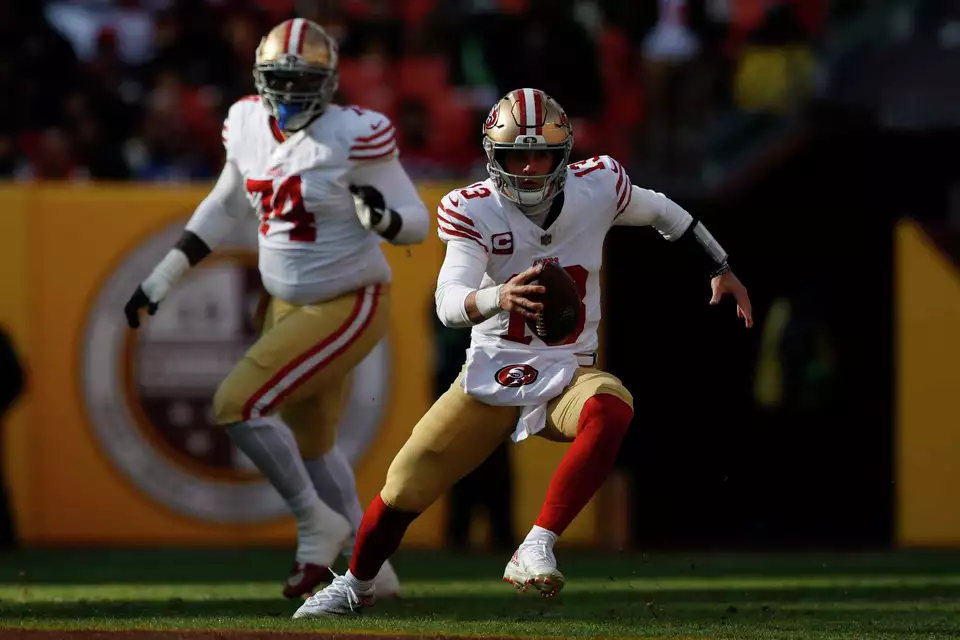

When Brock Purdy was asked last month about the first interception he threw against the Ravens, he didn’t describe just what he’d failed to see — lurking safety Kyle Hamilton — Purdy also revealed what he felt.
The San Francisco 49ers’ quarterback admitted he was too amped up after back-to-back long completions on the game’s first drive, and his emotions influenced the ill-advised throw.
“That’s something,” Purdy said, “that I had to learn the hard way.”
Purdy, 24, was just beginning to share how his mind had contributed to a four-interception performance in a heavily hyped 33-19 Christmas Night loss to Baltimore on a prime-time stage.
The team captain went on to say he was affected by the chatter before a game between 11-3 teams in which he’d compete against QB Lamar Jackson, a fellow NFL MVP candidate. And Purdy acknowledged he worried about throwing an embarrassment-adding interception after he threw his fourth pick early in the third quarter.
In the aftermath of his failure, Purdy’s news conference was a master class in authenticity and accountability. It didn’t include a whiff of defensiveness from a Mr. Irrelevant who understandably could own a last-man-picked complex.
It’s rare to get this level of candor from NFL quarterbacks, who play perhaps the most scrutinized and critiqued position in professional sports. The glare can inspire subtle blame shifting, thinly veiled excuse-making and a reflexive desire to defend themselves against detractors who don’t know Cover 2 from a safety blitz.
Brian Griese cherishes Purdy’s grace amid adversity because he lived in the fishbowl for more than a decade. The 49ers’ quarterbacks coach played the position for 11 seasons in the NFL and, at 24, he replaced Broncos’ Hall of Fame QB John Elway in his first year as a starter in 1999.
Griese’s background explains why he became animated during a recent interview when asked about Purdy’s prized intangible.
“It’s extremely rare because it goes against human nature,” Griese said. “You play the position of quarterback and you’re under so much pressure and stress and heat — even when things are going well. It’s constant stress. And when things don’t go well, it just magnifies. And it’s human nature to deflect. Or to try to hide. And that’s not just who Brock is.”
Griese says the ability to shoulder responsibility is priceless when it comes to a quarterback’s locker-room standing. It’s a trait Purdy has shown teammates that he has after last year’s success-stuffed rookie season in which he was largely protected from slings and arrows as an out-of-nowhere underdog.
This season, his first full year as a starter, also has been wildly successful. Purdy set a franchise record for passing yards (4,280), posted the 14th-highest passer rating (113.0) in NFL history and became the first S.F. QB voted to a Pro Bowl since 2002.
However, Purdy also threw five interceptions during a three-game losing streak. He became the first S.F. QB to throw four picks in a game since 2015. He continues to have skeptics who point to his elite supporting cast to diminish his accomplishments. And he has endured criticism — for wearing a backward baseball cap at news conferences.
Yes, it can be stressful, even when all is going well.
“Brock has never wavered in his responsibilities,” Griese said. “And I know for a fact — I feel it from the team — that their level of respect and admiration for him has grown exponentially through those experiences and how he’s handled them. That is gold for a quarterback. And the leader of a team.
“And he wasn’t seeking that. He was just being himself. It’s just who he is. He’s going to be accountable to the team first. And he’s going to be accountable to himself as far as how he wants to interact with people and take ownership. That’s not something you can fake. And that’s probably the thing that his teammates admire the most about him.”
A quarterback admitting his psyche hurt his performance — as Purdy did after his Christmas calamity — could lead to questions about his mental toughness. However, Purdy’s willingness to publicly detail his in-game issues has the opposite effect: It reveals a level of self-confidence and security.
Purdy has explained that this stems from his faith, which provides an identity and worth beyond his high-profile job and offers protection against outside perceptions. It’s what allows him to publicly reveal himself even if what was just revealed in a game wasn’t flattering.
“It’s definitely unique in today’s game,” pass rusher Nick Bosa said. “People feel attacked and want to be defensive about certain things. But it shows his maturity. … I think just being honest is a good way to go about your life.”
Purdy delivered an impromptu locker-room message after he threw two late-game interceptions in a 31-17 loss to the Bengals on Oct. 29, the final loss in the 49ers’ three-game skid.
Purdy’s message to his teammates: I touch the football on every play, I’m responsible for this, and I have to improve.
“He understands what the quarterback is — you’re kind of the face of the franchise,” tight end George Kittle said. “You’re kind of the reason we’re going to win and lose games, and you have to be OK with putting yourself out there.
“He’s mature enough to handle that pressure of being the 49ers’ starting quarterback. … There’s a lot that people expect of Brock. But I just think he does such a good job of being himself and just being an overall good human being.”
Purdy is a unicorn when it comes to his on-field performance: No player selected last in the NFL draft has come close to matching his success. But he’s also one of a kind in how he handles his failures.
He’s comfortable revealing what he failed to see and how he felt, elevating himself in his lowest professional moments.
“You certainly have to have the physical ability and mental acuity to play this position,” Griese said. “And Brock has that. But I do think that his temperament, and his accountability, and his integrity play a huge role in his success.”
Reach Eric Branch: ebranch@sfchronicle.com; Twitter: @Eric_Branch
Jan 16, 2024
By Eric Branch
Eric Branch has covered the 49ers at the San Francisco Chronicle since 2011, when he arrived after covering the team in 2010 at the Santa Rosa Press Democrat.
A graduate of UCLA, he’s won nine national APSE awards in various divisions, including recognition in 2018 for a breaking-news story on the arrest of 49ers linebacker Reuben Foster. In 2023, he received a first-place award in feature writing from the Pro Football Writers of America for a story on team pastor Earl Smith. Before covering the 49ers, he covered endless events, including archery tournaments and lawnmower races, while also working at the Logansport (Ind.) Pharos-Tribune, York (Pa.) Daily Record, Alexandria (La.) Town Talk and San Luis Obispo Tribune. He was included in the “Best American Sports Writing 2001,” under notable writing of that year, for a column on the joy and challenge of being a small-town sportswriter.
He can be reached at ebranch@sfchronicle.com.


 True solitude is a way of being that needs to be cultivated. You cannot switch it on or off at will. Solitude is an art. Mental training is needed to refine and stabilize it. When you practice solitude, you dedicate yourself to the care of the soul.