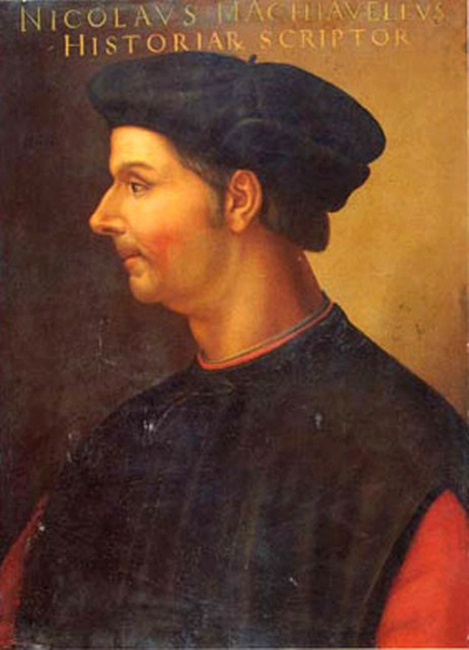
Everyone, even the blandest ones among us, has more than one side to them. However, there are people whose impact on the world, for better or worse, is so profound that it overshadows everything else about them.
Their contributions might be in the form of a theory, a work of fiction, a mode of behavior, their role in a historical event, or simply the force of their personality. Such impactful legacies often inspire eponyms, words that are derived from someone’s name.
This week, we’re diving into the whimsical world of eponyms, celebrating names that have journeyed from the halls of history and pages of fiction into our everyday vocabulary.
What eponyms would you coin after leaders, past or present, in your country? Share on our website or email us at words@wordsmith.org. Include your location (city, state). Include: Eponym, part of speech: definition, usage example.
Machiavellianism
PRONUNCIATION:
(mak-ee-uh-VEL-ee-uh-niz-uhm)
MEANING:
noun: The use of unscrupulous means, cunning, and deceit in pursuit of power, especially in politics.
ETYMOLOGY:
After Niccolo Machiavelli (1469-1527), Florentine statesman and author of The Prince, a political treatise describing the use of craft and deceit to achieve political power. Earliest documented use: 1607.
“… but the United States is still by far the most important nation in the world. All the forces of the earth are pouring through the United States . All the forces of the earth are pouring through the United States. All the forces of the earth are concentrated there. Europe’s economic power, or Japan’s economic and political ferment, or all that is happening in Russia or Eastern Europe, or China’s immensity, or Africa or the Middle East–it is all coming together and pouring through the government and people of America and the American land. It is up to America how all these forces will meet and act on each other and resound back into the world, the earth. Population, environment, morality, technology, medicine and old age, the preservation and destruction of tradition, new knowledge, new values–all, everything, is coming together in America in one way or the other of its effects or phases. What happens in America is what will determine the development and action of all these forces.”
–German businessman quoted in The American Soul by Jacob Needleman
On listening:
“This kind of process took place during the blistering summer of Philadelphia summer, the process of a group of ordinary human beings listening to each other, not as people usually listen to each other, but as people can listen: from a source deeper in themselves which opens them not only to the thought and views of their neighbor, but to something wiser and finer in themselves and, perhaps, in the universe itself. “
On fame:
“…when we consider the motivation, in Washington and in many other of the Founding Fathers, which may seem to us now as superficial and vain–namely, their preoccupation with what they referred to as “fame.” This word meant something very different, and much more honorable, than what we mean by it today–it implied becoming worthy to be known and respected by others.”
On leadershio:
“If the sage would guide the people, he must serve with humility. If he would lead them, he must follow behind. In this way when the sage rules, the people will not feel oppressed. When he stands before them. they will not be harmed. The whole world will support him and and will not tire of him. Because he does not compete. He does not meet competition.”
–Tao Te Ching
Woodrow Wilson on Lincoln:
“We say [Lincoln] was honest; men used to call him “Honest Abe.” But honesty is not q quality. Honesty is the manifestation of character. Lincoln was honest because there was nothing small or petty about him, and only smallness and pettiness in a nature can produce dishonesty. Such honesty is a quality of largeness. It is that openness of nature which will not condescend to subterfuge. which is too big to conceal itself. Little men run to cover and deceive you. Big men cannot and will not run to cover, and do not deceive you. Of course, Lincoln was honest. But that was not a peculiar characteristic of him. He was not small or mean, and his honesty was not produced by any calculation, but was the genial expression of the great nature that was behind it.
“Then we may also say of Lincoln that he saw things always with his own eyes. And it is very interesting that we can pick out individual men to say that of them. The opposite of the proposition is, that most men see things with other men’s eyes. And that is the pity of the whole business of the world. Most men do not see things with their own eyes.”
Historian Richard Hofstadter on Lincoln:
“Here, perhaps, is the best measure of Lincoln’s personal eminence in the human calendar–that he was chastened and not intoxicated by power.
On the “Second Democracy”:
“The second democracy is a community devoted solely and entirely to truth. It does not accumulate wealth. … It doe not make war. It is not “strong”; it is not an economic force in the world. It does not have an army. It does not make treaties. It does not devise financial innovations.”
“The second democracy is the soul of the first democracy–our democracy, our world.
“The second democracy–the community based on the equality of all men and woman who search for conscience–requires the political and social freedom and external tolerance that are provided by the kind of democratic society Americans now live in and whose principles were so carefully crafted in Philadelphia in the summer of 1787.”
I used to be enraged whenever a white person would say racism has been around ‘for ages,’ and that we can never get rid of it.
I’m out here trying to heal from my trauma — and here they are, telling me about how the Mongol Empire hated everybody and how actually white people were one of the first to be enslaved.
These facts never helped, given the overwhelming amount of racism in the world today is a direct consequence of European colonialism on the rest of the world.
Whether the economic de-throning of China as the world’s foremost economy at the hands of drug-dealing British aristocracy, or Europe’s collaborative devastation of the whole African continent — the inequality (and hence disdain) we see today is a result of the scheming of yesterday.
Being told that humans had always been judgmental and vindictive was not the message I needed; nor is it one that I believe in today.
But I have come to realize that as long as geopolitical power imbalances exist, racism will always find a way to rear its head.
Some nations will be seen as higher and others lesser; this will reflect upon citizenry, because humans inherently filter out excess information in favor of generalized patterns.
Education and nuance can help, but that tendency will always remain with changing global power struggles.
The best we can do is align ourselves with a deeper truth, however uncomfortable.
Our true identity is not our race, nor our circumstances.
Nor even our attachment to these.
If we see each other as atomistic collections of race, gender, sexuality, & habits, with nothing more, we lose our fundamental dignity as a species that’s capable of higher consciousness.
It is ironic that the Abrahamic religious doctrines of the “saved” and the unbelievers, as well as the doctrine of discovery, are the root source of much of today’s colonialist imbalance and inequality…
New Thinking Allowed with Jeffrey Mishlove • Streamed live 2 hours ago Before she could speak, Lorna Byrne has been able to communicate with angels and spirits. Even though she is severely dyslexic, she has written bestselling books. All that she has learned was taught to her by angels. Among her countless precognitive experiences, include knowing, at the age of 10, who she would marry. Millions of angels are on earth. Although, she describes many angels as unemployed. She shares how we can employ them to receive their messages and help. She has had several near-death experiences (NDEs), including visiting heaven. She says we have NDEs to know that we don’t die. Lorna Byrne is a spiritual teacher, international bestselling author, and philanthropist. Her books have been published in more than 50 countries. Lorna has been seeing angels since she was a baby. She sees angels, physically, with as much clarity as the rest of us see people. She is author of seven books, including A Message of Hope from the Angels, Stairways to Heaven, and Angels in My Hair: The True Story of a Modern-Day Irish Mystic. She is the founder of the Lorna Byrne Children’s Foundation. Her website is lornabyrne.com.
The James Webb Space Telescope has discovered the oldest black hole ever detected, breaking its own record.
The black hole dates back more than 13 billion years, to roughly 430 million years after the Big Bang. That’s a blip in cosmic time. The universe was in its infancy when this black hole was devouring its home galaxy.
It’s about 40 million years older than the record-breaking black hole Webb also discovered and announced in November.
An artist’s impression of a black hole.
The new finding is making scientists scratch their heads even harder about what happened in the beginning of the universe, because this black hole is way too big.
Advertisement
A paper detailing the discovery was published in the peer-reviewed journal Nature on Wednesday.
Scientists don’t understand how black holes got so big so fast
Black holes form when stars die and collapse into an ultra-dense object with such powerful gravity that not even light can escape its pull. Then the black hole can grow larger as it swallows material from the surrounding galaxy.
The newly discovered black hole is a few million times the mass of our sun.
With scientists’ current understanding of this process, it should have taken about a billion years for it to grow to that size. But given its age, this ancient black hole had to achieve a miraculous growth spurt in fewer than 400 million years.
Advertisement
This isn’t the first black hole that scientists have found to be too big for its era.
The ancient one discovered in November turned out to be a supermassive black hole with somewhere between 10 million and 100 million times the mass of our sun.
A picture taken by JWST and Chandra X-ray observatory shows the location of a UHZ-1 and its black hole near the beginning of the universe.
“It is simply too big too early. It’s like looking in at a kindergarten classroom and there among all the 5-year-olds is one that is 150 pounds and/or six feet tall,” Daniel Holz, a theorist at the University of Chicago who studies black holes, told The New York Times about that black hole.
But spotting this latest big black hole, earlier than ever in the universe’s formation, is “a giant leap forward,” Roberto Maiolino, an astrophysicist at University of Cambridge who led Wednesday’s paper, said in a press release.
Advertisement
A cosmic clue in this black hole’s outsized appetite
A disk of hot gas swirls around a feeding black hole in this illustration.
This ancient black hole seems to be guzzling the gas in its galaxy much faster than its counterparts that appear later in the universe. In fact, it’s eating so quickly that the researchers think it’s killing the galaxy by creating an ultra-fast “wind” of gas that could stop new stars from forming.
That galactic gluttony could point to a missing link. Perhaps early black holes just consumed material five times faster than scientists thought possible.
“Very early galaxies were extremely gas-rich, so they would have been like a buffet for black holes,” Maiolino said.
Otherwise, early black holes could have been born big. But that would open another can of cosmic worms. It’s not clear how the early universe could birth something so massive.
He added that his team hopes to search for smaller “seeds” of black holes with future Webb observing time.
Webb may yet discover even older black holes as it peers further and further into the distance, closer and closer to the beginning of everything — and to our understanding of it all.
American Experience | PBS • Jan 16, 2024 In the 1930s, Summer camps opened up across the country. But these weren’t normal summer camps: they were the creation of the German American Bund, a pro-Nazi organization with a vision of America ruled by white Christians. NAZI TOWN, USA tells the largely unknown story of the Bund, which had scores of chapters in suburbs and big cities across the country and represented what many believe was a real threat of fascist subversion in the United States. Watch this extended preview of NAZI TOWN, USA, premiering Tuesday, January 23rd at 9/8c on PBS, PBS.org and the free PBS App. Official website → https://to.pbs.org/3tuHAiH Composite art made from stock photos of models.
Nazi Town, USA Preview & Panel Discussion | American Experience | PBS
Ebayed • Jan 18, 2024 • Explore the life and teachings of G.I. Gurdjieff, a mystic and spiritual teacher whose profound philosophy, known as the Fourth Way, has inspired seekers of self-realization. This video delves into key aspects of Gurdjieff’s life, his transformative teachings, and the impact of The Work on spiritual development. ? Key Points: Gurdjieff’s early life in the Russian Empire. The Fourth Way: A unique spiritual teaching integrating mysticism, psychology, and esotericism. The Work: Emphasizing self-observation, self-awareness, and breaking free from mechanical behavior. Influences from Eastern philosophies and extensive travels in the East. Notable books like “Meetings with Remarkable Men” and “Beelzebub’s Tales to His Grandson.” The establishment of spiritual communities and schools. Gurdjieff’s lasting legacy and diverse interpretations of his teachings.
American Exp • Aug 3, 2023 Official site: https://www.pbs.org/wgbh/americanexpe… Explore the life and times of author L. Frank Baum, the creator of one of the most beloved, enduring and classic American narratives. By 1900, when The Wonderful Wizard of Oz was published, Baum was 44 years old and had spent much of his life in restless pursuit of success. With mixed results he dove into a string of jobs — chicken breeder, actor, marketer of petroleum products, shopkeeper, newspaperman and traveling salesman — Baum continued to reinvent himself, reflecting a uniquely American brand of confidence, imagination and innovation. During his travels to the Great Plains and on to Chicago during the American frontier’s final days, he witnessed a nation coming to terms with the economic uncertainty of the Gilded Age. But he never lost his childlike sense of wonder and eventually crafted his observations into a magical tale of survival, adventure and self-discovery, reinterpreted through the generations in films, books and musicals.
Consciousness, sexuality, androgyny, futurism, space, the arts, science, astrology, democracy, humor, books, movies and more