How Not to Waste Your Life

By Maria Popova (themarginalian.org)

“Let me not seem to have lived in vain,” the Danish astronomer Tycho Brahe whispered on his deathbed, not realizing that the astronomical tables he was leaving behind would become the portal through which Kepler arrives at the laws of planetary motion; not realizing that the measure of an unwasted life is not what outlives it but how it was lived — how much integrity and authenticity and creative vitality filled these numbered days, these unrepeatable hours.

Most of us will not leave behind a revolutionary insight into the nature of the universe, but we too forget that no matter what we do leave behind — a line of DNA, a great book, a hospital wing — it is only, in poet Muriel Rukeyser’s shimmering words, in the living moment that “we touch life and all the energy of the past and future”; it is only, in poet Mario Benedetti’s shimmering words, when we cease sparing ourselves and start spending ourselves that we come truly alive.

The most prolific diarist of all the Transcendentalists, Nathaniel Hawthorne (July 4, 1804–May 19, 1864) takes up the question of what that means throughout his voluminous notebooks. Between story ideas (one of which became The Scarlet Letter), tender records of raising his young son, and lyrical accounts of his rambles in nature, he keeps reckoning with how to live in order not to look back with “a lament for life’s wasted sunshine.”

Nathaniel Hawthorne

Fatherless since the age of four, so achingly introverted he was reported to duck behind trees and rocks to avoid speaking with townspeople, described by Hermann Melville (who wrote him passionate love letters and dedicated Moby-Dick to him) as a man of “great, genial, comprehending silences,” Hawthorne felt deeply the brevity of life and the urgency of filling it with meaning — nowhere more movingly than in watching his young daughter interact with his dying mother. He understood that the haunting proximity of death is precisely why we can’t afford to live a short distance from alive; that while there are infinitely many kinds of beautiful lives, it falls on us to make ours beautiful.

In a journal entry from his early thirties, Hawthorne writes:

All sorts of persons, and every individual, has a place to fill in the world, and is important in some respects, whether he chooses to be so or not.

In a sentiment Nietzsche would echo a generation later in his insistence that “no one can build you the bridge on which you, and only you, must cross the river of life,” Hawthorne observes that we must each make that choice for ourselves and find our own place, seeing past the values of our upbringing, the templates of our culture, and the permission slips of our epoch. To lose our “own aspect” in these imprints is for Hawthorne nothing less than “a mortal symptom of a person.” We can’t, he cautions, “use other people’s experience.” But in order to use our own, to learn from it so that our lives may broaden and deepen, we must first learn to trust ourselves, developing a “feeling within” of “what is true and what is false” without in order to have “the right perception of things.”

Because the mind is the crucible of experience and perception, there is no greater waste of life than the waste of mind. Admonishing against his era’s equivalent of scrolling a social media feed, Hawthorne writes:

The peculiar weariness and depression of spirits which is felt after a day wasted in turning over a magazine or other light miscellany, different from the state of the mind after severe study; because there has been no excitement, no difficulties to be overcome, but the spirits have evaporated insensibly.

(This is precisely why learning something is the best way to lift yourself up when the world gets you down.)

Art from An Almanac of Birds: 100 Divinations for Uncertain Days, also available as a stand-alone print

A year into his thirties, not knowing he had already lived more than half his store of living, Hawthorne itemizes what it would take to have an unwasted life:

Four precepts: To break off customs; to shake off spirits ill-disposed; to meditate on youth; to do nothing against one’s genius.

In his time, the word “genius” retained more of its original Latin connotation, meaning not only one’s creative talent or intellectual prowess but one’s essential spirit. It is the body that trembles with aliveness, but it is the spirit that animates it with life. Hawthorne never lost sight of a fundamental truth our productivity-obsessed culture is continually negating at its own expense: What fortifies the spirit to do its work in the world, be it art or activism, often appears on the surface as wasted time — the hours spent walking in a forest and watching the clouds over the city skyline and pebble-hunting on the beach, the purposeless play of the mind daydreaming and body dancing, all the while ideas and fortitudes fermenting within.

Reflecting on one such period of his life, filled with tending to his vegetable garden, reading, napping, walking with his wife, picking white lilies from the riverside and scarlet cardinal-flowers from the edge of the pond, Hawthorne writes:

My life, at this time, is more like that of a boy, externally, than it has been since I was really a boy… My business is merely to live and to enjoy; and whatever is essential to life and enjoyment will come as naturally as the dew from Heaven.

[…]

I look back upon a day spent in what the world would call idleness, and for which I can myself suggest no more appropriate epithet; and which, nevertheless, I cannot feel to have been spent amiss. True; it might be a sin and shame, in such a world as ours, to spend a lifetime in this manner; but, for a few summer-weeks, it is good to live as if the world were Heaven. And so it is, and so it shall be; although, in a little while, a flitting shadow of earthly care and toil might mingle itself with our realities.

A century later, George Orwell would embody the same truth about the spirit, growing a rose garden while dismantling totalitarianism.

Art from An Almanac of Birds: 100 Divinations for Uncertain Days. (Available as a print and as stationery cards, benefitting the Audubon Society.)

Couple with Henry James on how to stop waiting and start living, then revisit Hawthorne on how to look and really see.

Endless Forms of Wonder: The Nautilus, the Leopard, and the Spirituality of Wildness

By Maria Popova (themarginalian.org)

We are the only animal captive in a cage of its own making. Its bars can look like many things — the screen, the self, the scintillation of being right — but it is from within it that we look out and call our little view the world, forgetting that to recover our wildness is to recover our humanity, to waste it is to waste our aliveness.

Few have offered a more powerful key to the cage than William Henry Hudson (August 4, 1841–August 18, 1922) — the Audubon of the pampas, who discovered his gift for channeling the beating heart of nature amid the ruin of his best laid plans and went on to influence generations of writers, from Henry James and Ernest Hemingway to Barry Lopez and Robert Macfarlane.

William Henry Hudson

All visionaries, even the farthest seers, are still a product of their time and place. In an era when hunting was the most popular sport and science studied living species as dead specimens, Hudson recounts how he first approached nature as “a sportsman and collector, always killing things.” But he was haunted by the uneasy sense that he was paying a high price for this violent negation of his kinship with other creatures, relinquishing some essential part of his own creatureliness.

Eventually, he traded the gun for the binoculars and the field notebook, determined to understand living beings on their own terms, collecting not bodies but observations, hunting not for game but for the play of ideas in a mind restless to apprehend the world.

Although he called himself a field-naturalist, Hudson wrote about what he observed with a scientist’s thirst for truth, a philosopher’s hunger for meaning, and a poet’s tenderness for the complicated miracle of being alive. In his moving 1919 memoir The Book of a Naturalist (public domain), he looks back on what he gained by giving up his era’s givens:

Abstention from killing had made me a better observer and a happier being, on account of the new or different feeling towards animal life which it had engendered. And what was this new feeling — wherein did it differ from the old of my shooting and collecting days, seeing that since childhood I had always had the same intense interest in all wild life? The power, beauty, and grace of the wild creature, its perfect harmony in nature, the exquisite correspondence between organism, form and faculties, and the environment, with the plasticity and intelligence for the readjustment of the vital machinery, daily, hourly, momentarily, to meet all changes in the conditions, all contingencies; and thus, amidst perpetual mutations and conflict with hostile and destructive forces, to perpetuate a form, a type, a species for thousands and millions of years!

These echoes of Darwin’s “endless forms most beautiful and most wonderful” are echoes of Hudson’s childhood — he had devoured On the Origin of Species as a boy in the wake of his mother’s death and had been deeply moved by its revelation of life as a ceaseless conversation between organisms and their environment, of the human animal as part of a vast and complex system, a part neither central and nor inevitable. Like most adults, he had unlearned the elemental truths we touch for a moment as children before culture and civilization slap our hand. Unlike most adults, he devoted his life to remembering what he had been bamboozled into forgetting — the wild wonder of life, the lavish otherness of its “endless forms,” so unbidden in their variousness: The world didn’t have to be beautiful, didn’t owe us three hundred species of hummingbirds, the needless blue extravagance of the bowerbird, the Fibonacci perfection of the argonaut.

Available as a print, benefitting The Nature Conservancy.

Reflecting on this awakening to the wonder of wildness and how it consecrates the world, Hudson writes:

The main thing was the wonderfulness and eternal mystery of life itself; this formative, informing energy — this flame that burns in and shines through the case, the habit, which in lighting another dies, and albeit dying yet endures for ever; and the sense, too, that this flame of life was one, and of my kinship with it in all its appearances, in all organic shapes, however different from the human. Nay, the very fact that the forms were unhuman but served to heighten the interest; — the roe-deer, the leopard and wild horse, the swallow cleaving the air, the butterfly toying with a flower, and the dragon-fly dreaming on the river; the monster whale, the silver flying-fish, and the nautilus with rose and purple tinted sails spread to the wind.

Couple with Seamus Heaney’s magnificent poem “Death of a Naturalist,” then revisit Hudson on how to be a happier creature and Darwin on the spirituality of nature.

Story: Tea Combat

Tea Combat   


A master of the tea ceremony in old Japan once accidentally slighted a soldier. He quickly apologized, but the rather impetuous soldier demanded that the matter be settled in a sword duel. The tea master, who had no experience with swords, asked the advice of a fellow Zen master who did possess such skill.

As he was served by his friend, the Zen swordsman could not help but notice how the tea master performed his art with perfect concentration and tranquility. “Tomorrow,” the Zen swordsman said, “when you duel the soldier, hold your weapon above your head, as if ready to strike, and face him with the same concentration and tranquility with which you perform the tea ceremony.”

The next day, at the appointed time and place for the duel, the tea master followed this advice. The soldier, readying himself to strike, stared for a long time into the fully attentive but calm face of the tea master. Finally, the soldier lowered his sword, apologized for his arrogance, and left without a blow being struck.

Author Unknown

 AN OPPORTUNITY FOR DAILY REFLECTION BROUGHT TO YOU BY THE SCHOOL OF PRACTICAL PHILOSOPHY

Pema Chödrön on blame

“We habitually erect a barrier called blame that keeps us from communicating genuinely with others, and we fortify it with our concepts of who’s right and who’s wrong.”

~ Pema Chödrön

Pema Chödrön (born 1936) is an American-born Tibetan Buddhist. She is an ordained nun, former acharya of Shambhala Buddhism and disciple of Chögyam Trungpa Rinpoche. Chödrön has written several dozen books and audiobooks, and was principal teacher at Gampo Abbey in Nova Scotia until recently. She retired in 2020. Wikipedia

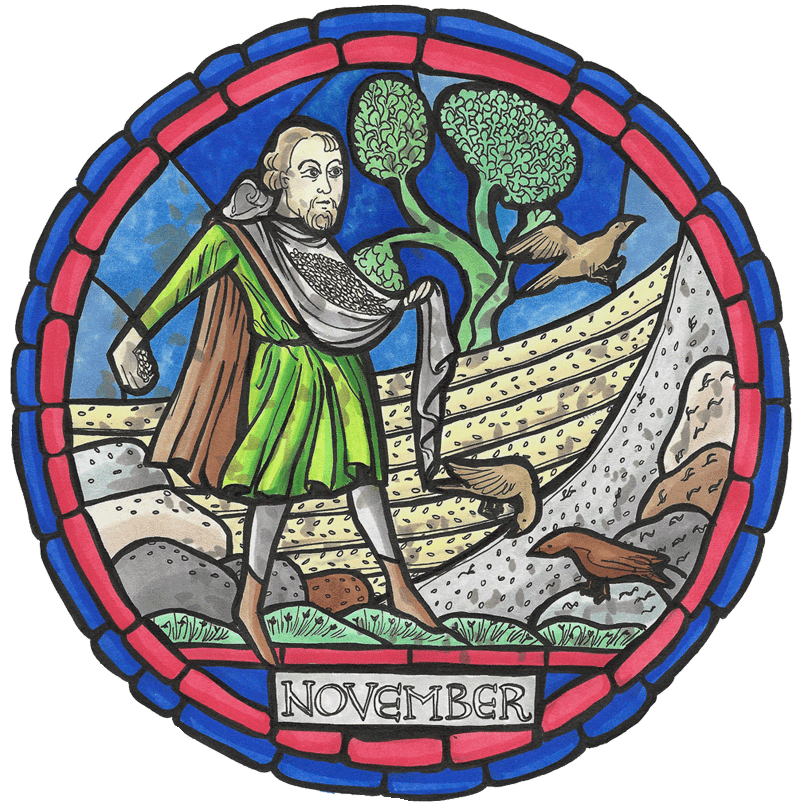
November Time

Asaf from OldNewMethod.com (asaf@oldnewmethod.com)

November

November

Time

In farming the earth, the seasons are rigid and predictable. Winter begins each year at the winter solstice, and although it will vary in rainfall and temperatures, it is always winter and always comes at this exact time. The same, of course, is true of spring, summer, and fall. The outer farmer can rely on this predictability and need not be concerned with the grape harvest during threshing time or pruning during the time for sowing​.

The seasonal fluctuations of inner farming are, by contrast, unpredictable. Every moment brings with it a new challenge and there is no telling when a labor may become relevant. Now confusion or lethargy sets in, so I must reaffirm or reformulate my aim, as discussed in January. Then negativity flares up, calling to mind the principles discussed in October. Then again, momentum seeks to overtake me, so I must apply the methods taught in May. To farm myself, I must remain armed with all my tools and be ready for the unexpected.

The acreage of outer farming is land; the acreage of inner farming is time. The more time we invest in self-observation, plugging leaks, cultivating attention, and applying any of the methods taught here, the faster our work progresses. On the other hand, the more time we waste through only intermittent practice, the more we allow our habits to reassert themselves and beat back our progress. There is aggressive competition over our time. Every thought, mood, desire, and sensation, competes to dominate our internal landscape and waste our time. This explains why it is so difficult to even remember to do our work. Unless we are vigilant, our impulse to work is crowded out by these other impulses. To dedicate more time to inner work—to utilize more of our acreage—we will have to continually shore up our impulse to work above our crowded internal landscape. We will have to remember more and forget less.

For this end, we employ the counting exercise. We aim to remember our work at least 100 times a day, tallying our progress through keeping count. There are various external aids for this, from the mechanical clicker to the digital phone. All are useful, as the point here is to attach an objective number to our frequency. Each time we remember, and make an effort to apply any tool of this teaching, we ‘click’ on our counter.

Tallying our moments of remembrance by itself motivates us to increase their frequency. At the same time, it exposes patches of our day lost in prolonged forgetfulness. Why was I able to click fairly frequently on my way to work, but entirely forgot once I stepped into my office? Why was I able to maintain good frequency while at my desk but lost remembrance altogether during lunchtime? The longer patches of forgetfulness outline the parts of our acreage that are presently under the full sway of Personality. This indicates unambiguously in which direction our farming must proceed.

When a seed germinates, it pushes its root downwards and its stem upwards in a line vertical to the plane of the earth. Likewise, when we successfully apply any of the methods taught here, we push through the artificiality of our Personality and touch Essence. Personality relies on our not-seeing, or self-forgetting. The more often we remember, the better we utilize our acreage, and the faster we will see progress in this work.

This is our labor for November.

The Hidden Agenda Behind Christian Fundamentalism! | Dr. Elaine Pagels

MythVision TV Oct 27, 2025 From the religious historian whose The Gnostic Gospels won both the National Book Award and the National Book Critics Circle Award comes a dramatic interpretation of Satan and his role on the Christian tradition. With magisterial learning and the elan of a born storyteller, Pagels turns Satan’s story into an audacious exploration of Christianity’s shadow side, in which the gospel of love gives way to irrational hatreds that continue to haunt Christians and non-Christians alike. https://www.elaine-pagels.com/

Spinoza on Cause and Effect

ChatGPT

1. One Substance, Infinite Expressions
Baruch Spinoza taught that all things are expressions (modes) of a single infinite reality he called God or Nature (Deus sive Natura). Nothing exists outside of it.

2. God as the Cause of Itself
God alone is causa sui — the cause of itself. God’s very essence involves existence, so its cause and effect are identical. In everything else, cause and effect are partial expressions of that one self-causing substance.

3. Necessary, Not Contingent, Causation
Everything follows from God’s nature with logical necessity, the way conclusions follow from axioms. Events don’t occur “in time” for God; they unfold eternally within one coherent order.

4. Thought and Extension
Reality shows itself in two main ways (attributes):

  • Thought – the order of ideas
  • Extension – the order of physical bodies
    Each runs in perfect parallel. Every mental cause-effect pair corresponds to a physical one; they are two aspects of the same process.

5. Equality of Cause and Effect
Only in God/Nature do cause and effect truly equal one another. In finite things, they are distinct expressions within the same whole — ripples on one ocean.

6. Essence of Spinoza’s View

“From the necessity of the divine nature there must follow infinitely many things in infinitely many ways.” (Ethics, I, Prop. 16)

In brief:

All causes and effects are the self-unfolding of one infinite substance. The universe is God thinking and acting through every mode.

Baruch Spinoza, also known under his Latinized pen name Benedictus de Spinoza (Noember 24, 1632 – February 21, 1677) , was a philosopher of Portuguese-Jewish origin, who was born in the Dutch Republic. Wikipedia

Money Revisited with Darryl Robert Schoon

New Thinking Allowed with Jeffrey Mishlove Nov 1, 2025 Darryl Robert Schoon is a financial analyst famous for having predicted the 2008 market crash. He is author of Light in a Dark Place: The Prison Years, Time of the Vulture, Report to the House Select Committee on Intelligence, Is God Confused?, and The Way to Heaven. He has also written a novel titled You Can’t Always Get What You Want. He is a minister with the Temple of Universality in Tucson, Arizona.  He suggests that the capitalist era that began with the Bank of England in the seventeenth century is nearing its end. The system was structured to create an excess of wealth at the top; but, it has reached a point where it cannot sustain itself. These are slow processes that can last for as long as a century. However, civilization will either dissipate or will reorganize itself into a different (presumably better) modality. New Thinking Allowed host, Jeffrey Mishlove, PhD, is author of The Roots of Consciousness, Psi Development Systems, and The PK Man. Between 1986 and 2002 he hosted and co-produced the original Thinking Allowed public television series. He is the recipient of the only doctoral diploma in “parapsychology” ever awarded by an accredited university (University of California, Berkeley, 1980). He is also the Grand Prize winner of the 2021 Bigelow Institute essay competition regarding the best evidence for survival of human consciousness after permanent bodily death. He currently serves as Co-Director of Parapsychology Education at the California Institute for Human Science. (Recorded on February 23, 2020)

God’s answer to Job

(Image from ccames.org)

“Where were you when I laid the earth’s foundation?
    Tell me, if you understand.
Who marked off its dimensions? Surely you know!
    Who stretched a measuring line across it?
On what were its footings set,
    or who laid its cornerstone—
while the morning stars sang together
    and all the angels[a] shouted for joy?

“Who shut up the sea behind doors
    when it burst forth from the womb,
when I made the clouds its garment
    and wrapped it in thick darkness,
10 when I fixed limits for it
    and set its doors and bars in place,
11 when I said, ‘This far you may come and no farther;
    here is where your proud waves halt’?

12 “Have you ever given orders to the morning,
    or shown the dawn its place,

Job 38:4-12 (New International Version)

Job’s answer to God

[T]herefore have I uttered that I understood not; things too wonderful for me, which I knew not.”

Job 43:2, King James Version

The Astrology Of November 2025 – Game Of Thrones

(Astrobutterfly.com)

November 2025 arrives with momentum and shifting allegiances. While Sagittarius season will officially begin late in the month, we’re still very much in Scorpio territory for most of the month. 

The mood is deep, watery, and mysterious – especially since, by mid-month, we experience 3 consecutive Grand Water Trines.

The depth and intensity of Scorpio, blended with the rising adventurous spirit of Sagittarius, creates a perfect mix of tension and possibility – like a cosmic Game of Thrones.

Jupiter and Saturn are closely trining throughout the month, both receiving supportive aspects from the Sun, Mercury, and later Venus.

Other standout features are the 2 intense lunations – the Taurus and Scorpio New and Full Moons are always the most intense ones, and this year the New Moon in Scorpio is especially potent.

On top of that, quite a few planets change direction, adding to the feeling that the tide is turning.

One of the most important shifts is Uranus re-entering Taurus, pulling us back to the themes and unfinished business of the 2017–2024 era. 

astrology game of thrones

But let’s take a look at the most important transits of the month:

November 4th, 2025 – Mars Enters Sagittarius

On November 4th, 2025, Mars leaves Scorpio and enters Sagittarius

After we’ve clarified what we really want (Mars in Scorpio), now with Mars in Sagittarius, it’s time to pack our bags and prepare for the adventure. Mars in Sagittarius awakens our hero and the heroine’s urge to explore, discover, and push boundaries. 

With Mars in Sagittarius, the world is an oyster – whether we book a flight, go and check out that local spot we’ve never visited before, or simply open a book and travel with our mind’s eye.

This is a time when what’s different becomes enticing – and we’re inspired to get out there and see what life has to offer. 

November 5th, 2025 – Full Moon In Taurus

On November 5th, 2025, we have a Full Moon at 13° Taurus.
This is an unaspected, archetypal Taurus Moon that seems to bring a stabilizing energy to Scorpio season’s proverbial intensity.

The Full Moon ruler, Venus, however – while in domicile in Venus, is anything but peaceful at the moment – sitting at the apex of a T-square with Pluto and Jupiter.

Perhaps there’s no escaping Scorpio season’s intensity after all.

November 7th, 2025 – Venus Enters Scorpio

On November 7th, 2025, Venus enters Scorpio and things get more intense all of a sudden.

Does it help that Venus immediately squares Scorpio’s ruler, Pluto, now at 1° Aquarius? No, it doesn’t. The first days of the ingress are as ‘Scorpio’ as we’d expect them to be. 

But mid-month onwards, Venus forms some beautiful Water trines with Jupiter in Cancer and Saturn and Neptune in Pisces, channeling that Scorpionic depth into healing and meaningful connection. 

If the first week of November is Inanna going into the underworld, the rest of the transit is the Phoenix rising.

November 8th, 2025 – Uranus Reenters Taurus

On November 8th, 2025, Uranus leaves Gemini and reenters Taurus.
When Uranus entered Gemini in July 2025, the momentum around AI became undeniable. When Uranus entered Taurus back in 2018, cryptocurrency volatility dominated the headlines. And when Uranus entered Aries in 2011, the world witnessed the Fukushima disaster.

You might think that a re-ingress – after Uranus has already spent 7+ years in Taurus – would be less dramatic, because “been there, done that” – but nope. 

That’s not how Uranus works. Whenever he crosses a sign boundary, all bets are off – he simply can’t help but shake things up.

Uranus’s last visit through Taurus is a chance to close a 7-year chapter of life with a bang. In 2026 – when Uranus enters Gemini for good – there’s no turning back. 

November 10th, 2025 – Mercury Goes Retrograde

On November 10th, 2025, Mercury goes retrograde at 6° Sagittarius. Mercury will stay retrograde until the end of the month, turning direct again on November 30th, at 20° Scorpio.

Mercury retrograde is one of those astro routines we religiously revisit every 3-4 months.

There’s no way around it, and whether we like it or not, Mercury retrogrades are necessary.
Otherwise, there would never be lessons learned, no opportunities to fix things, and all those subtle course corrections that might not sound as exciting as a Jupiter trine, but make our lives easier in the long run.

November 12th, 2025 – Jupiter Goes Retrograde

Speaking about Jupiter, on November 12th, 2025, Jupiter goes retrograde at 25° Cancer.

And speaking of Jupiter trines, Jupiter is currently in a tight trine to Saturn, which is good news. Both Jupiter and Saturn change direction this month, so this slower-than-usual pace in the sky means they stay linked in a trine orb for longer.

This gives us a chance to make some moves that are truly in our best interests. Jupiter and Saturn are social planets – they shape how we deal with the world, from the social circles we gravitate toward to how we handle jobs and everyday responsibilities.

So when these 2 giants are in alignment, we just find it easier to function socially.

Stationary Jupiter trine Saturn helps us feel like we belong to something bigger than ourselves, and find our natural place in the world. 

November 17th, 2025 – Grand Water Trine

On November 17th, we have a grand water trine at the 25th degree of the water signsSun is at 25° ScorpioJupiter at 25° Cancer, and Saturn at 25° Pisces

We’ve already touched on Jupiter trine Saturn, but when the Sun joins in on November 17th, the energy becomes personal.

Suddenly, our deeper motivations and the direction of our path become not only clearer, but also more purposeful. We feel that our own journey is a meaningful piece in the greater puzzle.

November 20th, 2025 – New Moon In Scorpio

On November 20th, 2025, we have a New Moon at 28° Scorpio.

This New Moon is tightly conjunct Mercury retrograde, so it coincides with the beginning of a new Mercury cycle – one that’s likely to deliver an important message or insight.

This is a highly auspicious New Moon – part of a Grand Trine – and without a doubt, one of the best New Moons we’ve had in a while. A dedicated report will follow closer to the date.

November 22nd, 2025 – Sun Enters Sagittarius

On November 22nd, 2025, the Sun enters Sagittarius. Happy birthday to all the dreamers and truth-seekers out there!

What would we do without our Sagittarius people, and how would we move forward without the spirit of Sagittarius season lighting the way?

This is when we celebrate Thanksgiving and get excited for Christmas preparations – at least in the Western world. But most cultures have their own ways of marking this season with optimism and a sense of hope for what’s ahead.

November 23rd-26th, 2025 – Grand Water Trine

On November 23rd, Mercury – and a few days later, Venus – trine Jupiter and Saturn, forming a Grand Trine at 24–25 degrees of the water signs.

This month we are truly blessed with a successive series of Grand Trines – Sun, Moon, Mercury, and now Venus – all aligning with Jupiter and Saturn.

While previous trines may have helped us clarify our purpose or direction, this is a feel-good transit – because hey, Venus is what makes us feel good. Jupiter adds an extra oomph, and Saturn makes sure we don’t go overboard.

This is a great time to celebrate something or simply spend time with people we care about.

November 28th, 2025 – Saturn Goes Direct

On November 28th, 2025, Saturn goes direct at 25° Pisces.

Saturn’s return to Pisces has been a mixed blessing: it tempered the fiery urgency of the Saturn-Neptune conjunction in Aries, which was likely needed. Yet at the same time, it’s drawn us back into familiar territory – places we might have hoped to leave behind.

But it’s not over till it’s over. There’s a big chapter of our lives that is slowly – very slowly – wrapping up.

From now until February 14th, 2026, when Saturn makes its final pass through Pisces, we have the opportunity to tie up loose ends and bring closure to unfinished business. Remember, Saturn is trine Jupiter – and will soon sextile Pluto – so there’s a lot of support in the sky.

November is less chaotic than other months, like the earlier part of the year or September – but when we look back, this could be the month when things finally clicked into place.

PS: Tomorrow the Astro Butterfly School will make an important announcement – a new 2.5-year educational program featuring 3 different paths: “Transform Your Life With Astrology,” “Natal Chart Mastery,” and “Astrology Through Time.” More information will be shared in the upcoming email.

Consciousness, sexuality, androgyny, futurism, space, the arts, science, astrology, democracy, humor, books, movies and more