
Democracy Now! Nov 3, 2025 Latest Shows Support our work: https://democracynow.org/donate/sm-de… President Trump held a lavish Great Gatsby-themed Halloween party at Mar-a-Lago Friday, just hours before an estimated 42 million people lost SNAP benefits across the country. Kirk Curnutt, the executive director of the international F. Scott Fitzgerald Society, says that while “Gatsby is famous for its lavish party scenes, [what] people often miss is that the entire thrust of the book is to critique that conspicuous consumption and the wastage that goes on in these sorts of events.”
Sri Aurobindo on the solidarity of the world

Maya Angelou on whining

(Angelou in 1993)
“Whining is not only graceless, but can be dangerous. It can alert a brute that a victim is in the neighborhood.”
~ Maya Angelou
Maya Angelou (April 4, 1928 – May 28, 2014) was an American memoirist, poet, and civil rights activist. She published seven autobiographies, three books of essays, several books of poetry, and is credited with a list of plays, movies, and television shows spanning over 50 years. She received dozens of awards and more than 50 honorary degrees. Wikipedia
Frank Sinatra – The Lady Is A Tramp with Ella Fitzgerald
Frank Sinatra Apr 29, 2016 Frank Sinatra performing “The Lady Is A Tramp,” featuring Ella Fitzgerald, part of Sinatra And Friends/The Man And His Music.
What the image of the Milky Way’s black hole really shows
CREDIT: ABHISHEK JOSHI / UIUC
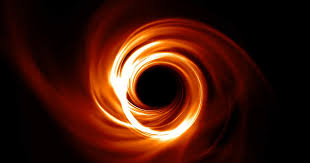
The massive object at the galaxy’s center is invisible. But this year’s picture of the swirling plasma around its edges will help to reveal more about the galaxy’s history and evolution.
By Katie McCormick 11.08.2022 (Knowablemagazine.com)
Support sound science and smart stories
Help us make scientific knowledge accessible to all
Donate today
Black holes keep their secrets close. They imprison forever anything that enters. Light itself can’t escape a black hole’s hungry pull.
It would seem, then, that a black hole should be invisible — and taking its picture impossible. So great fanfare accompanied the release in 2019 of the first image of a black hole. Then, in spring 2022, astronomers unveiled another black hole photo — this time of the one at the center of our own Milky Way.
The image shows an orange, donut-shaped blob that looks remarkably similar to the earlier picture of the black hole in the center of galaxy Messier 87. But the Milky Way’s black hole, Sagittarius A*, is actually much smaller than the first and was more difficult to see, since it required peering through the hazy disk of our galaxy. So even though the observations of our own black hole were conducted at the same time as M87’s, it took three additional years to create the picture. Doing so required an international collaboration of hundreds of astronomers, engineers and computer scientists, and the development of sophisticated computer algorithms to piece together the image from the raw data.
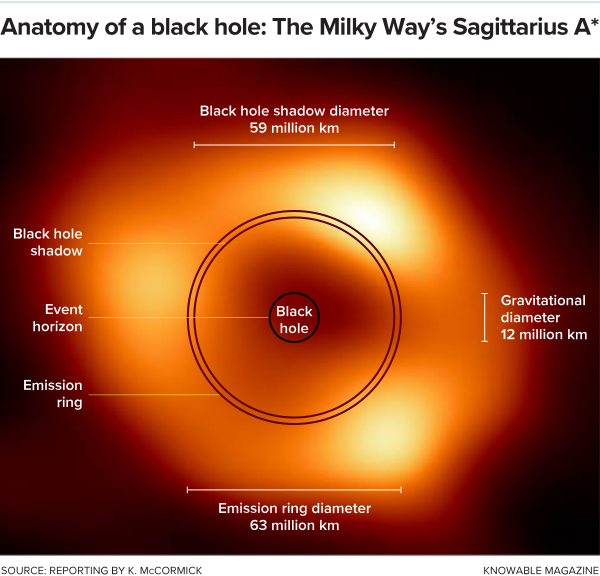
These “photos” do not, of course, directly show a black hole, defined as the region of space inside a point-of-no-return barrier known as an event horizon. They actually record portions of the flat pancake of hot plasma swirling around the black hole at high speeds in what’s known as the accretion disk. The plasma is composed of high-energy charged particles. As plasma spirals around the black hole, its accelerating particles emit radio waves. The blurry orange ring seen in the images are an elaborate reconstruction of these radio waves captured by eight telescopes scattered around the Earth, collectively known as the Event Horizon Telescope (EHT).
The latest image tells the tale of the epic journey of radio waves from the center of the Milky Way, providing unprecedented detail about Sagittarius A*. The image also constitutes “one of the most important visual proofs of general relativity,” our current best theory of gravity, says Sera Markoff, an astrophysicist at the University of Amsterdam and member of the EHT collaboration.
Studying supermassive black holes such as Sagittarius A* will help scientists learn more about how galaxies evolve over time and how they congregate in vast clusters across the universe.
From the galactic core
Sagittarius A* is 1,600 times smaller than Messier 87’s black hole that was imaged in 2019, and is also about 2,100 times closer to Earth. That means the two black holes appear to be about the same size on the sky. Geoffrey Bower, an EHT project scientist at the Academia Sinica Institute of Astronomy and Astrophysics in Taiwan, says that the resolution required to see Sagittarius A* from Earth is the same as would be required to take a picture of an orange on the surface of the Moon.
The center of our galaxy is 26,000 light-years away from us, so the radio waves collected to create this image were emitted around the time that one of the earliest-known permanent human settlements was constructed. The radio waves’ voyage began when they were first emitted from particles in the black hole’s accretion disk. With a wavelength of about 1 mm, the radiation traveled toward Earth relatively undisturbed by the intervening galactic gas and dust. If the wavelength were much shorter, like visible light, the radio waves would have been scattered by the dust. If the wavelength were much longer, the waves would have been bent by charged clouds of plasma, distorting the image.
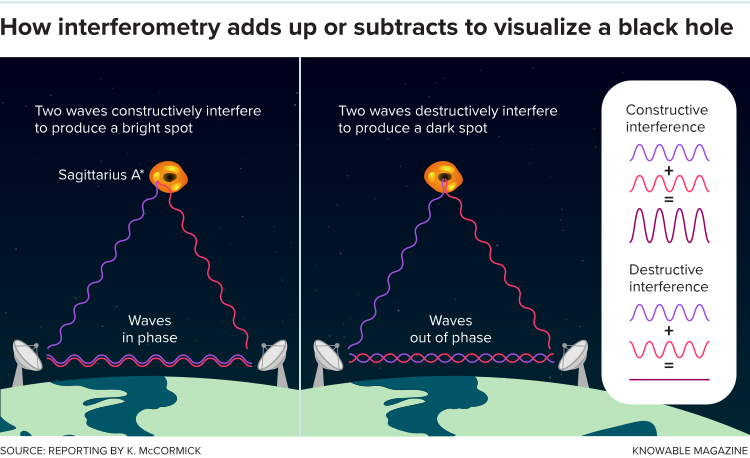
Finally, after the 26,000-year trek, the radio waves were picked up and recorded at the radio observatories distributed across our planet. The large geographic separation between the observatories was essential — it allowed the consortium of researchers to detect extremely subtle differences in the radio waves collected at each site through a process called interferometry. These small differences are used to deduce the minuscule differences in the distance each radio wave traveled from its source. Using computer algorithms, the scientists managed to decode the path-length differences of the radio waves to reconstruct the shape of the object that emitted them.
Researchers put all this into a false-color image, where orange represents high-intensity radio waves and black represents low-intensity. “But each telescope only picks up a tiny fraction of the radio signal,” explains Fulvio Melia, an astrophysicist at University of Arizona who has written about our galaxy’s supermassive black hole. Because we’re missing much of the signal, “instead of seeing a crystal clear photo, you see something that’s a little foggy … a little blurred.”
The image helps reveal more about the black hole’s event horizon — the closest point to which anything can approach the black hole without being sucked in. Beyond the event horizon, not even light can escape.
From the image, scientists have been able to better estimate the size of the event horizon and deduce that the accretion disk is tilted by more than 40 degrees from the Milky Way’s disk, so that we’re seeing the round face of the flat accretion disk, rather than the thin sliver of its edge.
But even if the black hole’s accretion disk were oriented edge-on relative to Earth, the gravity around the black hole warps the space around it so much that light emitted from the backside of the black hole would be bent around to come toward us, making a ringlike image regardless of its orientation. So, how do scientists know its orientation? Because the ring is mostly round; if we were viewing the accretion disk edge-on, then the ring would be more squished and oblong.
Stay in the Know
Sign up for the Knowable Magazine newsletter today
Markoff thinks that this new ability to look into the heart of our galaxy will help to fill in gaps in our understanding of the evolution of galaxies and the large-scale structure of the universe. A dense, massive object such as a black hole at the center of a galaxy influences the movements of the stars and dust near it, and that influences how the galaxy changes over time. Properties of the black hole, such as in which direction it spins, depend on the history of its collisions — with stars or other black holes, perhaps. “A lot of people … look at the sky and think of it all as static, right? But it’s not. It’s a big ecosystem of stuff that’s evolving,” Markoff says.
So far, the fact that the image matches the scientists’ expectations so precisely makes it an important confirmation of current theories of physics. “This has been a prediction that we’ve had for two decades,” Bower says, “that we would see a ring of this scale. But, you know, seeing is believing.”
10.1146/knowable-110822-1
Katie McCormick is a quantum physicist-turned-science writer based in Sacramento, California. Read more of her work at www.katiemccormickphd.com.
John Berger on hope

“Hope is not a form of guarantee; it’s a form of energy, and very frequently that energy is strongest in circumstances that are very dark.”
–John Berger
John Peter Berger (November 5, 1926 – January 2, 2017) was an English art critic, novelist, painter and poet. His novel G. won the 1972 Booker Prize, and his essay on art criticism Ways of Seeing, written as an accompaniment to the BBC series of the same name, was influential. He lived in France for over fifty years. Wikipedia
Walt Whitman Had Some Thoughts on Sex
“What Do You Call Free Love? There’s No Other Kind of Love”
Brenda Wineapple April 22, 2019 (lithub.com)
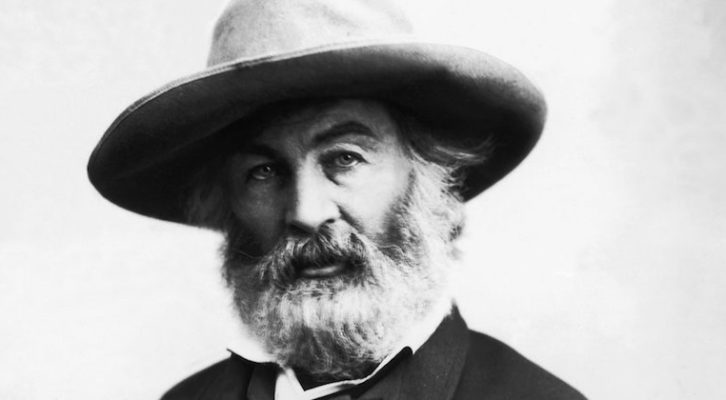
Toward the end of Walt Whitman’s life, the writer Horace Traubel visited him often at his home in Camden, New Jersey, and recorded their conversations on friendship, family, the Civil War, literature, and other topics, producing thousands of pages of transcripts in total. In Walt Whitman Speaks, editor Brenda Wineapple offers selections from their conversations, including these on sex.
*
Damn the expurgated books! I say damn ’em! The dirtiest book in all the world is the expurgated book!
Sex is a red rag to most people. It takes some time to get accustomed to me, but if the folks will only persevere they will finally feel right comfortable in my presence. “Children of Adam”—the poems—are very innocent: they will not shake down a house. A man was here the other day who asked me: “Don’t you feel rather sorry on the whole that you wrote the sex poems?” I answered him by asking another question: “Don’t you feel rather sorry on the whole that I am Walt Whitman?”
*
All this fear of indecency, all this noise about purity and sex and the social order and the Comstockism particular and general is nasty—too nasty to make any compromise with. I never come up against it but I think of what [Heinrich] Heine said to a woman who had expressed to him some suspicion about the body. “Madame,” said Heine, “are we not all naked under our clothes?”
*
We have got so in our civilization, so-called (which is no civilization at all) that we are afraid to face the body and its issues—when we shrink from the realities of our bodily life: when we refer the functions of the man and the woman, their sex, their passion, their normal necessary desires, to something which is to be kept in the dark and lied about instead of being avowed and gloried in.
*
The body is stubborn: it craves bodily presences: it has its own peculiar tenacities—we might say aspirations as well as desires.
*
Obscenity? Obscene? Oh! Is the surgeon’s knife obscene? It might just as well be said of the one as the other. This is a picture to the life, a cut to the bone. It is not a pleasant book: it is horrible, horrible, in its truth, its graphic power.
*
There was one of the department heads at Washington who conceived a great dislike for the word virile—gave out orders that it should not be used in any of the documents issuing from that department. I was very curious about it, and asked him once how his antipathy (and it was a virile antipathy!) arose. He said that he hated the word—that it called up in him images of everything filthy, nasty, vile. It was very amusing. I remarked to him: “Did it never occur to you that the fault is in you and not in the word? I use the word—like it—and am never once brought by it into touch with the images you speak of.” But he was obdurate—remarking only: “Well—whatever: I won’t have it! I hate the word!” And yet he was a man of force, filled his place well, in all the usual ways was sound and sensible.
*
I often say to myself about Calamus—perhaps it means more or less than what I thought myself—means different: perhaps I don’t know what it all means—perhaps never did know.
*
Any demonstration between men—any: it is always misjudged: people come to conclusions about it: they know nothing, there is nothing to be known; nothing except what might just as well be known: yet they shake their wise heads—they meet, gossip, generate slander: they know what is not to be known—they see what is not to be seen: so they confide in each other, tell the awful truth: the old women men, the old men women, the guessers, the false-witnesses—the whole caboodle of liars and fools.
*
“Calamus” is a Latin word—much used in Old English writing, however. I like it much—it is to me, for my intentions, indispensible—the sun revolves about it, it is a timber of the ship—not there alone in that one series of poems, but in all, belonging to all. It is one of the United States—it is the quality which makes the states whole—it is the thin thread—but, oh! the significant thread!—by which the nation is held together, a chain of comrades; it could no more be dispensed with than the ship entire.
*
I have heard nothing but expurgate, expurgate, expurgate, from the day I started. Everybody wants to expurgate something—this, that, the other thing. If I accepted all the suggestions there wouldn’t be one leaf of the Leaves left—and if I accepted one why shouldn’t I accept all? Expurgate, expurgate, expurgate! I’ve heard that till I’m deaf with it. Who didn’t say expurgate? Rossetti said expurgate and I yielded. Rossetti was honest, I was honest—we both made a mistake. It is damnable and vulgar—the mere suggestion is an outrage. Expurgation is apology—yes, surrender—yes, an admission that something or other was wrong. Emerson said expurgate—I said no, no. I have lived to regret my Rossetti yes—I have not lived to regret my Emerson no. Expurgate, expurgate, expurgate—apologize, apologize: get down on your knees.
*
Emerson was quite vigorous in talking about the critics—talking with me: he said: “I seem to mystify them—rather mystify than antagonize them”: which I guess was true. I seem to make them mad—rile them: I mystify them, too, but they don’t know it: they only know I am vile, indecent, perverted, adulterous.
*
The world now can have no idea of the bitterness of the feeling against me in those early days. I was a tough—obscene: indeed, it was my obscenity, libidinousness, all that, upon which they made up their charges.
*
It has always been a puzzle to me why people think that because I wrote “Children of Adam,” Leaves of Grass, I must perforce be interested in all the literature of rape, all the pornography of vile minds. I have not only been made a target by those who despised me but a victim of violent interpretation by those who condoned me.
*
What do you call free love? There’s no other kind of love, is there? As to the next step—who knows what it means? I only feel sure of one thing: that we won’t go back: that the women will take care of sex things—make them what they choose: man has very little to do with it except to conform.
*
I think Swedenborg was right when he said there was a close connection—a very close connection—between the state we call religious ecstasy and the desire to copulate. I find Swedenborg confirmed in all my experience. It is a peculiar discovery. It was Burns—Whittier’s friend Burns—who said in a couple of lines of one of his poems, I’d rather cause the birth of one than the death of 20! And that would be my doctrine, too!
*
We have gone on for so long hurting the body that the job of rehabilitating it seems prodigious if not impossible. The time will come when the whole affair of sex—copulation, reproduction—will be treated with the respect to which it is entitled. Instead of meaning shame and being apologized for, it will mean purity and will be glorified.
*
The woman who has denied the best of herself—the woman who has discredited the animal want, the eager physical hunger, the wish of that which though we will not allow it to be freely spoken of is still the basis of all that makes life worth while and advances the horizon of discovery. Sex: sex: sex: whether you sing or make a machine, or go to the North Pole, or love your mother, or build a house, or black shoes, or anything—anything at all—it’s sex, sex, sex: sex is the root of it all: sex—the coming together of men and women: sex: sex.
__________________________________

Walt Whitman Speaks: His Final Thoughts on Life, Writing, Spirituality, and the Promise of America as told to Horace Traubel, edited by Brenda Wineapple (Library of America).ShareSave
Brenda Wineapple Horace Traubel Leaves of Grass Library of America sex Walt Whitman Walt Whitman Speaks

Brenda Wineapple
Brenda Wineapple was born in Boston, raised in northern Massachusetts (on the New Hampshire border), and now lives in New York. She has received such numerous honors as a Literature Award from the American Academy of Arts and Letters, a Pushcart Prize, a Guggenheim Fellowship, an American Council of Learned Societies Fellowship, two National Endowment Fellowships in the Humanities, and most recently an NEH Public Scholars Award for The Impeachers. She is also an elected member of the American Academy of Arts and Sciences and of the Society of American Historians and regularly contributes to major publications such as the New York Times Book Review, The New York Review of Books, and The Nation.
Canada’s therapists know what they’re going to be talking about this week
1 day ago by Luke Gordon Field ( @lukemaybefunny ) (thebeaverton.com)

TORONTO – Canada’s psychologists, psychiatrists and PTSD specialists are all pretty confident they know what they’ll be covering with their patients this week.

“Usually it’s a bit of a mystery,” said Dr. Monica McMichael. “Is it going to be a dream they had last night about their 3rd grade teacher, or something their Mom said in passing 2 months ago?”
“But this week it will definitely be about… well, you saw.”
Having suffered one of the most heartbreaking losses in the history of sports during last night’s World Series Game 7, Blue Jays fans need a place to process their trauma, and the nation’s mental health specialists are ready to pick up the slack.
“We are here for you. Whether you want to get into the gritty details of the Blue Jays stranding multiple runners at third base, or take a more big picture look at how cursed Toronto sports fandom is and wonder what it says about your psychological make up that you keep hurting yourself by following these teams, we got you,” said Dr. McMichael.
“The only problem is that we are also traumatized by what happened, so who do we talk to?
On AI


Jared Yates Sexton on the rising resistance to Trump’s authoritarianism
FIVE MINUTE NEWS Nov 2, 2025 THE WEEKEND SHOW with MeidasTouch Author Jared Yates Sexton joins Anthony Davis to discuss the rising resistance to Trump’s authoritarianism, including the courts ruling to restore SNAP benefits. Plus the rise of the new left in the face of the far right with Zohran Mamdani changing the rules for Democratic campaigning – only on The Weekend Show.