By G. Allen Johnson, Staff Writer Nov 11, 2025 (SFChronicle.com)
Gift Article
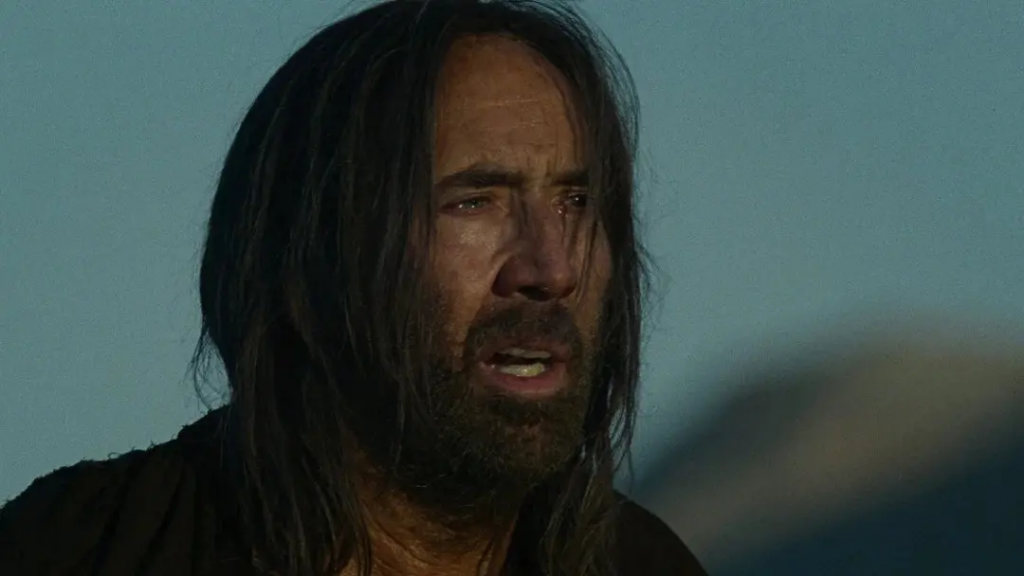
Nicolas Cage as Joseph in the Biblical film “The Carpenter’s Son.”Magnolia Pictures
“The Carpenter’s Son” dares to imagine what Jesus’ childhood would have been like if his earthly father had been Nicolas Cage.
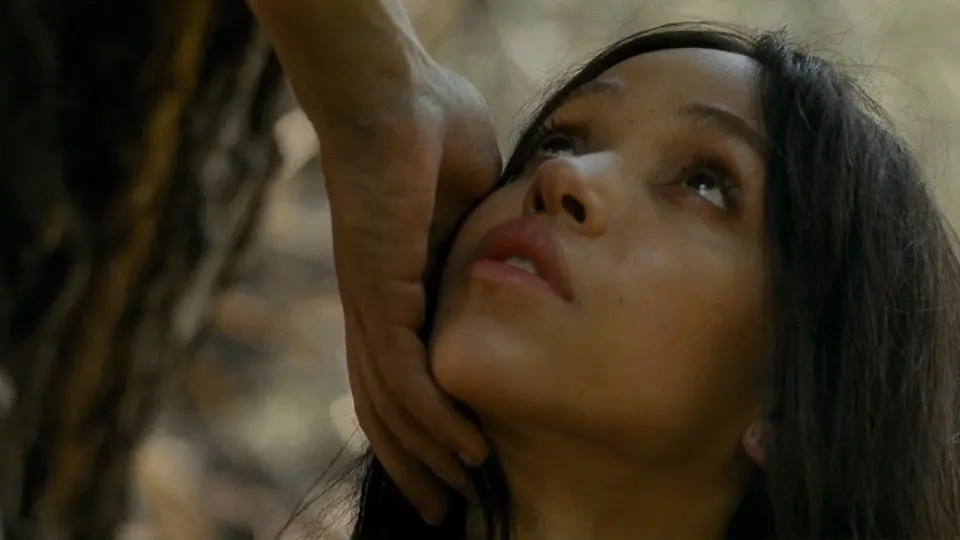
Like everyone who comes into Cage’s cinematic orbit, it would have been, to put it mildly, weird. Add FKA Twigs, last seen in the remake of “The Crow” (2024), as Jesus’ mother Mary, and writer-director Lotfy Nathan’s drama — horror film, really — is one of the most unique Biblical movies ever made.
That doesn’t make it good, necessarily, but it is certainly interesting.
There isn’t much known about Jesus’ teens and 20s. His so-called “missing years,” from age 13 to 30, are largely undocumented in the New Testament, which allows Nathan’s imagination to run wild.
Based in part on the Infancy Gospel of Thomas, a second century text that some Christians consider heretical, the film opens with Joseph (Cage) and his family in hiding in a small village in Roman-controlled Egypt. The emerging religious reputation of Jesus (Noah Jupe) has made him a target, causing the family to move.
Mary is the soft, nurturing presence, but Joseph is a disciplinarian, gruffly forcing Jesus to learn his religious lessons and instill work ethic.
FKA Twigs as Mary in the Biblical film “The Carpenter’s Son.”Magnolia Pictures
While Joseph plies his carpentry trade to keep the family afloat, Jesus is left to wander the village and is exposed to such things as class divisions, leprosy, cruelty and other human conditions.
He is befriended by a strange child (Isla Johnston), who challenges the teenager’s emerging belief system and begins a series of what Jesus soon realizes are temptations — possibly by Satan.
Soon Jesus begins to have frightening nightmares and visions. An alarmed Joseph doubles down on his religious teachings, realizing what’s at stake.
Describing this makes it sound like there’s more plot than there actually is, but “The Carpenter’s Son” isn’t a conventional story. It’s more of a mood piece, with a true run time of just barely 90 minutes. But it’s got Cage, and that’s the difference maker.
More Information
“The Carpenter’s Son”: Biblical horror. Starring Nicolas Cage, Noah Jupe and FKA twigs. Directed by Lotfy Nathan. (R. 94 minutes.) In select theaters Friday, Nov. 14.
Add “The Carpenter’s Son” to the actor’s rogues gallery of characters in the past few years that includes the hermit-like former chef in “Pig”; a movie star named Nick Cage in “The Unbearable Weight of Massive Talent”; the befuddled professor who inexplicably appears in people dreams in “Dream Scenario” and, earlier this year, the title character in “The Surfer.”
No surprise, then, that Cage’s Joseph is the most bizarre since the one that wore the Amazing Technicolor Dreamcoat.
RAPID CITY, SD—Saying that he always strives to set a strong example for his son to follow, local father Gary Dalton told reporters Tuesday that he has been carefully teaching his 9-year-old boy Zachary how to overreact with blind rage to completely irrelevant bullshit.
“Now that Zach’s getting older, it’s important for me to show him how to deal with the minor inconveniences in life by blowing them totally out of proportion,” said Dalton, noting that he frequently tries to demonstrate to his son the proper way to fly off the handle both at home and in public. “Zach should know that small, trivial irritations, like misplaced keys or having to relight the pilot light in the basement, should trigger an unbridled anger inside him. And that’s not something he can fully learn from his friends at school or by watching TV—he needs a father figure right there, blowing up in his face about never, ever messing with the DVR again for him to see exactly how it’s done.”
“It’s up to me as a parent to become unsettlingly irate over something as small as letting the screen door slam shut, so that Zach learns to never let even the most petty, negligible nuisance slide,” Dalton added. “He’s an observant kid and he really looks up to me, so I’m sure he’ll catch on quickly.”
In an effort to help guide his son’s development, Dalton explained that he consistently tries to embody the qualities of irritability, hostility, and bitterness in his daily life, emphasizing to his fourth-grade son the importance of letting his annoyance over an inconsequential matter develop into a lingering, biting resentment that makes others feel uncomfortable to be near him.
In addition, the 42-year-old market researcher said that he has been making a concerted effort of late to show his boy how to obsess over such ultimately trifling things as a driver going too slow in the left lane or a person who is slightly holding up a line, and to interpret these incidents as if they were significant, deliberate personal slights.
Dalton told reporters that he believes he’s made significant headway with his son in recent weeks. In particular, the local father cited several “very constructive” instances in which he demonstrated how to absolutely flip out when someone asks him to pull the car over to use the bathroom; when to pound his fist on a table and mutter the phrases “Goddammit” and “I don’t need this” in increasingly loud and aggressive tones; and the proper way to scowl, roll his eyes, and pantomime hurling his cell phone violently to the floor when his wife calls to tell him that something came up and he’ll have to drive the children to their soccer game.
“I always try to lead by example, but now, when some meaningless little thing doesn’t go Zach’s way, I’ll help guide him through the process of treating it as if it were the end of the world,” said Dalton, noting how his own father instructed him how to fly into a rage over barely anything at all when he was a child. “Just last weekend, when a waitress brought him the wrong item, I laid out the process of having a public meltdown step-by-step, showing him exactly how to get irrationally livid, how to clench his teeth and curse under his breath, and then how to belittle a stranger’s intelligence in a loud, confrontational scene that causes others to look over in shock and disgust. I think it really made a strong impression on him.”
The local father told reporters that he was particularly looking forward to an upcoming family camping trip, claiming that a single explosive outburst in such close quarters would “go a long way” toward helping his son understand how to generalize a small frustration into a broad, unrestrained sense of anger that simmers for days and effectively ruins the whole family’s entire weekend.
Dalton reported, however, that he feels he’s able to get through to his son most clearly when he and Zach spend time alone together.
“When it’s just me and Zach, I can really show him up-close how enraged he should become over the unimportant things in life,” said Dalton, highlighting recent instructive one-on-one interactions in which he lashed out at his son for talking during a TV show and for touching the thermostat. “My hope is that, one day, Zach will be able to show his own son how to completely freak out at the slightest provocation and then snap at his wife and children.”
“These are important life skills I’m passing down to Zach, which he’ll be able to use nearly every day as he gets older,” Dalton continued. “And I really look forward to watching him grow into the arbitrary, quick-to-anger man I know he’s capable of becoming.”
There are experiences in life that strike at the center of our being, sundering us in half with unforeseen pain for which we were entirely unbraced. Because we know that this is possible — from the lives of others, from our own past experience, from the history of the heart recorded in our literature — we are always living with the awareness, conscious or unconscious, that life can sunder us at any given point without warning. This is the price of consciousness, which makes living both difficult and urgent. “Nothing is easy when you might come apart in the middle at any moment,” Tove Jansson (August 9, 1914–June 27, 2001) writes in her almost unbearably wonderful 1972 masterpiece The Summer Book (public library), written in the wake of her mother’s death.
Jansson’s observation here is literal: Her protagonist — a little girl named Sophia, who is living on a small Nordic island with her elderly grandmother after her mother’s death — finds herself thinking about what it’s like to be a worm, fabled to go on living two new lives when split in half.
Worms — those humblest of creatures, which Darwin regarded with absolute amazement and celebrated as the unsung sculptors of the biosphere, having tilled and fertilized the Earth as we know it — dwell in the popular imagination as a living metaphor for regeneration, for turning trauma into redoubled life. (Here, poetic truth and scientific fact diverge — in reality, most earthworms, of which there are more than 1,800 species, have a distinct head and tail; if cut in the middle, some species can regrow a new tail from the head half and go on living, but the tail half dies. Perhaps the planarium flatworm — a tiny invertebrate belonging to the phylum Platyhelminthes, separate from earthworms — is the more scientifically accurate metaphor, for it can regrow its entire body from the smallest cut fragment.)
Still, the poetic image of the cleaved worm that goes on living is a fertile thought experiment for how we may think about those most sundering experiences.
Wondering about what it may be like for the worm to be cut in half, Sophia discovers one of life’s elemental truths — that the price of all growth is pain, but the pain passes and the growth remains:
The worm probably knows that if it comes apart, both halves will start growing separately. Space. But we don’t know how much it hurts. And we don’t know, either, if the worm is afraid it’s going to hurt. But anyway, it does have a feeling that something sharp is getting closer and closer all the time. This is instinct. And I can tell you this much, it’s not fair to say it’s too little, or it only has a digestive canal, and so that’s why it doesn’t hurt. I am sure it does hurt, but maybe only for a second.
It always hurts to grow twice as alive. And the question is always what are you going to do with your new uncharted life. Jansson imagines this is the ultimate challenge of the worm halves as they come to live as reborn wholes:
They realized that from now on life would be quite different, but they didn’t know how, that is, in what way.
ARIES (March 21-April 19): The Akan concept of Sankofa is represented by a bird looking backward while moving forward. The message is “Go back and get it.” You must retrieve wisdom from the past to move into the future. Forgetting where you came from doesn’t liberate you; it orphans you. I encourage you to make Sankofa a prime meditation, Aries. The shape of your becoming must include the shape of your origin. You can’t transcend what you haven’t integrated. So look back, retrieve what you left behind, and bring it forward.
TAURUS (April 20-May 20): The coming weeks will be an excellent time for you to engage in STRATEGIC FORGETTING. It’s the art of deliberately unlearning what you were taught about who you should be, what you should want, and how you should spend your precious life. Fact: Fanatical brand loyalty to yourself can be an act of self-sabotage. I suggest you fire yourself from your own expectations. Clock out from the job of being who you were yesterday. It’s liberation time!
GEMINI (May 21-June 20): We should all risk asking supposedly wrong questions. Doing so reminds us that truth and discovery often hide in the compost pile of our mistaken notions. A wrong question can help us shed tired assumptions, expose invisible taboos and lure new insights out of hiding. By leaning into the awkward, we invite surprise, which may be a rich source of genuine learning. With that in mind, I invite you to ask the following: Why not? What if I fail spectacularly? What would I do if I weren’t afraid of looking dumb? How can I make this weirder? What if the opposite were true? What if I said yes? What if I said no? What if this is all simpler than I’m making it? What if it’s stranger than I can imagine?
CANCER (June 21-July 22): Cancerian novelist Octavia Butler said her stories were fueled by two obsessions: “Where will we be going?” and “How will we get there?” One critic praised this approach, saying she paid “serious attention to the way human beings actually work together and against each other.” Other critics praised her “clear-headed and brutally unsentimental” explorations of “far-reaching issues of race, sex, power.” She was a gritty visionary whose imagination was expansive and attention to detail meticulous. Let’s make her your inspirational role model. Your future self is now leaning toward you, whispering previews and hints about paths still half-formed. You’re being invited to be both a dreamer and builder, both a seer and strategist. Where are you going, and how will you get there?
LEO (July 23-Aug. 22): The Tagalog language includes the word kilig. It refers to the butterfly-in-the-stomach flutter when something momentous, romantic or cute happens. I suspect kilig will be a featured experience for you in the coming weeks—if you make room for it. Please don’t fill up every minute with mundane tasks and relentless worrying. Meditate on the truth that you deserve an influx of such blessings and must expand your consciousness to welcome their full arrival.
VIRGO (Aug. 23-Sept. 22): Your liver performs countless functions, including storing vitamins, synthesizing proteins, regulating blood sugar, filtering 1.5 quarts of blood per minute and detoxifying metabolic wastes. It can regenerate itself from as little as twenty-five percent of its original tissue. It’s your internal resurrection machine: proof that some damage is reversible, and some second chances come built-in. Many cultures have regarded the liver not just as an organ, but as the seat of the soul and the source of passions. Some practice ritual purification ceremonies that honor the liver’s pivotal role. In accordance with astrological omens, Virgo, I invite you to celebrate this central repository of your life energy. Regard it as an inspiring symbol of your ability to revitalize yourself.
LIBRA (Sept. 23-Oct. 22): The pupils of your eyes aren’t black. They are actually holes. Each pupil is an absence, a portal where light enters you and becomes sight. Do you understand how amazing this is? You have two voids in your face through which the world pours itself into your nervous system. These crucial features are literally made of nothing. The voidness is key to your love of life. Everything I just said reframes emptiness not as loss or deficiency, but as a functioning joy. Without the pupils’ hollowness, there is no color, no shape, no sunrise, no art. Likewise in emotional life, our ability to be delighted depends on vulnerability. To feel wonder and curiosity is to let the world enter us, just as light enters the eye.
SCORPIO (Oct. 23-Nov. 21): Your dreams speak in images, not ideas. They bypass your rational defenses and tell the truth slantwise because the truth straight-on may be too bright to bear. The source of dreams, your unconscious, is fluent in a language that your waking mind may not be entirely adept in understanding: symbol, metaphor and emotional logic. It tries to tell you things your conscious self refuses to hear. Are you listening? Or are you too busy being reasonable? The coming weeks will be a crucial time to tune in to messages from deep within you.
SAGITTARIUS (Nov. 22-Dec. 21): The tour guide at the museum was describing the leisure habits of ancient Romans. “Each day’s work was often completed by noon,” he said. “For the remainder of the day, they indulged in amusement and pleasure. Over half of the calendar consisted of holidays.” As I heard this cheerful news, my attention gravitated to you, Sagittarius. You probably can’t permanently arrange your schedule to be like the Romans’. But you’ll be wise to do so during the coming days. Do you dare to give yourself such abundant comfort and delight? Might you be bold enough to rebel against the daily drudgery to honor your soul’s and body’s cravings for relief and release?
CAPRICORN (Dec. 22-Jan. 19): The Zulu greeting Sawubona means “I see you.” Not just “hello,” but “I acknowledge your existence, your dignity and your humanity.” The response is Ngikhona: “I am here.” In this exchange, people receive a respectful appreciation of the fact that they contain deeper truths below the surface level of their personality. This is the opposite of the Western world’s default state of mutual invisibility. What if you greeted everyone like this, Capricorn—with an intention to bestow honor and recognition? I recommend that you try this experiment. It will spur others to treat you even better than they already do.
AQUARIUS (Jan. 20-Feb. 18): Bear with me while I propose an outlandish-sounding theory: that you have enough of everything. Not eventually, not after the next achievement, but right now: You have all you need. What if enoughness is not a quantity but a quality of attention? What if enoughness isn’t a perk you have to earn but a treasure you simply claim? In this way of thinking, you consider the possibility that the finish line keeps moving because you keep moving it. And now you will decide to stop doing that. You resolve to believe that this breath, this moment and this gloriously imperfect life are enough, and the voice telling you it’s not enough is selling something you don’t need.
PISCES (Feb. 19-March 20): The Inuit people have dozens of words for snow. The Scots have over a hundred words for rain. Sanskrit is renowned for its detailed and nuanced vocabulary relating to love, tenderness and spiritual bliss. According to some estimates, there are ninety-six different terms for various expressions of love, including the romantic and sensual kind, as well as compassion, friendship, devotion and transcendence. I invite you to take an inventory of all the kinds of affection and care you experience. Now is an excellent phase to expand your understanding of these mysteries—and increase your capacity for giving and receiving them.
In 1913, C.G. Jung started a unique self- experiment that he called his “confrontation with the unconscious”: an engagement with his fantasies in a waking state, which he charted in a series of notebooks referred to as The Black Books. These intimate writings shed light on the further elaboration of Jung’s personal cosmology and his attempts to embody insights from his self- investigation into his life and personal relationships. The Red Book drew on material recorded from 1913 to 1916, but Jung actively kept the notebooks for many more decades.
Presented in a magnificent, seven-volume boxed collection featuring a revelatory essay by noted Jung scholar Sonu Shamdasani—illuminated by a selection of Jung’s vibrant visual works—and both translated and facsimile versions of each notebook, The Black Books offer a unique portal into Jung’s mind and the origins of analytical psychology.
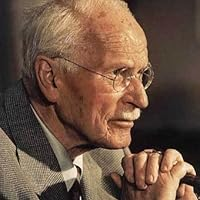
Carl Gustav Jung (/jʊŋ/; German: [ˈkarl ˈɡʊstaf jʊŋ]), often referred to as C. G. Jung, was a Swiss psychiatrist and psychotherapist who founded analytical psychology. Jung proposed and developed the concepts of extraversion and introversion; archetypes, and the collective unconscious. His work has been influential in psychiatry and in the study of religion, philosophy, archeology, anthropology, literature, and related fields. He was a prolific writer, many of whose works were not published until after his death.
The central concept of analytical psychology is individuation—the psychological process of integrating the opposites, including the conscious with the unconscious, while still maintaining their relative autonomy. Jung considered individuation to be the central process of human development.
Jung created some of the best known psychological concepts, including the archetype, the collective unconscious, the complex, and synchronicity. The Myers-Briggs Type Indicator (MBTI), a popular psychometric instrument, has been developed from Jung’s theory of psychological types.
Though he was a practising clinician and considered himself to be a scientist, much of his life’s work was spent exploring tangential areas such as Eastern and Western philosophy, alchemy, astrology, and sociology, as well as literature and the arts. Jung’s interest in philosophy and the occult led many to view him as a mystic, although his ambition was to be seen as a man of science. His influence on popular psychology, the “psychologization of religion”, spirituality and the New Age movement has been immense.

 “The Carpenter’s Son”: Biblical horror. Starring Nicolas Cage, Noah Jupe and FKA twigs. Directed by Lotfy Nathan. (R. 94 minutes.) In select theaters Friday, Nov. 14.


 The worm probably knows that if it comes apart, both halves will start growing separately. Space. But we don’t know how much it hurts. And we don’t know, either, if the worm is afraid it’s going to hurt. But anyway, it does have a feeling that something sharp is getting closer and closer all the time. This is instinct. And I can tell you this much, it’s not fair to say it’s too little, or it only has a digestive canal, and so that’s why it doesn’t hurt. I am sure it does hurt, but maybe only for a second.