What ‘The American Revolution’ Says About Our Cultural Battles

Critic’s Notebook

In Ken Burns’s newest documentary, the war for independence was also a civil war. Amid a bitter fight over history, its timing feels urgent.
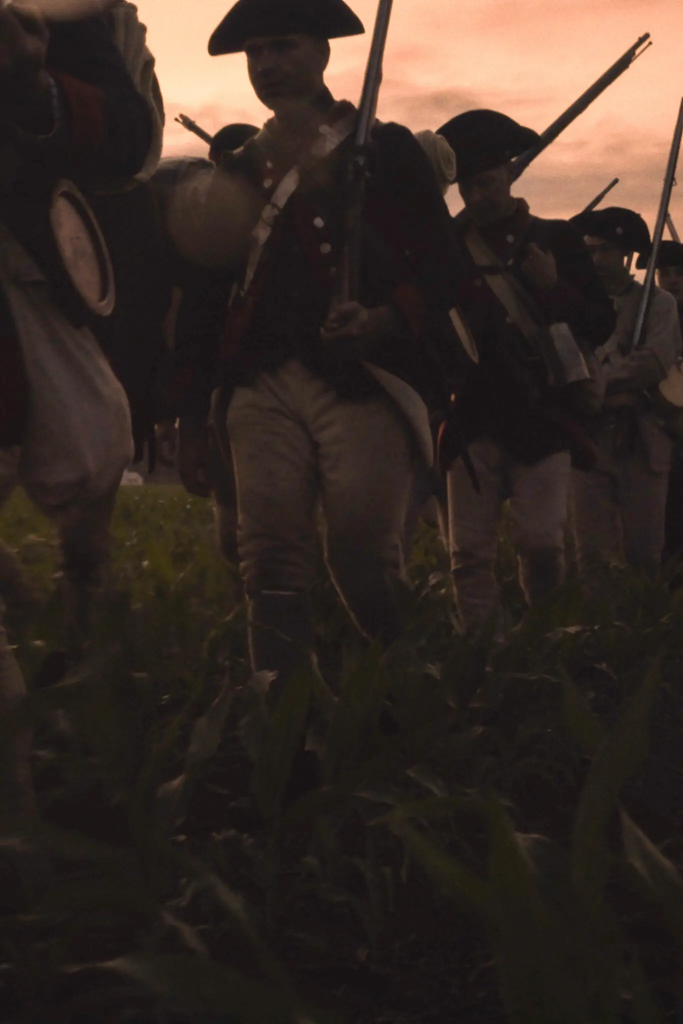
Credit…American Revolution Film Project/Florentine Films

James Poniewozik

By James Poniewozik

James Poniewozik, the chief television critic for The New York Times, has been writing about the connections between TV and politics since the 1990s. He last wrote about Ken Burns with the 2021 documentary “Hemingway.”

  • Nov. 14, 2025 (NYTimes.com)

In 1990, Ken Burns established his reputation with an enormous PBS documentary about a civil war. Thirty-five years later, with “The American Revolution,” he’s made another one.

We may not be used to thinking of the fight for independence from Britain that way. But this sweeping and sneakily provocative six-part series, which begins on PBS on Nov. 16, says that we should.

“The greatest misconception about the American Revolution is that it was something that unified Americans,” the historian Alan Taylor says in the second episode. “It leaves out the reality that it was a civil war among Americans.”

Part of that division involved the bitter and often savage recriminations between pro-independence Americans and those loyal to Britain. But those were not the only Americans at battle. As “The American Revolution” emphasizes, the war was also often a struggle between American colonizers and Native Americans, between enslavers and the enslaved. Some Americans won their sovereignty and freedom. Others — particularly non-European Americans — lost it.

“The American Revolution” is not Burns’s most innovative film; its techniques and rhythms are familiar from “The Civil War” and its successors. It is not his most moving; that title likely goes to his 18-hour heartbreaker, “The Vietnam War.” But it is perhaps his best-timed, and not only because the country’s 250th anniversary is coming next year but also because Americans are again passionately and even violently divided, over matters including history itself.

It arrives as public broadcasting, along with its mission to speak to every part of America, has been perhaps mortally wounded. It comes in an era of political violence and cultural war over American history, with deeply divided camps claiming the mantle of 1776.

A painting recreates a battle scene from the American Revolution
In the absence of available photography, “The American Revolution” uses art works like “The Death of General Mercer at the Battle of Princeton, January 3, 1777,” by John Trumbull, as visual elements.Credit…Alamy, via American Revolution Film Project/Florentine Films

And it is dedicated to a belief that seems increasingly old-fashioned: that we share a common story and that people are willing to hear it, both the good and the bad. There was a time when Burns’s expansive tales of the past could draw a broad audience of Americans, whatever their differences in the present. Perhaps that too is now history.

ON THE SURFACE, “The American Revolution” — directed by Burns with Sarah Botstein and David Schmidt and written by his longtime collaborator Geoffrey C. Ward — is exactly what Burns’s past documentaries and your memories of grade-school history class would lead you to expect.

Peter Coyote’s familiar, soothing narration tells of a rebellion that was not guaranteed to succeed. It lays out the Enlightenment ideals that inspired America’s fledgling democracy. It builds tension through the patriots’ early military disasters, illustrating battles with red and blue arrows snaking across parchment-hued maps, from land to sea, city to frontier, Lexington to Yorktown.

As in “The Civil War,” Burns and company create the kinetic illusion of war footage, cutting between artworks and re-enactment images to the sound effects of cannon. There are long, ugly descriptions of bayonet warfare. The war it depicts is not the jolly enterprise of fifes and drums and men in powdered wigs but savage, sweaty butchery, often among neighbors.

Also as in “The Civil War,” Burns enlists a troupe of celebrities to voice historical figures and common people. George Washington (Josh Brolin) emerges as a complicated hero, a field general who made numerous tactical mistakes but who also had the singular personal magnetism and character to hold together exhausted troops and squabbling politicians.

So far, so History 101. But the film also makes clear quickly that there is more to this story. The introduction shifts from Thomas Paine (Matthew Rhys) urging resistance against tyranny to a description of the Haudenosaunee Confederacy, a Native American democracy that long preceded the United States. It weaves in the voices of enslaved Black Americans, who fought on both sides of the war. (Washington, the historian Christopher Leslie Brown says, worried that having them fight alongside white soldiers would undermine the institution of slavery.)

A watercolor print shows a group of soldiers holding rifles as a commander in a red coat looks on.
An illustration by Greg Harlin for the documentary depicts Lord Dunmore’s Ethiopian Regiment. The series includes the voices of enslaved Black Americans, who fought on both sides of the war.Credit…American Revolution Film Project/Florentine Films

Over its 12 hours, “The American Revolution” takes two parallel tracks: the stories of white leaders who would eventually appear on dollar bills and in portrait galleries, and those of Americans of color, who were often used as pawns or had to choose which side of the war offered them the best chance at autonomy.

These multiple tracks, in the film’s telling, are part of the same larger story. The revolution was part of a worldwide war involving British colonies stretching to the Caribbean and Asia. And a big motive of the colonists, the film argues, was westward expansion into Native American lands beyond the Appalachians, which the British had forbidden (and in which Washington, among others, had financial interests).

The result is neither a glorification of the revolution nor a condemnation of the founding fathers. It’s just an attempt to bring in as many affected voices as possible, to situate “the most consequential revolution in history” in a global context, to make America’s founding story even bigger than you were originally taught.

THIS SHOULDN’T BE CONTROVERSIAL. It is simply history for grown-ups, which assumes that people can accept both that the revolution was a triumph for the idea of liberty and that the revolutionaries who fought it didn’t live up entirely to their beautiful words.

It is also the kind of story Burns has been telling for decades. “The Civil War” established an aesthetic style — the pans across old photos, the plangent fiddle music — as well as a people’s history approach that put the stories of foot soldiers and civilians on the same level as those of presidents and generals. The series drew some criticism, including that it was too sympathetic to Southern rationalizations for the war, but around 40 million Americans tuned in for a long-form history lesson whose most whiz-bang special effects were tintype photographs.

On a crowded review platform with a tank parked in front of it, President Trump stands and salutes troops walking past.
The Trump Administration has thrown out symbols of diversity in the military in favor of celebrations of tradition and dominance, including a parade on the president’s birthday.Credit…Kenny Holston/The New York Times

Burns’s approach hasn’t really changed much. There are some new tools, like 3D graphics, and some nods to the times. (“The Civil War” referred to “slaves”; “The American Revolution” talks about “enslaved people,” the preferred term among those who argue that it is dehumanizing to define people by their status as property.) You could imagine a timeline when “The American Revolution” would seem nothing more than an earnest, slightly dull prequel to “The Civil War.” But in our actual timeline, America, with a landmark birthday approaching, is in the midst of a pitched war over its own past. In this timeline, “The American Revolution” feels urgent, necessary and maybe even risky.

The second Trump administration has been purging cultural institutions of the barest whispers suggesting that the country’s history was anything but glorious triumph. The president has criticized the Smithsonian Institution for focusing on “how horrible our Country is, how bad Slavery was” and had its museums scrutinized for their “alignment with American ideals.”

His administration has ordered the renaming or review of military ships named for civil rights leaders and the restoration of military base names that honored Confederate generals. It has thrown out symbols of diversity and social progress in favor of celebrations of tradition and dominance. And the military parade that President Trump threw on his birthday, under the banner of the America250 semiquincentennial celebration, suggests he may cast next year’s anniversary in his own aggressive image.

When you control how people discuss the past, you control how they see the present and imagine the future. No wonder the country’s political movements have also fought to claim the legacy of ’76, from the Obama-era Tea Party to the current “No Kings” protests, whose anti-royalist branding is straight out of “Schoolhouse Rock.” The president has joined the war of symbolism too. On the day of massive demonstrations in October, the president shared a fake video of himself flying a military jet, wearing a golden crown and dumping excrement on the marchers.

A large crowd of protesters hold signs.
Many U.S. political movements, including the recent No Kings protests, have sought to channel the anti-royalist spirit of the American Revolution.Credit…Caroline Gutman for The New York Times

“THE AMERICAN REVOLUTION” COULD be a teaching moment right now, a chance to find common ground, a reminder and warning about a volatile time when neighbors sought retribution against neighbors.

Though the film was in production for over eight years (around as long as the war for independence took to fight), it feels pointedly current. Sometimes the parallels are subtle. The film notes that Washington mandated smallpox inoculations for soldiers, and it’s hard to imagine that anyone in the editing room was unaware of the Covid vaccine battles. The resentments of frontier settlers over limits on expansion recall the grievances of modern rural politics.

Other similarities hit, as history often does, square on the nose. As the current administration sends the National Guard into cities over the objections of local officials, the film describes the British alienating Bostonians by sending an army — citing security concerns — to occupy the city. “Good God,” says the Rev. Andrew Eliot (voiced by Tom Hanks), “what can be worse to a people who have tasted the sweets of liberty?”

And as the film describes the draft constitution’s balance of powers, the choice of emphasis is hard to ignore. “They feared that a demagogue might incite citizens into betraying the American experiment,” Coyote says. “Alexander Hamilton was concerned that an ‘unprincipled’ man would ‘mount the hobby horse of popularity’ and ‘throw things into confusion.’” The script names no current names, but critics of President Trump have cited this quote for years.

Meanwhile, the return of Burns, one of PBS’s biggest non-Muppet stars, is a meta-testament to another current story — the war on public broadcasting. The funding credits of “The American Revolution” note that it was “made possible, in part, with support from the Corporation for Public Broadcasting.” That organization announced plans to shut down next year, after Congress clawed back $1.1 billion in funding.

Burns has called the cuts “short sighted” but said he will personally be able to continue his work. He’s in the position to do that because of the support public TV provided him from early on. But Burns is 72. Who will support his successors? In a media environment that rewards flash, conflict and catering to ideological bubbles, what other network will tell Americans, all Americans, that they share a common set of facts, a common history and common challenges?

Marjorie Taylor Green in a hearing holds a sign critical of PBS.
Representative Marjorie Taylor Greene, Republican of Georgia. Earlier this year, the Republican-led Congress rescinded $1.1 billion in funding from public broadcasters.Credit…Anna Rose Layden for The New York Times

Of course “The American Revolution” does not address the public-broadcasting controversy or the continuing fights over public history in museums and universities, but it is an implicit part of those arguments. The series makes its case the way Burns’s whole body of work has: by trying to tell a full story and trusting, maybe with quaint optimism, that all kinds of Americans will want to hear it.

The series might well draw controversy pointing out the founders’ contradictions. But “The American Revolution” is also deeply patriotic. It gushes with love for America’s natural beauty, for its democracy and for its professed, if not always realized, ideals.

In its telling, the American story is one of always striving to get closer to those ideals — not of being perfect but of becoming more perfect. Its closing words are “The revolution is not over.” You can take that as a tribute to how the spirit of democracy endures. But watching the series in these times, I also hear an echo of the end of “The Civil War,” in which the historian Barbara Fields says: “The Civil War is still going on. It’s still to be fought. And regrettably, it can still be lost.”

As the historian Vincent Brown says in “The American Revolution,” you can admire how Thomas Jefferson articulated the cause of human freedom and recognize that he denied freedom to the humans he owned. “I think it’s incumbent on all of us to take those words from Jefferson and make them real in our own lives,” he says, “even if they weren’t real in his.”

Patriotism, “The American Revolution” argues by example, is not about hiding the stains of the past behind pretty oil paintings. It means loving your country enough to tell its whole story. Once upon a time, that mission might have seemed middlebrow and dull. Today, for better or worse, it is positively revolutionary.

James Poniewozik is the chief TV critic for The Times. He writes reviews and essays with an emphasis on television as it reflects a changing culture and politics.

A version of this article appears in print on Nov. 16, 2025, Section AR, Page 10 of the New York edition with the headline: A History Forged in Battles. Order Reprints | Today’s Paper | Subscribe

See more on: U.S. PoliticsPublic Broadcasting ServiceKen BurnsRead 433 comments

(Contributed by Michael Kelly, H.W.)

Origins of Christianity and the Biblical Canon, with Richard Carrier

The Funny Thing About Religion Aug 17, 2025 This is the full interview with Richard Carrier recorded for the film BATMAN & JESUS    • BATMAN & JESUS – Determining Canon in Comi…   in 2016. Topics of Discussion: 00:00 The Sequence of the Gospels 01:31 The Earliest Material Written on Jesus 02:32 Methodology Used Determining Biblical Canon 04:58 Creation of a Biblical Canon 06:07 Motivation for a Biblical Canon 07:22 Biblical Canon Exclusions 08:40 Language and Literacy at the Time of Canonization 10:54 Language of the New Testament 12:00 Coptic Gospels 12:37 Scribal Error 14:03 Order of the New Testament and Missing Letters 15:55 Dating the Gospels 20:39 Savior Gods and Mystery Cults 28:31 Dying-and-Rising Deities 31:22 Islam, Mormonism, and the Cargo Cults 36:35 The Book of Enoch 38:44 Romulus 43:06 The Long Ending of Mark and Pentecostalism 46:45 The Gospels as Mythology vs. History 49:15 Sources of Revelations from God 50:00 Jesus and Satan as Mythology 54:31 The Luddites and Ned Ludd 57:20 Original Christianity vs. Christianity Today 59:47 The Holy Trinity 01:01:00 Euhemerization 01:06:36 Does it matter? Dr. Richard Carrier is a renowned historian, philosopher, and author, best known for his work in historical methodology, the philosophy of science, and the study of early Christianity. Holding a Ph.D. in ancient history from Columbia University, Carrier has become a leading voice in the debate over the historicity of Jesus, advocating the controversial Christ Myth Theory. His scholarly yet accessible approach has made him a popular figure in secular and skeptical circles, frequently addressing topics such as ancient history, biblical criticism, historical Jesus studies, Bayesian reasoning, and the scientific examination of religious claims. Carrier is the author of several influential books including On the Historicity of Jesus, Proving History, and Sense and Goodness Without God, which explore the intersection of science, philosophy, and religion. He is a frequent guest on podcasts, lectures, and debates, engaging with audiences on topics like atheism, critical thinking, logic, and ancient philosophy. His content is ideal for viewers interested in secular humanism, mythicism, rational inquiry, and evidence-based analysis of historical claims. Whether you’re a skeptic, student of history, or just curious about the origins of Christianity, Richard Carrier offers deep insights grounded in scholarly rigor and clear reasoning. For more visit: https://www.richardcarrier.info/


BATMAN & JESUS – Determining Canon in Comics & Christianity (2025 Documentary)

The Funny Thing About Religion Apr 20, 2025 A council of self-proclaimed Batman experts is assembled in an attempt to canonize the Batman series while religious experts explain the canonization of the Bible in Christianity, raising the question – was Jesus a man or a myth? Dive deep into the fascinating parallels between pop culture and religion in BATMAN & JESUS. This thought-provoking film explores how fans and followers alike define “canon” in two seemingly different worlds: the DC Comics universe and Christian theology. From Batman’s ever-evolving storylines to the New Testament’s formation, this documentary unpacks how sacred texts and superhero lore are shaped, debated, and preserved. Perfect for fans of comic books, Christian history, theology, fandom culture, and media analysis, this 2025 documentary bridges faith and fiction in a way you’ve never seen before and examines how stories become sacred—whether they’re about a caped crusader in Gotham or a messiah in Galilee. By analyzing the creation of canon in both the DC Comics universe and early Christianity, the documentary invites skeptics, secular thinkers, comic book fans, and historians alike to question who decides what’s “official” and why it matters. A must-watch for anyone interested in mythology, religion without belief, comic book culture, and the power of narrative, whether you are a theology student, comic book collector, or documentary lover. Featuring Robert M. Price, Richard Carrier, David Fitzgerald, Aron Ra, Faisal Saeed Al Mutar, Killah Priest, and Paul Provenza Batman & Jesus was written and directed by Jozef K. Richards Music by Scott Hampton https://www.imdb.com/title/tt5070262/https://www.kintoumedia.com/movies

Why Democracy Survives Populism, the Dangers of AI, Sharp Power in the Gulf, and More

 Why Democracy Survives Populism, the Dangers of AI, Sharp Power in the Gulf, and More

This week, the Journal of Democracy is sharing our entire January 2024 issue

Why are would-be strongmen so unlikely to succeed in undoing democracy? What steps can we take to protect democracies from advanced AI? Should we be worried about the Gulf states’ growing influence?

The January 2024 Journal of Democracy answers these questions and more! Read free for a limited time.The Journal of Democracy is published quarterly in January, April, July, and October. Members of the press and members of Congress who wish to receive electronic access should email our managing editor. For more information, please visit our website or send us an email.

Subscribe now for full access to the Journal of Democracy archives.

Image Credit: Marvin Recinos/AFP via Getty Images

Trump Denies Writing 36-Volume Comic Titled ‘Don And Jeff: Time Pedophiles’

In Each Issue, Duo Travels To Past For Underage Sex

Published: November 13, 2025 (TheOnion.com)

WASHINGTON—Dismissing the swashbuckling sci-fi romp as “a total hoax” amid growing scrutiny over his relationship with Jeffrey Epstein, President Donald Trump made remarks Tuesday denying that he had written a 36-volume comic titled Don And Jeff: Time Pedophiles.

Obtained last month by the House committee investigating the late financier and child sex trafficker, the Time Pedophiles saga depicts Trump and Epstein journeying through various historical eras aboard Epstein’s Chronolita Express time machine, taking on Edo-period samurai, ancient Roman legionaries, and Wild West gunslingers in their never-ending quest for underage sexual partners. 

Though Trump was prominently credited as writer and illustrator on every cover, in addition to appearing as a doodled version of himself in several “Molester’s Soap Box” columns, where he would frequently rant about the unfair treatment of sexual predators, the president has vigorously disputed the series’ authenticity.

“Epstein was no friend of mine, and I never drew us becoming knights and competing at a joust for the virginity of a 13-year-old Eleanor of Aquitaine,” Trump said when asked about Time Pedophiles by a reporter, suggesting that someone else could have written, inked, and lettered the series before falsely signing his name. “Anyone who knows me knows I wouldn’t draw myself in a covered wagon picking up minors on the Oregon Trail, nor would I write a story arc about going back into prehistory, long before humans invented the age of consent, to hit on Cro-Magnon girls. Sorry to disappoint, but the fact is, I don’t draw cavemen.”

“I’ve never written a caveman in my life,” he added, though several one-shot comics the president drew for charity in the early 2000s depict cavemen in a style nearly identical to those in Time Pedophiles.

The storylines in the series are largely driven by the reliance of Epstein’s time machine on Enigmium, a mysterious substance that “never ages” and can only be obtained via sexual encounters with girls between the ages of 12 and 17. Each arc typically begins with the erudite Don rattling off facts about their next destination, only for Jeff to interrupt him with his catchphrase, “But what does [the Qing dynasty/Prohibition-era Atlantic City/Belle Époque France] have to do with getting pussy?”

The duo’s time-faring underage sexcapades also feature numerous cameos from Don and Jeff’s team of “Temporoconspirators,” including Doc Dershowitz, the madcap inventor constantly developing new gizmos—like the Groomatizer Ray and allegation-proof underwear—for the Time Pedophiles to test out, as well as Chief Engineer Ghislaine, the Chronolita Express’s mechanic and Jeff’s on-and-off paramour, whose direct exposure to the timestream in a tragic massage accident left her forever trapped in the body of an adult woman.

Despite the president’s repeated denials of having ever depicted himself and Epstein commissioning Leonardo da Vinci to build them a mechanical clockwork nymphet who goes haywire and chases them through the canals of Venice after Jeff carelessly fondles a dial controlling her aggression levels, Americans expressed unease that Epstein and Trump opted to self-publish Time Pedophiles through a company they founded called GROPE comics. 

In a nationwide poll conducted by Pew Research Center, 84% of respondents called the comic unpresidential and said they were disturbed by the Time Pedophiles traveling back to ancient Egypt in the “Groom Like An Egyptian” storyline and getting two breastlike pyramids constructed in their honor for molesting 14-year-old Cleopatra. In addition, 77% were appalled by the Time Pedophiles rescuing Joan of Arc from being burnt at the stake only to heave her back into the blaze upon learning she was 19. 

Similarly, 89% of those polled said they disapproved of the chapter where Don deliberately lands the Chronolita Express in the Miss Teen Mesopotamia changing room, and 68% said that Trump should immediately resign if he did indeed pen the issue in which an incident at a 19th-century girl’s boarding school leads to Don unwittingly becoming Jeff’s great-grandfather.


Clockwise from top left: child sex offenders Don and Jeff flee a T. rex, remodel the Great Sphinx of Giza in Jeff’s image, fight samurai, and briefly rescue Joan of Arc.

“Assuming the comics in this omnibus collection are authentic, the entire series paints a damning picture of Trump and Epstein’s relationship,” said political analyst Sarah Helbecker, pointing specifically to the series’ retrospective final chapter, in which Don and Jeff wind up in the year 5000 and are put on trial by an all-female robo-society for their crimes against women, girls, and the young velociraptor from the “Jurassic Pedos” arc. “The whole courtroom sequence reads like a confession, but before anyone faces any consequences, a portal appears and the duo receive a deus ex machina pardon from the Pedophile King of the Chro-noverse, who is strongly hinted to be a future version of Don himself.”

Helbecker added, “The American people should ask themselves just what the president meant when he concluded every issue of Time Pedophiles with the motto ‘Three cheers for molestation, and may every historical era be another wonderful secret!’” 

Translation Saturday Meeting November 15


Translation Saturday Meeting


November 15th
11:00 AM – 12:00 PM PST

Mike Zonta, H.W., M.

In a crisis — any crisis — The Prosperos offers Translation.  Translation Saturday Meetings is a weekly series of Translation presentations by veteran Translators, live and up to date on the issues of the day.

It is not a Translation workshop,  It is not a Translation class.  It is not a group Translation, though group participation is encouraged.

It is, however, restricted to those who have taken Translation class. So if you have never taken Translation class, check the calendar tab on The Prosperos website (TheProsperos.org) or get in touch with us and we will schedule a class.

Last week our sense testimony was:  “People in positions of trust can be untrustworthy.”  And our conclusion was:  People is Consciousness always being Trustworthy/Truthworthy.  This week Heather Williams, H.W., M., will be our guest Translator. 

– – – – – – – – – – – – – – – -Dare to join us!!!- – – – – – – – – – – – – – – – –

Here’s the link:  https://us02web.zoom.us/j/81749347119

For more info please email Mike Zonta at:

zonta1111@aol.com

Weekly Invitational Translation:  The only way to deal with a trauma is to deny it.

Translation is a 5-step process of “straight thinking in the abstract” comparing and contrasting what seems to be truth with what you can syllogistically, axiomatically and mathematically (using word equations) prove is the truth. It is not an effort to change, alter or heal anything. It is a sort of prayer. It is a salute to the answer already arrived.

The claims in a Translation may seem outrageous, but they are always (or should always be) based on self-evident syllogistic reasoning. Here is one Translation from this week. 

1)    Truth is that which is so.  That which is not truth is not so.  Therefore truth is all that is.  Truth being all is therefore total, therefore whole, therefore full, therefore fulfilled.  I think therefore I am.  Since I am and since Truth is all that is, therefore I, being, am Truth.  Since I, being, am Truth, therefore I, being, have all the attributes of Truth.  Therefore I, being, am total, whole, full, fulfilled.  Since I am mind (self-evident) and since I (being) am Truth, therefore Truth is Mind.  (Euclid’s axiom:  Things equal to the same thing are equal to each other.)  Since Truth is Mind, therefore Mind has all the attributes of Truth.  Therefore Mind is total, whole, full, fulfilled. 

2)    The only way to deal with a trauma is to deny it.

Word-tracking:
deal with:  handle, respond, despond  (go against promise)
promise:  to assure, sure, certain, cure, accurate, right, true
respond:  to answer, to swear against
trauma:  wound, injury, not just, not right, not truth
deny:  to declare untrue, to refuse, to say no, to reject

3)    Truth being all that is, the only thing that can be sent forth (promised) is truth, therefore All that is promised is Truth.  Truth being all that is and since to deny is to declare untrue, therefore Truth is the only thing that can be declared.  In physics they say for every action there is an equal and opposite reaction.  Truth being all that is, there can be no Actor (or Action) other than Truth.  Therefore Truth is the only Actor (Action).  And, again, Truth being all that is, there can be no Reactor (Reaction) other than Truth.  Therefore Truth is the only Reactor (Reaction).  Therefore Truth reacts to Itself by affirming Itself.

4)    All that is promised is Truth.
        Truth is the only thing that can be declared.
        Truth is the only Actor (Action).  
        Truth is the only Reactor (Reaction). 
        Truth reacts to Itself by affirming Itself.

5)    Truth is the only Promise made, the only Promise kept.

Weekly Invitational Translation Group invites your participation.  If you would like to submit a Translation on any subject, feel free to send your weekly Translation to  zonta1111@aol.com and we will anonymously post it on the Bathtub Bulletin on Friday.

For information about Translation or other Prosperos classes go to: https://www.theprosperos.org/teaching.

Prosperos Sunday Meeting November 16


SUNDAY MEETING — NOVEMBER 16

Mara Pennell, H.W., m.


Choices, Chances
and Changes


What is the connection between choices, chances and changes? Discover the answer at this upcoming Sunday Meeting!

Mara Pennell, H.W.,m. first encountered The Prosperos as a young teenager; she returned to the school as an adult and received her High Watch degree in 2020. She currently serves on several committees and as High Watch President, in addition to being an interning Mentor.

For more information, click here:
https://www.theprosperos.org/prosperos-events/sunday-talk-tba-wemx4-l66wa

SUNDAY MEETING November 16, 2025
11:00 am Pacific / Noon Mountain /
1:00 pm Central / 2:00 pm Eastern


NEW LINK…PLEASE USE THE JOIN BUTTON BELOW FOR MEETING

Join Sunday Meeting

By contribution.  Please click here to contribute:

Contribute!

Call In Information:One tap mobile 
+16699006833,,81707590593# US (San Jose) 
+16694449171,,81707590593# US 
— 

Meeting ID: 858 8286 3391

Find your local number: https://us02web.zoom.us/u/kdTAYZq0XQ 

God is consciousness | Rupert Sheldrake on panpsychism and spirituality

The Institute of Art and Ideas 88,545 views Oct 30, 2025 Rupert Sheldrake explores the concept of God as the consciousness that exists not only within humans, but within the entire cosmos. Are we all fragments of the same, greater consciousness? With a free trial, you can watch the full talk NOW at https://iai.tv/video/discovering-the-… The modern world’s faith in science has made the idea of the supernatural seem like a silly child’s fantasy, at least in the minds of many. Yet, 50% of people do still believe, or suspend disbelief, in the supernatural. Join radical scientist and spiritualist, Rupert Sheldrake, to explore a reality that lies beyond the scientific view of reality. #consciousness#panpsychism#spirituality#spiritual#god Rupert Sheldrake is an English scientist whose research into parapsychology and evolution led to the theory of morphic resonance. Other topics he has written and spoken on include precognition, the relationships between spirituality and science and the psychic staring effect. Sheldrake’s most recent book is ‘Science and Spiritual Practices’. The Institute of Art and Ideas features videos and articles from cutting edge thinkers discussing the ideas that are shaping the world, from metaphysics to string theory, technology to democracy, aesthetics to genetics. Subscribe today! https://iai.tv/subscribe?utm_source=Y…00:00 We all share the same consciousness 00:26 God, angels, and the supernatural split 02:03 The sacred in Hindu culture 03:30 Mystical encounters and near-death experiences 06:45 The benefits of meditation 08:37 The ground of consciousness of the whole universe 10:40 The varieties of spiritual practice 14:52 Psychedelics, morphic resonance, and the natural world For debates and talks: https://iai.tv For articles: https://iai.tv/articles For courses: https://iai.tv/iai-academy/courses

The Transformative Psychotherapy of Milton Erickson with Paul J. Leslie

New Thinking Allowed with Jeffrey Mishlove Nov 12, 2025 Psychology and Psychotherapy Paul J. Leslie, EdD, is a psychotherapist in private practice in Aiken, South Carolina. He is professor of psychology at Aiken College. He is author of The Art of Creating a Magical Session: Key Elements for Transformative Psychotherapy, Low Country Shamanism: An Exploration of the Magical and Healing Practices of the Coastal Carolinas and Georgia, Potential Not Pathology: Helping Your Clients Transform Using Ericksonian Psychotherapy, and Shadows in the Session: The Presence of the Anomalous in Psychotherapy. He discusses the significant, yet somewhat forgotten, influence of the late Milton Erickson upon the field of psychotherapy. Erickson had a unique gift of finding ways to profoundly influence positive change in his clients within a brief time period. Paul Leslie illustrates this intuitive process with several stories. Erickson’s methods were such that, sometimes, his colleagues wondered if he was going a bit crazy. Nevertheless, it has been possible to systematize his approach to some extent. Today there is a school of Ericksonian therapy. New Thinking Allowed host, Jeffrey Mishlove, PhD, is author of The Roots of Consciousness, Psi Development Systems, and The PK Man. Between 1986 and 2002 he hosted and co-produced the original Thinking Allowed public television series. He is the recipient of the only doctoral diploma in “parapsychology” ever awarded by an accredited university (University of California, Berkeley, 1980). He is also the Grand Prize winner of the 2021 Bigelow Institute essay competition regarding the best evidence for survival of human consciousness after permanent bodily death. He is Co-Director (with Callum Cooper) of Parapsychology Education at the California Institute for Human Science. (Recorded on December 17, 2019)

Consciousness, sexuality, androgyny, futurism, space, the arts, science, astrology, democracy, humor, books, movies and more