Like the young teenagers who delight in doing things differently from their parents, new Buddhists in non-Asian countries seem to be going through their own proud adolescence by challenging the boundaries of traditional Buddhism. Fortunately, for both our youngsters and Western Buddhists, the arrogance of youth soon gives way to the mature, long years of understanding and respect for tradition. It is in order to hasten this growing up of Buddhism in Australia that I write this article on the meaning of ‘Sangha’ as it was meant to be understood by the Lord Buddha.
In the Tipitaka, the recorded Teachings of the Lord Buddha, one finds two main focuses for the meaning of Sangha: the third part of the Threefold Refuge (in the Buddha, Dhamma and Sangha) and the third factor of the to-be -worshipped Triple Gem (The Buddha, Dhamma and SavakaSangha). On odd occasions in the Tipitaka, ‘Sangha’ is used to denote a ‘herd’ of animals (Patika Sutta, Digha Nikaya) or “flock” of birds (Jataka Nidana), but groups of lay disciples, both men and women, are always described as ‘parisa’, an assembly.
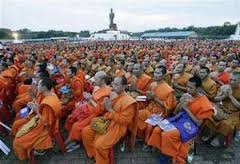
So what is the meaning of Sangha in the first main context, in the Threefold Refuge? Certainly, only an exceedingly eccentric Buddhist would take as their third refuge a sangha of birds (only “one gone cuckoo”, as they say!). In fact, the Tipitaka is precise in what is meant by the third refuge. In the Canon, on every occasion that an inspired person took the Threefold Refuge as an expression of their faith, it was either in the Buddha, Dhamma and Bhikkhu Sangha, or in the Buddha, Dhamma and Bhikkhuni Sangha. Thus, in original Buddhism, the meaning of Sangha in the context of the Threefold Refuge is unarguably the Monastic Sangha.
The Sangha as the third factor of the Triple Gem worshipped by Buddhists seems to have a different meaning. It is called the Savaka Sangha (or Ariya Sangha) and is defined as those attained to any of the Eight Stages of Enlightenment (the 4 usual stages divided into Path and Fruit) who are “worthy of gifts, hospitality, offerings and reverential salutations, and who are the unsurpassed field of merit in the world”. So, in the original texts, who are the “unsurpassed field of merit and worthy of offerings and salutations”?
In the Dakkhinavibhanga Sutta (Majjhima 142), the Buddha said that, “an offering made to the monastic Sangha is incalculable, immeasurable. And, I say, that in no way does a gift to a person individually ever have a greater fruit than an offering made to the monastic Sangha”. Consistency proves that the Savaka Sangha, the unsurpassed field of merit in the world, must be a part, a subset of the monastic Sangha — there is no greater fruit than an offering to the monastic Sangha.
Furthermore, in the world of the Tipitaka, offerings and reverential salutations would always be given by the laity to the monastic and never the other way around. Even the highly attained lay disciple Ugga Gahapati who was a Non-Returner is seen to be giving reverential salutations to ordinary bhikkhus and serving their needs with his own hands (Anguttara Nikaya, Eights, Suttas 21 & 22). Thus, those “worthy of gifts, hospitality, offerings and reverential salutations”, the Savaka Sangha, are again shown to be a part of the monastic Sangha of both genders.