
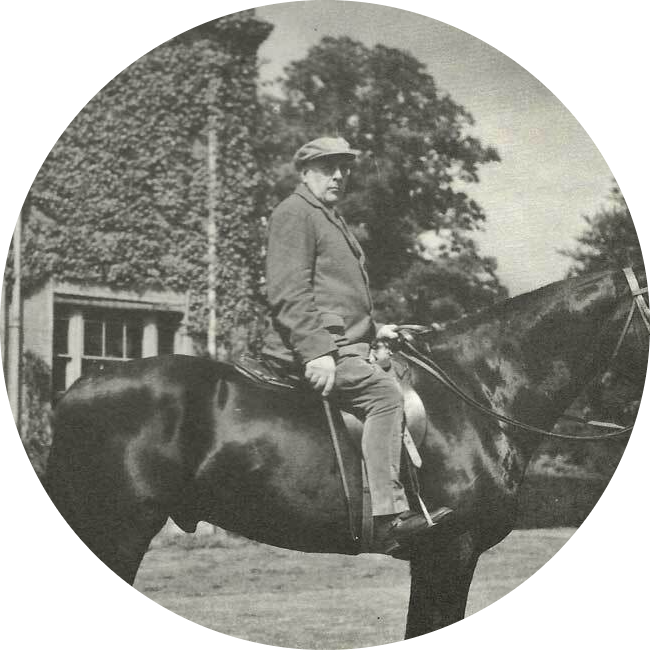
ABANDONING THE SYSTEM
By the spring of 1946, at 68 years of age, Ouspensky’s health has rapidly deteriorated on account of a chronic kidney condition. In the summer, he gives his final lectures in New York to impart the unwelcome news to his American students that he will leave for England and hand off continuity of the school at Franklyn Farms to Madame Ouspensky.
On January 23rd, 1947, Ouspensky returns to England and proceeds to give six lectures at Colet Gardens from February to June to an audience of over 300. The sight of his greatly diminished health catch his English students off guard, eclipsed only by a dramatically altered demeanor that does not fit with the teacher that they remember.
[QUESTION] Do you wish us to continue with the program you gave us in 1940?
[OUSPENSKY] Program? I don’t know program. Which program?
[QUESTION] Program which you gave in 1940.
[OUSPENSKY] No, I don’t remember.
[…]
[QUESTION] We have been trying to follow out the teaching you gave us years ago.
[OUSPENSKY] I gave no teaching.
[QUESTION] You told us certain things to help us.
[OUSPENSKY] You misunderstand.
[QUESTION] Where can we begin to work now?
[OUSPENSKY] I will see what you want to know and where you want to begin, and then we will see first step, and perhaps we will find second step. We don’t know first step, that is the question. That you must remember.x
[QUESTION] Do you mean, Mr. Ouspensky, that you have abandoned the System?”
[OUSPENSKY] There is no System.xi
Ouspensky produces extraordinary confusion, passing himself off as a stranger who offers no acknowledgement or connection to the teaching that has been the central basis of his identity and profession for over two decades. He is terse in every reply, refusing to speak in the jargon of the teaching, and rejects any notion of a common aim, instead directing questioners back to themselves, to their own personal position, as the starting point.
The audience is divided by those who view the spectacle as evidence of his deteriorated condition, while others receive it as a demonstration of a deeper sincerity. Some go further to recognize in it an invitation to free themselves of the form of the teaching known as the “system”, which after so many years has rendered itself a burden on their further understanding.
[OUSPENSKY] You must start again. You must make a new beginning. You must reconstruct everything for yourselves – from the very beginning. xii
[OUSPENSKY] Yes, I said abandon, not destroy. xiii
To be continued…


SOURCES
- Psychological Commentaries by Maurice Nicoll
- Conversation of Ouspensky with Gerald Palmer (1946)
- Autobiographical Note
- In Search of the Miraculous by Peter Deminaovich Ouspensky
- P. D. Ouspensky Memorial Collection, Sterling Memorial Library, Yale University
- A Further Record by Peter Deminaovich Ouspensky
- Witness by John Godolphin Bennett
- Fragments of an Unknown Teaching (1926 manuscript) by Peter Deminaovich Ouspensky
- The Constitution, Objects, and Organization of the Historico-Psychological Society
- February 24th, 1947, Colet Gardens
- May 21st, 1947, Colet Gardens
- The Theory of Celestial Influence by Rodney Collin
- Last Remembrances of a Magician by Rodney Collin and Francis Roles
IN 2022/3, BEPERIOD WILL BE CREATING A FULL-LENGTH DOCUMENTARY ON GEORGE GURDJIEFF
Part I:
Gurdjieff
Part II:
Teaching
Part III:
School
Part IV:
Initiation
Part V:
Fourth Way
(ggurdjieff.com)