
- By Benjamin Pimentel | Examiner staff writer |
- Feb 17, 2023 Updated Feb 19, 2023 (SFExaminer.com)

The artificial intelligence craze now sweeping the world began in the Mission District.
On Nov. 30, OpenAI announced a new tool from San Francisco’s Pioneer Building on 18th Street, a 100-year-old structure whose first life was a luggage factory.
Without much fanfare, the startup said its new AI chatbot, called ChatGPT, could interact with a user “in a conversational way, answer follow-up questions, admit its mistakes, challenge incorrect premises and reject inappropriate requests.”
Frenzy ensued. ChatGPT amassed more than a million users within five days of releasing its free app. By January, it had 13 million unique visitors every day and 100 million monthly active users. It is the most astounding product rollout since the dot-com era.
ChatGPT has proved to be a fun, if unnerving, tool. You could can use it to write poems, essays, wacky lyrics or draft business proposals. The excitement for a tool that writes and “thinks” much faster than most humans has touched nearly every realm: business, politics, education, the arts. It has turned the spotlight on artificial intelligence, a field born from Alan Turing’s theory of computation and that computer scientists have long predicted would transform the very nature of human existence.
“It exploded on the landscape,” Jef Loeb, creative director of the San Francisco advertising agency Brainchild Creative, told The Examiner. “San Francisco was definitely ground zero for this.”
Google’s AI fumble wipes out $100 billion in market cap
A glitch in Google’s AI chatbot rollout triggers a stock sell-off as competition in AI heats up.
When AI hibernated
“AI winter” is what the tech world calls the period when the quest for artificial intelligence technology, which began after World War II, seemed to be going nowhere — when funding dried up, research stalled and overall interest waned like they did in the 1970s-1980s and again in the mid-1990s.
But AI has been on a steady march forward since the start of the 21st century. The advance was propelled by more powerful chips, more sophisticated software and ever-expanding reach of the web.
AI reached a high point this winter in the San Francisco Bay Area, where a lot of these capabilities emerged — the chips, the software, the new approaches.
Google’s search engine blazed the trail for “machine learning,” which trains computers to solve problems by figuring out patterns. Eventually, Silicon Valley companies, including startups, turned to a new AI approach that offered even more impressive capabilities.
“Deep learning” uses artificial neural networks that can pick up, record and process data and signals that are then organized the way human memory operates. With deep learning, a computer can mimic the way the human brain works.
That computing firepower and more sophisticated algorithms made it possible to create pretty much anything — essays and letters, business proposals, paintings, videos. It’s called Generative AI.
And ChatGPT underscored its power.
Google unveils ChatGPT rival in AI counteroffensive
Google introduces its chatbot, Bard, as artificial intelligence rivalry heats up
Enter OpenAI
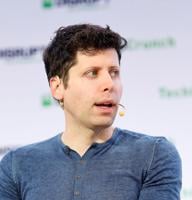
Sam Altman, CEO and co-founder of OpenAI, studied computer science at Stanford and served as president of YCombinator, the world-famous Mountain View startup accelerator that launched such famous names as Airbnb, Stripe and DoorDash.
Altman co-founded OpenAI in 2015, with tech pioneers like Tesla CEO (and now Twitter owner) Elon Musk, investor Peter Thiel and LinkedIn co-founder Reid Hoffman. The company started out as a nonprofit with a noble goal: to “advance digital intelligence in the way that is most likely to benefit humanity as a whole, unconstrained by a need to generate financial return.”
In February, Altman told Forbes, “I think capitalism is awesome. I love capitalism. Of all of the bad systems the world has, it’s the best one — or the least bad one we found so far. I hope we find a way better one.”
OpenAI and ChatGPT sparked a new wave of capitalist fervor. Suddenly, AI was the buzzword among investors. Every startup or tech company had to have an AI plan.
Asking about an AI strategy became a routine part of doing business, said Logan Allin, managing partner and founder of Fin Capital, a San Francisco venture investment firm. “When talking to people, I ask, ‘What is your answer to AI?’” he told The Examiner. “If you can’t answer that at the board level or the management level, you have a big problem.”
There was also a distinct shift in attitude among big institutions that invest in VC firms — pension funds, endowments and sovereign wealth funds — said Nicolai Wadstrom, founder and CEO of BootstrapLabs, another San Francisco VC firm focused mainly on AI.
People “we have known for a long time” and who weren’t exactly enthusiastic about AI suddenly “changed their minds” about the technology, Wadstrom said. “That’s a clear change in the past 100 days.”
That wasn’t surprising. ChatGPT astounded anyone who tried it. When Allin of Fin Capital asked ChatGPT for insights into investing in the growing segment of the financial tech industry called embedded finance, “the answer that came back was incredibly thoughtful,” he said.
“We were like, ‘Oh, boy, this is very disruptive,” he told The Examiner.
So disruptive, in fact, that just 10 weeks after it was introduced, ChatGPT actually sparked a major tech brawl. The technology was immediately tagged as a serious threat to Google, especially with OpenAI’s close relationship with Microsoft, one of the startup’s major investors.
The stakes became clear when Google fumbled the opening salvo of its AI counteroffensive in February. The tech giant introduced its own AI chatbot named Bard, but an ad for the new tool featured an incorrect response to a question on the James Webb Telescope. The error sent Alphabet’s stock plummeting, wiping out $100 billion in market value.
“Google comes out with Bard, which is a terrible name, and second of all, they completely dropped the ball,” Allin said. “The market reaction was definitely severe. But rightly so. This is the future of search.”
Can AI help fix homelessness in SF?
An AI-powered program is helping LA identify people at risk of becoming homeless before they hit the skids
The future of tech
But ChatGPT also raised questions about the future of tech.
Three days after it was introduced, Elon Musk tweeted to Altman: “ChatGPT is scary good. We are not far from dangerously strong AI.”
Altman agreed, tweeting back, The new technology “poses a huge cybersecurity risk” and as AI becomes more powerful “we have to take the risk of that extremely seriously.”
These risks became evident just days after ChatGPT was announced.
On Dec. 21, three weeks after ChatGPT’s release, a team of Check Point Software engineers in San Carlos and Tel Aviv flagged a user on an underground hacking forum who bragged about creating a phishing malware with help from ChatGPT. The hacker had zero coding skills.
A few days later, on New Year’s Eve, another user started a thread titled “Abusing ChatGPT to create Dark Web marketplace scripts.”
Sergey Shykevich, a Check Point threat intelligence manager, called the chatter on underground hacking forums “the beginning of the first step on possible future nightmares.” ChatGPT, he argued, became a resounding success “too fast.”
Beyond enabling criminal hackers on the Dark Web, other worries have emerged.
Schools braced themselves for the impact of ChatGPT’s use on campuses. At Stanford, some professors began overhauling their courses to get ahead of how the tool was used in assignments. An informal poll by Stanford Daily found “a large number of students” have used the tool to take final exams.
Generative AI came under fire when a brewing battle over how some companies used the work of artists exploded into the open. A group of artists filed a lawsuit in San Francisco federal court accusing three prominent AI imaging companies — Stability AI, Midjourney and DeviantArt — of copyright infringement and unlawfully appropriating their work. One of the artists, San Francisco illustrator Karla Ortiz, criticized what she described as “the deeply exploitative AI media models practices.”
“If misinformation and fake news was bad before, this is only really going to accelerate that times 10,” Chris McCann, a partner at San Francisco venture firm Race Capital, told The Examiner. “It’s going to be much, much, much harder to understand the provenance” of a creative work, “whether somebody actually made this themselves, not made by themselves, whether it’s augmented. It’s going to become way more confusing.”
But there were also those who touted ways by which AI can help creators.
In Palo Alto, Nikhil Abraham and Mohit Shah, founders of CloudChef, joined Indian chef Thomas Zacharias in introducing a new AI-based tool that can record the way a chef cooks — and use the digitized information to recreate their dishes. The technology “essentially codifies the chef’s intuition and helps us recreate the recipe,” Thomas told The Examiner.
Zacharias receives royalties from CloudChef, which sells his meals through an online marketplace, access to a new market and customers, he said, that “I could never have even dreamt of.”
Catching an essay written with AI … with help from AI
OpenAI rolls out new tool to flag AI-written text, especially those created with its wildly successful ChatGPT.
The next cloud, the next internet
Silicon Valley legend John Chambers, the former CEO of Cisco, the San Jose tech giant, predicts that “AI will be the game changer for the high-tech industry.”
“AI will be the next cloud, the next internet.” And the important advances in AI, he told The Examiner, will “most likely come from a new player because that’s how it’s always occurred before.”
As in other major tech waves, that “new player” will likely come from the Bay Area.
Allin said he hopes the ChatGPT craze “creates a resurgence in R&D and the recognition that the heart of frontier R&D is still in San Francisco.”
Major tech companies have left. Startups are eyeing other states and regions to set up shop. But “San Francisco is still where the best ideas are being generated,” Allin said. “And obviously AI is a key part of that.”
Altman actually said pretty much the same thing two years ago, when the Bay Area and the whole world were reeling from the pandemic.
In December 2020, two years before ChatGPT turned his company into a household name, he tweeted, “It’s easy to not be in the Bay Area right now, because there’s not much to miss-out on.”
But he wasn’t giving up, he declared.
“If you want to have the biggest possible impact in tech, I think you should still move to the Bay Area,” Altman said. “The people here, and the network effects caused by that, are worth it. It’s hard to overstate the magic of lots of competent, optimistic people in one place.”
When AI is your sous chef
CloudChef recreates master chef cooking with AI
@benpimentel