
Sep 4, 2023 (SFGate.com)
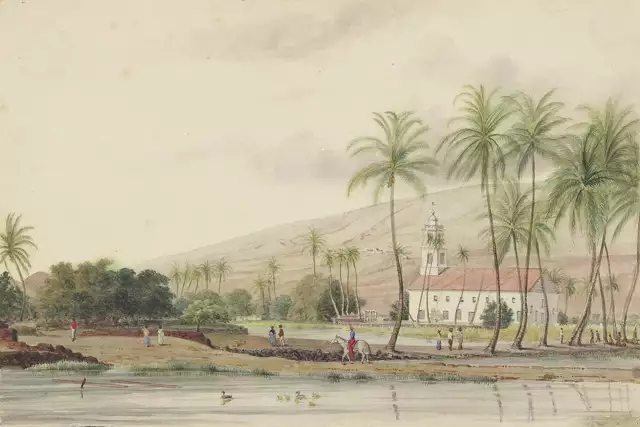
An 1855 watercolor by James Sawkins portrays Mokuula Island surrounded by a fishpond in Lahaina.James Gay Sawkins
Over 7,300 miles away from Hawaii, a wooden statue of the high-ranking Hawaiian deity sits on display in a German museum. The statue depicts the goddess Kihawahinemokuhiniakalamaulakalaaiheana, or Kihawahine, who originally resided in Lahaina at what was once an 11-acre royal fishpond.
According to Hawaiian legend, she protected the Lahaina wetland and guarded Mokuula, a small island that was the home of Hawaiian royalty until the mid-1840s, when the capital of the Hawaiian Kingdom moved to Honolulu. The rise of sugar plantations and water diversions eventually dried the land, and the site was filled and turned into a county baseball park in the early 1900s.
Since the devastating Lahaina fire, Native Hawaiians are renewing calls for the statue of Kihawahine to be returned to the Maui community as it looks to the past in determining the town’s future.
Article continues below this ad
Kihawahine was born human to 16th-century Maui Chief Piilani and deified after death. She transfigures from a woman into a powerful moo (pronounced MOH-OH) and back again. The moo are dragons, serpents or reptiles of any kind and most often guard lakes and streams. Because Hawaii does not have any native reptiles, it’s believed Hawaiian legends of moo originate from ancient ancestral memories from the continent of Asia.
Standing about two feet in height, the statue of Kihawahine depicts a kneeling woman, carved out of a native Hawaiian wood and made with pearl shell eyes and human teeth.
In Kamehameha’s unification of the kingdom, Kūkā‘ilimoku, the male god of war, is most often mentioned as his primary akua. It was however, his taking of the sacred princess Keōpūolani, the incorporation of her mo‘okūauhau (genealogy), & his worship of her goddess Kihawahine… pic.twitter.com/6MkVHYEBho
— Kiaʻi Report ? (@Kiai_Report) August 23, 2023
For over 100 years, the Kihawahine carving has been in the hands of Berlin’s Ethnological Museum, located inside the Humboldt Forum. The museum is part of the Staatliche Museen zu Berlin and overseen by the Prussian Cultural Heritage Foundation.
Article continues below this ad
SFGATE reached out to the Prussian Cultural Heritage Foundation, the Staatliche Museen zu Berlin and Humboldt Forum for comment and did not receive a response.

Site of Mokuula in Lahaina on the island of Maui in Sep. 30, 2012.SeaHorsePunch/Wikicommons
It’s not uncommon to find Hawaiian artifacts and iwi kupuna (ancestral Hawaiian skeletal remains) at museums, universities and other institutions around the world – in most cases, they were stolen from the community in the 19th and 20th centuries. Efforts have been made by the Office of Hawaiian Affairs to repatriate remains and other cultural treasures. Recently, a Berlin museum returned 32 skulls to the OHA to return to Hawaii, but there’s still more to bring home.
“If you’ve acquired something because you robbed a grave or because they are stolen, those items need to be returned,” Colin Kippen, interim CEO of the Office of Hawaiian Affairs, told Hawaii Public Radio.
Article continues below this ad
The Kihawahine statue isn’t made of bone, but it was taken from a burial site. In the mid-1880s, German physician Eduard Arning was invited by King Kalakaua to study Hansen’s disease in the Islands – and while doing so, he collected 500 objects, including the Kihawahine carving.

The Humboldt Forum in Germany has possession of the Kihawahine statue.Heiko T. via Yelp
Before it ended up in Arning’s hands, the Kihawahine’s last known whereabouts was on the Hamakua coastline of Hawaii Island, hidden in a covered hole alongside a human skull.
“There is some mystery about how Arning obtained Kihawahine, but there is no question that she came from a burial site,” wrote H. Glenn Penny in his book, “In Humboldt’s Shadow: A Tragic History of German Ethnology.”
When Arning returned to Germany, he gave his collection to the Berlin Museum of fur Volkerkunde in 1887, which is now Berlin’s Ethnological Museum.
Now Hawaiians want the statue returned home. It is imbued with mana, or spiritual power, not just of the goddess but from the carver and from the people who worshipped it before.
Editor’s note: SFGATE recognizes the importance of diacritical marks in the Hawaiian language. We are unable to use them due to the limitations of our publishing platform.
More Hawaii News
— Maui fires also devastated a critical lifeline for Lanai
— People on this Hawaii island ‘disappeared.’ Here’s why.
— Hawaii has the longest lava tube on Earth. It’s in this guy’s backyard.
— Hawaii residents battle with billionaire owner of Molokai Ranch
We have a newsletter all about Hawaii, with news, tips and in-depth features from the Aloha state. Sign up here.
Sep 4, 2023
Christine Hitt is the Hawaii contributing editor for SFGATE. She is part-Native Hawaiian from the island of Oahu, and a Kamehameha Schools and University of Hawaii graduate. She’s the former editor-in-chief of Hawaii and Mana magazines.