
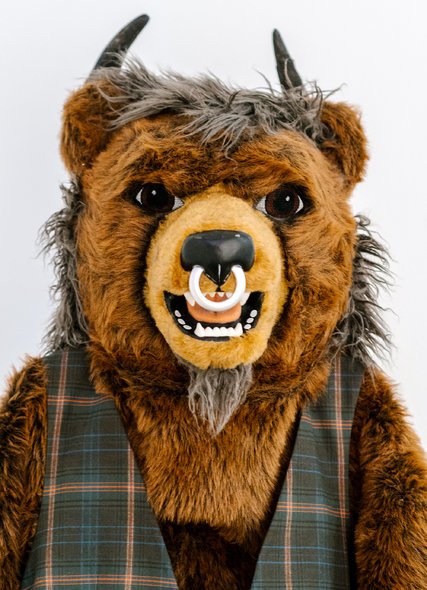
 “Crossing Object (inside Gnomen),” by Nayland Blake, from the exhibition “Trigger: Gender as a Tool and a Weapon,” at the New Museum. Self-portraiture takes many forms in the show, one of them being trans-species.CreditJake Naughton for The New York Times
September 28, 2017 (NYTimes.com)
The New Museum isn’t new any more. It hit 40 this year, by some reckonings early middle age, though it’s still thinking young, or youngish, and living in the now. One thing that made it feel fresh early on was that it did shows on themes no other museums were tackling, like the 1982 “Extended Sensibilities: Homosexual Presence in Contemporary Art,” the first major American institutional survey of work by gay and lesbian artists. Now comes another such venture, “Trigger: Gender as a Tool and a Weapon,” a look at concepts of “trans” and “queer” as embodied in new art.
“Extended Sensibilities” had problems. With its inclusion of abstraction along with figurative work, it struck some viewers as not explicitly gay enough, as dodging the political issues its title raised. A similar charge of indirection, or indeterminacy — I’d call it healthy disorder — could probably be leveled at “Trigger.”
As an exhibition, its brief is to break down, through art, the binary male-female face-off that gay and lesbian often represented, to stretch the perimeters of gender to the snapping point. The goal is to inject the disruptive power of not-normal back into the discussion of difference at a time when the edge of mainstream gayness has been dulled by the quest for assimilation.
The difficulty is that queer, and to some extent trans, are hard to capture, institutionally. Slipperiness is built into them; they don’t sit still. Trans by definition is the act of changing, going beyond the boundaries of gender (and race, and class). Those boundaries are porous, and crossings in any direction are negotiable. Queer is even more category-aversive. It’s not so much a personal identity as a political impulse, a strategy for thwarting assimilation and sowing constructive chaos at a time when culture wars are again escalating.

This is not to say there are no through lines. Grounding the show are historical references that keep the gay-trans-queer links always in sight. We get an encyclopedic dose of that history in a newsprint photo-collage posted in the museum’s main elevator. Produced by the artist Chris E. Vargas, and attributed to the Museum of Transgender History and Art that he founded as an archive in 2013, the picture is a group shot of L.G.B.T.Q.I. (Lesbian, Gay, Bisexual, Transgender, Queer, Intersex) celebrity spanning the centuries.

On the second floor, the New York painter Leidy Churchman serves up a hot pink version of a hot Marsden Hartley hunk. And Mariah Garnettprojects images of herself, impersonating the 1970s gay porn star Peter Berlin, on a spinning disco ball. One floor up, two young filmmakers, Reina Gossett and Sasha Wortzel, commemorate a figure who gay visitors to the 1982 New Museum show might have recognized: Marsha P. Johnson (1945-1992), born Malcolm Michaels and self-identified as a drag queen, who is credited, in some accounts, with throwing a mirror-shattering shot glass that triggered the 1969 uprising at the Stonewall bar.

Johnson was a “drag mother” to young trans women living in the New York City streets, and the tendency to replace hostile birth families with families of choice has long been a hallmark of gay, trans and queer life. The artist and performer Justin Vivian Bond made the switch as a teenager, nominating, from afar, the Estée Lauder model Karen Graham, seen in magazine ads, as a surrogate mother.

The artist, who identifies as “trans-genre,” uses “Mx.” as an honorific, and prefers to be referred to as “they,” tells this adoption-by-proxy story in an installation called “My Mother | Myself,” which sets drawings of Ms. Graham by a teenage Bond beside recent, superglam Bond self-portraits to illustrate how trans self-fashioning works.

Self-portraiture takes many forms in the exhibition, one of them being trans-species. During the show’s run, the artist Nayland Blake will periodically don a full-length bear costume and, as a character called Fursona, will stage hug-fests for visitors. More generally, however, images of trans and queer bodies tend toward abstraction. Troy Michie cuts and pastes images from pornographic magazines to create poly-racial erotic figures. (His work is also in “Found: Queer Archaeology; Queer Abstraction” at the Leslie-Lohman Museum in Soho.) Paul Mpagi Sepuyaedits and blends bodies photographically in the studio creating an atmosphere of entrapment and seduction.

Tschabalala Self, who stitches racially and sexually ambiguous figures from patches of fabric on canvas, is one of several artists working with traditionally female-associated media. (Feminism is, of course, deeply folded into the show.) Diamond Stingily, who as a child hung out in her mother’s Chicago hair salon, is another: her sculpture, a single long braid of artificial hair, trails through all three floors of the show and into the lobby. Vaginal Davis, originally from Los Angeles, now in Berlin, adds social class to the mix in small wall reliefs made from Dollar Store beauty supplies: Wet n Wild nail polish, Aqua Net hair spray and perfume by Jean Nate.

Ms. Davis’s sculptures are only subtly figurative. And the show’s organizers — Johanna Burton, director and curator of education and public engagement at the New Museum, working with Natalie Bell and Sara O’Keeffe, assistant curators – have included a substantial amount of entirely abstract work of a kind 1982 audiences perceived as apolitical, though here it is not.
