
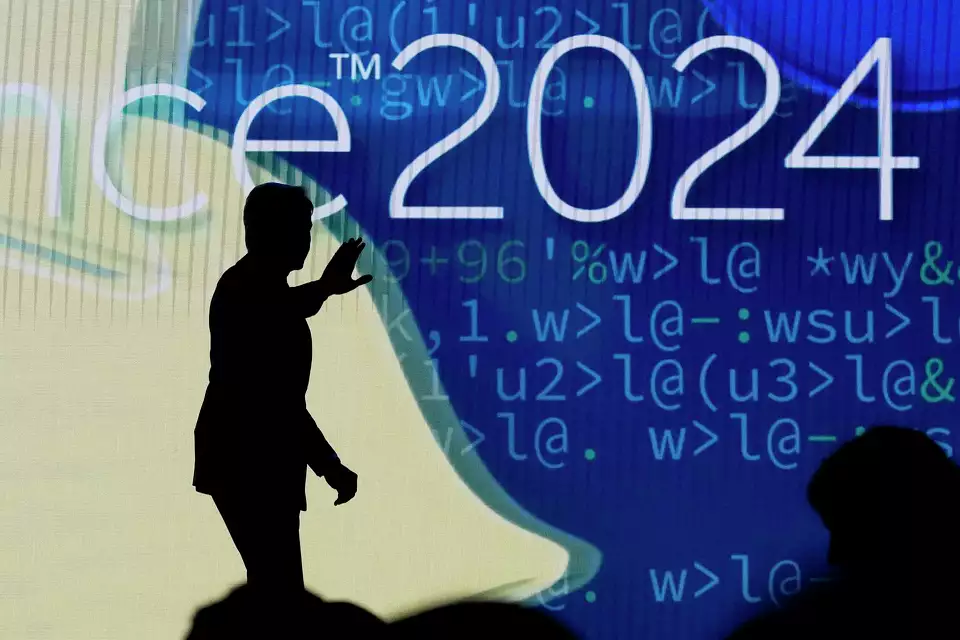
Speakers at the RSA Conference in San Francisco warned that AI and politics are heading for a collision, with unknown consequences for freedom and democracy.Jeff Chiu/Associated Press
Imagine instead of five or six ballot initiatives each year there were 500 or 600. Or perhaps we might have chatbots pushing out political propaganda, or even laws written by and enforced by computer programs.
That was a possible and not-too-distant future outlined by Bruce Schneier, a lecturer at the Harvard Kennedy School of Government, during the RSA Conference at San Francisco’s Moscone Center this week. The four-day, digital security-focused event also attracted U.S. Secretary of State Antony Blinken and U.S. Department of Homeland Security Secretary Alejandro Mayorkas, all of whom discussed the disruption and the dangers that artificial intelligence poses for security and democracy.
Schneier outlined a mostly optimistic future in which the technology fundamentally alters how politicians and politics operate.
The changes AI makes possible in politics — such as writing a candidate’s speeches and statements — might sound bizarre, but they’re actually a continuation of existing norms, Schneier said. “When a president makes a speech, we all know they didn’t write it. When a legislator sends a campaign email, we all know they didn’t write that either,” he said.
More For You
AI-generated news is here from S.F.-based Hoodline. What does that mean for conventional publishers?
Can AI accurately triage ER patients? UCSF study suggests yes, 89% of the time
“In the future. I think we will accept that almost all communications from our leaders will be written by AI.”
Beyond that, Schneier floated a future in which the machines could act like campaign managers, organizing people, conducting polls, and chatting with constituents on a scale most politicians cannot handle or afford now.
AI could even eliminate the need for politicians entirely, he said — admitting the idea was a little “out there.”
Such a future might entail everybody having a personal bot trained on their own political preferences that would advise them how to vote, Schneier said. That would allow for more voting and more ballot initiatives, as long as the technology could reliably inform voters.
“It’s hard to know whether this will be a good thing,” he said.
Speaking on the opening day of the conference, Blinken gave a speech that he didn’t likely pen by himself from start to finish.
The secretary of state outlined a range of technologies, including AI, that the U.S. government hopes to harness while staving off their worst effects and preventing other nations from using them for ill.
“Some of our strategic rivals are … using digital technologies and genomic data collection to surveil their people, to repress human rights,” Blinken said, including “the employment of AI-based tools to deepen polarization and undermine democracies.”
Schneier offered a similar warning about a future in which millions of AI-controlled social media accounts supercharged the propaganda of politicians and nation states.
Blinken also focused on the technology’s positive impacts, noting that diplomatic officers have begun using AI and other machine learning capabilities to search, summarize, translate and draft documents. “That allows our diplomats to spend less time face to screen and more time face to face with our partners,” he said.
During a roundtable discussion with reporters, Mayorkas pointed out the ways in which the technology is already being used at the border and elsewhere.
“Where we are most advanced in our use of AI at the border is actually using it to identify anomalies in commercial trucks, passenger vehicles, and detect efforts to smuggle fentanyl and other contraband into the United States,” he said.
He said agency officers who interview refugees are also beginning to train by interacting with AI programs designed to act like a traumatized refugee who might be reticent to discuss their full story.
Those examples are the seeds of Schneier’s prediction that AI will affect every aspect of our society. How far off in the future is not clear, but “AI is coming for democracy,” he said. “Whether the changes are a net positive or negative depends on people like us.”
Reach Chase DiFeliciantonio: chase.difeliciantonio@sfchronicle.com; Twitter: @ChaseDiFelice
May 9, 2024
REPORTER
Chase DiFeliciantonio is a reporter at the San Francisco Chronicle where he covers tech and how AI is changing the city and the region. He previously covered business, labor issues, and San Francisco’s recovery from the pandemic’s economic and other effects. A fifth-generation San Franciscan, prior to joining the Chronicle in early 2020 he covered legal and business news at the North Bay Business Journal and the Daily Journal.