

Published in The Infinite Universe
2 days ago (Medium.com)
What would it be like to catch up to a beam of light? That was the question that the 16 year old Einstein asked himself. Ten years later, he would publish his answer: you cannot catch it at all.
That doesn’t stop physicists from trying to use Einstein’s theory to explain what a beam of light might “experience”. Unfortunately, they almost always get it wrong because they try to transfer our concept of time to light inappropriately.
There are different ways to think about time in physics. A dimension is “timelike” if it has a metric signature that is the opposite of your space dimensions. We define a dimension using a coordinate. Moving in a particular dimension means making a small displacement such that all but that coordinate stay the same. A metric, meanwhile, is a mathematical object that allows us to measure distances in multidimensional spaces with arbitrary coordinate systems.
You can see right away that it is possible to create coordinate systems where our concepts of time and space might be very complicated over long distances. For example, if I were to take a spacetime and define a hyperspherical coordinate system on it somewhat arbitrarily, there is no guarantee that any particular coordinate direction will align with my familiar concept of time. In such a system I would have three angles and a radial direction. If I were to define it such that time is in an angular dimension rather than the radial one, that might work for a small amount of time but eventually time which I perceive would deviate from that dimension. You could say this is just a bad choice of coordinates and you’d be right. Still, nevertheless, at any given point there will be a particular direction that is “timelike” in the sense that if I apply my metric to it, it will be negative (assuming we choose our signs so that timelike is negative and spacelike is positive which is often written -+++).
In the familiar four dimensions we normally work with there is only one dimension of time. That means that, for a given observer, there is a timelike Killing vector that defines time for them. A Killing vector is another useful mathematical object, and all it says is that if I displace a small amount in the direction of this Killing vector then all the other points get displaced such that they stay the same in relation to one another.

The above is an example I copied from Wikipedia just for illustration purposes. In this case, the Killing vectors are the white arrows. If you move along these vectors, the circle rotates, so nothing changes.
If I have a particle moving through spacetime, it traces out a line called a world line. In this case, its Killing vector is simply in the direction of its motion in spacetime. If we are in the particle’s reference frame, meaning it is not moving at all from our perspective, then that vector would simply be in time alone.

Another perspective on time is a little different and that has to do with the perception of time. Things don’t just move in time, they experience change in time. As far as we know, we never experience more than one moment of time simultaneously. That sense of experience of time is sometimes called a temporal dimension. It is not present in the theory of general relativity at all because in that theory time is treated like an ordinary dimension. Time is only special because it is timelike so it has a causal structure. That causal structure, however, doesn’t tell us anything about how time is experienced.
Our experience of time, the fact that time has an arrow and things flow from past to future, is only contained in one physical theory: thermodynamics (as well as its quantum equivalent). Yet, these theories are not fundamental but only look at how particles (or more generally what are called microstates) behave in large numbers. Fundamentally, there is no real explanation for the arrow of time.
Our dimension of time, the one we are familiar with, has both of these properties: it is timelike, and it is temporal.
I came across an idea for how to explain what time is like for light while playing around with a coordinate system called the Infalling (or in-going) Eddington-Finklestein coordinate system. This coordinate system was first written down by Sir Roger Penrose but he credited papers by Arthur Eddington and David Finklestein. The classic textbook on general relativity, Gravitation by Misner, Thorne, and Wheeler, affectionately known by those in the biz as “MTW” also used this name. It has stuck ever since.
This coordinate system was developed to look at black holes from the perspective of beams of light falling in. Thus, imagine you are riding a beam of light as if falls in.
In general relativity, a beam of light follows a null trajectory, meaning that if you calculate the length of its velocity vector in four dimensions, its length is zero. That may seem counter-intuitive, but, in spacetime, when computing distances, the square of the time component of the velocity has the opposite sign of the space components. If the length of the time component, the temporal speed, is equal to the spatial speed, you have a null trajectory. The only objects that have spatial and temporal speeds the correct sizes for this to happen are those going the speed of light. All such objects also, by definition, have no “rest mass”, meaning if we could ride those beams of light we would measure no mass.
Many science communicators, including professional physicists, attempt to explain what you would experience as a beam of light by imagining what happens as a massive object, such as yourself, accelerates closer and closer to the speed of light. From the perspective of someone watching you accelerate, you would appear to slow down more and more. Since this process continues indefinitely, it would seem that at the speed of light, which you can never reach, your clock would stop and you would no longer experience time.
This isn’t quite correct, however, because nothing with rest mass can have a null trajectory. As you approach the speed of light, rather, the length of your four-dimensional velocity stays the same, nonzero. As your spatial speed increases, instead, your temporal speed also increases to compensate. That is why you appear to slow down. At the speed of light, the lengths of these two speeds would be effectively infinite, so, yes, your clock might stop. (Your spatial and temporal speed become infinite rather than just equal to the speed of light because of its Lorentz factor, which gets multiplied by the two values to express the total velocity in spacetime.)
This means that you are not approaching anything like a null trajectory as you accelerate. For the beam of light, both temporal and spatial speed are finite and they are both, in the right units, the speed of light itself, not infinity.
Thus, while your clock does become infinitely slow to an outside observer as you approach the speed of light, light itself has a perfectly ordinary ticking clock that can never change. It never gets slower and never gets faster. It is always the same for all observers: exactly the speed of light. Yet, one cannot exist within the rest frame of light and so the one place where such a clock does not exist is there.
In other words, it is meaningless to talk about what a beam of light experiences because such a statement presumes a rest frame, and light doesn’t have one.
There is, however, a way in which light does not perceive the passage of time and we can understand that if we look at light falling into black holes.
Black holes put massive and massless objects on a more even playing field where we can compare the two and what happens as they approach the event horizon.
In our usual coordinate system for a black hole, which represents a distant, stationary observer, as an astronaut approaches the event horizon time slows down. If they have a clock with them sending out regular pulses back to the distant observer, the interval between the pulses would get longer and longer until they would effectively stop. We can know that because the time coordinate becomes infinite at the event horizon. We say there is a singularity there.
This singularity, at the event horizon, however, is not a real one but a coordinate singularity, and we can remove it with a new coordinate system.
When we change coordinate systems, however, we are changing our perspective. The infalling EF coordinates change that perspective to that of a light beam falling into the black hole.
In these coordinates, we have a new kind of time parameter, usually called v, which is a combination of our usual time and a radial coordinate called the tortoise coordinate. The tortoise coordinate goes to negative infinity as one approaches the event horizon of a black hole.
We now add together our old time coordinate and the tortoise coordinate and the infinities cancel each other out. (We can formalize this cancellation using the mathematical concept of limits.)
This new coordinate, v, when kept constant, represents the trajectory of a beam of light falling into the black hole.
Unfortunately, the picture of EF coordinates on Wikipedia is misleading, but you can look at the correct picture here in Figure 19.4. Essentially, the constant v lines lie on the edge of light cones as they turn in towards the black hole.
Now, suppose I want to take a spacetime in infalling EF coordinates and decompose it into space evolving in time rather than only individual trajectories. We call space at a given moment in time a spatial slice. These spatial slices evolve along lines where v is constant, meaning that the change in v from slice to slice is zero.
Since v stands in for our time coordinate here, it is clear that “time” isn’t changing from slice to slice. We still move forward from slice to slice from the perspective of a distant observer, but, from the perspective of an internal observer, there is no movement. The clock is always pointing to the same time from the beginning of the universe to the end.
This is the correct way to think about a beam of light. Rather than imagining a massive body accelerating to the speed of light, we simply imagine a coordinate system that is aligned with light trajectories.
It turns out that our intuition from special relativity is correct. Light has no experience of time at all. Every point along the beam has an independent existence as if it were in a separate universe from all the others.
We can illustrate this with an analogy. For a massive body, you can imagine a flipbook with an animation. As you flip the book, you see a horse galloping.
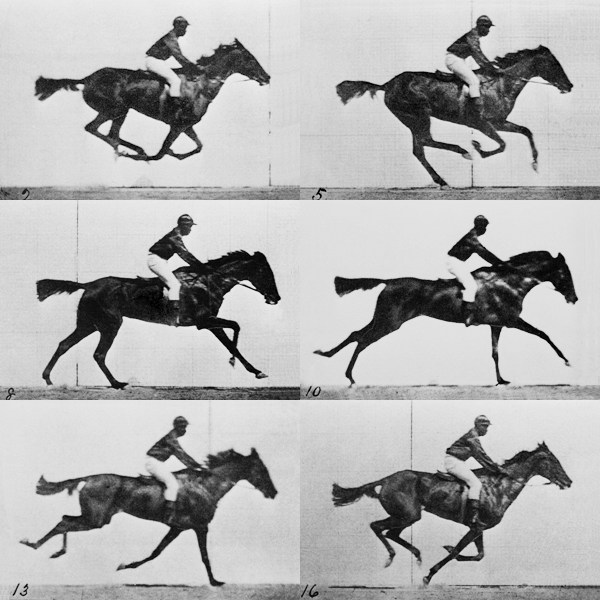
To simulate this picture approaching the speed of light, you could insert more and more pages so the horse appears to gallop more and more slowly. At the speed of light, this stack becomes infinitely large. For a light beam, however, every page in the flipbook shows the same image of a horse. It isn’t infinitely large. It is just all the same.
Unlike the moving horse, where the difference between one page and the next has some meaning as an interval of time, the difference between one page and the next in the stationary flipbook has no meaning. You can have one page or an infinite number of pages. There is no meaningful definition of time. It has ceased to exist.
The other interesting feature of light falling into black holes is that, while they can fall in, they cannot emerge.
Thus, like time itself and like thermodynamics, entering a black hole has an “arrow”. It works in one direction but not the reverse. (This arrow is very closely related to thermodynamics in fact.)
Since the beam of light does not experience time passing, does that mean it is both inside and outside the black hole at the same “time”?
Not exactly, rather, every point along its trajectory is, in a sense, separate from every other point, as if each point were in its own universe. Whereas a massive body evolves in time from its perspective because it has a timelike Killing vector, a beam of light has no evolution from its own perspective (while it does from ours). Its worldline has a null Killing vector. For itself it is more like a string draped across space and time than a thing in motion. The irreversibility of its motion is only apparent from an observer following a timelike trajectory like us. For a beam of light, the past and future are all the same.

Written by Tim Andersen, Ph.D.
·Editor for The Infinite Universe
1.2M views. Principal Research Scientist at Georgia Tech. The Infinite Universe (2020). andersenuniverse.com; https://timandersen.substack.com/