

Jul 4, 2023 (Medium.com)
CONTENT WARNING: Descriptions of sexual violence and patient abuse
To the editors of Psychopharmacology,
The undersigned individuals felt compelled to inform Psychopharmacology that multiple authors of two publications featured within your journal have omitted information concerning an adverse event stemming from a clinical trial.
To be specific, the undersigned are aware of an incident involving drug-facilitated patient abuse that was omitted from the relevant medical literature. This prolonged incident of patient abuse occurred within a randomized controlled trial examining the therapeutic potential of 3,4-methylenedioxymethamphetamine (MDMA) as a pharmacological adjunct to psychotherapy.
Given that the organization that sponsored the clinical trial (the Multidisciplinary Association for Psychedelic Studies, also known as MAPS) is on the verge of potentially gaining FDA approval for MDMA-assisted psychotherapy for post-traumatic stress disorder (PTSD), the undersigned individuals cannot overemphasize the need for decisive action from Psychopharmacology.
In this open letter, we address the incident of patient abuse, ethical lapses by MAPS and its founder Rick Doblin, and several issues within MAPS clinical research that contributed to the incident. We urge Psychopharmacology to promptly address this matter so as to provide the broader scientific community with up-to-date and accurate information about the clinical trial in question. We hope that this letter raises awareness within the academic community regarding the risks of patient abuse within MAPS-sponsored trials of MDMA-assisted psychotherapy.
The two articles in question are as follows:
Section 1) A Summary Of The Incident Of Patient Abuse:
In December 2014, a PTSD-afflicted survivor of sexual assault enrolled in a MAPS-sponsored phase 2 clinical trial in Vancouver. The participant in question, M*****n B*****n, was administered MDMA on three separate occasions by her two MAPS-trained psychotherapists, Dr. Donna Dryer and Richard Yensen, Ph.D.
Flash forward to 2021, Ms. B*****n provided her clinical footage to investigative journalists who uncovered the extent of her abuse in the treatment room. The published footage included Yensen and Dryer repeatedly cuddling, spooning, holding, kissing, and eye gazing with their patient.
At one point, Ms. B*****n was gagged with a towel while her arms were pinned down. In addition to visibly demonstrating resistance strategies, Ms. B*****n can be heard sobbing and moaning for prolonged periods of time.
Despite the abusive and traumatic nature of these sessions where Ms. B*****n was administered MDMA, she followed the advice of her therapy team to “trust the process” and (on paper) her symptoms improved. Upon the completion of her three treatment sessions in June 2015, Ms. B*****n moved from Vancouver to Cortes Island, a remote island off the coast of British Columbia where Yensen and Dryer live. Ms. B*****n chose to do so because she was experiencing financial instability and was allegedly offered free psychotherapy sessions by Yensen and Dryer.
Ms. B*****n has alleged that Richard Yensen inappropriately touched her in September 2015. In response to this improper behavior, Ms. B*****n immediately fled the island via ferry. However, after significant persuasion by Yensen, Ms. B*****n returned to the island by the end of the month. Shortly before she returned to Yensen and Dryer’s property, Ms. B*****n replied to Yensen via email, stating that “You are right and I am sorry. I am horrible and can’t even see what’s true anymore.” Ms. B*****n was, in her own words, “utterly dependent” upon her therapists at this particular time.
In March 2022, Ms. B*****n published the following statement on Twitter: “I told a psychiatrist what happened after I escaped [a MAPS clinical trial]. She summarized my experience as ‘[She] was drugged, seduced, raped, blamed and held in thrall as a sex slave’.”

In October 2015, Ms. B*****n completed active treatment in the phase 2 study. Around this time, she was spending significant amounts of time at the home of her MAPS-trained therapists where she performed manual labor and secretarial duties on their behalf. Given that Ms. B*****n was replying to MAPS emails addressed to Yensen and Dryer, MAPS was in possession of evidence that indicated Ms. B*****n had moved hundreds of kilometers away to live in close proximity to her therapists on a remote island.
At the Science and Non-Duality Conference held in late October 2015, Richard Doblin, Ph.D. (the Founder and President of MAPS) stated that MAPS adherence raters “are able to watch the videotapes of all the therapy sessions” within MAPS clinical trials. Regarding the approved clinical protocols for the MAPS trial involving Ms. B*****n, the documentation clearly states that “adherence criteria and competence ratings will be conducted by qualified, trained blinded adherence raters who will analyze video data […]”.
Section 2) A List Of The Documented Allegations Regarding Richard Yensen And Donna Dryer
- Ms. B*****n alleged that Yensen and Dryer openly referred to themselves as “mommy and daddy”.
- Ms. B*****n alleged that Yensen and Dryer openly referred to Ms. B*****n as their “experiment”.
- Ms. B*****n alleged that in January 2016, Yensen kissed her by placing his tongue in her mouth.
- Ms. B*****n alleged that in March 2016, Yensen digitally penetrated her.
- Ms. B*****n alleged that Yensen described the above-mentioned act as a form of “exposure therapy”.
- Ms. B*****n alleged that in May 2016, Yensen described Ms. B*****n as “selfish”, “seductive”, and a “manipulative bitch” for turning down his sexual advances on at least one occasion.
- Under penalty of perjury, Ms. B*****n stated that “during the course of [her] treatment, Dr. Yensen committed sexual assaults upon [her] which included but were not limited to having sexual intercourse [,] inappropriately touching [her], inappropriately exposing himself [,] violating [her] privacy, verbally commenting on sexual matters to [her], making sexualized gestures, sounds, and actions towards [her], [and] using inappropriate and sexualized language with [her].”
- This behavior allegedly continued until Ms. B*****n successfully “escaped” in 2017.

Section 3) Dr. Doblin’s Public Statements Regarding Safety In MAPS Clinical Trials
In April 2016, Dr. Doblin appeared on the Joe Rogan Experience and assured Mr. Rogan’s listeners that MAPS therapy sessions are videotaped and scored. As he put it, “Everything is videotaped. We even have it scored. We have raters that look at the therapists and score them on how much they’re complying (cohering) with our method.”
Three months later, Dr. Doblin appeared on the EntheoNation podcast and stated that “We’ve got 4 basic principles of how we operate [at MAPS]. The first is to create a safe space [so as to satisfy] that need to feel protected […] People in our research know that they’re safe […] no one can abuse them […]”.
Approximately six years after Dr. Doblin made these remarks, Dr. Doblin appeared on the Psychedelics Today Podcast and spent twenty minutes addressing concerns regarding the media’s publication of Ms. B*****n’s clinical footage. While discussing Ms. B*****n’s years-long abuse at the hands of her MAPS-trained therapists, Dr. Doblin stated that “I don’t know what we coulda done to stop that from happening”.
Despite this, Dr. Doblin claimed that once MAPS became “aware of this situation, we acted promptly and responsibly.” He emphatically denied the existence of an institutional “cover-up” four times over the course of eight minutes during that podcast appearance. He added that “as far as (you know) the unethical sexual misconduct, we pretty much have, umm, been public about it… told everybody about it […]”.
At face value, Dr. Doblin has claimed that MAPS acted appropriately and transparently in the wake of being informed of Ms. B*****n’s abuse. By way of contrast, compelling evidence will soon be presented that MAPS researchers omitted information from the medical literature regarding this incident of patient abuse.
Before this evidence is presented, it should be noted that MAPS released a public statement regarding sexual violence within “the psychedelic community” in October 2021. The statement claimed MAPS “believe[s] that communities are strengthened through open discussion of allegations of abuse or maltreatment. We demonstrate that belief through our actions, policies, and practices.”
Section 4) A Brief Summary Of The Incident Of Academic Dishonesty:
In October 2018, Ms. B*****n forwarded complaints to MAPS Public Benefit Corporation (MAPS-PBC). Exactly six weeks after MAPS-PBC gained possession of these documents, Psychopharmacology formally “received” MAPS’ finalized submission of their Phase 2 publication. In April 2019, Psychopharmacology formally “accepted” MAPS’ submission and published the article in the subsequent month.
In June 2020, Psychopharmacology published MAPS’ long-term follow-up research to Ms. B*****n’s clinical trial which offered “heartfelt gratitude” to Yensen and other MAPS staff members (in the Acknowledgements section).
The primary investigator of the long-term follow-up research mentioned above (Lisa Jerome, Ph.D.) is described on the MAPS website as “believ[ing] in the necessity of interpreting and sharing research knowledge that will best help MAPS PBC produce transparent, thorough and honest documents and reports”. Despite this, her publication asserted that “[t]here were no indications of abuse potential for MDMA” (Jerome et al., 2020).
Although Yensen promptly confirmed Ms. B*****n’s complaints submitted to MAPS-PBC, the authors of the aforementioned publications abstained from adequately informing the broader academic community about this adverse event and the contextual factors surrounding it. Ironically, MAPS stated in April 2019 that the organization “commit[s] to ongoing personal and professional self-reflection regarding ethics and integrity”.
In May 2019, MAPS issued a public statement on their website which claimed that “[m]onitoring of study records throughout the course of the trial & afterward didn’t indicate signs of ethical violation […] The protective measures in place include[d] […] video recording of all therapy visits, monitoring of study and therapy activities, and clinical supervision. In this case, none of these measures were sufficient.”
The statement did not describe the years-long sexual violence that Ms. B*****n endured as “abuse”. Instead, it repeatedly referred to her abuse as a “sexual relationship”.
At face value, these statements imply that MAPS monitored all of Ms. B*****n’s clinical footage and failed to find “signs of ethical violation”. However, MAPS representatives have provided journalists with “more than five different answers” regarding who reviewed Ms. B*****n’s clinical footage and when the footage was reviewed.
The principal investigator of the Phase 2 study, Dr. Michael Mithoefer, has stated on the record that the “adherence rating and robust supervision” within MAPS Phase 2 research “wasn’t as robust as we have now. And obviously it was not as robust as we needed it to be”. This should be cause for alarm.
Section 5) A Brief Summary of Dr. Doblin’s Academic Dishonesty:
Given that the Founder and President of MAPS (Richard Doblin, Ph.D.) is listed as an author on both of the relevant publications, the undersigned wish to raise awareness regarding how Dr. Doblin has betrayed his own sense of ethics and (despite his claims to the contrary) engaged in an institutional “cover-up” related to the aforementioned story of patient abuse.
Flashing back to April of 1962, Dr. Walter Pahnke conducted a randomized placebo-controlled study known as the “Good Friday Experiment” which sought to investigate whether psilocybin could produce genuine mystical experiences. Twenty Andover Newton Theological Seminary students participated in a group session with half being given 30mg of purified psilocybin while the other ten were given niacin as a placebo.
During the course of the experiment at Boston’s Marsh Chapel, one of the participants (who was randomly assigned to receive psilocybin) felt invigorated by the preacher’s Good Friday sermon. Making a quick departure for the church’s exit, the participant felt compelled to tell the world about his interpretation of Jesus’s crucifixion. Dr. Pahnke followed in pursuit.
To Pahnke’s dismay, the participant hastily initiated a physical altercation with a mailman. In the immediate aftermath of the incident, Dr. Pahnke injected the participant with a dose of Thorazine sufficient enough to tranquilize them. As grim of a story as this was, Dr. Pahnke never acknowledged within his academic publications that this drug-related adverse event occurred.
In 1991, Dr. Doblin severely criticized Dr. Pahnke’s grave errors in judgment. Specifically, Dr. Doblin wrote in The Journal of Transpersonal Psychology that “[n]eedless to say, this occurrence should surely have been mentioned in Pahnke’s thesis and, by those few who knew that such an event had actually transpired, in any subsequent reporting on the experiment. Pahnke probably did not report his use of the tranquilizer because he was fearful of adding to the ammunition of the opponents of his research.”
Dr. Doblin added that “Even in an educated scholar, bias can overwhelm facts. This observation, of course, is also true of Pahnke. His silence about his administration of a tranquilizer may perhaps have been good politics; certainly, it was bad science. […] There is no justification for this omission no matter how unfairly the critics of this research may have used the information and no matter how minimal the negative persisting effects reported by the subject. […] These very serious omissions point to an important incompleteness in Pahnke’s interpretation of the effects of psilocybin.”

In his doctoral dissertation, Dr. Doblin acknowledged the risks of sexual abuse within psychedelic-assisted psychotherapy. On page 361 of his dissertation, Dr. Doblin wrote that “[t]he loving and trusting feelings that can be induced by MDMA can make patients more vulnerable to sexual abuse”. On page 299 of his dissertation, Dr. Doblin remarked that “[a]buse refers to situations in which the medical professionals entrusted with administering psychedelic psychotherapy intentionally do so in an inappropriate manner, for instance, to facilitate the sexual abuse of patients.”
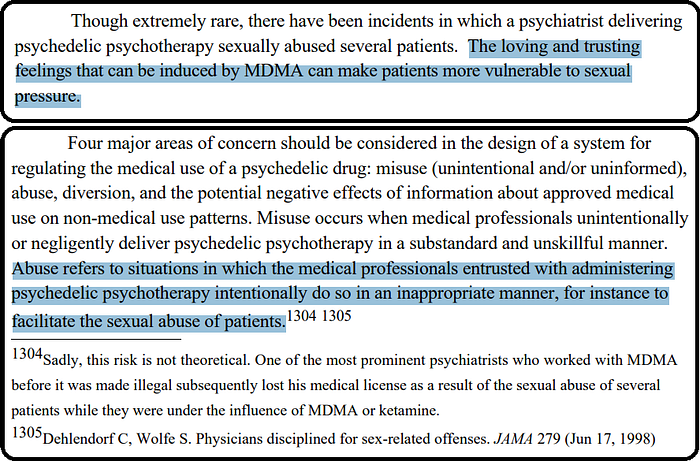
Although Dr. Doblin severely criticized Dr. Pahnke for omitting information related to an adverse drug-related event, Dr. Doblin has not addressed his organization’s choice to omit Ms. B*****n’s story of drug-facilitated patient abuse from the relevant medical literature.
The undersigned believe that Dr. Doblin’s failure to publicly disclose the contextual factors regarding Ms. B*****n’s abuse within the medical literature is antithetical to initiating academic discourse about MDMA’s ability to elicit physical arousal, issues of transference in psychotherapy, informed consent regarding the use of touch in MAPS clinical trials, and the multitude of risks surrounding MDMA-assisted psychotherapy.
Indeed, Dr. Doblin is aware of the risks associated with the clinical use of a suggestibility-enhancing drug with boundary-dissolving qualities, yet his actions as of late potentially indicate that he does not take this matter as seriously as he once did.
Section 6) Dr. Doblin’s Public Comments About The Incident Of Abuse
In July 2022, Dr. Doblin appeared on Ethan Nadelmann’s podcast to insist that “this unethical sexual misconduct became sexual after the therapy was over when the cameras were off”. Dr. Doblin affirmed Mr. Nadelmann’s misguided belief that “the major ethical issue wasn’t what happened in the moments of therapy which one can see on the videotape”. By way of contrast, Ms. B*****n’s footage clearly depicts Yensen repeatedly pushing his groin into his patient’s backside as his co-therapist (Dryer) attempted to convince their patient that she was safe.

While on Psychedelics Today in 2022, Dr. Doblin described Ms. B*****n’s abuse on Cortes Island as a “sexual situation” consisting of Yensen engaging in “bad behavior”. During that broadcast, Dr. Doblin argued that MAPS’ failure to promptly review Ms. B*****n’s clinical footage was simply a “mistake” and that MAPS was not “liable” for Yensen’s conduct. He claimed that the published clinical footage was “selectively edited” by journalists, adding that people “get the impression from looking at the videos that these therapists are actively abusing this patient. They’re restraining her and she’s… but it was more of this technique […]”.
Indeed, Dr. Doblin described MAPS-trained therapists pinning down a drugged patient’s body while hampering their ability to respirate as a therapeutic “technique”. In the same podcast, Dr. Doblin added that this particular “technique” is based upon a “provocative approach” that was “developed” by Salvador Roquet, a known torturer for the DFS. Dr. Doblin argued that such “psychodrama […] can be beneficial” within the context of psychotherapy.
During the same podcast, Dr. Doblin also implied that MAPS reviewed Ms. B*****n’s clinical footage from her first therapy session in 2015. As he put it, “[t]he early therapy session […] had been reviewed and there were some comments given back to them, but it seemed that they were fine to go on their own […]”.
However, one of the journalists who uncovered Ms. B*****n’s abuse viewed the first therapy session in a different light. Lily Kay Ross, Ph.D. (a sexual violence researcher) described the first therapy session in the following terms: “Richard Yensen is in almost constant physical contact with [Ms. B*****n]. Like, she’ll go to brush her hair out of her face and he’ll grab her hand in the middle of it to hold her hand. And this escalates throughout the session. So eventually he’s like kneeling on the floor and kind of leaning over [Ms. B*****n], and then he’s in the bed with [Ms. B*****n] and he’s holding [Ms. B*****n]. And then Donna Dryer is in the bed with [Ms. B*****n] as well.”
Section 7) Discussion Section
Dr. Doblin has repeatedly downplayed the most egregious of Richard Yensen’s conduct, an act that has resulted in semantic infiltration of public discourse. By echoing deceptive rhetoric about this incident of patient abuse, Dr. Doblin is undoubtedly misleading people and may potentially be abusing the public’s trust.
Perhaps the most egregious of Dr. Doblin’s evasive euphemisms is his oft-repeated claim that Yensen engaged in a “sexual relationship” with his own patient. Time and time again, Dr. Doblin has appeared at public speaking engagements (including academic conferences) to echo the rhetoric of Ms. B*****n’s abuser. If one reads the court documents related to Ms. B*****n’s civil suit, it is clear that Yensen declared under penalty of perjury that he engaged in a consensual “sexual relationship” with Ms. B*****n.
Given that adherence to trial protocols is essential for ensuring the safety of participants, it’s worth mentioning that the same journalists who uncovered Ms. B*****n’s abuse also reported (in March 2022) that MAPS adherence raters had “caught therapists cuddling on the floor with patients” at a Phase 2 study site in Switzerland.
Three weeks after this was reported, Dr. Doblin attended a panel event held by Penn Nursing and asserted that “[a]s far as we know, there’s only one case where a [MAPS] therapist had a sexual relationship with a patient. So (you know) there may be others that we’re not aware of, but nobody has brought that to light.” For the record, MAPS has yet to address the concerns regarding the study site in Switzerland.
Sexual abuse, by definition, involves a power imbalance in which one person uses force, coercion, or manipulation to engage in sexual violence. Repeatedly referring to acts of sexual violence as a “sexual relationship” minimizes the harm done to victims and perpetuates the false notion that such abuse was somehow consensual or acceptable. It also places blame on the victims, suggesting that they somehow contributed to or participated in the abuse.
Using accurate language to describe sexual abuse is important for several reasons. First and foremost, it acknowledges the reality of the harm done to the victim and validates their experience. It also helps to dispel the myths and misconceptions surrounding sexual violence (e.g. that victims somehow consented to the abuse). Perhaps what’s most important is that it holds perpetrators accountable for their actions and sends a message that sexual violence will not be tolerated.
Language is an incredibly powerful tool that shapes our understanding of the world around us. The way we talk about sexual abuse can have a significant impact on how we perceive and respond to the issue. Using language that minimizes the violent nature of sexual abuse (e.g. referring to it as a “sexual relationship”) reinforces harmful misconceptions that prevent victims from getting the help they need while also contributing to a culture that tolerates sexual violence.
If appropriate actions are not taken by the broader academic community on this matter, victims of patient abuse within psychedelic clinical trials will be less likely to come forward and potentially seek help given that they may believe that their experience will not be taken seriously. If appropriate action is taken on this matter, we can continue working toward creating a culture where sexual violence is not tolerated and where all survivors are valued, respected, and protected.
Finally, the undersigned wish to emphasize that the psychopharmacological effects of the investigational drug in question (MDMA) contributed to Ms. B*****n’s abuse. Regardless of whether it is utilized as a pharmacological adjunct to psychotherapy, MDMA can engender states of emotional vulnerability, increase one’s suggestibility, and lower one’s psychological defenses.
fMRI research by Gillinder Bedi and colleagues indicates MDMA “diminishes responses to threatening stimuli and enhances responses to rewarding social signals”. As expressed by Katherine MacLean Ph.D., MDMA allows people to “feel empathy toward another person, even someone they might not normally like, and to feel safer than normal, even in threatening situations.” Dr. Doblin has acknowledged that the use of MDMA as a pharmacological adjunct to psychotherapy bears the potential of making patients “more suggestible”. Ms. B*****n has described the doses of MDMA provided to her within the MAPS clinical trial as having the ability to “alte[r] your consciousness in such capacity that you have no ability to say no or yes”.
Given that the MAPS Manual encourages clinicians to offer “nurturing touch” and “focused bodywork” to patients at any visit during the clinical trial, concerns have been raised regarding the use of touch within psychedelic-assisted psychotherapy. Although the MAPS Manual for MDMA-Assisted Psychotherapy repeatedly emphasizes the importance of an ongoing informed consent process regarding the use of touch in therapy, it would be important to consider that MDMA (a consciousness-altering and suggestibility-enhancing entactogen) can affect trial participants’ decision-making abilities.
Given that these factors can significantly increase trial participants’ vulnerability to abuse by clinicians, the relationship dynamics present within MDMA-assisted psychotherapy “presents greater vulnerabilities than the typical power imbalance in psychotherapy” (Devenot et al., 2022).
Section 8) Conclusion
“Burying past abuse to protect an agenda is, by nature, another form of abuse. We are ethically obligated to bring awareness to past abuse in order to recognize and prevent future abuse”, said Thalia Rachel Harrison in their 2022 master’s thesis entitled “Altered Stakes: Identifying Gaps in the Psychedelic-Assisted Therapy Research Informed Consent Process”
Although MAPS has published two (2) web pages that have addressed the aforementioned incident of patient abuse, it is clear that MAPS omitted the story from the relevant medical literature. Psychopharmacology’s submission guidelines explicitly state that “If there is suspicion of misbehavior or alleged fraud, the Journal and/or Publisher will carry out an investigation following COPE guidelines”.
Given the severity of the situation at hand, the undersigned call upon the editors of Psychopharmacology to take decisive action so that the broader medical community may become better informed about the risks present within MAPS-sponsored trials of MDMA-assisted psychotherapy.
Given that Dr. Doblin has estimated that MAPS will obtain FDA approval for MDMA in June of 2024, the undersigned individuals respectfully request that your organization complete a prompt and thorough investigation of the material presented within this letter.
The undersigned individuals request a public response to this letter within sixty (60) days regardless of the status of any potential investigation.
Respectfully submitted,
Sasha Sisko, Journalist & Podcaster
Additional Signatories

Katherine MacLean, Ph.D., Research Scientist & Writer
Russell Hausfeld, Senior Writer and Researcher at Psymposia
David S. Prescott, LICSW (Director of the Safer Society Continuing Education Center)

Erika Rosenberg, Ph.D. (Founding Faculty, The Compassion Institute; Consulting Scientist, Center for Mind and Brain, UC Davis; Chief Scientific Office, Humain, Ltd.)
*Post-Script #1: A complete copy of the letter addressed to the editors of Psychopharmacology (with footnotes) has been separately uploaded to Google Drive for permanent record-keeping purposes.
*Post-Script #2 (Clarification): This open letter was originally published with M*****n B*****n’s name left unredacted. Although Ms. B*****n publicly came forward more than a year ago and although her story has been widely shared in media reports, I (Sasha Sisko) have edited the public-facing portion of the open letter to redact her name so as to respect her privacy. Although I have engaged in private correspondence with Ms. B*****n, I did not obtain her permission to mention her name in this open letter. I regret this error in judgment and look forward to receiving ongoing commentary from others in the academic community.
Post-Script #3 (Clarification): In 2019, Psychopharmacology published MAPS initial findings from their phase two research — an article that claimed that “[t]here were no unexpected MDMA-related SAEs [Serious Adverse Events]” (Mithoefer et al., 2019). The long-term follow-up research to MAPS Phase 2 trials asserted that “[t]here were no indications of abuse potential for MDMA” (Jerome et al., 2020).
Post-Script #4 (Correction): An earlier version of this publication implied that MAPS and MAPS-PBC gained possession of Ms. B*****n’s complaints at the exact same time in October 2018. This open letter has been CLARIFIED to state that MAPS-PBC (alone) gained possession of these documents exactly six weeks prior to Psychopharmacology formally receiving MAPS’ finalized submission of their Phase 2 research. It is not a matter of public knowledge as to when, exactly, Ms. B*****n’s complaints were forwarded from MAPS-PBC to MAPS. At the time of publication, I assumed the complaints were immediately forwarded from MAPS-PBC to MAPS, but I cannot state this with absolute certainty. I regret the error and apologize for any confusion this may have caused. I welcome MAPS to provide documentation as to when they formally received Ms. B*****n’s complaints from MAPS-PBC.
Post-Script #5 (Clarification): Due to overwhelming inquiry from colleagues, I have added context at the end of a quote from Richard Doblin, Ph.D. within Section 6 of the open letter. “You get the impression from looking at the videos that these therapists are actively abusing this patient. They’re restraining her and she’s… but it was more of this technique […]”
Post-Script #6 (Correction): An earlier version of this publication utilized the incorrect verb tense for a singular word (“include”) while quoting MAPS’ May 2019 statement regarding Ms. B*****n. The open letter has been corrected to provide more context. I regret the error.
Post-Script #7 (Addition): A brief paragraph regarding Lisa Jerome, Ph.D. has been added to Section 4.
Post-Script #8 (Clarification): The letter has been amended to state that Richard Yensen confirmed Ms. B*****n’s complaints as outlined in her complaints submitted to MAPS-PBC in October 2018. An earlier version of this publication stated that Yensen “promptly confirmed” her “allegations”, but I did not specify which allegations Yensen confirmed in 2018. I regret the error. The original source material stated that “Richard Yensen and Donna Dryer verbally confirmed to MAPS that this sexual relationship did occur”.
Post-Script #9 (Correction): The letter originally stated that Dr. Doblin criticized Dr. Pahnke within his undergraduate thesis, but the quote was actually obtained from an article he wrote in The Journal of Transpersonal Psychology expanding upon his undergraduate thesis project. I regret the error.
Post-Script #10 (Contact): If any other colleagues wish to add their name to this open letter, please message me at @SashaTSisko on Medium, @SashaSisko on Twitter, or @Sasha__Sisko on Instagram.

Written by Sasha Sisko
Independent Journalist & Podcaster. Support me at patreon.com/SashaSisko or https://www.paypal.com/paypalme/sashasisko or https://account.venmo.com/u/SashaSisko
(Contributed by Gwyllm Llwydd)