
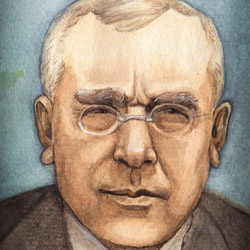
20TH CENTURY MATHEMATICIAN & PHILOSOPHER

INTRODUCING PETER OUSPENSKY
Piotr Demianovich Ouspensky (March 4, 1878–October 2, 1947) was a Russian philosopher who rejected the science and psychology of his time under the strong suspicion that there had to exist superior systems of thought. In his youth, he studied mysticism and esotericism and traveled extensively in search of ancient wisdom, sensing that past ages knew more than his present one. “I felt that there was a dead wall everywhere,” he commented in one of his early biographical notes. “I used to say at that time that professors were killing science in the same way as priests were killing religion.”
When Ouspensky met George Gurdjieff and was introduced to the Fourth Way in 1915, he realized that the barrier towards knowledge lay in oneself; one couldn’t find the truth without simultaneously laboring to live the truth. Real knowledge could only come with sufficient preparation for receiving it. Ouspensky spent the rest of his life laboring to make the Fourth Way principles his own and to share them with like-minded people. In so doing, he became an agent of truth for his age, carrying the wisdom of the pre-World War era into the middle of the twentieth century.
OUSPENSKY’S EARLY YEARS
Ouspensky was born in Moscow in 1878 in a middle class household that was fond of the arts. In his autobiographical accounts he describes himself as atypical, a disinterest in behaving like other children, and an early inclination towards more mature topics like the natural sciences. His lucid memory of these very early years extended to even before the age of two:
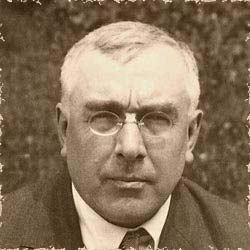
Peter Ouspensky
[MAURICE NICOLL] But I am sure that you remember your life far better than I remember mine, and that your life has had more meaning.
[OUSPENSKY] Yes, but not quite in the way you mean. I have noticed how much you have forgotten. In my case, as a child I did not play with toys. I was less under imagination. I saw what life was like at a very early stage. i
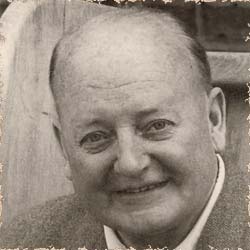
Maurice Nicoll
These precocious qualities appear to have crystallized in his youth both a steadfast dissatisfaction with the schooling system and, later in his adolescence, an unwavering sense of disapproval towards the academic and scientific establishment. The impulse to take personal ownership of his studies began to be apparent as early as the age six, with Ouspensky choosing to be self-taught in the sciences instead of pursuing formal education, with a particular fascination with the theory of the fourth dimension.
Behind this impulse, however, lay the more indelible mark left on his psyche in repeated experiences of déjà vu between Ouspensky and his younger sister, then five and three years of age, in which he recounts how they were able to remember small events before them having yet occurred.

[OUSPENSKY] How can you speak to mother, grandmother, about former lives even when you learn to talk? They will lock you up. I remembered very well. I was very lonely. I had to wait for sister to be born and then to learn to speak, three, four years perhaps, before I had someone to talk to.
Then it used to happen often like this: she used to look out of window and tell me about people she saw. There was very good combination in our street, policeman first, then postman, like that. She used to know who would come round corner because she remembered.
She would say (only we used our own baby language), “Now there will be policeman.” I say, “And now will come tax collector,” and he came. When we did this often I said to her, “Shall we tell mother, grandmother?” And little sister would say, “What use to tell mother, grandmother? They don’t know, they don’t understand anything.” Just think, I was five, she was three. ii
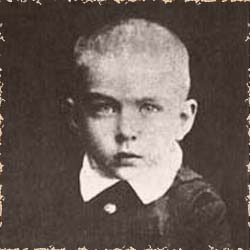
Ouspensky in Childhood
These experiences undoubtedly contributed to the very early conviction in the young Ouspensky of the existence of a veiled reality behind which stood a much different world with radically different meanings towards life than what was ordinarily understood by the adults around him. It was the inherent seed in him that expressed itself in later years of studies and personal development, and never in fact ceased.
To be continued…
(ggurdjieff.com)