

Mar 6, 2023 (mitch-horowitz-nyc.medium.com)
How a Quaker socialist revolutionized the prosperity gospel
The mind is its own place, and in it self
Can make a Heav’n of Hell, a Hell of Heav’n.
— Paradise Lost
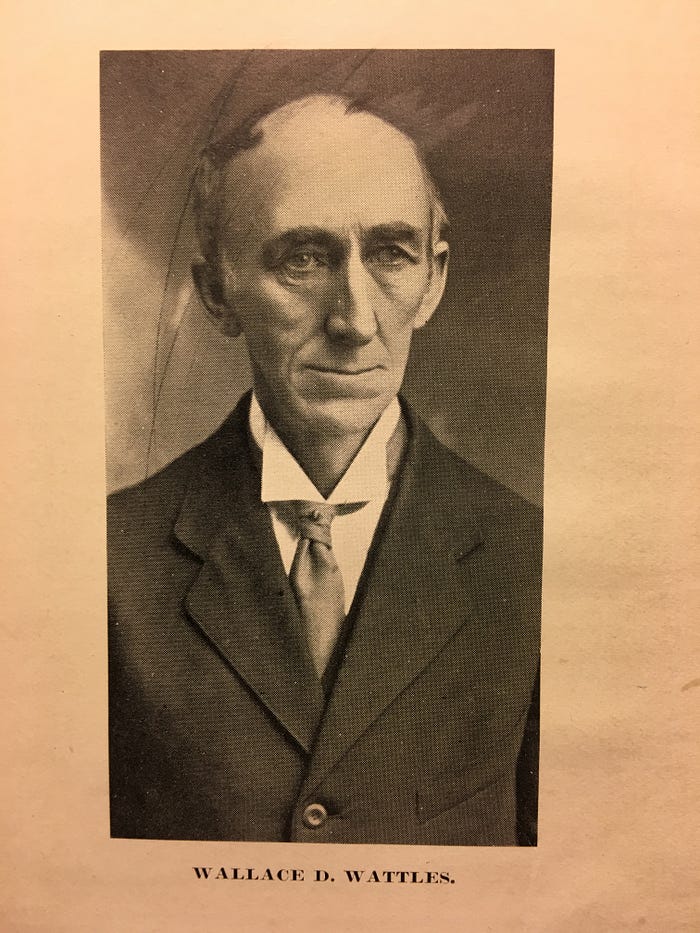
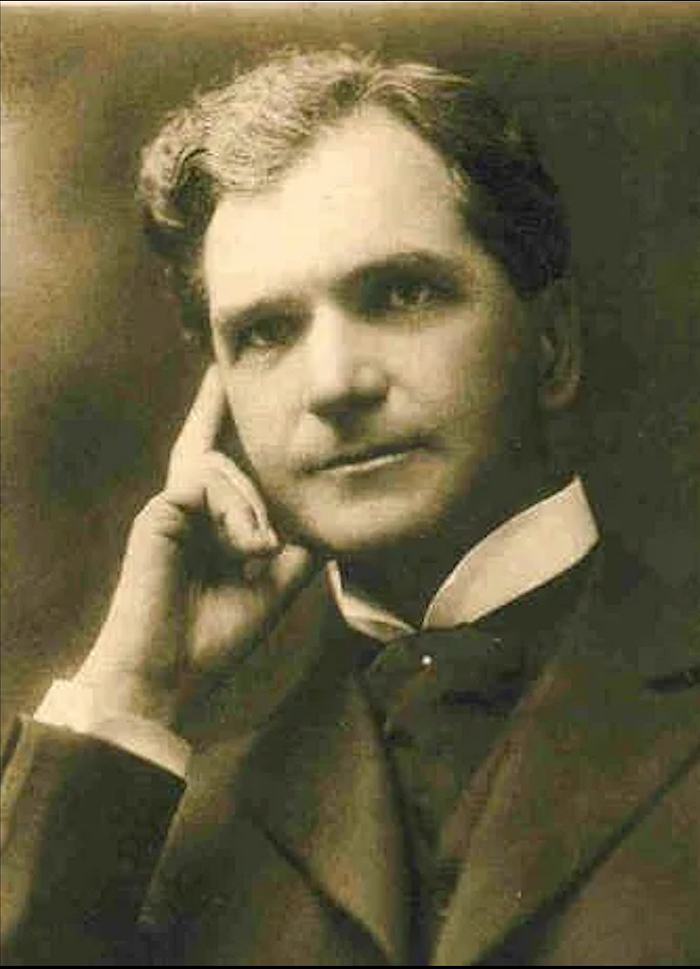
Itbegan as the bleakest of Christmases at the Wattles home. In the Indiana winter of 1896, the family patriarch, Wallace, a rake-thin Methodist minister with a passion for defending workers and the poor, had been away in Chicago at a conference of social reformers. A Christian socialist, Wallace D. Wattles was already irritating the more conservative members of his congregation, some of whom were eyeing his dismissal.
Back home in La Port, Indiana, his family could not afford a Christmas tree; all they could muster was an evergreen branch decorated with a few smudgy tallow candles and strung with popcorn. Gifts were meager — the family spent the last of its holiday savings on a cuff box which waited for Wattles under the branch.
“Finally father came,” his daughter Florence recalled in a 1911 letter to his publisher Elizabeth Towne. “With that beautiful smile he praised the tree, said the cuff box was just what he had been wanting — and took us all in his arms to tell us of the wonderful social message of Jesus.”[1]
It was a critical turning point for Wattles. In Chicago, he had met a radical minister named George D. Herron (1862–1925). An ardent purveyor of the “social gospel,” Herron gained national prominence using the message of Christ to condemn the cruel mechanisms of an economic system that sent children to work in cotton mills. He impressed upon Wattles that Christ’s vision of social justice must be at the heart of the pastorate’s mission.
For Wattles, born in 1860 on an Illinois family farm, where he was still laboring at age 19 in the rural Nunda Township,[2] it was the final stroke in a spiritual philosophy he was developing himself. The minister had been imbibing metaphysical ideas that were bubbling up around him and combining them with his own experiments into the creative powers of thought.
As Wattles saw it, the individual was a prisoner to outer circumstance only to the degree that he or she was a prisoner of circumstance within. Free the mind, he concluded, and outer circumstance will follow. Reading Eastern philosophies along with Descartes, Spinoza, Leibnitz, Schopenhauer, Hegel, and Emerson, the seeker reasoned that if the mind — this magical, ethereal “thinking stuff” that molded the surrounding world — could be properly harnessed, there was no limit to what a person could achieve.
America in the late 19th century was suffused with influences from Spiritualism, Mesmerism, Christian Science, and Theosophy. Each, in its own fashion, imbued the nation’s spiritual culture with the conviction that divine mysteries existed not at the top rung of a cosmic ladder but within the settings of ordinary life.
And ordinary life was undergoing remarkable changes. As the 19th century closed, the fruits of modern science appeared everywhere: telegraphs, motor engines, electricity, wireless signals, X-rays, and automated production. In medicine, Pasteur’s germ theory was explaining illnesses that for years had resisted understanding. In biology, Darwin had theorized a gradual order in the development of all forms of life. In politics, Marx and Engels had classified economics as a matter of “science,” in which inevitable outcomes could be foreseen. In psychology, Freud had begun to codify childhood traumas that triggered adult neuroses while William James and F.W.H. Myers postulated the existence of a “subliminal mind” (later called the subconscious or unconscious), which was the driving engine of emotional life. Along with other luminaries, the pair founded the British and American Societies for Psychical Research which sought to scientifically test clairvoyance and mediumship. Hypnotists (more respectable versions of Mesmerists) claimed the power to alter behavior through autosuggestion and conditioning.
Caught in this onrush of currents, intellectual leaders from all walks of life — academia, clergy, business — reasoned that scientific principles were applicable to every aspect of existence. Why couldn’t there be a “science” of success, or even a “science” of religion — that is, a protocol of definable, rational steps that would produce a desired result?
Inspired by the possibilities, a group of religious thinkers and impresarios formed a loosely knit spiritual movement around this “scientific” religious concept. Thoughts, they argued, could be seen to produce actual events, such as health or sickness, wealth or poverty. They claimed Ralph Waldo Emerson as their founding prophet: “We know,” the Concord mystic wrote in “Spiritual Laws” in 1841, “that the ancestor of every action is a thought.” The Bible, in their reading, seemed to agree, particularly the Proverb: “As a man thinketh in his heart, so is he.” In an enthused leap of reasoning, the movement that came to be called New Thought maintained that the individual’s creative mind is synonymous with the creative force called God. As such, a person could literally think his dreams to life. It was America’s boldest — and most influential — attempt at what religious scholar John B. Anderson called “a practical use of the occult powers of the soul.”[3]
The metaphysical dimensions of New Thought could seem so magical, so unrestrained in their promise of limitless potential, that a 1926 bestseller by publisher Robert Collier (1885–1950) deemed New Thought, The Secret of the Ages.

Many of the movement’s most popular writers and sermonizers re-imagined worldly acquisition as the very exercise of God’s will. In their hands, it was as if the entire object of Transcendentalism — that is, transcendence of earthly bonds and distractions — had been turned on its head. And here New Thought’s sense of ethics and seriousness as a religious movement fell open to question: What was to finally separate this philosophy from being anything other than a tool for pursuing one’s most random drives and selfish wants? Was this the endpoint of American religious innovation — the vaunted “secret of the ages?”
Onthis question hung the dilemma of Indiana minister Wattles. Although his books became central to a 21st century New Thought revival and served as a major influence behind the mega-selling book and movie The Secret, the social-gospel advocate had wanted the “occult powers of the soul” to serve a different end than worldly gain, or that alone.
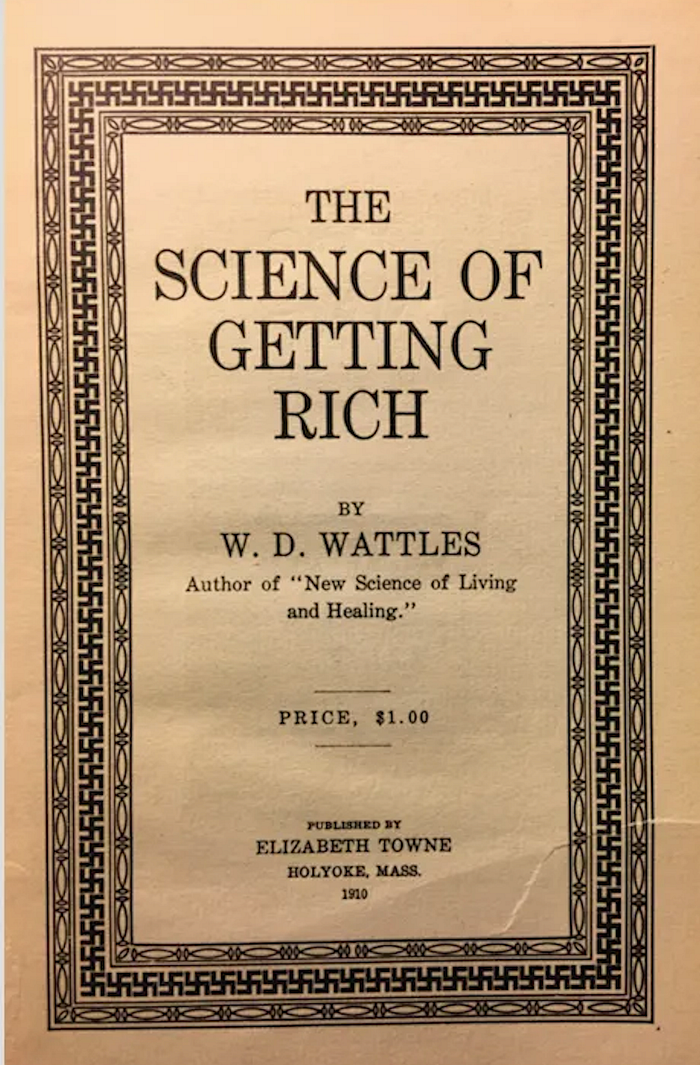
It wasn’t that he eschewed New Thought’s emphasis on wealth building — indeed, he embraced such aims in his 1910 guide The Science of Getting Rich. But there was a critical difference in Wattles’ approach, one overlooked by those who later embraced his work: Wattles believed in using mind-power to wipe away barons of industry and overthrow the prevailing social order. Rather than a narrowly conceived iteration of success, The Science of Getting Rich was, in fact, a guidebook to personal utopia, where state and corporate dinosaurs are predicted to wither away, replaced by a cooperative system of widespread wealth and beneficent anarchy. The author taught that by “thinking in a Certain Way” you can at once personally succeed and counter oppressive economics, writing with emphasis in the original:
You are to become a creator, not a competitor; you are going to get what you want, but in such a way that when you get it every other man will have more than he has now.
I am aware that there are men who get a vast amount of money by proceeding in direct opposition to the statements in the paragraph above, and may add a word of explanation here. Men of the plutocratic type, who become very rich, do so sometimes purely by their extraordinary ability on the plane of competition…Rockefeller, Carnegie, Morgan, et al., have been the unconscious agents of the Supreme in the necessary work of systematizing and organizing productive industry; and in the end, their work will contribute immensely toward increased life for all. Their day is nearly over; they have organized production, and will soon be succeeded by the agents of the multitude, who will organize the machinery of distribution.
If Wattles’ more careful readers detected a tinge of socialist language, they were right. The author saw New Thought as a means to the kind of leisurely socialist utopia that had enthralled legions of readers of Edward Bellamy’s Victorian-era futuristic novel, Looking Backward. In A New Christ, published the same year as The Science of Getting Rich, Wattles envisioned a marriage of New Thought — America’s homegrown success philosophy — and Christian Socialism:
As we approach socialism, the millions of families who are now propertyless will acquire their own beautiful homes, with gardens and the land upon which to raise their food; they will own horses and carriages, automobiles and pleasure yachts; their houses will contain libraries, musical instruments, paintings and statuary, all that a man may need for the soul-growth of himself and his, he shall own and use as he will.
It was as though Karl Marx had imbibed the mother’s milk of American metaphysics. Within Wattles there existed a struggle to unite two mighty currents that were sweeping early 20th century America: social radicalism and mind-power mysticism. Was it possible, as Wattles dreamed, that these movements could be united into one radical whole? Could there be a revolution by mental power?
Bythe time he emerged as a New Thought leader, Wattles had already been forced to resign from his Methodist pulpit in North Judson, Indiana, in 1900.[4] He had gone too far in his social radicalism, at one point insisting that churches should refuse monetary offerings from businessmen who profited off sweatshop labor. Soon after, he announced his departure from Methodism and grew active in the more progressive environs of Quakerism.
Wallace gained allies in mind-power circles — particularly his trailblazing publisher Elizabeth Towne (1865–1960), a Massachusetts suffragette who ran his work in her New Thought journal Nautilus. Towne began the magazine in 1898, as a single mother with two children to support. Her marriage — which began when she dropped out of school at age 14 — finally ended in divorce in 1900.[5]
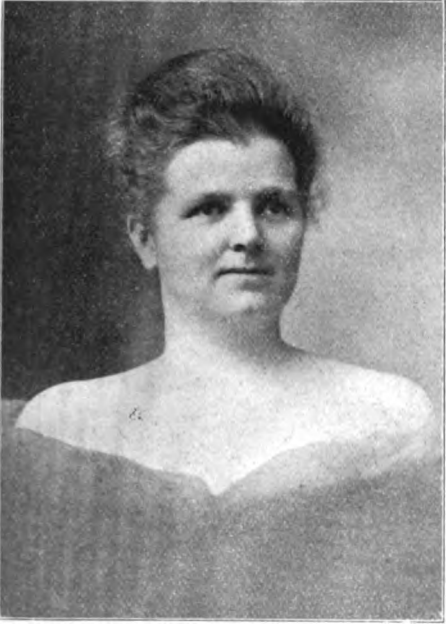
Relying on temporary financial backing from her father of $30 a month for six months, Towne built Nautilus into a relative powerhouse of up to 90,000 monthly subscribers with some of her own books surpassing sales of 100,000 copies. Towne ran the journal until age 88 in 1953, making it one of the longest-running spiritual magazines in American history. Her career played out in the political arena, as well. In 1926, Towne was elected the first female alderman in Holyoke, Massachusetts. Two years later she mounted an unsuccessful independent bid for mayor. Towne and her second husband, William, were also active in Theodore Roosevelt’s 1912 Progressive Party campaign for president.
Taking inspiration from the presidential runs of socialist leader Eugene V. Debs (1855–1926), Wattles made his own upstart bids for public office, each time on Debs’ Socialist Party of America ticket. In his home state of Indiana, Wattles first campaigned for Congress in the Eighth Congressional District in 1908.
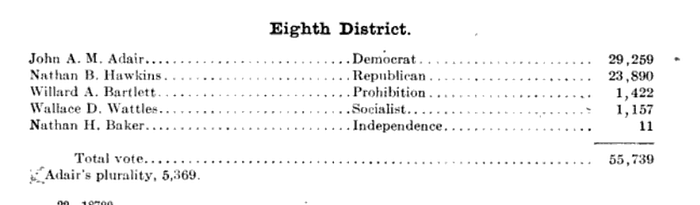
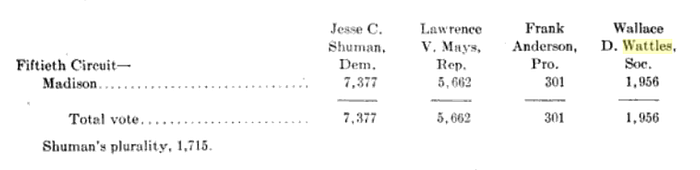
After distantly trailing, he ran the following year for mayor of his hometown of Elwood, Indiana, where he placed a surprisingly close second. Finally, in 1910 he ran for Prosecuting Attorney for Madison County, Indiana, coming in third.
During his 1909 mayoral campaign, the delicate-framed man stood before 1,300 striking workers during a heated showdown at a local tin mill and pledged them his support.[6]

Seen in a certain light, these were heterodox activities, not only for Towne as a woman, but for both she and Wattles as New Thought leaders. The movement emphasized the ideal of action from within. Although several early New Thoughters, including author and publisher Helen Wilmans (1831–1907) and British writer James Allen (1864–1912), were active in reformist politics — pioneering Black nationalist Marcus Garvey (1887–1940) himself sounded New Thought themes[7]— too much notice of tragedy, poverty, or injustice, so went the New Thought gospel, served only to perpetuate such things.
Hence, Wattles could sometimes sound at war with himself. In one stroke he urged readers, “do not talk about poverty; do not investigate it, or concern yourself with it,” and at other times he spoke passionately before audiences of the squalor of Chicago tenements and the hopelessness of immigrant children living there. He admiringly quoted from the social-reform journalism of Elbert Hubbard (1865–1915), who had exposed child-labor abuses in turn-of-the-century cotton mills. Hubbard, as it happened, was another success prophet with a taste for social protest.
Hubbard was famous for his 1899 motivational essay, A Message to Garcia, in which he extolled the can-do heroics of a U.S. soldier during the Spanish-American War. Business leaders loved it. Yet Hubbard lost his life while hoping to end another war. In 1915, Hubbard and his wife Alice, a suffragette and New Thought enthusiast, died with nearly 1,200 civilians when a German U-boat torpedoed the passenger ship Lusitania in the waters off Ireland. Hubbard boarded the ship in New York on a self-styled peace mission to Europe where he declared plans to interview the German Kaiser and inveigh against the carnage of the Great War. “Big business has been to blame for this thing,” wrote the motivational hero before he left, “…let it not escape this truth — that no longer shall individuals be allowed to thrive through supplying murder machines to the mob.”[8]
Even the most popular New Thought prophet of the day, Ralph Waldo Trine (1866–1958), harbored a passion to unite mysticism and social reform. Trine gained a legion of followers through his 1897 mind-power book, In Tune with the Infinite. It was the book that every New Thought minister and writer seemed to have read and borrowed from. Industrialist Henry Ford kept copies in his office and would press it on guests. But beneath Trine’s placid, almost priestly exterior beat the heart of another social radical. A 1902 profile in the New Thought magazine Mind said Trine believed in the cooperative ethos of socialism, and that he planned to write a book “from the viewpoint of a socialist who is such because of his New Thought philosophy.”[9]
It is not clear that Trine ever wrote such a book, but something very close appeared under his byline in 1906: In the Fire of the Heart. While In Tune With the Infinite employed a gentle, folksy tone emphasizing gratitude and generosity, In the Fire of the Heart revealed different colors. The New Thought pioneer summoned a “great people’s movement to bring back to the people the immense belongings that have been taken away from them,” calling it “the supreme need of our time.” Trine inveighed against “predatory wealth,” advocated busting up monopolies, striking for higher wages, and placing essential utilities and industries into public hands. This was one book that Henry Ford didn’t give away to friends. In fact, Fire in the Heart and Trine’s 1910 followup Land of Living Men seemed to make little impact at all on his followers. By 1928, the spiritual writer was an honored guest in Ford’s office, where he engaged in an almost fawning interview with the automaker. Their conversation was turned into a popular book, The Power That Wins, which ranged from Ford’s love for avocados to his belief in reincarnation. Whatever Trine’s innermost commitments, he would never again be seen — nor succeed as — a political Jeremiah.
In1911, in what was to be Wattles’ last book, The Science of Being Great, he offered tribute, probably the only in all of motivational literature, to his socialist hero Debs, a fellow Hoosier who later went to federal prison for opposing U.S. entry into World War I:
To rid yourself of the old false ideas you will have to think a great deal about the value of men — the greatness and worth of a human soul. You must cease from looking at human mistakes and look at successes; cease from seeing faults and see virtues. You can no longer look upon men and women as lost and ruined beings that are descending into hell; you must come to regard them as shining souls who are ascending toward heaven. It will require some exercise of will power to do this, but this is the legitimate use of the will — to decide what you will think about and how you will think. The function of the will is to direct thought. Think about the good side of men; the lovely, attractive part, and exert your will in refusing to think of anything else in connection with them.
I know of no one who has attained to so much on this one point as Eugene V. Debs, twice the Socialist candidate for president of the United States. Mr. Debs reverences humanity. No appeal for help is ever made to him in vain. No one receives from him an unkind or censorious word. You cannot come into his presence without being made sensible of his deep and kindly personal interest in you. Every person, be he millionaire, grimy workingman, or toil worn woman, receives the radiant warmth of a brotherly affection that is sincere and true. No ragged child speaks to him on the street without receiving instant and tender recognition. Debs loves men. This has made him the leading figure in a great movement, the beloved hero of a million hearts, and will give him a deathless name. It is a great thing to love men so and it is only achieved by thought. Nothing can make you great but thought.
Wattles’ daughter, Florence, a budding socialist orator in her own right, insisted that her father’s earlier mayoral vote got rigged and the election had been stolen. “They voted not only the dead men in the cemeteries, but vacant lots as well,” 23-year-old Florence said in her 1911 address to a socialist convention in Kokomo, Indiana. “We were robbed of the election, but in 1912 we will carry the election. Mark that. And we’ll get the offices, too. We mean to do it through a thorough and completely effective organization.”[10]

On the stump, Florence exuded the same sense of biblical justice as her father, the man who told of the social gospel and the metaphysical powers of the mind. “We don’t want to vote merely because it is our right…,” she said in a 1916 speech in Indianapolis. “We don’t want to vote merely to get into practical politics. We don’t want to vote in order to sit in the legislature or on the bench. We want to vote on behalf of the struggling masses, and to do good for those about us.”[11]
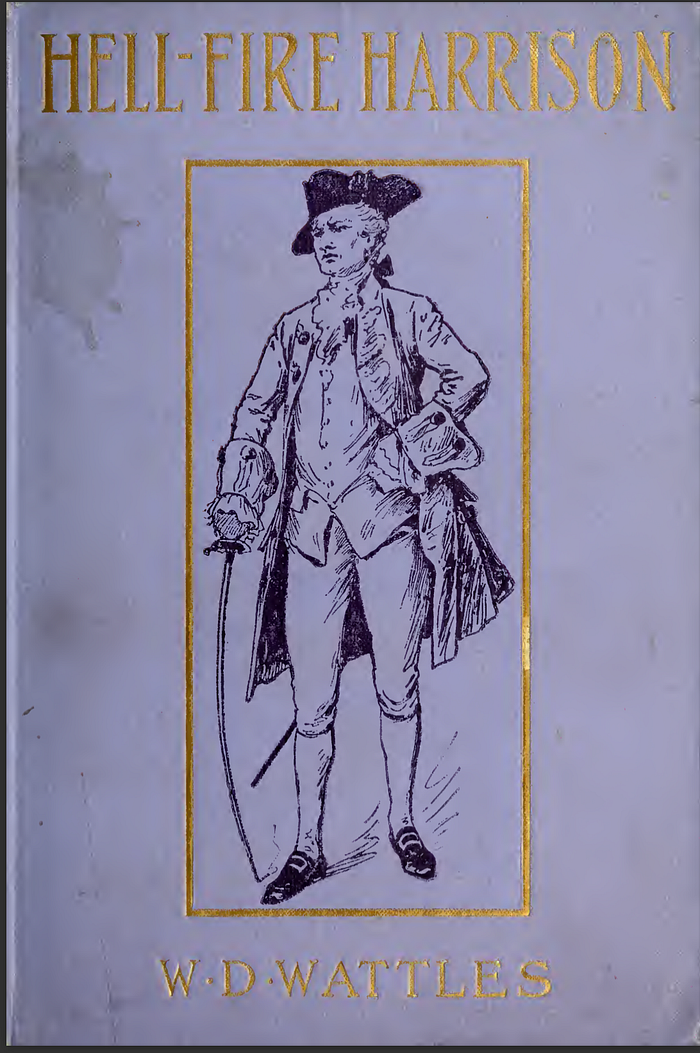
With Florence at her father’s side, her spirits fresh and ready for a fight, anything seemed possible. Yet within a week of Florence’s Kokomo speech, Wattles was dead. Though his writings had extolled the curative powers of thought, he had always been physically frail. His health collapsed on February 7, 1911, when he died of tuberculosis at age 50 while traveling to Ruskin, Tennessee, which had been home to the Ruskin Commonwealth Association, a socialist commune from 1894 to 1901. In addition to his numerous books and articles on mind metaphysics, Wattles left behind a sole novel published in 1910, Hell-Fire Harrison, about the adventures of an independent-minded American tobacco farmer and congressman in late-18th century England.
The Fort Wayne Sentinel, knowing the local author and organizer mostly as a political figure, noted “he was one of the best known socialists in Indiana.” And, almost as an afterthought, “He also wrote several books on scientific subjects.”[12]
For her part, Florence moved in 1917 to New York City, where she worked for publisher E.P. Dutton, becoming director of publicity in 1925. Losing none of her old fire, she wrote to Debs’ brother Theodore on company letterhead on January 30, 1930, addressing him as “Dear Comrade,” and seeking his input and records for a potential biography she hoped would be published on his brother.
“You will recall my father,” she wrote. “He was W.D. Wattles. And is buried in Elwood, Indiana. He and Comrade Hollingsworth” — Indiana social gospel minister J.H. Hollingsworth — “were very dear friends. Comrade H. knew father much better than you and ‘Gene ever knew him, but even you know of him and his work…He was a remarkable personality, and a beautiful spirit, which, to me, at least, has never died…”

Wattles’ reputation and works experienced an extraordinary rebound nearly a century following his death. In 2007, word spread that The Science of Getting Rich was a source behind The Secret. The book began to hit bestseller lists. I published a paperback edition myself that reached number-one on the Bloomberg Businessweek bestseller list. My audio condensation later hit number-two on iTunes.
But what many of Wattles’ new generation of readers missed was his lifelong dedication to the ethic of collective advancement and creativity above brutal or underhanded competition; and his belief that competition itself was an outmoded idea, soon to be supplanted by the creative capacities of the mind . Once unlocked, he taught, these greater faculties would grant working people the keys to a life of prosperity for themselves and all around them.
Was Wattles’ vision of New Thought and social reform really so utopian? We live in an age of remarkable new discoveries of the mind’s power: physicians have performed successful placebo surgeries[13] and demonstrated the placebo response in weight loss[14] as well as in instances where placebos are transparently administered[15]; in the field called neuroplasticity, brain scans reveal that the brain’s neural pathways are actually “rewired” by thought patterns — a biological act of mind over matter[16]; quantum physics experiments pose extraordinary questions about causality between thought and object, with implications extending to the perceptual basis of reality itself[17]; and academic ESP research repeatedly demonstrates the nonphysical conveyance of data across boundaries of time, space, and mass in laboratory settings.[18] Wattles’ mission, now more than a century old, was to ask whether these extraordinary possibilities, which were only hinted at in the science of his day, can be applied and experimented with on the material and social scales of life.
Wattles did not live long enough to see the enduring influence of The Science of Getting Rich. But his calm certainty and profoundly confident yet gentle tone as a writer suggest that he understood the portent of what he was conveying.
Although The Science of Getting Rich will always be his classic, a core runner up is his widely read The Science of Being Great. The final line of his opening chapter is: “You can become what you want to be.” That statement forms the heart of his career. Moreover, it is, in a sense, an encapsulation of American metaphysical ideals — the outlook of a still-young nation when Wattles wrote his books. His vision harmonized with the sense of limitless possibility that many Americans felt in the early 20th century when the nation’s growth and expansion seemed endless. This ethic still inspires people today.
Wattles’ work can bridge the divisions some seekers feel between pursuit of self-betterment and aspiration to something greater; for him, the two were synonymous. He believed, with no sense of personal conflict, that the potential of the individual must be expressed both socially and materially. “Man is formed for growth,” Wattles wrote in The Science of Being Great, “and he is under the necessity of growing. It is essential to his happiness that he should continually advance. Life without progress is unendurable.”
If you venture into his 1910 and 1911 books, I think you will discover Wattles’ complete philosophy of life: namely, that each person is run through by a capillary of immaterial influx — call it God, Nous (Ancient Greek for over-mind), or nonlocal intelligence — which can raise the individual to extraordinary heights of personal excellence, acts of creativity, and skills marked by virtuosity. But to fully place him or herself within this eternal, creative current, Wattles wrote, the individual must first be in alignment with generativity and reciprocity to other, like-created beings. (A different view of the author’s model, which I explore in The Miracle Club and Daydream Believer, is that the psyche is capable of selecting — a term I prefer to manifesting — among different intersections of time, a concept considered by some quantum and string theorists.)
Self-refinement, Wattles concluded, is the key to transforming oneself into a vehicle for this Greater Principle of life, which yearns for expression through individual beings.
Everything that this good and thoughtful man believed necessary for a powerful life appears in these short and compelling books. He wished them to deliver readers to their greatest heights of achievement — and deepest sense of responsibility.
Notes
[1] The recollections of Florence Wattles appear in a letter that publisher Elizabeth Towne included in a reprint edition of Wallace D. Wattles’ The Science of Being Great (1911), which Towne retitled How to Be a Genius.
[2] United States Federal Census, 1880. Wattles’ birthdate is sometimes given as 1861 (“abt 1861” the census document reads, identifying him as a 19-year-old “farm laborer” born in Illinois). Consensus is 1860, hence I have used that date.
[3] John B. Anderson is quoted from New Thought, Its Lights and Shadows (Sherman, French & Company, 1911).
[4] “Leaves the Methodists,” Fort Wayne Sentinel, June 27, 1900.
[5] Sources on Towne include “What Women Are Doing Today” by Lucie M. Yager, The Business Woman’s Magazine, Vol. 4, May 1905; “Elizabeth Towne, Author, Leader in Religion, Dies,” North Adams Transcript, June 1, 1960; Mind Cure in New England: From the Civil War to World War I by Gail Thain Parker (University Press of New England, 1973); and “Pioneering Woman in Publishing and Politics” by Tzivia Gover, Historical Journal of Massachusetts, Vol. 37, Spring 2009.
[6] “Trouble at Elwood,” Fort Wayne Sentinel, July 12, 1909.
[7] I explore this side of Garvey’s career in my Occult America and One Simple Idea.