

Dec 17, 2021 ((zora.medium.com)
Remembering a world-renown performer, World War II spy, and Civil Rights, Activist

So, there’s a myth about Black activists, particularly women, that insists we tend to sacrifice too much for the cause, neglecting self-care. However, many examples throughout history show how Black joy and the struggle live side-by-side, breaking the binary argument. For instance, Josephine Baker became a world-renown performer, a Civil Rights Activist, and even a World War II Spy for the French. Yet, despite her commitment to fighting against racial segregation, she looked amazing every step of the way, met some of the most interesting, influential people, and captivated the hearts of millions.
Baker, born Freda Josephine McDonald in 1906, grew up in St. Louis, Missouri. She spent her youth living in poverty, and “at age eight Josephine cleaned houses and babysat for wealthy white families, often being poorly treated.” However, Baker’s love of dancing lifted her out of these circumstances, landing her a spot on Broadway. By the 1920s, Josephine Baker became a wildly popular performer in France but dedicated much of her life to fighting against racism.
Josephine Baker became an icon within the Black community, representing poise, beauty, and grace. Yet, still, she felt the sting of Jim Crow, facing blatant disrespect because of her skin color. By 19, she left the United States, becoming a burlesque dancer in Paris music halls. “Her risqué dance routines while clad in little more than a string of pearls and a rubber banana skirt made her a Jazz Age sensation. After branching out into singing and acting in films, she became Europe’s highest-paid entertainer,” becoming a French citizen in 1937, several years before the start of World War II.
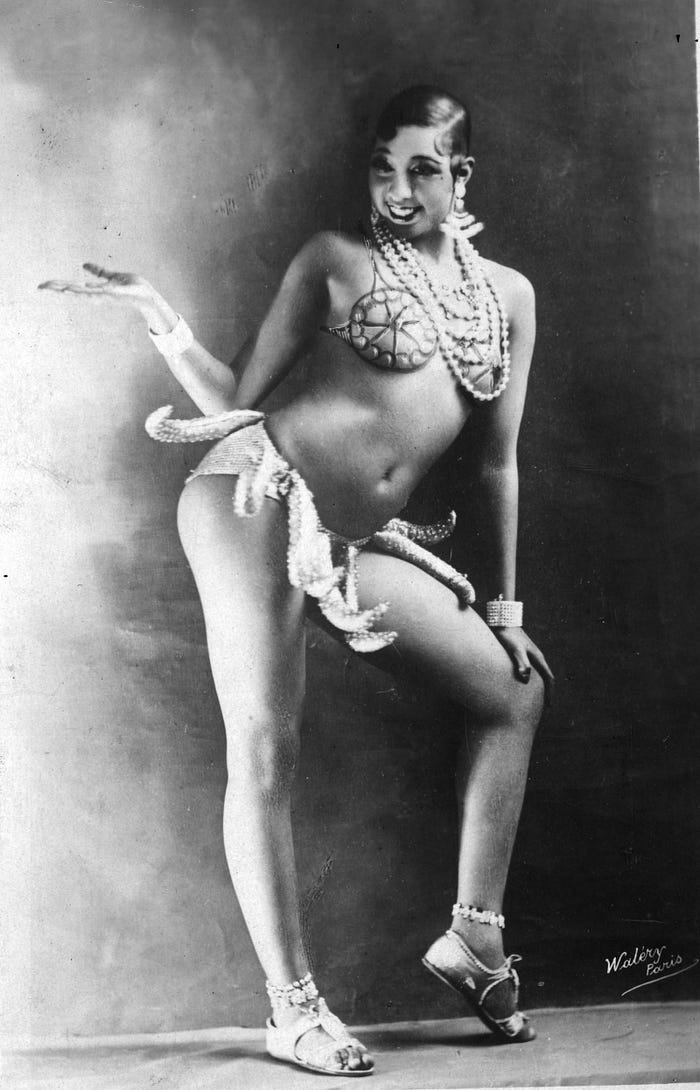
Josephine Baker became a spy in World War II for the French. While originally from America, she was dedicated to the French people saying, “France made me who I am, the Parisians gave me their hearts, and I am ready to give them my life.”Working with the French Resistance, Baker helped by “smuggling secret messages in invisible ink on her musical sheets.” Because she was famous, no one found her travels inherently suspicious.
“Baker would eavesdrop and flirt to gather information about German troop locations and airfields from high-ranking Italian, Japanese, and Nazi officials. Fellow secret agent Jacques Abtey, masquerading as her assistant, recorded the information in invisible ink on her sheet music, while Baker pinned important photos to her underwear and counted on her fame to avoid a strip search (History Extra).”
“She hid Jewish refugees and weapons in her château that Bakerskin had helped pay for.” Baker fought against American racism and German Naziism, becoming a champion for many people. Notice no one ever accused Baker of disregarding her self-care. Her understanding of the struggle and unwavering activism lived side-by-side with her captivating performances across Europe.
America’s legacy of racism ran off the young starlet, who became a world treasure. France, by comparison, offered a better quality of life for Black people, which was well-established. Following the Lousiana Purchase of 1803, many Black Americans who could leave for France did so, leading to the first Mass Migration of its kind, years before the Harlem Renaissance. “After World War I broke out, more than 200,000 American black soldiers, mostly from the South, came to France to fight for freedom and democracy — something they didn’t have back in their own country (NPR).”
The French, who gifted the United States the Statue of Liberty to celebrate the abolition of slavery, offered a haven for Josephine Baker, who, like most Black people of the era, understood the difficulties of living in the Jim Crow south. Nevertheless, Baker took the most precious thing she could from America — herself.
Josephine Baker became an icon within the Black community, representing poise, beauty, and grace.
Not only did she leave, but Baker also continued to fight against the racism that divided her home country. Notably, the “Negro singer” canceled her plans to appear in Atlanta after three separate hotels refused her lodging. White Americans, during her lifetime, many supporters of segregation stood in stark opposition to her resistance. Fueled by her fame, Baker became an indispensable activist bringing attention to the sheer inhumanity of America’s apartheid.
The Statue of Liberty is the Embodiment of Juneteenth
Did You Think It Was Created to Honor Immigrants?
In 1951, Josephine Baker refused to perform for a segregated audience in the United States, rejecting a $10,000-a-week-deal to perform at the Copa City Club in Miami. “She persisted, and Baker triumphed, performing before the first integrated audiences in the U.S.” Her resistance placed her at the forefront of the Civil Rights resistance. The NAACP named her its Most Outstanding Woman of the Year.

Baker became the only woman speaker at the 1963 March on Washington.
“I have walked into the palaces of kings and queens and into the houses of presidents. And much more. But I could not walk into a hotel in America and get a cup of coffee, and that made me mad.
And when I get mad, you know that I open my big mouth. And then look out, ’cause when Josephine opens her mouth, they hear it all over the world. . . . (Josephine Baker as cited by Washington Post).
Imagine that, walking into palaces and being welcomed like royalty only to come home and be treated like a second or third-class citizen because of the color of your skin — that’s what it was like to take a walk in Josephine Baker’s shoes. After Martin Luther King Jr.’s assassination, his wife Coretta Scott King “asked her to consider taking her husband’s place as the Civil Rights Movement leader. Baker refused, saying that her children were “too young to lose their mother.”
While she refused to be the face of the movement, she continued to fight against racial segregation and intolerance throughout her life. As a result of her performances, activism, and service to France, “Josephine Baker will become the first Black woman to be entombed in the Pantheon in Paris,” praising her as a lasting icon.
You see, Josephine Baker shattered the activist trope long ago, dispelling the myth that Black activists can’t fight against racism while also having a good time. Her career also challenged the notion that women are reduced to their beauty or ability to produce change. No one can mistake her for just a pretty face or a nose-to-the-grind activist. Josephine Baker’s story reminds us all that Black women are dynamic and don’t have to choose one path or another; they can take the road less traveled and still triumph in the end.