
Dec 3, 2022 (mitch-horowitz-nyc.medium.com)
Remembering a philosopher of esotericism
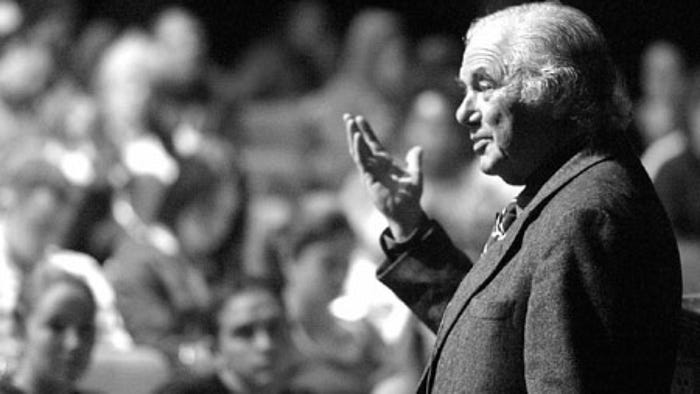
Philosopher and author Jacob Needleman died at age 88 on November 28, 2022. With his passing, our culture lost not only a distinguished and widely published scholar of religions, but one of the few writers of our age who proved capable of communicating the nature of inner experience.
In more than twenty books, spanning from 1970 to 2016, Jerry, as he was known to friends, defined the interior life of the mind, emotions, and body — the fears, frivolities, and moments of resplendent awareness — and the individual’s fitful ability to see, to relate to life in fleeting ways that affirmed the human striving, and warranted belief in, the presence of a greater dimension of existence.
Indeed, Jerry’s fullest gift as a writer was the capacity to compellingly describe inner contradictions and strivings — a quality possessed by Ralph Waldo Emerson, Krishnamurti, and very few other modernist spiritual figures. Topics that would implode on other writers were perfectly molded in his hands.
I had the opportunity to witness Jerry’s abilities closely from when I first began publishing him at Penguin Random House with the appearance of one of the books of which he was justly proudest, The American Soul in 2002 to An Unknown World in 2012. His virtuosity was palpable — and, I warrant, explainable.
Jerry possessed, of course, great personal sensitivity as well as decades of immersion in the penetratingly truthful ideas of 20th century spiritual philosopher G.I. Gurdjieff (1877–1949). Any individual with those coordinates could venture valuable observations. But his work stood, too, on another set of shoulders: the writer’s preternatural work ethic.
By the time I met Jerry, born in 1934 and with numerous books published as well as an education from Harvard, Yale, and the University of Freiburg, and a professorship in philosophy at San Francisco State, he was already something of a grand eminence on the public spiritual scene. I knew several accomplished spiritual writers who, by that stage of their careers, had more or less checked out — allowing themselves to defer to eager, younger, and sometimes sycophantic colleagues, who recorded lectures and conversations which were spun into half-books.
The company’s president admired Jerry’s work. I once told her, “This man is over seventy and he writes every day.” In one of the few publishing meetings I attended where something useful got said, an executive announced: “We want writers who are dedicated to and serious about their craft.” He could have been describing Jerry. That was the writer’s secret, if there was any: constant effort and practice. In a different context, Gurdjieff said: “You must understand that ordinary efforts do not count. Only super-efforts count.” Jerry abided.
Indeed, I came to feel that Jerry’s finest books appeared in the latter part of his career. My personal favorite is Why Can’t We Be Good? from 2008. In it, he probed one of the core fissures of human nature: our incapacity to act on our ideals. This inability, as Jerry understood, stems from the individual’s actual unfamiliarity with his or her nature; a hole we fill with fuzzy, rote, and false self-estimation. Man is asleep, as Jerry understood from the work of Gurdjieff. Not in some metaphorical way but actually — and on a scale that one almost never sees.
Although Jerry received a fair degree of media attention— including interviews by Bill Moyers in his “A World of Ideas” TV special and just credit for popularizing the term “New Religious Movements” — the author was, at times, pained by his relative lack of recognition in mainstream letters. Prominent reviews were rare. (As of this writing, days after his passing, not a single obituary has yet appeared.) The reason for this, I aver, was Jerry’s unwillingness to compromise his precise — and sparkling — language and ideas. He would not employ cheapened or off-the-shelf phraseology; he would not devise lists; he would not give books cute, cloying, or affected titles; he would not pursue trends; he would not wink at or wiseacre over the depth of problems facing the individual; and, above all, he would not disguise or condition belief and ideals. It wouldn’t have occurred to him. In Money and the Meaning of Life in 1991 he wrote:
A Freudian psychoanalyst once summed up to me his vision of the human condition by saying that man is not as bad as he thinks he is, nor can he become as good as he dreams of becoming. The assumption of this book is precisely the opposite of the psychoanalytic view: man is in far worse condition than he believes, but he can become far greater than he imagines.
Jerry’s points about the universally degraded nature of our existence were not easily communicated to readers accustomed to accepted modes of inquiry or pedantry. Indeed, he remarked to me that during his early years as a student of religion, not once did a professor suggest that the ideas under scrutiny might be actually true. Upon publication of Why Can’t We Be Good?, one reviewer extolled the book’s “eloquent and entertaining thoughts” (never was the latter descriptor more misapplied) and concluded that the author “discovers that our inability to be good is simple: humans are creatures of choice, and our freedom allows us to make bad choices as well as good ones.” The writeup marked one of the few instances when I violated my professional rule of never complaining to a publication about a review. The unnamed critic had literally (I use the word carefully) misunderstood Jerry’s book to the extent of its opposite. His point wasn’t that individuals possess choice and select poorly. Nor was his point that we lack choice. Rather, our false condition requires immense self-work and observation before we can assume the mantle of choice.
Jerry was accustomed to people — students, seekers, reviewers, talkers — trying to reprocess truth through more familiar (and less painful) language. When sampling the ideas of Gurdjieff, onlookers were apt to say, “Oh it’s like…,” filling in a recognizable metaphor. Jerry’s response: “It’s not like anything.” Once at a New York City workshop, the philosopher conducted an exercise in sacred movements. “It’s fun,” an attendee remarked. Jerry replied, “If you knew your life depended on it, you wouldn’t find it fun.”
I do not mean to leave the impression that there was a sternness to Jerry. He wore an impish grin, laughed easily (including at himself), and genuinely enjoyed people’s company. I recall attending a conference for his book The American Soul at a spiritual center in Virginia Beach, VA, and seeing him smile at strangers at the beachfront hotel. “Do you have a nice room?” he asked a busy vacation mom as she entered the elevator. The formerly beleaguered woman smiled, “Oh, yes, very nice.”
“You see,” he told me, “if you just recognize people they light up.”
There was also another Jerry who could be fussy and finicky to the point of annoyance. He could pit people against one another. At times, there was tension between us. I will share a slightly embarrassing memory — to myself — in the service of telling the truth, which he would have wanted and expected. I once grew enthralled listening to Jerry’s beautiful baritone narration of the Bhagavad Gita on a book-on-tape before we started calling them audiobooks. Each time he invoked Krishna telling his wavering warrior-disciple, “Fight, Arjuna,” I felt a charge go through me. I fantasized about one day whispering the same words to Jerry on his deathbed. But we both went separate ways; I never got the chance.
And yet: the meticulous wisdom and hard-won insights of his books entered my bones, as they did those of many seekers. Whenever I’m tempted to render a trite statement or quick-and-neat judgment, something stops me (or ought to). That is Jerry’s influence. It stays with me whenever I try.
“Fight, Arjuna.”