
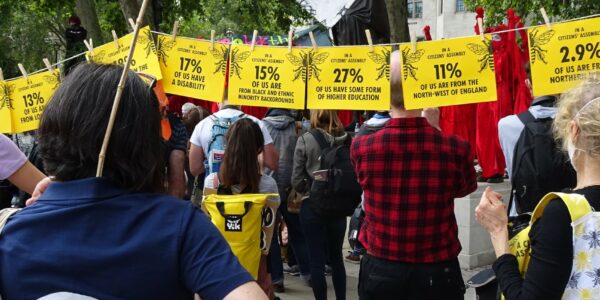
We know the world is spinning towards catastrophe. We know it’s time to act.
And we know our “leaders” aren’t doing enough. In the UK, the political system that should be driving change is failing to do what is needed.
That’s why we need a Citizens’ Assembly on Climate and Ecological Justice to break the deadlock and to put fairness and justice at the centre of decision-making.
Electoral politics – the problem in a nutshell
“Politics as usual” isn’t good enough. Think about these issues and see how citizens’ assemblies can make things better.OppositionLobbying and DonorsShort term thinkingNot representative
Introduction to the Third Demand
In the UK, Extinction Rebellion’s Third Demand is that the Government must create and be led by the decisions of a Citizens’ Assembly on Climate and Ecological Justice. What is a citizens’ assembly?
Citizens’ assemblies are not new, and are gaining popularity around the world. They can empower people, communities and entire countries to make important decisions in a way that is fair and deeply democratic.
The Citizens’ Assembly on Climate and Ecological Justice will bring together a “mini public” of ordinary people to investigate, discuss and make recommendations on how to respond to the climate emergency. Similar to jury service, members will be randomly selected from across the country. The process will be designed to ensure that the Assembly reflects the whole country in terms of characteristics such as gender, age, ethnicity, education level and geography. Assembly members will hear balanced information from experts and those most affected by the emergency. Members will speak openly and honestly in small groups with the aid of professional facilitators. Together they will work through their differences and draft and vote on recommendations.
The Citizens’ Assembly will be run by non-governmental organisations under independent oversight. This is the fairest and most powerful way to cut through party politics. It will empower citizens to actually work together and take responsibility for our climate and ecological emergency.
This isn’t pie in the sky – it’s proven practice. Citizens’ assemblies around the world have shown that ordinary people can understand complex information, weigh the options, and make informed choices.
Citizens’ assemblies are used to address important issues that electoral politics can’t fix on its own. In recent years, Ireland’s Citizens’ Assembly broke the deadlock on two controversial issues: same-sex marriage and abortion. The recommendations of the Citizens’ Assembly informed public debate and provided politicians cover to make the necessary changes.
Even the UK Parliament has experimented with citizens’ assemblies. For example, the Citizens’ Assembly on Social Care worked with House of Commons Select Committees, and three similar local level projects were held as part of the Innovation in Democracy initiative. In 2020 Climate Assembly UK was commissioned by six House of Commons Select Committees to respond to Parliament’s declaration of an environment and climate emergency – see more below.Why is Extinction Rebellion demanding a citizens’ assembly on climate and ecological justice?
This is an emergency. The challenges are big, wide-ranging and complex. And solutions are needed urgently.
Extinction Rebellion believes that part of the problem is the way electoral politics works:
- Political power in the UK is in the hands of a few elected politicians. Over the last 40 years, this system has proved incapable of making the long-term decisions needed to deal with the climate and ecological emergency. Politicians simply can’t see past the next election.
- Members of parliament are lobbied by powerful corporations, seek sympathetic media coverage, and calculate their policies based on potential public reactions and opinion polls. This leaves many of them either unable or unwilling to make the bold changes necessary to address the emergency.
- Opinion polls often gather knee-jerk reactions to loaded questions. They do not allow respondents to become informed or engage with others with different perspectives. For an issue as complex as the climate and ecological emergency, opinion polling won’t cut it.
Here is how a Citizens’ Assembly on Climate and Ecological Justice can break the deadlock:
- A Citizens’ Assembly on Climate and Ecological Justice will empower citizens to take the lead and politicians to follow with less fear of political backlash.
- Citizens’ assemblies are fair and transparent. Assembly members have an equal chance of being heard. Briefing materials, experts, and other presenters are vetted by diverse stakeholders and shared publicly. This produces informed democratic decisions.
- Citizens’ assemblies are especially useful when difficult trade-offs are necessary. For example, experts might propose policies for how to meet a 2025 target for net-zero greenhouse gas emissions and the assembly could decide which they prefer. They would also consider how to mitigate the impacts of changes on the most vulnerable people.
A citizens’ assembly provides us, the people, with a way to decide what’s best for our future, even if that requires radical changes in the present. Moreover, because they are informed and democratic, the Citizens’ Assembly’s decisions will provide political cover and public pressure for politicians to set aside the usual politicking and do the right thing.Why randomly select citizens for the citizens’ assembly?
Members of citizens’ assemblies should be randomly selected from the general public for 3 main reasons:
- Random selection treats everyone equally. All citizens are threatened by the emergency. This process gives all citizens an equal chance to help make the big decisions as we try to address the crisis.
- It’s fair. The random selection is done in a way that ensures the Citizens’ Assembly reflects our whole country in terms of characteristics like gender, age, income, and ethnicity. And random selection means no particular group and no particular view is overrepresented or able to dominate the assembly.
- It allows for honest conversation. Unlike elected politicians, ordinary citizens who are randomly selected have no political debts and don’t have to worry about pleasing a party or getting reelected. So they can speak honestly, listen to others and decide based on what they truly believe is best for the country.
It was first used by the Ancient Athenians, who believed that the principle of appointment by lot was integral to fair and impartial decision-making. And it is still applied in our modern legal system, where people are chosen at random for jury duty. Random selection enables people from more diverse backgrounds to contribute to decision-making.
For more detailed information on the selection process, check out our Citizens’ Assembly Guide!Legally binding or not?
People often ask if the Citizens’ Assembly on Climate and Ecological Justice would be legally binding, i.e. would the government be legally obliged to take on the recommendations. The central issue here is that for the recommendations of a Government-commissioned citizens’ assembly to be legally binding, a change in UK law would first have to be made. All UK acts of law must have parliamentary scrutiny and consent.* This necessary change in UK law is extremely unlikely to be agreed by the UK parliament and we therefore consider a demand that requires it to be unachievable.
Additionally, any legislation passed by parliament can be reversed at any time. Parliament cannot be bound by previous decisions, it always has the power to undo them. In summary, a demand that a CA’s recommendations be legally binding not only potentially delays action on the CEE, it also is no guarantee that commitments won’t simply be rescinded in the future.
Whether or not it is legally binding is ultimately irrelevant. What is important is that the citizens’ assembly has the support of the public. If enough people understand what a CA is, how it differs from the system in place, and if it is seen to be fair, transparent, and robust it will be seen as legitimate and the government will be obliged to take the recommendations on board.
* The Conservative Government attempted to prorogue parliament in 2019 in an attempt to avoid parliament’s scrutiny and consent. This was proved to be unlawful.How to address deep seated issues concerning fairness and justice
Injustice is at the heart of the climate and ecological crisis and has to be central to the learning and deliberation of the citizens’ assembly. Racial justice, social justice, economic justice, global justice, are all part of historical and ongoing injustices. It is essential that this is recognised and considered throughout the Citizens’ Assembly on Climate and Ecological Justice.
Who takes part?
- A fairer representation of people than in the current parliamentary system. For example, how many MPs are unemployed or living from one paycheck to the next? How representative are they really?
- The wealthiest 1% only have 1% representation on the assembly.
- In order to reduce barriers to participation and give a fair opportunity for people to take part a payment is made, care responsibilities, accomodation, and travel expenses are covered.
- The term ‘citizens’ assembly’ is unfortunate in many ways because non-citizens can take part if they live in the UK. The term ‘citizen’ in this context really just means ordinary people who are not career politicians.
- A diverse assembly means that a wide range of perspectives is considered in the decision-making process and ultimately makes for fairer results.
How are the citizens’ assembly members briefed?
- For our Third Demand, XR expects the assembly members to learn how this crisis came about – amongst other things this would include historical responsibility such as colonialism, global justice, and economic structures that have created the crisis.
- Assembly members will be trained to identify bias – whether it’s their own or that of the speakers.
What do they hear?
- Speakers will not just be ‘experts’ such as scientists and academics, but people with lived experiences.
- These will include voices from people who are already affected by the CEE – people from the UK such as farmers with failed crops or families with flooded homes, and also people from other countries for whom the CEE is a daily reality already (famine, floods, droughts, fires).
- Assembly members must have the power to invite further speakers if they feel certain groups or topics have not been properly addressed in the assembly.
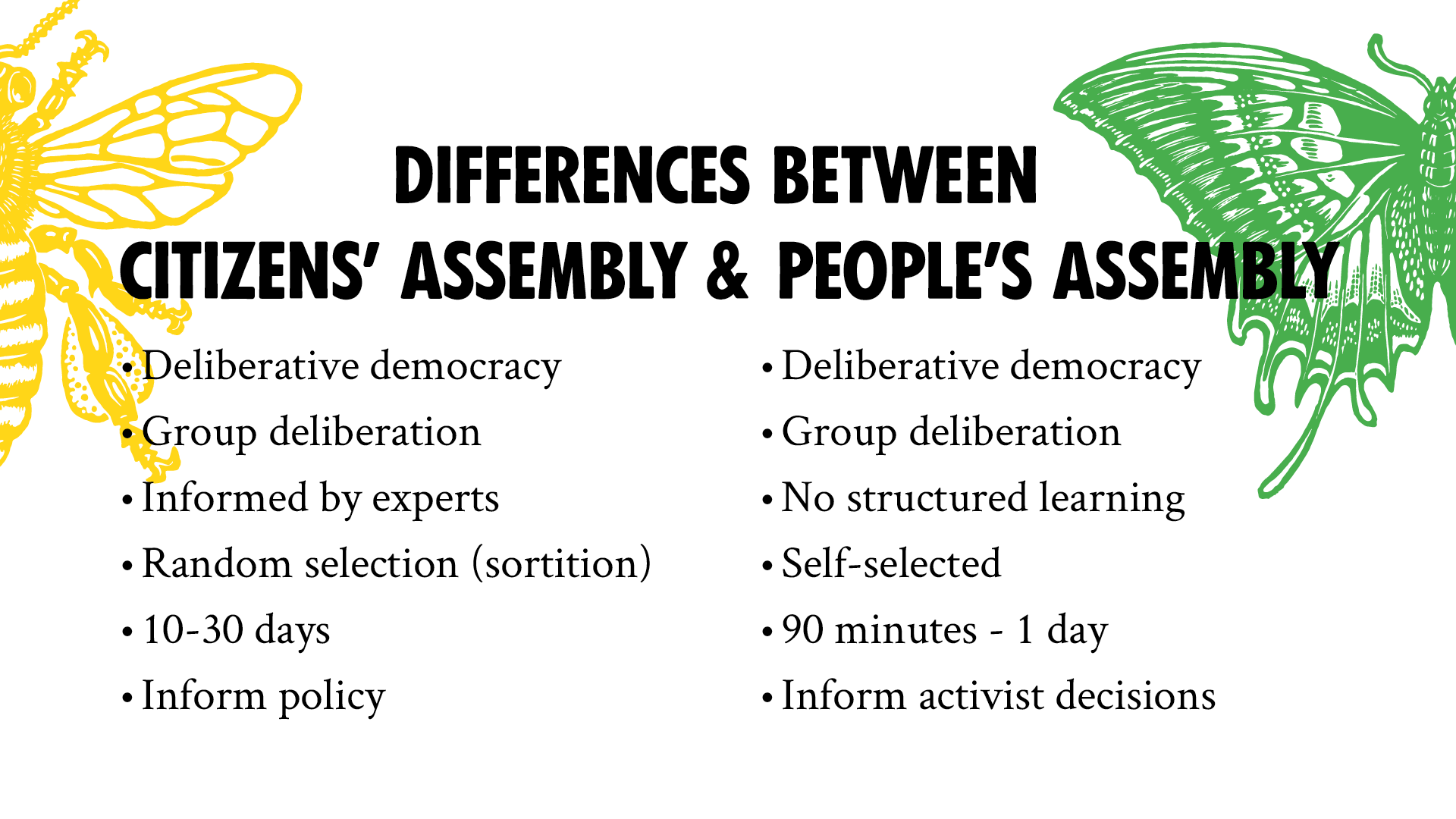
How do citizens’ assemblies differ from people’s assemblies?
Extinction Rebellion’s third demand is for the UK Government to create and be led by the decisions of a UK-wide Citizens’ Assembly on Climate and Ecological Justice. We use other democratic processes, such as people’s assemblies, in order to generate ideas, gather feedback and make decisions. When it comes to real democracy, Extinction Rebellion walks the walk.
Both citizens’ assemblies and people’s assemblies give ordinary people the opportunity to discuss and reflect on important issues. Professional facilitators provide structure to the discussion and ensure no one dominates. However the purpose and structure of citizens’ and people’s assemblies is very different.
Citizens’ assemblies are made up of ordinary people who are randomly selected from the population, similar to jury service. The selection is done in a way that ensures that assembly members accurately reflect the whole population in terms of key characteristics such as gender, age, ethnicity, education level and geography. This means they will better reflect and represent the interests of the entire population. They also have a structured learning phase in which members hear from experts and different groups affected by the issue. Citizens’ assemblies are usually focused on informing policy and are particularly useful on issues that are too controversial or long-term for politicians to deal with by themselves. It is a formal process that takes months to plan, and a citizens’ assembly can last from a few months to over a year.
In contrast, people’s assemblies are organised discussion forums open to anyone who would like to attend (i.e. self-selected). A people’s assembly is a way to structure meetings with a large number of people and can be used to generate ideas, discuss issues and make decisions. People’s assemblies can last between one and four hours and can take place anywhere — such as in occupied spaces such as roads and city squares. They have often been used in revolutionary movements, for example, Occupy, the Arab Spring, and the Gilets Jaunes. People’s assemblies were used throughout XR’s April Rebellion to discuss a wide range of issues, from democracy and inclusivity to how to end the April Rebellion.
More at: https://extinctionrebellion.uk/be-the-change/citizens-assembly/