
May 26 · (medium.com)
Life in the UK in the 2050s
Inspired by Erik Hoel’s post on making good predictions for 2050 I thought I’d take a crack at it. As we are all to some extent regional thinkers., and most predictions for the 2050s I’ve read have generally been from Americans, I thought I’d be upfront about my regional (British) perspective and focus on my predictions for Britain in the 2050s.
As Erik pointed out in his piece, the 2050s are not as far away as they sound. Being 28 years away, predicting the future world of 2050 is the same challenge as predicting today’s world in 1992. I’m 29, so I don’t remember 1992, but I do remember a time when my household didn’t have mobile phones, a computer, or the internet.
Other than that technological side of life, most things remain strikingly similar: housing, school, average wages (adjusted for inflation), the % of time we spend working, and how we get around all have changed only somewhat and are not so radically different as to seem alien to someone from 1992 transported to today. We don’t have flying cars or robot butlers, and we don’t live in blade runner.
So here are my predictions for what 2050s Britain will be like:
The built environment of most of Britain will look the same as it does now.
When we envision the future, we often think either of a dystopian collapse or of drastically new urban forms. Usually, everything is made of some mystery white material for some reason, often there’s lots of green around, and everything looks very high tech. Basically some version of this:
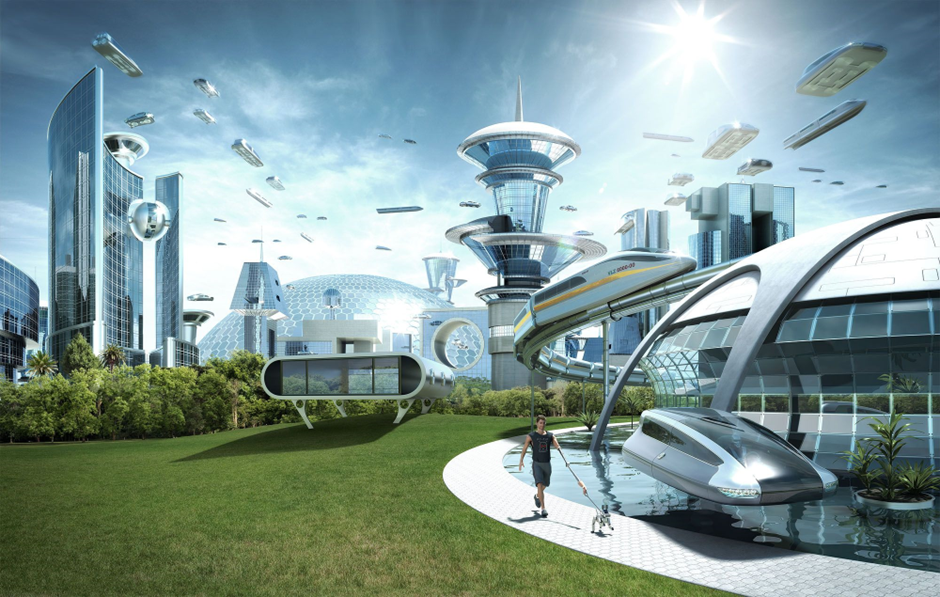
My very boring prediction for Britain in 2050 is that for most people in most places it will look like this:

Laws that prevent building on the green belt will broadly remain in place thanks to a collation of NIMBY and ‘environmentalist’ interests. (Environmentalist is here in air-quotes because preserving the green belt is often confused as being a pro-environment choice but if you care about the environment at a global level then green belt preservation is not helpful. More on this inherent tension later.)
Many cities will of course see considerable development, but they will not become futuristic looking. Most of the main landmarks of our cities are already protected or would become protected if anyone threatened to change them, and most of the urban environment we will inhabit in 2050 has already been built. Where I live, the council wanted to make some sensible changes to a roundabout to improve pedestrian safety, and local residents fought it tooth and nail, claiming it was an ‘iconic roundabout’. If it takes years of consultation just to try to change a dangerous roundabout to an intersection, then I don’t see us significantly re-configuring our urban fabric by 2050.
If you could time travel into the London, Leeds or Manchester in 2050, you’d probably not notice the difference save for maybe some public realm improvements and maybe a few more new residential skyscrapers in the background.
The housing crisis will become more acute- NIMBY Vs YIMBY will be a major political divide.
Very much due to the NIMBY forces identified previously that mean the urban fabric won’t change much, Britain’s housing crisis will likely continue to get worse over the next 28 years, to the point where the majority of people will never own a home. This is fundamentally due to Britain continuing to not build enough housing, due to a web of planning restrictions and laws that make housebuilding ever more difficult.
Economic growth (in-large part driven by AGI, which I’ll get onto), especially in the high productivity golden triangle of London, Cambridge and Oxford will mean higher salaries, which will drive a bidding war of house prices ever higher in these areas. Counterintuitively, it will be hardest to build housing where it is most needed (Oxfordshire, Cambridgeshire, Desirable parts of suburban London) so the areas that currently have the highest prices already 2022 will see the largest rises. This is because wealthy-home owners are best able to work the system to prevent housebuilding in their areas.
Growth does not have to translate into higher house prices, but when supply is constrained, it inevitably will.
The growing % of the population that are not homeowners will represent a majority, but as their interests are geographically diffuse (they want lower prices, but have no strong incentive to back an individual development at a local level) they will struggle to make a big enough impact to bring annual housebuilding numbers up high enough to reverse the housing price rises.
Artificial intelligence will make a huge impact on the Labour market, but government intervention/rules will dampen this.
So far these predictions have be dull. Speculating that the future will hardly differ from the present.
One area I do expect genuinely massive change is progress in Artificial Intelligence.
AI now is rather like the internet in 1992. Those who understand it know it is going to have a massive and profound impact on the world. But most people haven’t really thought about it very much.
Advances like GPT-3 and DALL-E are showing that AI threatens white-collar more than blue-collar work, which rather inverts the trends of the last 50 years, where technology has reduced the value/bargaining power of manual labour relative to ‘knowledge work’. AI is probably mere years away from replacing significant numbers of routine knowledge workers, and within a 10–15 year time frame as it gets drastically better it seems likely to be transformative. Self-driving vehicles, whilst slower to roll out than initially predicted will also become the norm in this time frame. We could be a long way from an AI plumber, but essentially any job that requires expertise in a purely informational sense, rather than a practical one, will be able to be done by AI.
Certain high-status professions that are well connected and organised will be able to protect themselves via credentials that AI cannot attain. Architects, Doctors, Barristers, Professors etc. are likely to keep their jobs despite AI being able to do them. They will have AI assistants that are able to make their lives much easier. However, a great many white-collar jobs that are not so connected/organised such as software developers, salespeople, administrative staff, graphic designers etc. will be completely replaced by AI.
But what does that mean for how we will experience society?
The destruction of vast numbers of jobs by AI will make the creation of jobs both very politically popular and more politically feasible (because AI will increase growth and concentrate profits, giving more tax revenue).
Lots of people will therefore work doing jobs that could easily be automated away by AI. The % of people employed by the government will rise and parties’ manifestos will try to out-bid each other on how many jobs they can create, even though said jobs don’t really need doing. They’ll probably be a roughly left-right political divide between pro-UBI parties (left) who think you may as well just give people money and let them do what they want and those who say that UBI leads to idleness and vice and causes social problems and so it’s better to pay people to do jobs that give them some purpose (right).
Jobs will be less important for conferring money, but will become more important for conferring status. Therefore people will still work hard and be highly competitive to get into desirable high-status jobs (e.g. journalists), even though their salary may be negligible.
Lots of people in fundamentally pointless jobs that could be done by AI will feel a great sense of ennui and long for a time when work actually needed doing. They’ll be an AI backlash but it will mostly be hot air, as AI will overall make us richer and we won’t want to go back, just like there’s a techlash now but no one really thinks we’ll turn the clocks back. AI will worsen inequality (the biggest gains will go to a small class of entrepreneurs), but also grow the over-all pie, so most people will not be worse off because of it.
The UK will be ‘Net’ carbon-neutral, emphasis on the net. The green movement will shift its focus away from climate change.
The UK will reach its target of reaching net-zero emissions by 2050. Electricity will be de-carbonised by lots of renewables, much cheaper batteries coming out in the 2030s, and a fair smattering of nuclear baseload. Electric cars will become the norm by the 2030s, and be almost phased out entirely by 2050, with the only ICE cars being interesting artifacts used by hobbyists. We will still use fossil fuels for air travel (though there may be some electric planes for short-haul flights enabled by battery breakthroughs) and gas will hang around as a source of energy for heating for far longer than we’d like, with many homes only just phasing out gas in the mid-2040s. We hit the target despite still burning fuel for air travel and a few other hard to decarbonize sectors using negative emissions technologies like BECCS and potentially some direct air capture, which will have matured massively by the late 2040s.
So, we’re still emitting some carbon in 2050, but we’re able to take more out of the atmosphere than we’re putting in. This decreases the salience of climate change as an issue in the UK, although climate change globally is not solved as many countries are not yet carbon neutral. The worst climate scenarios (4 degrees+) are successfully avoided by global decarbonization efforts. But they are not fast enough to prevent significant warming (2 degrees) so the world’s climate has changed significantly, making heatwaves and extreme weather more likely. This causes big problems but is not apocalyptic.
Some groups wrongly conclude this meant climate change was never going to be extremely dangerous. The reality is we successfully acted to avoid the worst outcomes.
By 2050s there are serious debates about whether to use negative emissions tech to reduce global temperatures back to pre-industrial levels or whether it’s best to leave it stable at the new elevated rate.
In 2022 climate change has become the top environmental issue by a long way, but by 2050 our successful action will mean the green movement will change to emphasize a range of ecological issues other than climate change and will continue to be politically relevant. Big debates will be around re-wilding, calling for a zero-waste society, and potentially anti-plastic campaigns that are mostly about vibes/aesthetics.
It’ll be environmentalists Vs conservationists
There’s nothing natural about the British countryside. Rolling hills populated by sheep divided by dry stone walls seem as old as time, but of course, these are manmade landscapes.
The words conservationist and environmentalist are currently used almost interchangeably but by 2050 the big divide between the two positions will be apparent.
In the 2030s in the race to hit the net-zero target, large amounts of tree planting will pitch environmentalists who want to re-forest large areas with conservationists who want to keep the English countryside the way it is now (which is not natural).
Breakthroughs in artificial meat will mean we could free up large amounts of farmland, but farmers will want subsidies to keep farming and keep it preserved it how it is. Environmentalists will want to be left to fall fallow and re-wilded. As more re-wilding occurs and less land is used for farming (thanks to improved yields, some vertical farming and artificial meat) they’ll be debates over the re-introduction of ever more and larger fauna. Think bears.
Outside of Britain some extinct animals will be brought back (Wolly Mammoths), but Britain will be too conservative to try re-introducing these.
The birth rate will continue to decline slowly — childlessness will be more common, but so will large families.
AI’s replacement of the need to work will mean a much more skewed distribution of fertility (rather than a typical family having 2 kids, many people have no kids, and a small but significant percentage have very many (6+) because generous child benefits enabled by AI induced growth mean it’s possible to have many kids without it being an economic burden. This helps arrest the decline in the birth rate somewhat, but doesn’t bring it back above replacement. Progress in AI means this is less of a worry, as it’s not like we need a strong birth rate to provide for the older generation’s pensions.
There will be flying cars, though only just.
Regulation will hold back flying cars for a long time, but as they become popular in other places in the world Britain eventually allows them as they’re just so useful. This will start to free us from roads, and therefore allow more inhabitation of the countryside, but this will be fought by environmentalists trying to preserve their newly re-wilded spaces.
____________________________________________________________
Quickfire:
Britain will still have an NHS
Scotland will get as devolved as possible, and have a very different political culture, but not leave the union.
(No country has ever left a union that directly subsidies it — unless you count Wales voting Leave). I’m much less sure of this one.
People will live considerably longer (150. Edit: people born in 2050 can expect to live to 150. Average live expectancy might rise to be around 90, but unlikely to pass 100) but the US will lead the breakthroughs in this area and the UK will lag behind
_______________________________________________________
I’ll be 57 in 2050 when I get to look back on these predictions. Over-all, I’m predicting a future that is somewhat better than today, but many things remain surprisingly similar. It is neither dystopian nor utopian. AI’s replacement of most jobs will leave many struggling for meaning, yet also mean we have a previously unimaginable amount of leisure time. Some people will handle that better than others. Seen as I’ll be gearing up for retirement by then, I’m hopeful I’ll be well placed to enjoy it.