
Jason Ward · Jan 3 · (Medium.com)
The true story of a group of teens who were stranded on a remote island for over a year
Ten years after William Golding released Lord of the Flies, six teenage boys found themselves stranded on a real desert island. Like in the book, there were no adults and it was up to them to survive.
In the novel, things famously went badly with the boys reverting to savagery and even murder. Golding was trying to make a point that humans, stripped of civilization, were still beasts at heart and would regress to a more primitive state.
So what happened when the scenario occurred in real life? Reassuringly for humanity, things turned out very differently.
Six boys set out on an adventure
On the 18th June 1965, six Tongan boys between the ages of 15 and 18 decided to have an adventure. They wanted to escape their strict Catholic school boarding school, St Andrew’s College, located in the Tongan capital of Nuku’alofa and sail off in search of a better life.
The friends were: Sione, Kolo, David, Stephen, Luke and Mano. In an interview years later Mano explained that the group was “bored” and thought they might sail to New Zealand. Things went wrong pretty quickly.
The boys had barely prepared for the trip. They didn’t even have a boat, so they “borrowed” one from a local fisherman they disliked. Their provisions were a few coconuts, two sacks of bananas, and a small gas burner. Unfortunately, they neglected to include things like a compass or a map.
In the early evening, the boys slipped out of the harbor. They sailed five miles north of the island, did some fishing, and then fell asleep. It had been calm and peaceful when they had dozed off but during the night a storm hit. The storm broke the anchor rope, as well as destroying the sail and rudder.
They were now adrift in a vast ocean with no food or water. For the next eight days, the vessel drifted. They tried to fish but without success. Using the hollowed-out coconuts, they managed to catch some rainwater, which was shared equally in the mornings and evenings.
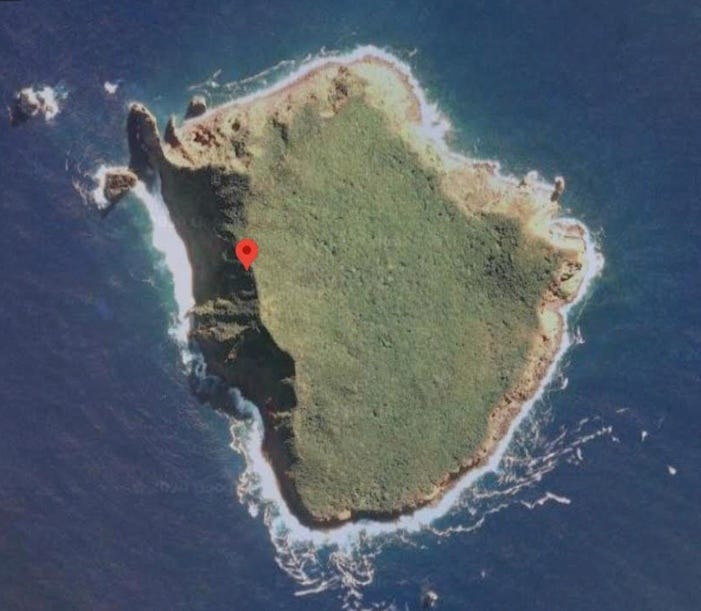
As the boat drifted in a south-westerly direction, it started to disintegrate and the boys were forced to bail water. On the eighth day, after drifting for roughly 200 miles, they spotted ‘Ata island.
Forced to abandon ship, the six young men spent the next 36 hours swimming to the island, using planks salvaged from their disintegrating boat.
Making landfall, the ordeal begins
Mano swam ashore first but was too weak from lack of food or water to stand. He called to the others and they all managed to make it ashore. For the first three months, they lived in a cave that they’d hollowed out of a cliff-face. They caught sea birds for meat and also drank their blood and eggs.
Desperate for proper food and water, the boys started to explore the island. One day they came across the ruins of Kolomaile village in a volcanic crater. The village had been deserted for a century but the friends found feral chickens, wild taro and bananas. Rainwater was caught in hollowed-out tree trunks.
With their immediate survival taken care of, the boys set about making the place more homely. They split into teams of two and drew up a roster for gardening, kitchen and guard duty. Stephen built a fire that was maintained for the rest of their time on the island. Kolo managed to build a guitar out of coconuts, salvaged wood and wire.
Whenever there was a disagreement, unlike in the Lord of the Flies, the boys took a time out, staying separate for a few hours until calm.
Things were occasional mishaps, however. One day, Stephen fell off a cliff and broke his leg. His friends made the perilous descent and carried him back up. They managed to set and splint his leg and, being young, it healed quickly.
At one point they built a raft and tried to escape but it broke apart on the reef. This was actually a good thing, as the boys thought they were in Samoa and planned to sail south. Which would have taken them into the open ocean.
Whenever they saw a vessel they lit signal fires but four vessels sailed past without seeing them. On the 11th September, 15 months after they had become marooned, a new boat arrived.
The six are rescued
Peter Warner was the son of one of the richest men in Australia. He was groomed to take over the family business but had other plans. When he was 17, he ran away to the sea in search of adventure. After five years of travelling the world, he finally returned home to an angry father and a job. Peter still kept a boat, however, and frequently took long trips.
It was on one such trip that brought him to ‘Ata island. Through his binoculars, he noticed strange burnt patches on the otherwise green cliffs. Spontaneous fires are rare in the tropics and he was intrigued.
It was then he saw a naked young man with hair down to his shoulders. More naked youths appeared and started yelling. The first one dived into the water and swam toward Warner’s boat.
Warner would later recount that when the boy made it to his vessel, he said, in perfect English, “My name is Stephen. There are six of us and we reckon we’ve been here 15 months.” The other five had soon swum over and clambered aboard.
Peter Warner found their story unlikely, so he called Nuku’alofa and relayed what Stephen had said. The radio operator soon replied: “You found them! These boys have been given up for dead. Funerals have been held. If it’s them, this is a miracle!”
By the time Captain Warner found the six teens, their camp was well established. They had food, fire, music, a small gym and even a badminton court. It was a far cry from the savagery predicted by William Golding.
They return to civilization and are arrested
Upon return to Nuku’alofa, they were examined by a local doctor, who was amazed at their overall health. He was also impressed by how well they had set Stephen’s now perfectly healed leg.
Then the police boarded Warner’s vessel and promptly arrested the six boys. The fisherman who owned the boat they had “borrowed” was still fuming over the theft and upon learning of their return had immediately pressed charges.
Again, it was Warner to the rescue. Knowing the boys’ ordeal was an interesting one, he sold the Australian rights to the story to a TV channel in Sydney. He kept the world rights. The channel paid him £150 which he used to pay the irate fisherman. Charges were dropped and the boys were free.
A happy ending
When Warner and the six young men returned to their home island of Haʻafeva, the entire population of 900 people turned out to welcome them back. Warner was declared a national hero.
King Taufa‘ahau Tupou IV invited the Australian for an audience. He thanked Warner for rescuing six of his subjects and granted him the right to trap lobster in his waters.
Warner returned to Sydney and quit his job. He had some money saved and so he bought a brand new fishing boat. Once again, the sea and a craving for adventure called to him. And he knew six young men who shared his outlook on life.

Warner contacted the six Tongans and offered them jobs as crew on his new boat. He promised them excitement and exploration on the high seas. This time with a compass and map.
They all accepted.
WRITTEN BY
Jason Ward
Freelance Writer, Author. Lives in Asia. www.jasonwardwriter.com Or email: thewordofward@gmail.com Top writer in History and Culture.

ILLUMINATION-Curated
Outstanding stories objectively and diligently selected by 40+ senior editors on ILLUMINATION