After Nations explores ‘a generalised state of crisis’ that afflicts the nation-state worldwide. In an effort to understand this crisis, Rana Dasgupta charts the development of the global nation state project from the Enlightenment to the present, its ongoing value unquestioned—to our detriment.
In its modern, fully-fledged form, the nation-state system is a very recent innovation, and one that departs from the normal history of the world – which is a story of empires. What we are seeing is the rapid disintegration of a system on which we had come to depend too completely.
After Nations offers a startling account of this exhilarating and terrible system. Its thesis will be disturbing to many, but we must quickly come to terms with it if we are to address the very grave challenges that now face us as a at their core, the political, economic, military and even environmental problems we face today are not the fault of inadequate policies or poor leadership. They are the consequence, rather, of our outdated political infrastructure – the nation-state system – which is not capable, even in theory, of protecting populations from twenty-first-century conditions. Five crises (“God”, “Money”, “Law”, “War” and “Nature”) will combine inexorably to diminish the ability of this system to deliver minimally acceptable outcomes.
The author’s aim, through a portrait of this time of crisis, is radically to re-imagine what the nation-state system can and should provide. His interrogation of what we might now ask of our neighbourhoods and cities, will here be writ After Nations asks what we want for our global future.
Rana Dasgupta is a British-Indian writer. He grew up in Cambridge, England and studied at Balliol College, Oxford, the Conservatoire Darius Milhaud in Aix-en-Provence, and the University of Wisconsin–Madison. He lives in Delhi, India.
His first novel, Tokyo Cancelled (2005), was an examination of the forces and experiences of globalization. Billed as a modern-day Canterbury Tales, thirteen passengers stuck overnight in an airport tell thirteen stories from different cities in the world, stories that resemble contemporary fairytales, mythic and surreal. The tales add up to a broad exploration of 21st century forms of life, which includes billionaires, film stars, migrant labourers, illegal immigrants and sailors. [1] Tokyo Cancelled was shortlisted for the 2005 John Llewellyn Rhys Prize.
Dasgupta’s second novel, Solo (2009) is an epic tale of the twentieth and twenty-first centuries told from the perspective of a one hundred-year old Bulgarian man. Having achieved little in his twentieth-century life, he settles into a long and prophetic daydream of the twenty-first century, where all the ideological experiments of the old century are over, and a collection of startling characters – demons and angels – live a life beyond utopia.
New Thinking Allowed with Jeffrey Mishlove Apr 1, 2026 James Tunney, LLM, is an Irish barrister and author of The Mystery of the Trapped Light: Mystical Thoughts in the Dark Age of Scientism plus The Mystical Accord: Sutras to Suit Our Times, Lines for Spiritual Evolution; also TechBondAge: Slavery of the Human Spirit, Human Entrance to Transhumanism: Machine Merger and the End of Humanity, and AI-Govnerveance: Care and Possession in Dustopia. His most recent book is Trotsky vs Jesus: Battle of the AI-Millennium. His website is https://www.jamestunney.com/about-the… He focuses on the distinctions between physical light and many forms of spiritual light, including magical light, Egyptian light, and divine light. He reflects on the multiple meanings of the notion of light entrapped within matter or flesh. He argues that scientism, to the extent that it denies the realities of the spirit, is a dark cultural force. He also points out the high value that spiritual traditions place upon darkness. New Thinking Allowed host, Jeffrey Mishlove, PhD, is author of The Roots of Consciousness, Psi Development Systems, and The PK Man. Between 1986 and 2002 he hosted and co-produced the original Thinking Allowed public television series. He is the recipient of the only doctoral diploma in “parapsychology” ever awarded by an accredited university (University of California, Berkeley, 1980). He is also the Grand Prize winner of the 2021 Bigelow Institute essay competition regarding the best evidence for survival of human consciousness after permanent bodily death. He is Co-Director of Parapsychology Education at the California Institute for Human Science. (Recorded on September 21, 2020)
New Thinking Allowed with Jeffrey Mishlove Mar 31, 2026 Colette Baron-Reid is an internationally bestselling author published in 27 languages. She is an Oracle expert, spiritual intuitive, personal transformation thought leader, business strategist, artist, and educator. She helps people become the artist of their own reality. She is author of eight books, including The Map: Finding the Magic and Meaning in the Story of Your Life, You’re in the Right Place, and The Art of Manifesting: A Meditative Drawing Practice to Rewire Your Brain and Create Your Reality. She has created 19 oracle cards, includingWisdom of the Oracle Divination Cards, The Spirit Animal Oracle, and Guides of the Hidden Realms Oracle. Her website is colettebaronreid.com. Colette describes how she created and popularized modern Oracle Cards that are themed variations from the traditional Tarot. She describes her Oracle Cards as tools of intentional synchronicity that can provide a mirror, direct guidance, and gnosis to the person making an inquiry. She suggests that the world is a living oracle, and you can uncover the truth of who you are, need to become, and what you want to create. 00:00 Introduction 03:11 Beginnings of Oracle Cards 11:20 Evolution of Tarot and Oracle Cards 24:31 Esoteric teachings and tools to communicate 26:47 Intuition and the future with Oracle Cards 35:06 Direct guidance and personal connection to higher power 36:36 Imagery, symbols, and language of the cards 40:18 Oracle cards for manifestation 45:19 Tools of synchronicity 46:19 Conclusion New Thinking Allowed CoHost, Emmy Vadnais, OTR/L, is a licensed occupational therapist, intuitive healer and coach, and spiritual guide based in St. Paul, Minnesota. Emmy is the founder of the Intuitive Connections and Holistic OT communities. She is the author of Intuitive Development: How to Trust Your Inner Knowing for Guidance With Relationships, Health, and Spirituality. Her website is https://emmyvadnais.com (Recorded on February 12, 2026)
New Thinking Allowed with Jeffrey Mishlove Mar 30, 2026 Psychology and Psychotherapy Richard Reichbart, JD, PhD, is a training and supervising psychoanalyst. For thirty five years, he has maintained a private practice for the treatment of adults, adolescents and children in Northern New Jersey. In addition, he is a short story writer, a parapsychologist, and a poet. He is author of The Paranormal Surrounds Us: Psychic Phenomena in Literature, Culture, and Psychoanalysis. Prior to his career in psychology, he worked as an attorney focusing on civil rights and Native American issues. Here he describes how he was introduced to parapsychology as a result of becoming a psychoanalytic patient of Jule Eisenbud. He describes how Eisenbud became a persona non grata within the psychoanalytic community as a result of his research in “thoughtography” with Ted Serios. He also describes Freud’s ambivalent attitude toward the paranormal. He points out, however, that telepathic experiences are rather common within the intimacy of psychoanalytic sessions. New Thinking Allowed host, Jeffrey Mishlove, PhD, is author of The Roots of Consciousness, Psi Development Systems, and The PK Man. Between 1986 and 2002 he hosted and co-produced the original Thinking Allowed public television series. He is the recipient of the only doctoral diploma in “parapsychology” ever awarded by an accredited university (University of California, Berkeley, 1980). He is also the Grand Prize winner of the 2021 Bigelow Institute essay competition regarding the best evidence for survival of human consciousness after permanent bodily death. He is Co-Director of Parapsychology Education at the California Institute for Human Science. (Recorded on November 7, 2020)
The WHO says loneliness kills 871,000 people a year—but the real cause isn’t smartphones or social media. It’s a 10,000-year experiment that dismantled the tribe.
The World Health Organization released a report last June that deserves far more attention than it got. One in six people on the planet, they found, is now affected by loneliness. It kills an estimated 871,000 people every year, more than 100 every hour, every hour of every day.
The Commission that produced the report called social disconnection “a defining challenge of our time” and drew a roadmap for governments and communities to respond. The usual proposals followed: more parks, better public transit, tech companies designing for connection rather than engagement, a minister of loneliness here, a national strategy there.
These are not bad ideas. But they’re solutions to a problem that’s being described incorrectly, and when you describe a problem incorrectly, your solutions tend to work at the edges rather than at the root.
The framing we keep reaching for treats loneliness as a malfunction, something that has gone wrong in an otherwise healthy social system. But what if loneliness at this scale is not a malfunction at all?
What if it’s the entirely predictable result of an experiment in how to organize human life that we’ve been running for about ten thousand years, and the results are now coming in?
I spent time in South Sudan in 2008, near the Darfur border, in a refugee settlement of 45,000 people who’d fled bombardment, rape, mass murder, and forced displacement. The conditions were severe by any measure: one hand-pumped well, no sanitation, no shelter beyond what people had gathered from the landscape, temperatures that dropped into the nineties at night.
Disease was everywhere. Food was scarce. And yet every single evening, in different corners of the settlement, someone brought out drums. The music would start, and then the singing, and then people were dancing and talking and the children were playing and the old men were telling stories to anyone who would listen. There was not a moment of the kind of blank, sealed-off isolation that I see on the faces of people riding the subway in any American city.
These were people who’d lost nearly everything. What they hadn’t lost, because it had not yet been taken from them, was each other. Not each other in the thin modern sense of being in proximity. Each other in the full sense: known, embedded, accountable, necessary to one another’s daily survival and daily joy. This is what a tribe is. This is what human beings lived inside of for the vast majority of the time we’ve existed as a species.
The Australian Aborigines have a phrase, “The Great Forgetting,” for what happened to European peoples over roughly the last two millennia as the old tribal structures were systematically dismantled by the British empire and then by the Catholic Church.
The sacred sites destroyed. The rituals banned. The languages absorbed into Latin and then into English and the national languages of nation-states. The commons enclosed. The grandmothers and grandfathers who carried the deep knowledge of how to live in a particular landscape, and how to live with one another, silenced or killed.
What was left, they know, was the outward form of a culture without its roots, people in tremendous numbers living side by side without any architecture for genuine belonging.
We don’t often tell this story when we talk about loneliness. We prefer to blame social media, or the pandemic, or smartphones, or the death of the third place. These things matter, but they’re just the symptoms.
The WHO report notes that loneliness kills as surely as smoking fifteen cigarettes a day. What it doesn’t ask is how it came to be that the default condition for hundreds of millions of people is a kind of low-grade starvation of genuine human contact, and whether that condition might have structural roots that run deeper than any app or urban planning initiative can reach.
The answer, if you look honestly at the anthropological record, is that we built a civilization optimized for productivity and consumption, and we did it by dismantling, piece by piece, everything that made human beings feel genuinely held.
The village. The extended family under one roof. The practice of sitting together in the evening rather than each retreating to a separate screen. The shared ritual that marked time and gave life its shape. The elder who knew your name and your history and could place you in a story larger than your own anxiety. None of these things went away because they were bad ideas; they went away because they interfered with the efficient production of workers and consumers.
I worked for years as a psychotherapist running a residential program for severely abused children, kids who’d been failed by every institution designed to protect them. What I saw, over and over again, was that the damage was not only what had been done to them; it was also what had never been provided.
Safety, yes. Food and shelter, yes. But beneath all of it, the absence of the sustained, unconditional, witnessed belonging that is the birthright of every child and that no therapeutic technique, however skilled, can entirely substitute for. You can heal a great deal. You can’t, however, manufacture a tribe after the fact and expect it to do what a tribe does when it’s the water a child has swum in from the beginning of her life.
This is not a counsel of despair. The drumming happened in the refugee settlement because the impulse toward community is not destroyed so easily. It’s biological. It’s written into us at a level that predates language or culture.
Researchers studying the neuroscience of loneliness find that it activates the same threat-detection circuitry as physical pain. This is not a coincidence: for most of human history, being separated from your group meant death.
The pain of loneliness is the nervous system’s alarm. We just built a world where the alarm goes off constantly and there is nowhere particular to run.
What this means practically is that the solutions worth trying are not the ones that make isolation more comfortable. They are, instead, the ones that re-create, in whatever scaled-down modern form we can manage, the conditions that the nervous system is actually asking for.
Not more social media followers, but more people who know when you’re sick and show up anyway. Not a longer list of connections on LinkedIn, but a smaller circle of people with whom you share actual obligations, actual history, actual meals.
The research consistently points toward exactly what every tribal culture already knew: that meaning and belonging are not separate things, that you can’t have one without the other, and that neither of them can be delivered through a screen or legislated into existence by a government commission.
The WHO is right that this is a public health crisis. But public health crises have causes, and the cause of this one is not a virus or a toxin. It’s a story we’ve been telling ourselves for ten thousand years about what civilization is for.
The good news is that stories can change. The drums are still in us, waiting.
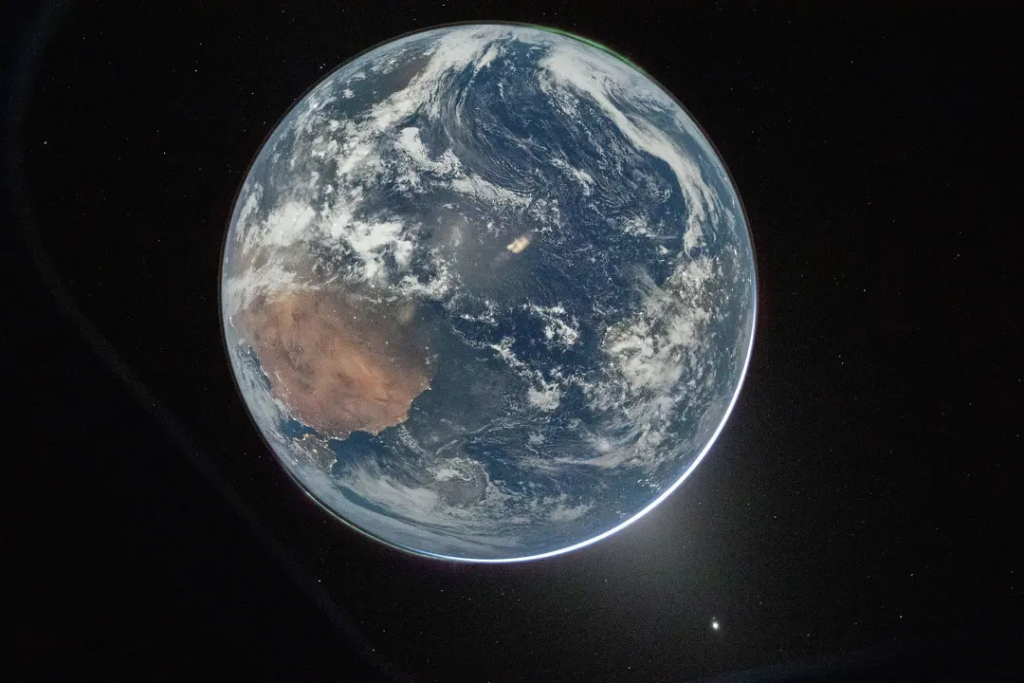
NASA footage showed its rocket successfully taking off from the Kennedy Space Center in Florida on Wednesday afternoon, carrying four astronauts out of view of the crowd that had gathered below to watch the historic launch.
Among the crew — three Americans and one Canadian — is California-raised Victor Glover, the mission’s pilot, and Christina Koch, the first woman to head to the moon. Glover will also become the first Black man to circumnavigate it.
The 10-day mission will take astronauts farther from Earth than humans have ever traveled. While no landing is planned, it’s a key step toward future moon missions — and eventually, missions to Mars.
The 32-story rocket lifted off at 3:35 p.m. Pacific. It marks the first crewed journey to the moon since 1972.
“We still call amazing things that humans do moonshots, and now our generation is going to get to have one of our own,” said Glover, who was born in Pomona and studied engineering at Cal Poly San Luis Obispo.
I remember the moment a friend’s son came home from school to recount with something between shock and exhilaration how he realized while talking to a classmate that the notion of a mental image is not merely a metaphor, that other people can conjure up in their minds things not before their eyes. And the moment another friend discovered that the inner stream of language with which most of us narrate our lives courses through neither his mother’s nor his sister’s mind. And always the moment I waded into the winter ocean with someone with whom I thought I shared uncommon understanding, and I exclaimed “Those needles!” as the icy water stabbed at my flesh, and she stared at me blankly, and when I asked what her sensation was, she took a long pause, then said: “Pressure.” Two bodies so seemingly similar, sharing 99.9% of their genome and 100% of their trust, immersed in the exact same environment, governed by consciousnesses so invisibly different as to render the contact between self and world sharp for one and blunt for the other.
Art by Giuliano Cucco from Before I Grew Up — a lyrical picture-book about the artist within
Moments like these jolt us awake from the dream of perfect understanding, stagger us with the realization that no one ever really knows what it is like to be somebody else, that between one consciousness and another there always gapes an abyss black as the inside of a skull, and though we may try to reach each other with love and reason, they twine but a tenuous footbridge across it. The best we can do is hold on to the ropes and hope that they will not fray before we reach the rim of understanding, the outer edge of the other, which is all we can ever touch — and still it is enough, this sliver of salvation from the loneliness of being ourselves, this outstretched hand across the icy blue.
Anne Enright faces this abyss in her lyrical novel The Wren, the Wren (public library), drawing from it not a point of despair but portal of possibility.
She writes:
We don’t walk down the same street as the person walking beside us. All we can do is tell the other person what we see. We can point at things and try to name them. If we do this well, our friend can look at the world in a new way. We can meet.
Looking back on viewing empathy “like it’s the solution (and it is! it is!) to pretty much everything,” the protagonist reflects:
I had a big beautiful cake in my head called “Feeling the Pain of Others” and I sliced it this way and that because I thought that emotion is the bridge between people, sentiment crosses space, sympathy is a gas, exhaled by one, inhaled by the other. Empathy! It’s just like melting. We can merge, you know. We can connect. We can cry at the same movie. You and I.
And yet, she comes to see, we struggle to do this, for it is at bottom a profoundly complicated thing. But perhaps we struggle because we have the wrong goal in mind — merging, in the end, is not the measure of closeness, of understanding, of the proximity between consciousnesses in the icy waters of being. Enright writes:
There is a real gap between me and the next person, there is a space between every human being. And it is not a frightening space. The empty air which exists between people might be crossed by emotion, but it might not. You need something else, or you need something first… Now, I think the word we need is “translation.”
Given the co-evolution of vision and consciousness, this gap in how we perceive the world is reflected in our actual sight — we each see the same photons differently due to variations in how our eyes and brains process light. While science is not there to furnish us with metaphors — its task is truth — we are creatures of meaning who cannot help but turn to metaphor as our best footbridge between truth and meaning. Enright’s protagonist reflects:
These days I am obsessed by light, it is so hard to commodify. I am not talking about a beautiful dawn, or holidays in the sun, or the light that makes a photograph look good. I am talking about brightness itself, the air lit up. The gleam on the surfaces of my typing hands. I love the gift of its arrival. The light you see is always eight and a half minutes old. Always and again. And you think it is shared by everyone but it is not shared, exactly — our eyes are hit by our own, personal photons.
Perhaps, in the end, the measure of understanding — which is “love’s other name” — is not seeing the same light but seeing the light in each other, the shy light shimmering over the ocean of our singularity.
New Life or Zombie? Finding Resurrection at Easter
How do we find stablity and security when amidst a world in turmoil ?
In this talk, recorded at Easter last year, William will explore opportunities for transcendence during this time of crisis in the USA and around the world. A big part of welcoming a fresh start is to say goodbye to ways of being that have become stale, predictable, or uninspiring. This presentation will investigate the challenges and rewards of taking a fresh view — not forgetting the power of genuine resurrection.
William Fennie currently serves as Dean of The Prosperos.
ARIES (March 21-April 19): Now is an excellent time to decide your favorite color is amaranth (a vivid red-violet), or sinopia (earthy red-orange), or viridian (cool blue-green, darker than jade). You might also conclude that your favorite aroma is agarwood (deep, smoky, resin-soaked wood) or heliotrope (cherry-almond vanilla) or petrichor (wet soil after a rain). I’m trying to tell you, Aries, that you’re primed to deeply enhance your detailed delight in smells, colors, tastes, feelings, physical sensations, types of wind, tones of voice, qualities of light—and everything else. Indulge in sensory and sensual pleasures!
TAURUS (April 20-May 20): My Taurus friend Elena keeps a “gratitude garden” in her backyard. When she feels grateful for a specific joy in her life, she writes it on biodegradable paper and buries it among her flowers, herbs and vegetables. “I feed the earth with appreciation,” she says. “Returning the gift.” She feels this practice ensures that her garden and her life flourish. Her devoted attention to recognizing blessings attracts even more blessings. Her cultivated appreciation for beauty and abundance leads her to discover more beauty and abundance. Elena’s approach is pure Taurean genius. I invite you to create your own rituals for expressing your thankful love. Not just paying dutiful homage in your thoughts, but giving your appreciation weight, texture and presence in the actual world.
GEMINI (May 21-June 20): Many of us periodically slip into the daydream that everything would finally feel right if only our lives were somehow different. If we’re single, maybe we imagine we ought to be partnered; if we’re partnered, we wish our beloved would change, or we secretly wonder about someone else entirely. That’s the snag. The blessing is this: In the days ahead, you’re likely to discover a surprising ease with your life exactly as it is, and feel a genuine, grounded peace. Congratulations in advance!
CANCER (June 21-July 22): A cautious voice in your head murmurs: “Proceed carefully. Don’t be overly impressed with your own beauty. Stick with dependable methods. Live up to expectations and avoid explorations into the unknown.” Your bold genius interrupts: “Tell that fussy, boring voice to shut up. The truth is that you have earned the right to be an inquisitive wanderer, an ingenious lover, a fanciful storyteller, and a laughing experimenter.”
LEO (July 23-Aug. 22): In medieval European gardens, there was a tradition of creating “pleasure labyrinths.” They were walking meditations that spiraled inward to a center, then back out again. There were no decisions and no wrong turns, just the relaxing, meditative journey itself. I think you need and deserve a metaphorical pleasure labyrinth right now, Leo. You’ve been treating every choice as a high-stakes dilemma and every path as potentially problematic. But what if the current phase isn’t about making the perfect decision? Maybe it’s about trusting that the path you’re on will take you where you need to go, even if it meanders. By cosmic decree, you are excused from second-guessing every turn.
VIRGO (Aug. 23-Sept. 22): Your eye for imperfection is a gift until it becomes the lens through which you see everything. The critical faculty that drives you to refine and enhance may also shunt you into a dead end of never-being-good-enough, where impossible standards immobilize you. In the coming weeks, dear Virgo, I beg you to use your vaunted discernment primarily in the service of growth and pleasure rather than constraint. Be excited by buoyant analysis that empowers constructive change. Homework: For every flaw you identify, identify two things that are working well. You won’t ignore what needs attention, but instead will compensate for the excessive criticism that sometimes grips your inner critic.
LIBRA (Sept. 23-Oct. 22): You Libras shouldn’t expend excessive effort trying to force the external world to be more tranquil. That’s mostly a futile task that distracts from your more essential work. The secret to your happiness is to cultivate serenity within. How do you do that? One reliable way to shed tension is to continually place yourself in the presence of beauty. Nothing makes you relax better than being surrounded by elegance, grace and loveliness. Now is a good time to recommit yourself to this key practice.
SCORPIO (Oct. 23-Nov. 21): In computer science, there’s a concept called “graceful degradation.” When a system encounters an error, it doesn’t crash completely. It loses some functionality but keeps running with what remains. According to my reading of the astrological omens, Scorpio, you’d be wise to acknowledge a graceful degradation like that. Something isn’t working as you had hoped and planned. A relationship? Project? Adventure? In classic Scorpio fashion, you’re tempted to burn it all down. But I encourage you to practice graceful degradation instead. Keep what still works and release only what’s actually broken. Not everything has to be all-or-nothing. You can lose some functionality and still run. You can be partially out of whack and still be valuable. PS: The awkwardness is temporary.
SAGITTARIUS (Nov. 22-Dec. 21): At your best and brightest, you are a hunter—though not the kind who stalks prey with weapons and trophies in mind. Your hunt is noble: the fervent pursuit of adventures that nourish your curiosity and the brave forays you make into unfamiliar territories where intriguing new truths shimmer. And now, as the world drifts deeper into chaos, you are called to respond with even more exploratory audacity. I invite you to further refine your hunter’s craft. Lift it up to an even higher, more luminous form of seeking.
CAPRICORN (Dec. 22-Jan. 19): Capricorn meditation teacher Wes Nisker guided his students to relax the relentless mental static that muddled their awareness. But he also understood that excessive striving can sabotage the peace we’re seeking. I invoke his influence now to help you release some of the jittery goal-obsession you’ve been gripped by. Nisker and I offer you permission to temporarily suspend the potentially exhausting drive to constantly be better and more accomplished. Instead, just for now, simply be your authentic self. Loosen your high-strung grip on self-improvement and allow yourself the radical luxury of purposelessness.
AQUARIUS (Jan. 20-Feb. 18): Here’s a danger you Aquarians are sometimes prey to: spending so much energy fixing the big picture that you neglect what’s up close and personal. You may get so involved in rearranging systems that immediate concerns get less than your best attention. I hope you won’t do that in the coming weeks. Your aptitude for overarching objectivity is a gift because it enables you to recognize patterns others can’t detect. But it may also divert you from the messy, intricate intimacy that gritty transformation requires. Your assignment: Eagerly attend to the details, which I bet will be more interesting than you imagine.
PISCES (Feb. 19-March 20): In horticulture, “hardening off” is the process of gradually exposing seedlings started indoors to outdoor conditions before transplanting them. Too much exposure too fast will shock them; no exposure at all will leave them unprepared. Let’s invoke this as a useful metaphor for you. I believe you are being hardened off, Pisces. Life is making small, increasing demands on your tender self. Though this may sometimes feel uncomfortable, I assure you that it’s preparation, not cruelty. You’re being readied for a shift from protected space to open ground. My advice is twofold: 1. Don’t retreat back into the ultra-safe greenhouse. 2. Don’t let yourself be thrown into full exposure all at once.
Homework: My book “Astrology is Real” is available at online bookstores. Read free excerpts here: tinyurl.com/BraveBliss
ARIES (March 21-April 19): Now is an excellent time to decide your favorite color is amaranth (a vivid red-violet), or sinopia (earthy red-orange), or viridian (cool blue-green, darker than jade). You might also conclude that your favorite aroma is agarwood (deep, smoky, resin-soaked wood) or heliotrope (cherry-almond vanilla) or petrichor (wet soil after a rain). I’m trying to tell you, Aries, that you’re primed to deeply enhance your detailed delight in smells, colors, tastes, feelings, physical sensations, types of wind, tones of voice, qualities of light—and everything else. Indulge in sensory and sensual pleasures!
TAURUS (April 20-May 20): My Taurus friend Elena keeps a “gratitude garden” in her backyard. When she feels grateful for a specific joy in her life, she writes it on biodegradable paper and buries it among her flowers, herbs and vegetables. “I feed the earth with appreciation,” she says. “Returning the gift.” She feels this practice ensures that her garden and her life flourish. Her devoted attention to recognizing blessings attracts even more blessings. Her cultivated appreciation for beauty and abundance leads her to discover more beauty and abundance. Elena’s approach is pure Taurean genius. I invite you to create your own rituals for expressing your thankful love. Not just paying dutiful homage in your thoughts, but giving your appreciation weight, texture and presence in the actual world.
GEMINI (May 21-June 20): Many of us periodically slip into the daydream that everything would finally feel right if only our lives were somehow different. If we’re single, maybe we imagine we ought to be partnered; if we’re partnered, we wish our beloved would change, or we secretly wonder about someone else entirely. That’s the snag. The blessing is this: In the days ahead, you’re likely to discover a surprising ease with your life exactly as it is, and feel a genuine, grounded peace. Congratulations in advance!
CANCER (June 21-July 22): A cautious voice in your head murmurs: “Proceed carefully. Don’t be overly impressed with your own beauty. Stick with dependable methods. Live up to expectations and avoid explorations into the unknown.” Your bold genius interrupts: “Tell that fussy, boring voice to shut up. The truth is that you have earned the right to be an inquisitive wanderer, an ingenious lover, a fanciful storyteller, and a laughing experimenter.”
LEO (July 23-Aug. 22): In medieval European gardens, there was a tradition of creating “pleasure labyrinths.” They were walking meditations that spiraled inward to a center, then back out again. There were no decisions and no wrong turns, just the relaxing, meditative journey itself. I think you need and deserve a metaphorical pleasure labyrinth right now, Leo. You’ve been treating every choice as a high-stakes dilemma and every path as potentially problematic. But what if the current phase isn’t about making the perfect decision? Maybe it’s about trusting that the path you’re on will take you where you need to go, even if it meanders. By cosmic decree, you are excused from second-guessing every turn.
VIRGO (Aug. 23-Sept. 22): Your eye for imperfection is a gift until it becomes the lens through which you see everything. The critical faculty that drives you to refine and enhance may also shunt you into a dead end of never-being-good-enough, where impossible standards immobilize you. In the coming weeks, dear Virgo, I beg you to use your vaunted discernment primarily in the service of growth and pleasure rather than constraint. Be excited by buoyant analysis that empowers constructive change. Homework: For every flaw you identify, identify two things that are working well. You won’t ignore what needs attention, but instead will compensate for the excessive criticism that sometimes grips your inner critic.
LIBRA (Sept. 23-Oct. 22): You Libras shouldn’t expend excessive effort trying to force the external world to be more tranquil. That’s mostly a futile task that distracts from your more essential work. The secret to your happiness is to cultivate serenity within. How do you do that? One reliable way to shed tension is to continually place yourself in the presence of beauty. Nothing makes you relax better than being surrounded by elegance, grace and loveliness. Now is a good time to recommit yourself to this key practice.
SCORPIO (Oct. 23-Nov. 21): In computer science, there’s a concept called “graceful degradation.” When a system encounters an error, it doesn’t crash completely. It loses some functionality but keeps running with what remains. According to my reading of the astrological omens, Scorpio, you’d be wise to acknowledge a graceful degradation like that. Something isn’t working as you had hoped and planned. A relationship? Project? Adventure? In classic Scorpio fashion, you’re tempted to burn it all down. But I encourage you to practice graceful degradation instead. Keep what still works and release only what’s actually broken. Not everything has to be all-or-nothing. You can lose some functionality and still run. You can be partially out of whack and still be valuable. PS: The awkwardness is temporary.
SAGITTARIUS (Nov. 22-Dec. 21): At your best and brightest, you are a hunter—though not the kind who stalks prey with weapons and trophies in mind. Your hunt is noble: the fervent pursuit of adventures that nourish your curiosity and the brave forays you make into unfamiliar territories where intriguing new truths shimmer. And now, as the world drifts deeper into chaos, you are called to respond with even more exploratory audacity. I invite you to further refine your hunter’s craft. Lift it up to an even higher, more luminous form of seeking.
CAPRICORN (Dec. 22-Jan. 19): Capricorn meditation teacher Wes Nisker guided his students to relax the relentless mental static that muddled their awareness. But he also understood that excessive striving can sabotage the peace we’re seeking. I invoke his influence now to help you release some of the jittery goal-obsession you’ve been gripped by. Nisker and I offer you permission to temporarily suspend the potentially exhausting drive to constantly be better and more accomplished. Instead, just for now, simply be your authentic self. Loosen your high-strung grip on self-improvement and allow yourself the radical luxury of purposelessness.
AQUARIUS (Jan. 20-Feb. 18): Here’s a danger you Aquarians are sometimes prey to: spending so much energy fixing the big picture that you neglect what’s up close and personal. You may get so involved in rearranging systems that immediate concerns get less than your best attention. I hope you won’t do that in the coming weeks. Your aptitude for overarching objectivity is a gift because it enables you to recognize patterns others can’t detect. But it may also divert you from the messy, intricate intimacy that gritty transformation requires. Your assignment: Eagerly attend to the details, which I bet will be more interesting than you imagine.
PISCES (Feb. 19-March 20): In horticulture, “hardening off” is the process of gradually exposing seedlings started indoors to outdoor conditions before transplanting them. Too much exposure too fast will shock them; no exposure at all will leave them unprepared. Let’s invoke this as a useful metaphor for you. I believe you are being hardened off, Pisces. Life is making small, increasing demands on your tender self. Though this may sometimes feel uncomfortable, I assure you that it’s preparation, not cruelty. You’re being readied for a shift from protected space to open ground. My advice is twofold: 1. Don’t retreat back into the ultra-safe greenhouse. 2. Don’t let yourself be thrown into full exposure all at once.
Homework: My book “Astrology is Real” is available at online bookstores. Read free excerpts here: tinyurl.com/BraveBliss
Consciousness, sexuality, androgyny, futurism, space, the arts, science, astrology, democracy, humor, books, movies and more