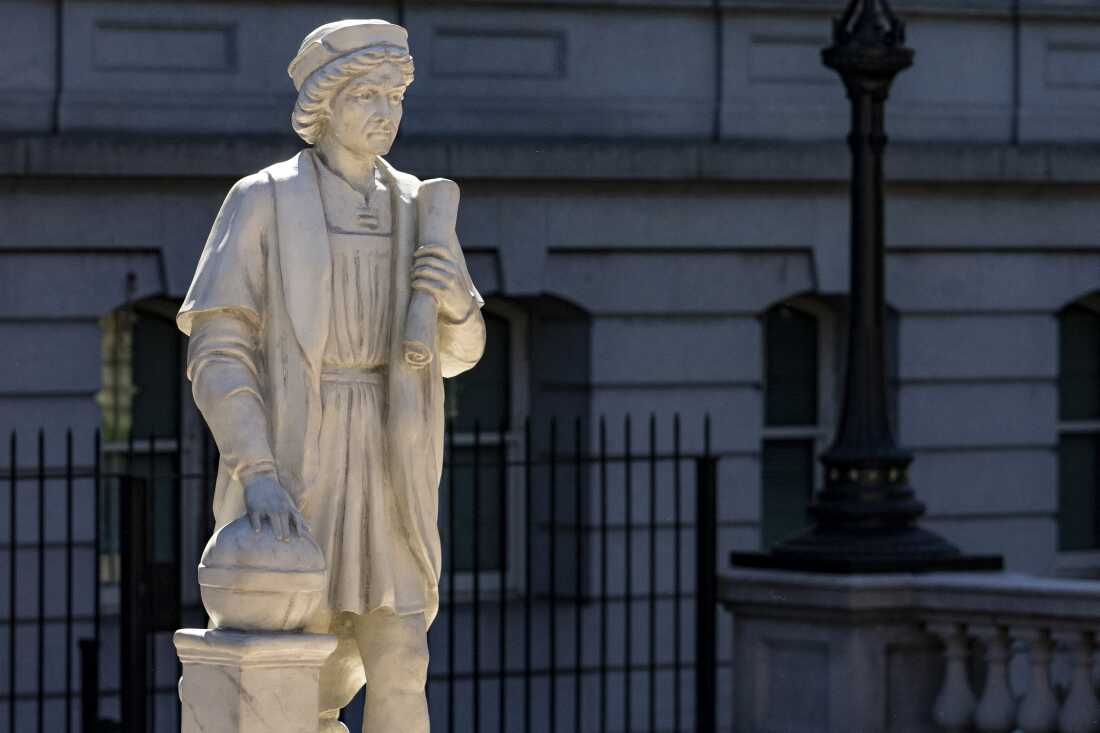
A statue of the explorer Christopher Columbus stands on White House grounds at the Eisenhower Executive Office Building (EEOB) in Washington, D.C., on March 23, 2026.
Jim Watson/AFP/Getty Images
The Trump administration placed a statue of Christopher Columbus on White House grounds over the weekend, doubling down on its efforts to commemorate the 15th-century explorer.
“As we celebrate our Nation’s 250th anniversary of independence, the White House is proud to honor Christopher Columbus’s legendary life and legacy with a well-deserved statue on the White House grounds,” Davis Ingle, a White House spokesperson, said in a statement. “In this White House, Christopher Columbus is a hero, and President Trump will ensure he’s honored as such for generations to come.”
The statue is a replica of the one that used to sit in Baltimore’s Little Italy, according to John Pica, a Maryland lobbyist and president of the Italian American Organizations United. In 2020, after the killing of George Floyd by a white police officer and a reckoning on racial justice issues in the U.S., protesters pulled the statue down and hurled it into the city’s Inner Harbor.
The marble statue depicted Columbus facing east towards the sun, and was dedicated by former Baltimore Mayor William Donald Schaefer and President Ronald Reagan in October 1984.
Soon after, Pica, who also has served as a Maryland state senator, said his group hired divers to fish pieces of the statue out of the harbor. They raised money through grants and private contributions to hire a Maryland sculptor to rebuild it, Pica said.
The replica had been finished for a few years and sat in storage until Pica got a call last week that the White House wanted the statue. The statue was installed around 2 a.m. Sunday morning, he said, and it is on loan to the White House until the end of Trump’s term.
“It’s a place where it can peacefully shine and be protected,” he added.
“It’s a source of pride for Italian Americans,” Pica said. “Christopher Columbus, notwithstanding the controversy around him, is a symbol of pride and adventure for Italian Americans.”
Pica said he understands the hesitancy around Columbus’ legacy. In a way, he said, Italian Americans are “stuck” with Columbus.
“We don’t raise a glass of wine to Christopher Columbus on Columbus Day,” Pica said. “We celebrate our heritage. We don’t have Columbus celebrations. We have Italian American celebrations and Italian heritage celebrations. It’s just Columbus happens to be the symbol.”
The statue is not the administration’s first attempt to shine a favorable light on the controversial figure.
“Outrageously, in recent years, Christopher Columbus has been a prime target of a vicious and merciless campaign to erase our history, slander our heroes, and attack our heritage,” the proclamation read. “Before our very eyes, left-wing radicals toppled his statues, vandalized his monuments, tarnished his character, and sought to exile him from our public spaces.”
Indigenous Peoples’ Day, which is not an official federal holiday but is celebrated by cities and states across the country, previously had been recognized by the Biden administration.
Members of the public offer mixed reactions to the statue
On Monday morning, groups of schoolchildren, tourists and locals passed by the White House and offered differing opinions of the statue.
The statue wasn’t visible to the public because of construction and fences walling off the area. But when Ivone Sagastume, a first-generation Guatemalan American, heard about the new statue, she was brought to tears. To her, she said, the statue is another way the Trump administration is dividing the country.
“We as a nation have fought for unity and for respect of other cultures,” Sagastume, 35, said. “That symbol is just going to destroy that even more, it’s just destroying what this country was built on.”
Gerald Horne, a professor of history and African American studies at the University of Houston, said that reaction to the statue makes sense.
“Statues are political statements and those who have objected to the statue of Christopher Columbus are objecting to his role in helping to ignite genocide against the Indigenous population, of being an enslaver himself,” Horne said.
Middle school history teacher Scott Silk, 57, looked out at the White House with a group of students from San Diego behind him.
“For so many people in the United States, Christopher Columbus is a symbol of racism and the oppression of native peoples,” he said.
He said if he and his students could see the statue, he would ask them to reflect on what it means.
But others, like Martha Castillo, a tourist from San Diego, Calif., said it’s important to remember American history.
“I think it’s a good idea to have it here,” Castillo, 55, said. “This is a historic place and I think it should be here in the White House.”
Peter Diaz, 47, traveled from Miami, Fla. to explore the city’s capital. Diaz said the country has “bigger problems” than a statue.
“How many statues do we have in every city? In every state?” he said. “Are those really the issues that we care about? Don’t you think we have to think about our kids?”
The phrase “To define it is to confine it” is widely attributed to Frank Lloyd Wright in various architecture and design contexts, often appearing in discussions of his organic architecture philosophy on sites like Goodreads, although it is not highlighted in the top search results of his quotes.
It encapsulates Wright’s approach to space, creativity, and nature. Here is the meaning and context behind this philosophy:
Organic Architecture: Wright believed that space should be fluid, continuous, and alive rather than segmented into rigid, box-like rooms.
Limitation of Definition: By strictly defining a space’s purpose (e.g., this is only a dining room) or boxing it in with solid walls, you lose the potential for flexibility, light, and connection to the environment.
“Space Within”: He famously believed that the “space within” was the reality of a building, not the walls. A defined (confined) space lacks that essential, expansive, and natural feeling.
Freedom of Design: By utilizing open floor plans and cantilevers, Wright sought to eliminate the “confinement” of traditional, restrictive, box-like architecture. Facebook +3
In essence, Wright felt that when you rigidly define a space, you limit its capacity to evolve and serve the human spirit.
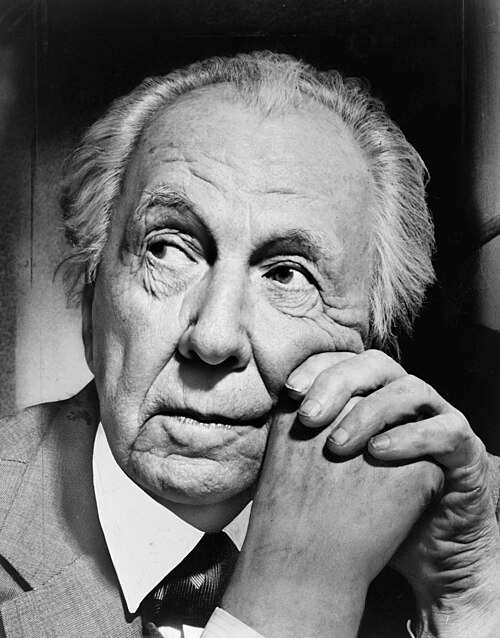
Frank Lloyd Wright Sr. was an American architect, writer, educator, and designer who created over 1,000 structures in a 70-year career. He’s known for his philosophy of “organic architecture,” which aimed to integrate buildings with nature and their inhabitants. Wright’s work was inspired by technology and nature, and he used innovative materials and structural forms to reflect the US’s diverse geography. (Wikipedia.org)
War is a timeless force in the human imagination—and, indeed, in daily life. Engaged in the activity of destruction, its soldiers and its victims discover a paradoxical yet profound sense of existing, of being human. In A Terrible Love of War , James Hillman, one of today’s most respected psychologists, undertakes a groundbreaking examination of the essence of war, its psychological origins and inhuman behaviors. Utilizing reports from many fronts and times, letters from combatants, analyses by military authorities, classic myths, and writings from great thinkers, including Twain, Tolstoy, Kant, Arendt, Foucault, and Levinas, Hillman’s broad sweep and detailed research bring a fundamentally new understanding to humanity’s simultaneous attraction and aversion to war. This is a compelling, necessary book in a violent world.
James Hillman (1926-2011) was an American psychologist. He served in the US Navy Hospital Corps from 1944 to 1946, after which he attended the Sorbonne in Paris, studying English Literature, and Trinity College, Dublin, graduating with a degree in mental and moral science in 1950.
In 1959, he received his PhD from the University of Zurich, as well as his analyst’s diploma from the C.G. Jung Institute and founded a movement toward archetypal psychology, was then appointed as Director of Studies at the institute, a position he held until 1969.
In 1970, Hillman became editor of Spring Publications, a publishing company devoted to advancing Archetypal Psychology as well as publishing books on mythology, philosophy and art. His magnum opus, Re-visioning Psychology, was written in 1975 and nominated for the Pulitzer Prize. Hillman then helped co-found the Dallas Institute for Humanities and Culture in 1978.
Retired into private practice, writing and traveling to lecture, until his death at his home in Connecticut on October 27, 2011 from bone cancer.
Dual aspect monism is a philosophical theory stating that mind and matter are not two distinct substances, but rather two complementary, inseparable aspects of a single, underlying reality. This fundamental, “psychophysically neutral” reality is neither inherently mental nor physical, but acts as a foundation from which both emerge. Wikipedia +5
Key Aspects of Dual Aspect Monism:
Fundamental Unity: Unlike dualism, it posits only one “stuff” or substance, known as the unus mundus (united world) in the Jung-Pauli scheme or the implicate order in Bohmian mechanics.
Irreducibility: Neither mind nor matter can be reduced to the other, nor can the underlying reality be reduced to either aspect.
Complementarity: Mind and matter are seen as two ways of looking at the same thing, similar to how a coin has two sides, or how quantum objects behave as both waves and particles.
Historical and Modern Context: While rooted in Spinoza’s philosophy (where one substance has two modes: thought and extension), it is a modern approach in the philosophy of mind, adopted by thinkers like David Chalmers, Wolfgang Pauli, and Carl Jung to bridge consciousness and physics. Reddit +4
Differences from Other Views:
Vs. Physicalism: Rejects that everything is fundamentally material.
Vs. Idealism: Rejects that everything is fundamentally mental.
Vs. Dualism: Rejects that mind and body are two separate substances that somehow interact. Wikipedia +4
This view offers a way to avoid the “hard problem” of consciousness by suggesting that subjective, mental experience and objective, physical activity are equally fundamental aspects of one reality. YouTube +1
In a book now marked by both critical acclaim and cross-cultural controversy, Jeffrey J. Kripal explores the life and teachings of Ramakrishna Paramahamsa, a nineteenth-century Bengali saint who played a major role in the creation of modern Hinduism. Through extended textual and symbolic analyses of Ramakrishna’s censored “secret talk,” Kripal demonstrates that the saint’s famous ecstatic and visionary experiences were driven by mystico-erotic energies that he neither fully accepted nor understood. The result is a striking new vision of Ramakrishna as a conflicted, homoerotic Tantric mystic that is as complex as it is clear and as sympathetic to the historical Ramakrishna as it is critical of his traditional portraits.
In a substantial new preface to this second edition, Kripal answers his critics, addresses the controversy the book has generated in India, and traces the genealogy of his work in the history of psychoanalytic discourse on mysticism, Hinduism, and Ramakrishna himself. Kali’s Child has already proven to be provocative, groundbreaking, and immensely enjoyable.
“Only a few books make such a major contribution to their field that from the moment of publication things are never quite the same again. Kali’s Child is such a book.”—John Stratton Hawley, History of Religions
Winner of the American Academy of Religion’s History of Religions Prize for the Best First Book of 1995
New Thinking Allowed with Jeffrey Mishlove Streamed live 2 hours ago Glenn Aparicio Parry, PhD, is author of Original Thinking: A Radical Revisioning of Time, Humanity, and Nature. He is the founder and director of the Circle for Original Thinking, a think tank based in Albuquerque, New Mexico. He was also given the name Kizhe Naabe (Ojibwe for “Kind-Hearted Man”) and is author of Original Politics: Making American Sacred Again. His newest book is Original Love: The Timeless Source of Wholeness. Glenn is offering an online seminar on April 9 – 30, four Thursdays, 10 am – 1 pm, MDT. See https://glennaparicioparry.com/events…
Nature lives in constant competition. In an ongoing bid for survival, each plant strives to encroach upon any available tract of land, capture any available drop of water, and reach up to any available ray of sunlight. This indiscriminate growth and expansion is the only way to avoid extinction…
April
Attention
Because essence is inborn while personality forms during childhood, we can understand the state of essence more clearly by observing little children. To a child, everything appears fresh and curious. Everything they see and experience penetrates them deeply and leaves a lasting impression. Their intellectual ability to name what they are experiencing is as yet undeveloped, so when they see a blade of grass they do not know to call it ‘grass’. For them, it may just as well be a miniature skyscraper perfectly placed in an endless green metropolis. A tree is not yet a ‘tree’; it is a jungle-gym, an apartment complex for birds, or an infinite array of other possibilities. A bird is a miracle of iridescent feathers, spectacular in motion and song. As the child progresses towards adulthood, seeing is gradually replaced by knowing, and essence becomes covered with an ever-thickening coat of personality. What they experience no longer penetrates directly as it did before, but is filtered through association, comparison, and criticism—if it is noticed at all. Comparing the state of children to adults we see that essence absorbs and personality deflects. Understanding this in turn instructs the direction of our farming. To weaken personality and strengthen essence, we will have to absorb more and deflect less—and we absorb through paying attention.
Attention functions mysteriously. It captures, in a fixed field, matter or energy, which without attention would diffuse indefinitely. When we sit on a bench in a park, the objects in our surroundings are there all the time—the grass, the trees, the chirping birds—but as long as we are not paying attention to them, then for us they do not exist. Once we do pay them attention, they not only come to life for us, but also influence us with new perceptions and emotions. Our essence feeds on these impressions, just as our body feeds on physical food. To demonstrate this, our April farmer holds up two seedlings, one wilted and the other healthy. A healthy leaf feeds on sunlight just like essence feeds on impressions. It fixes electrical energy into cellular matter just as essence absorbs impressions and is influenced by them. The sunlight is always there; it is up to the leaf to make use of it. Impressions are always there; it is up to us to absorb them by paying attention. This means that it is within our power to influence our essence through directing our attention.
One effective method we use for putting this into practice is the Looking Exercise. For the duration of a minute, we take in one visual element after another in our immediate environment. By ‘taking in’, we mean perceiving what we are looking at without attaching a verbal association to it. The challenge here is to stay with each impression long enough to absorb it, but not so long as to allow our thinking function to generate associations to what we are seeing. For example, while sitting in the park, look at the bench, then the grass, then a tree, then birds in flight—aiming to actually see them, rather than merely register they are there. The aim is to force ourselves to favor the impressions around us over our habitual associations or daydreaming. One big advantage of this method is that it can be exercised anywhere. This in itself is a lesson that helps dissolve the illusion that our internal efforts require favorable conditions.
If, indeed, we do observe that taking in impressions brings about a tangible shift in our internal landscape, with a crescendo of emotions, this in itself is no small revelation. We have found a way to weaken personality and feed essence that is almost always applicable. Very few situations in everyday life favor essence over personality. We have found a way to begin reversing this. At any time we can make an effort to absorb—to see what is before us, to feel our body pressing against our chair, to favor listening to others over the urge to speak—and in so doing, we revitalize the wilted leaves of our essence.
This is the labor of April.
ABOUT THE SCHOOL Our projects are undertaken with the understanding that a school must give back. It must harness the talent and resources of its members to form an expression that can outlast them.Learn more about the School of the Old New Method
WATCH AN INTRODUCTORY WORKSHOP Learn more about the Old New Method – Watch recordings of our online gatherings that introduce the knowledge and practical methods we use.Available through purchase. View Workshops ABOUT THE FOUNDER I had no structural foundation at my disposal, no institution, no location, no following—only the conviction that these truths were pertinent to contemporary seekers… Drawing inspiration from the agricultural metaphor embedded in ancient wisdom, I arranged the central concepts into twelve monthly labors, creating a yearly cycle of symbolic cultivation tasks… Soon, a hundred people committed to practicing this cyclical teaching on a regular basis. This was the beginning of my school.”Read the full autobiographical note by Asaf Braverman ABOUT THE TEACHING Nature develops us only up to a certain point and then leaves us unfinished, just as it creates wheat but not bread, milk but not butter, grapes but not wine…Learn more about our teaching
On March 28th, 2026, Saturn in Aries is sextile Pluto in Aquarius. Saturn is at 5° Aries, and Pluto at 5° Aquarius.
Aspects between slow-moving planets like Saturn and Pluto are always important because they shape the larger direction things are moving in.
It’s these big, underlying influences that affect every single one of us, whether we’re aware of them or not.
When we think of Saturn and Pluto, we usually reduce them to generic keywords like discipline and systems (Saturn), or long-term transformation (Pluto).
Which is all correct – but if we want to understand what’s really being set into motion, we need to go one layer deeper and look at the larger story that is unfolding.
The Larger Saturn-Pluto Cycle: 2020-2033
This sextile is the first aspect in the current Saturn-Pluto cycle that started in January 2020.
Yes, that conjunction astrologers had been warning about for years, and which we now associate with Covid and all the mayhem that followed.
That conjunction was in Capricorn, a sign associated with institutions, structures, and authority.
When Saturn conjuncted Pluto, institutions tightened. Systems became more rigid. Structures were reinforced. These were all very literal expressions of Saturn and Pluto in Capricorn.
But if we focus only on these surface-level manifestations, we miss what Saturn and Pluto actually set into motion.
The same forces that triggered the institutional response – the control, the restrictions – ALSO activated something else: the individual taking responsibility for their own life.
The events around the beginning of this Saturn-Pluto cycle in 2020 made us reassess what really matters. Priorities shifted. Many of us started working from home. Many of us changed careers.
And what initially felt like a crisis response gradually became something else – an opportunity to reorganize our lives in ways more aligned with who we are.
This is also perhaps the first time when people at large began to question “the system” – and seriously consider what it would mean to step outside of it.
And of course, a big part in this shift was played by another important transit that followed Saturn-Pluto: the Jupiter-Saturn conjunction at 0° Aquarius in late 2020.
However, Saturn-Pluto in itself set a new cycle of authority into motion – initiating a 33-year cycle that fundamentally reshapes how power, control, and responsibility are structured.
What’s important to keep in mind with conjunctions is that they are the “point zero”, the seeding of the cycle. This is when something new is planted, but we don’t yet see what it will grow into. That takes time.
What actually unfolds – what grows from that seed – is only revealed in the subsequent phases of the cycle, as the 2 planets begin to interact through aspects: first the sextile, then the square, then the opposition, and so on.
Saturn And Pluto – Reconfiguration Of Systems
The Saturn-Pluto sextile this month is the first real aspect following the Saturn-Pluto conjunction in 2020.
Saturn represents the systems our world operates under – anything from books and online directories (systems that store information), to roads, infrastructure, the way we structure our time, and how we run our work.
Saturn is how the 3D world we live in is organized and operates.
Pluto, as the outermost planet in our solar system, represents the principle of transformation.
Whenever a 3D Saturn system reaches a point where it is no longer productive, becomes outdated, or starts to break down, Pluto – this ‘invisible hand’ – steps in to make the necessary adjustments.
So when this Saturn-Pluto cycle started in 2020, it initiated a new way of organizing reality, rooted in the societal changes that unfolded at that time.
Many focused on the restrictive side of Saturn – the control, the institutionalization, the top-down decision making. But this overlooks the role Pluto was playing in the background.
… the more Pluto intensifies its response and stress-tests the system.
Counterintuitively, what is used to control and tighten things even further has the opposite effect.
It’s a law of nature: when a system feels threatened, it tightens its grip. The impulse is to become even more controlling, even more rigid.
Saturn And Pluto – When Control Becomes The Breaking Point
But then something shifts.
The very attempt to enforce control starts to raise questions.
“Wait a minute… something doesn’t add up.” “Why go to such lengths?” “What is really going on here?”
A sense of distrust naturally emerges when something is pushed too forcefully, when the need to control becomes too visible.
The more we try to convince, the harder the message is to believe.
People simply stop buying into it.
Sometimes there is a clear turning point, but in most cases – and as we’ve seen across cycles – these shifts happen gradually. Cycles don’t collapse overnight; they naturally grow out of what no longer resonates.
Saturn Sextile Pluto – The Quiet Exit
People stop participating. They disengage. They step away from a narrative that is no longer convincing, from something that has lost its appeal.
This has already been happening in the past years in many areas.
Take media and communication. Before the rise of the internet and alternative media, most people relied on a limited number of ‘sources of truth’ – institutionalized, centralized, easy to control.
Slowly but surely, these traditional channels started to lose their legitimacy.
In parallel, alternative media began to offer more options. Forums. Comment sections that, even when moderated, still allow different perspectives to slip through. Podcasts. Private channels.
It was the growing dissatisfaction with the old that created the space – and the demand – for these new forms to emerge.
These developments unfolded in parallel.
First, a small number of people disengaged, while the first alternative media platforms became available and started to gain traction.
Then more and more people disengaged. Fewer and fewer people watched TV and traditional media, and more and more people turned to podcasts or private channels.
It didn’t happen in one big moment where people said “I quit.” They simply shifted their attention.
When we stop participating in a system that is no longer convincing, alternatives naturally emerge and grow.
And this is what the sextile is about – the first opening where something new can begin to take shape alongside what is no longer working.
Saturn Sextile Pluto – When Options Start To Appear
In the Hero’s Journey, the sextile is the first major aspect after the conjunction – the moment when the Hero, once embarked on the journey, begins to receive help.
A mentor appears. An animal companion. A clue. Something that might be easily overlooked, but proves instrumental.
With the sextile, nothing dramatic happens. But this is when options start to appear.
And while we might not always recognize their relevance, paying attention – engaging with the archetypal ‘3rd house’ energy of the sextile – allows us to notice them.
The principle is simple, and it’s something people across time and cultures have recognized: when we commit to a new path, support begins to show up.
Not all at once, not in obvious ways – but through small openings, signals, and opportunities that invite us to move forward.
Saturn In Aries Sextile Pluto In Aquarius
So how might this play out with Saturn in Aries sextile Pluto in Aquarius?
First and foremost, Saturn in Aries brings responsibility back to the individual. With Saturn in Aries, authority is no longer something we can look up to. WE are the authority.
And while the idea that there’s no one out there who can save us can feel daunting at first, it’s also very liberating. If there’s no one out there, it means it’s up to us. And this is something we CAN control.
Pluto in Aquarius, on the other hand, speaks of transformation at the level of systems – decentralizing concentrated power structures and redistributing power across networks.
In 2024, Pluto moved out of Capricorn, entering Aquarius. Think of Capricorn as the main artery – centralized, structured, controlled. And Aquarius as the network of smaller vessels, distributing resources, information, and energy in all directions.
The Waterbearer (Aquarius) takes what the Sea Goat (Capricorn) has concentrated at the top of the mountain and pours it back into the system.
And this is exactly what begins to happen now when the Aries-Aquarius energies are being activated.
With Saturn sextile Pluto in Aries-Aquarius, people come together in new ways, finding alternative ways to connect, collaborate, and build.
Parallel systems begin to form – systems that allow for a more distributed and more sustainable way of organizing reality.
However intense reality may appear right now – there are clear signs that the systems and structures we’ve relied on are on the verge of breaking down.
The new is already emerging, and we are in that in-between phase where there is the most chaos, the most uncertainty, but also the greatest opportunity.
With every choice we make – the food we buy, the type of content we consume, where we spend our money – we either reinforce the old structures OR help bring something new into being.
The Saturn-Pluto sextile is about recognizing that in every crisis, opportunities – by design – inevitably emerge.
What changes things is what we choose to engage with.
The old only disappears when we stop feeding it. And the new takes shape every time we choose it.
Subscribe To Future Updates
If you want to keep up with the future transits, make sure you subscribe to Astro Butterfly’s weekly newsletter.
Two of today’s maverick authors on anomalous experience present a perception-altering and intellectually thrilling analysis of why the paranormal is real, but radically different from what is conventionally understood.
Whitley Strieber ( Communion ) and Jeffrey J. Kripal (J. Newton Rayzor professor of religion at Rice University) team up on this unprecedented and intellectually vibrant new framing of inexplicable events and experiences.
Rather than merely document the anomalous, these authors–one the man who popularized alien abduction and the other a renowned scholar and “renegade advocate for including the paranormal in religious studies” ( The New York Times )–deliver a fast-paced and exhilarating study of why the supernatural is neither fantasy nor fiction but a vital and authentic aspect of life.
Their suggestion? That all kinds of “impossible” things, from extra-dimensional beings to bilocation to bumps in the night, are not impossible at rather, they are a part of our natural world. But this natural world is immeasurably more weird, more wonderful, and probably more populated than we have so far imagined with our current categories and cultures, which are what really make these things seem “impossible.”
The Super Natural considers that the natural world is actually a “super natural world”–and all we have to do to see this is to change the lenses through which we are looking at it and the languages through which we are presently limiting it. In The extraordinary exists if we know how to look at and think about it.
American writer best known for his novels The Wolfen,The Hunger and Warday and for Communion, a non-fiction description of his experiences with apparent alien contact. He has recently made significant advances in understanding this phenomenon, and has published his new discoveries in Solving the Communion Enigma.
Strieber also co-authored The Coming Global Superstorm with Art Bell, which inspired the blockbuster film about sudden climate change, The Day After Tomorrow.
His book The Afterlife Revolution written with his deceased wife Anne, is a record of what is considered to be one of the most powerful instances of afterlife communication ever recorded.
(Goodreads.com)
Consciousness, sexuality, androgyny, futurism, space, the arts, science, astrology, democracy, humor, books, movies and more