Long before he became the world’s most beloved neurologist, Oliver Sacks was a twenty-seven-year-old medical resident on his first hospital post when an operation left one of his patients with an unstoppable hiccup. Already a bridge figure between medicine and literature, he found himself haunted by a Somerset Maugham short story about a man who dies of hiccups after a woman casts a spell on him. Fearing his patient might suffer the same fate unless something jolted his brain out of the spasmodic loop, Oliver suggested something radical yet emblematic of what would become his lifelong gift for harmonizing the physiology of the body and the poetry of the mind: bringing in a hypnotist. His colleagues were skeptical bordering on scornful. But the patient had been hiccuping for six days straight and no medical intervention had worked. Oliver recounts in his magnificent more-than-memoir:
To our amazement, [the hypnotist] was able to get the patient “under” and then to give him a posthypnotic command:
“When I snap my fingers, you will wake up and no longer have hiccups.”
The patient woke up, free from hiccups, and they never recurred.
Why the strange mental intervention was so effective in abating this debilitating reflex of the body, and how it contours the most effective strategy for waking up from the trance of heartbreak, is rooted deep in our evolutionary history.
The spiral galaxy UGC 10214, known as Tadpole. (Photograph: Hubble Space Telescope)
A hiccup is an involuntary sharp inspiration of air as the epiglottis — the flap of skin in the back of the throat — shuts, producing the hic sound for which the spasm is named. Like our limbs carry the genetic blueprint of our dorsal fins, like our tailbones encode our primate ancestry, hiccups reminds us of where we came from. Although our basic neural infrastructure for breathing evolved from that of fish, the hiccup’s distinctive pattern of nerve and muscle activity is an inheritance from the tadpole stage of our amphibian ancestors. Tadpoles use both their gills and their lungs to breathe, pumping water into the mouth and across the gills but keeping it from entering the lungs by flapping the glottis to seal the breathing tube — one long hiccup.
Frontispiece of The Natural History of Fishes, Amphibians, & Reptiles, or Monocardian Animals, 1838.
While our bodies evolved beyond recognition from the tadpole, our brains maintained the neural circuitry of this dual process — most likely, to help nursing infants manage breathing and suckling simultaneously. The vestigial gills of human embryos are no longer present in most adults, but the neuroanatomy of gilled breathing remains and is activated by certain stimuli to cause hiccups — eating too much or too fast, drinking carbonated beverages, being exposed to a rapid temperature change, undergoing extreme stress.
This is why, despite the panoply of folk remedies and pop culture myths for stopping hiccups, ranging from backbends to biting into lemon, the most effective way is simply to reset the brain out of its evolutionary time machine by making a more complex demand of its neural circuits. (For me, doing a bit of calculus invariably stops a spell of hiccups.) Although physical interventions like controlled breathing can sometimes help, it is rather the cognitive demand they make with the focus they require that interrupts the spasms.
A paradox of the human animal is that while we have not fully outgrown the bodily vestiges of our evolutionary inheritance, we have also paid a heavy price for our growing mental complexity. (“Never say higher or lower,” Darwin scribbled in the margin of a natural history book, arguing with the author about the so-called higher animals. “Say more complicated.”) As we rose from the oceans and crawled onto the land, then climbed the trees to learn to be social, then back came down to walk upright beneath a canopy of one hundred trillion synapses, we became creatures capable of love, which made us capable of loss — this is the price of consciousness.
The experience of heartbreak — a recursive mental gasp for reciprocity that is no longer available, or perhaps never really was — is essentially an emotional hiccup: a spasm of thought that feels involuntary, interrupts healthy functioning, and causes debilitating discomfort you are unable to will away. Like the ceaseless hiccups of Oliver’s patient, it is abated only by a mental reset — by setting the mind on a different track of focus that demands enough of its cognitive resources to displace the loop of rumination. It hardly matters what it is — beginning an absorbing new project (this is what the bird divinations did for me), learning a new language or a new craft (this is how ceramics came into my life), training for a triathlon or taking up the cello or going down a delicious rabbit hole about the impossibility of bats or the invention of the bicycle or the chemistry of blue (this is how I wrote Traversal). What does matter is to remember that all feeling floats on a current of thought coursing through the brain at eighty feet per second. Divert the current and the charge of the feeling dissipates — perhaps not to perfect neutrality, but to something bittersweet and bearable, like the memory of childhood, like the body remembers its gills.
In March 2026, we are in full swing of eclipse season. On March 3rd, we have a Total Lunar Eclipse in Virgo, bringing culminations, adjustments, and very real-world consequences.
At the same time, we are still integrating the Saturn-Neptune conjunction at 0° Aries from February – the reset that marked the official beginning of a new era.
And yet, while the new era has technically begun, we are still processing the previous one. Pisces energy is still strong in March, with several planets lingering in the last sign of the zodiac.
This creates a very particular atmosphere – part closure, part ignition. We are standing with one foot in the ocean of the past, and the other already on dry land.
… then at the equinox, things heat up quickly – on March 20th, 2026, we have a rare concentration of 6 planets in Aries.
Later this month, we have an exact Saturn-Sextile Pluto.
But let’s take a look at the most important transits of the month:
March 3, 2026 – Full Moon And Total Lunar Eclipse in Virgo
On March 3rd, 2026, we have a Full Moon and Total Lunar Eclipse at 12° Virgo.
This is a South Node Eclipse, bringing to culmination themes that have been running in the background. In Virgo, this can show up as outdated systems, perfectionist habits, or responsibilities that no longer make sense in the context of where we are heading.
The Eclipse is sextile Jupiter, so despite the usual intensity associated with eclipse season, there is support available. There is a bigger framework that makes the adjustments easier to understand.
Not everything that ends is a loss – some things simply need to be reorganized.
March 6th, 2026 – Venus Enters Aries, Venus Conjunct Neptune And Saturn
On March 6th, 2026, Venus enters Aries, and from this moment on, it’s action time.
Venus is the first personal planet to activate 0° Aries, the point where Saturn and Neptune met in February – giving us a more personal taste of that larger reset.
On February 20th, Saturn and Neptune planted a seed. Now, when the personal planets start crossing that degree, we begin to understand what that seed actually means for us, personally. The collective shift becomes individualized.
And when we talk Venus, we talk values – what matters to us, what we desire, what we are willing to invest energy in.
Out of all the possibilities that have opened up, what truly resonates? What feels aligned with who we are now, not who we used to be? What does not only sound good on paper, but actually feels right?
March 7th, 2026 – Sun Conjunct Mercury
On March 7th, 2026, the Sun is conjunct Mercury retrograde at 16° Pisces, marking the beginning of a brand new Mercury cycle which sets the direction for the next 3-4 months.
The Sun-Mercury conjunction – like any conjunction – is a seed moment. It’s that “chemical reaction” where 2 planets come together and initiate something new. With the Sun and Mercury, this points to a new cycle of clarity around identity and purpose.
This conjunction also trines its ruler Jupiter, now at 15° Cancer, which adds support and coherence to the process.
If you have a project in mind – something related to your purpose, healing, improving relationships, or simply bringing a new idea into the world – this new Mercury cycle is especially supportive. The soil is receptive, and the timing is constructive.
March 11th, 2026 – Jupiter Goes Direct
On March 11th, 2026, Jupiter stations direct at 15° Cancer. From this point onwards, Jupiter will move forward quite quickly through Cancer, entering Leo already at the end of June.
We have 4 more months of Jupiter in the sign of its exaltation. This month, the planets in Pisces apply trines, one by one, to Jupiter, creating flow and support and helping things move forward more naturally.
Let’s enjoy it while it lasts.
March 14th-17th, 2026 – Mercury Conjunct Mars Conjunct North Node
Between March 14th and March 17th, we have a powerful triple conjunction: Mercury retrograde and Mars both activate the North Node, now at 8° Pisces. On March 15th we have the exact Mercury-Mars conjunction at 9-10° Pisces.
When the planet of the mind (Mercury) meets the planet of action (Mars), we not only think or talk about something – we act on it. We say what we mean. We walk the talk. We go for it.
And when we go for it, we don’t just go in any direction. With the North Node involved, the focus is aligned with where we are meant to grow, with the path of our destiny.
March 19th, 2026 – New Moon In Pisces
On March 19th, 2026, we have an auspicious New Moon at 28° Pisces. The New Moon is conjunct Neptune and Saturn (now in the early degrees of Aries) and is exactly sextile Uranus in Taurus.
This New Moon can help us see how exactly we can bring a dream – or something we never thought would actually materialize – into reality, in one way or another.
The outcome may not be exactly how we originally imagined it. Saturn and Neptune are now in Aries, so the expression is different from the Pisces version of the dream.
But it will nevertheless be an expression of something authentic, something that has been building for a long time and is now ready to take form in a more concrete way.
March 20th, 2026 – Sun Enters Aries
On March 20th, 2026, the Sun enters Aries. Happy birthday to all Aries out there – and happy new astrological year to everyone!
Just like Venus earlier in the month, soon after entering Aries the Sun will conjunct both Neptune (on March 21st) and Saturn (exact on March 25th).
Now we’re talking. THIS is the real beginning of a new cycle – a new hero or heroine’s journey.
The Sun’s ingress into Aries marks that threshold moment when we shift from waiting for things to happen “out there” to making things happen ourselves.
Aries in general – and particularly 0° Aries – carries that primordial ignition energy, generating incredible momentum. This is pure birth energy!
March 20th and the days that follow are particularly important for articulating and gaining clarity around your purpose. This is a time to make a commitment. From this point onwards, there’s no turning back to the old version of you.
March 21st, 2026 – Mercury Goes Direct
On March 21st, 2026, Mercury goes direct at 8° Pisces, clearing some of the mist that always gathers in the last sign of the zodiac.
But if we are really honest, sometimes we like getting lost in the fog. Call it daydreaming, creative wandering, or simply taking some time off – and “off” is a very Mercury-in-Pisces word.
Sometimes we need that silence, that drifting, that space where things are not sharply defined, in order to reconnect with ourselves and what actually matters.
As Mercury moves forward again, the insights gathered during the retrograde begin to crystallize. What was vague starts to make more sense.
March 26th, 2026 – Venus Conjunct Chiron In Aries
On March 26th, 2026, Venus is conjunct Chiron at 25° Aries, reminding us where there is still healing to be done, where there is still acceptance needed around the “I am.”
But we have come a long way. In the past 7 years, while Chiron has been in Aries, every single year we have gained a little more self-understanding, a little more courage to stand in who we are.
Believe it or not, this is the very last Venus-Chiron conjunction in Aries, at least for the next 43 years or so.
Venus conjunct Chiron will bring one final breakthrough in how we relate to ourselves – and a deeper recognition that we are enough as we are.
March 28th, 2026 – Saturn Sextile Pluto
On March 28th, 2026, Saturn (at 5° Aries) is exactly sextile Pluto (at 5° Aquarius). This is a subtle, yet constructive transit suggesting that deeper structural changes are starting to gain practical support.
Saturn brings discipline and implementation. Pluto brings systemic transformation. The sextile between them suggests that the world may begin putting some operational plumbing in place.
Conversations around infrastructure – perhaps something connected to energy, systems, or strategic alliances – could start moving from idea to execution.
This is not loud or dramatic. But it is functional. And sometimes that is exactly what is needed for real change to take hold.
March 30th, 2026 – Venus Enters Taurus
On March 30th, 2026, Venus enters her sign of domicile, Taurus.
Picture Aphrodite in the Hanging Gardens of Babylon – pure, effortless beauty rooted in nature.
Even if we do not naturally connect with Venus from this more earthy, sensual angle – and that depends, of course, on our own natal chart wiring and current transits – every time Venus is in Taurus, the atmosphere shifts a little bit.
The world feels a little more grounded, a little more tangible, and a little more beautiful.
Aspects And Aspect Patterns 1-Year Program
On March 3rd, 2026 – yes, at the Lunar Eclipse sextile Jupiter – we are starting our 1-year course on Aspects and Aspect Patterns.
Aspects are the connective tissue of the chart – what brings the different parts of the chart to life. Aspects are the most real and tangible part of astrology, because aspects are nothing else but the movements of the planets in the sky.
The Astro Butterfly blog – the transit report – is simply a snapshot of the aspects planets makewith each other in a given period of time, in this case one month.
And our natal chart is nothing else but a picture of the sky at the time of our birth, when planets were configured in particular aspects with each other.
When we understand how planets communicate with each other through aspects,3 important things happen:
We understand ourselves better. All our internal conflicts in life come from the fact that there are parts of us – parts of our psyche – that don’t fully understand each other. When we understand our aspects – properly, not with Google or computer-generated reports – we begin to see how those parts are wired together. We find acceptance. We find wholeness. We start fully living.
We understand the world better. We begin to see how the energies of the moment are a reflection of the dance of the planets in the sky through aspects. With time, life becomes less of a mystery. We understand that events are part of larger cycles, and that everything fits into a broader framework.
And most importantly, when inner understanding meets outer reality, we find alignment. We understand how we are meant to participate. We find our place in the world.
Astrology is one of the most wonderful tools for awareness and growth when we use it properly.
Aspects And Aspect Patterns is a 1-year journey into the language of aspects and aspect patterns – how they shape who we are, how they show up in the world around us, and how understanding them helps us live in alignment with both.
You can learn more about the program and enroll here:
Just before the eleven-year-old Walt Whitman dropped out of school to begin his first job, his parents diverted a portion of their meager working-class means toward a subscription to the radical paper The Free Enquirer, inspired by The Enquirer published by the radical philosopher William Godwin — Mary Shelley’s father — a generation earlier and an ocean over.
The prospectus of The Free Enquirer promised:
While there is no doctrine so sacred that we shall approach its discussion with apprehension, there is none so extravagant that we shall treat its expression with contempt… We will reject no creed but the creed of force, nor any system of morality but that which teaches intolerance.
One half of that we was the Scottish-born, newly naturalized radical reformer Fanny Wright. “She possessed herself of my body and soul,” Whitman would recall of her in the final years of his life, adding that he “never felt so glowingly towards any other woman.” He would remember her as “a brilliant woman, of beauty and estate, who was never satisfied unless she was busy doing good—public good, private good,” a woman “whose orbit was a great deal larger” than those of her contemporaries — “too large to be tolerated long by them,” rendering her “one of the best in history though also one of the least understood.”
Fanny Wright
Born into a well-off freethinking family in Scotland in 1795, Frances Wright was still a toddler when she lost her father, her mother, and her only brother in close succession. No inheritance is large enough to recompense the loss that savages a child orphaned at so tender an age, but the inheritance Fanny and her surviving younger sister received contoured a different possibility of life than was granted most orphans. Into that possibility Fanny sketched in a life of uncommon courage and action.
Raised in England by an eighteen-year-old aunt who introduced her to the ideas of French materialism and bruised her with the temperamental lashes of a teenager, Fanny returned to Scotland at sixteen to live with a great-uncle — a professor of moral philosophy who vehemently opposed the slave trade and who now held the chair Adam Smith had held a generation earlier at the University of Glasgow, heralded as the academically commensurate but more progressive counterpart to Oxford and Cambridge. Taken with Fanny’s restive intellect, the university librarian risked his job to grant her full access to one of Europe’s most lavish repositories of knowledge. Fanny — tall, slender, muscular, with a firm step and large, forthright blue eyes awned by short, curly chestnut hair — sought out everything she could about the history of the United States, spending the leaden Scottish winters immersed in the ideals of the New World and the emerald summers roaming the ancient Highlands with her sure-footed stride, dreaming about the democratic vistas of the American experiment in government that had captivated her moral and political imagination.
She was eighteen when she composed A Few Days in Athens — an imaginative fictional translation of a lost ancient Greek manuscript. At the heart of her lyrical, thoroughly original novel is an admonition against self-righteousness and a clarion call for justice, tolerance, and moral discipline, advancing the Epicurean philosophy of atomic realism, which for many centuries was misunderstood as a philosophy of pleasure but is, in fact, predicated on a moral framework that the young Wright encapsulated perfectly:
In the pleasure, — utility, — propriety of human action — whatever word we employ, the meaning is the same — in the consequences of human actions, that is, in their tendency to promote our good or our evil, we must ever find the only test of their intrinsic merit or demerit.
Epicurus from an 1813 engraving by Anthony Cardon. (New York Public Library)
Much of what the world remembers of Epicurus — the first of the Greek philosophers to admit women as his students — has come to us on the wings of poetry. A quarter millennium after him, the Roman poet Lucretius grew enchanted with the Epicurean vision of fathoming life through matter, introducing it to a Roman audience in his monumental book-length poem On the Nature of Things, which opened with an ode to Venus and went on to inspire millennia of minds: Isaac Newton and Thomas Jefferson, Mary Shelley and Mary Oliver. Channeling Epicurus, Lucretius wrote in the first century:
Nor was the mass of matter more compact nor ever set at wider intervals, for nothing increases and nothing perishes. Therefore the motion of the atoms themselves is the same now as it has ever been, and so hereafter will their motion be; and what has been born will evermore be born in the same way; will be, and will grow strong with strength as it is given by natural law. For nothing can ever change the sum of things; there is no hiding-place, nothing outside, no source-place where another power might rise bursting, to change the nature and course of things.
Epicurus and Lucretius were the original arithmeticians of the world, the poets of interdependence, singing the totality of things. Across the immense expanse of time and space, across the abyss of cultures and civilizations, Walt Whitman would rise as the next great poet of totality, with Fanny Wright as his formative influence. “What chemistry!” he would exult in the transmutation of life into death into more life in a poem titled “This Compost.” But it was Fanny Wright who revived the Epicurean materialist poetics in the golden age of chemistry. In an author’s note tucked toward the end of the novel, she crystallized its basic conceit:
How beautifully have the modern discoveries in chemistry and natural philosophy, and the more accurate analysis of the human mind — sciences unknown to the ancient world — substantiated the leading principles of the Epicurean ethics and physics — the only ancient school of either, really deserving the name.
Epicurus was largely influenced by Democritus, born a century earlier — the first person to formulate an atomic theory of the universe. In one of the handful of surviving fragments from his immense and influential body of work, Democritus personifies the senses and the intellect, staging between them an argument about the nature of reality. When the intellect scoffs that everything we perceive as blue or red, sweetness or bitterness, is just “atoms in the void,” the senses quip: “Poor intellect, do you hope to defeat us while from us you borrow your evidence? Your victory is your defeat.”
Epicurus seized upon this paradox to expose fundamental truths of human experience. Taking his ideas as a touchstone, Fanny Wright argued that everything from our happiness to our conceptions of right and wrong hinges on how well or poorly we understand “the position we hold in this beautiful material world.” She argued that “the elements composing all substances, so far as we know and can reason, eternal, and in their nature unchangeable; and it is only the different disposition of these eternal and unchangeable atoms that produces all the varieties in the substances constituting the great material whole, of which we form a part.”
She took care to keep materialism from slipping into reductionism — such a conception of nature’s phenomena, she added, “is not explaining their wonders, for that is impossible, but only observing them.” She placed the observation of external and internal phenomena at the center of our conscious experience, at the center of any understanding of the world calibrated by reality rather than taken on faith from doctrine and dogma. She argued — against the grain of her time, against the preoccupations of her age bracket — that moral philosophy is closer to science than to theology, for it concerns itself with the pursuit of truth and justice — a pursuit governed by observation and experiment:
Real philosophy is opposed to all systems. Her whole business is observation; and the results of that observation constitute all her knowledge. She receives no truths, until she has tested them by experience; she advances no opinions, unsupported by the testimony of facts; she acknowledges no virtue, but that involved in beneficial actions; no vice, but that involved in actions hurtful to ourselves or to others. Above all, she advances no dogmas — is slow to assert what is, and calls nothing impossible. The science of philosophy is simply a science of observation, both as regards the world without us, and the world within; and, to advance in it, are requisite only sound senses, well developed and exercised faculties, and a mind free of prejudice… Both as regards the philosophy of physics and the philosophy of mind, all is simply a process of investigation. It is a journey of discovery.
The science-minded Thomas Jefferson cherished A Few Days in Athens as “a treat… of the highest order.” It became a great influence on the young Whitman, who saw in it an emboldening testament to how powerful an instrument the poetic imagination could be for dismantling dogma, unfastening social strictures, and magnifying alternative possibilities for the realities we have taken as givens. “[The book] was daily food to me: I kept it about me for years,” he recounted in old age, urging the young in his orbit to read it. At the age Mary Shelley was when she composed Frankenstein, Wright wrote:
Knowledge… is the best riches that man can possess. Without it, he is a brute; with it, he is a god. But like happiness, he often pursues it without finding it; or, at best, obtains of it but an imperfect glimpse. It is not that the road to it is either dark or difficult, but that he takes a wrong one; or if he enters on the right, he does so unprepared for the journey.
[…]
All learning is useful, all the sciences are curious, all the arts are beautiful; but more useful, more curious, and more beautiful, is the perfect knowledge and perfect government of ourselves. Though a man should read the heavens, unravel their laws and their revolutions; though he should dive into the mysteries of matter, and expound the phenomena of earth and air; though he should be conversant with all the writings, and the sayings, and the actions of the dead… though he should do one or all of these things, yet know not the secret springs of his own mind, the foundation of his opinions, the motives of his actions; if he hold not the rein over his passions; if he have not cleared the mist of all prejudices from his understanding; if he have not rubbed off all intolerance from his judgments; if he know not to weigh his own actions, and the actions of others, in the balance of justice — that man hath not knowledge; nor, though he be a man of science, a man of learning, or an artist, he is not a sage.
Fanny Wright was twenty-three when she left Scotland and sailed for America with her sister. Aboard the ship, she composed a poem in which she declared her “daring hand and fearless soul,” a soul whose twin she saw in Lord Byron’s Childe Harold — a soul “as strange, as proud, as lonely from its birth — with powers as vast.”
In her studies, she had seen again and again how every political system aimed at justice and equality, from the dawn of democracy in ancient Greece to the French Revolution of her childhood, had fissured under the uneven weight of its stated ideals staked on moral imagination and their warped enactments aimed at profit and power. America was to her the oasis of optimism that stood a chance of making the ideal real, and so she set out to see for herself how the principles laid out in the Declaration of Independence were translating into practice. On America’s soil, she would soon prove herself to possess that rare and rapturous quality of resolve that sets the revolutionary apart from the mere rebel — a life devoted not only to exposing the roots of evil but to uprooting them, remedying the poisoned soil, and replanting lush ennobling alternatives.
Shortly after arriving in New York, she wrote, produced, and published a play about Switzerland’s fight for independence from Napoleonic rule, which Jefferson lauded for the way it granted “dignity and usefulness to poetry.” From there, Fanny and her sister traversed several thousand miles inland — two young women traveling unchaperoned across small towns and frontier hinterlands. She recorded her exuberant impressions in a series of letters to the erudite, radical, and charming Scottish relative who was the closest thing Fanny had to a mother figure — a woman who had lived in America in her youth and had encouraged the adolescent Fanny’s countercultural aspiration to be a woman of letters with the assurance to see herself as endowed with “the imagination, the temperament… of genius.”
1830s engraving of Fanny Wright by Charles Joseph Hullmandel after Auguste Hervieu. (Met Museum.)
Fanny exulted in the new frontiers of possibility in America, particularly around the one colossal issue on which she parted ways with the ancient Greeks: the Aristotelian assertion that men were the proprietors of reason and therefore the proprietors of women, whose reasoning faculty was inferior by nature. She saw America as Grecian in its democratic ideals but unencumbered by the limiting gender-role conventions of the old world — a new world where “women are assuming their place as thinking beings, not in despite of the men, but chiefly in consequence of their enlarged views and exertions as fathers and legislators.” But the reality of slavery — which had been only a political abstraction at the Scottish library — disquieted her, staggered her with its flagrant betrayal of this new nation’s founding principles.
Upon returning to Europe two years later, Fanny edited her transatlantic letters into what became one of the era’s most popular geopolitical bridges in literature: Views of Society and Manners in America — part travelogue, part memoir, part treatise of political philosophy. Luminaries and decorated revolutionaries on both sides of ocean and channel lavished her with commendations and invitations — Jeremy Bentham, Thomas Paine, Mary Shelley. Among them was the Marquis de Lafayette — a key figure in the French Revolution, who had been so moved by America’s struggle for independence that in the bad English he picked up along the way to Philadelphia, he had offered to serve, and did serve, without pay in the war, then helped draft one of the most influential documents of human rights in collaboration with Thomas Jefferson.
Through the portal of mutual admiration, across the gaping divide of language and nation and age, Fanny Wright and Lafayette became friends, then lovers. She wrote to him:
You marvel sometimes at my independent way of walking through the world just as if nature had made me of your sex instead of poor Eve’s. Trust me, my beloved friend, the mind has no sex but what habit and education give it, and I who was thrown in infancy upon the world like a wreck upon the waters have learned, as well to struggle with the elements as any male child of Adam.
Three years later, Fanny returned to America, this time with Lafayette, accompanying him on his twenty-four-state farewell tour of the country, witnessing his hero’s welcome at every stop, and staying with him at Jefferson’s home at Monticello. He was especially celebrated in New York, where he was invited to ceremoniously lay down the corner-stone of a new free library for youths and mechanics. From there, Fanny Wright parted from Lafayette to travel down the Mississippi River by herself before rejoining him in New Orleans. Along the way, she grew increasingly disquieted to see the country she had admired since girlhood as a pinnacle of democracy prop itself up on the backs of disenfranchised people.
When Lafayette headed back to Europe, she decided to stay and do what she could to help a young nation live up to the ideals that would build not just a new nation but a new world. Within a year — her thirtieth — she had become an American citizen and ridden horseback to Memphis to found an experimental colony on the banks of the Wolf River, devoted to preparing enslaved men and women for their self-earned emancipation and lifelong empowerment, devoted to rectifying the many ways in which America’s institutions fell short of its founding principles. She had identified slavery as the greatest hypocrisy in the American dream of democracy — the greatest fault line along which the new landmass of possibility could collapse into a failed experiment. She had conversed with many a slaveholder and managed to sway them on moral grounds but failed to weaken their attachment to the material profit they derived from slavery. And so she set out to make her counterargument empirically — to prove that an enslaved person could become a free person with no cost to society, and an intellectual equal worthy of citizenship.
In the experimental community, labor was divided among all the members, who were paid for their work, and the work schedules were structured so that portions of each day were devoted to education and the elevation of mind. Raised in the lap of European aristocracy, where most young people never learn to perform basic chores, Fanny labored shoulder to shoulder with her Black colleagues from dawn until nightfall, her Amazonian frame seen chopping wood and rolling logs up the Tennessee hills. Word of the community — which she named Nashoba, the indigenous Chickasaw word for “wolf” — soon spread across the continent and across the Atlantic.
When Fanny, having worked herself into physical collapse, became dangerously ill with malaria, her physician insisted that she take a break from the toil and the humid climate. She returned to England — partly to recover, but partly to recruit new allies for Nashoba. She met with Mary Shelley and left her longing to visit America for the blazing example of what a woman could achieve there, forever remembering “Miss Wright of Nashoba” as “the most wonderful and interesting woman I ever saw.”
But that is all Nashoba remained — a contour of possibility. The experiment struggled to flourish under a trying confluence of chance and callousness. Just as crop failure imperiled the community’s livelihood, it became known that Fanny had fallen in love with one of the Black women in the colony. Her critics squandered no time using the relation- ship against her, hurling incendiary public accusations of “free love” in the backwoods of the South. Fanny responded with dignity and reason, proposing that miscegenation, rather than a condemnable corruption of American society, was a necessary next step toward living up to America’s founding democratic ideals.
America was not ready — her supporters grew too frightened of being tarred with immorality by proxy and withdrew their support.
Having devoted years of her life and more than half of her material assets to the Nashoba experiment, Fanny dismantled the colony. It was decided that New Orleans would be the place for the Black Nashobans to resettle. She traveled with them to see to their safety, arranging for their housing and employment. She then headed to the country’s epicenter of culture to attack the problem at the root.
Fanny had come to see that prejudice — be it racism or sexism or the hostility to reality perpetrated by the religiously devout — was not the cause of the malady but a symptom of the malady: the American failure to rein in emotional quickenings with reason and discern fact from opinion. The remedy for unreason and unreality was science, is always science. Without science — without a framework for apprehending reality unsullied by human subjectivity — there can be no social justice.
In 1829, Fanny Wright moved to New York and purchased a former church in the Bowery. A generation after the French revolutionaries renamed Notre Dame “The Temple of Reason,” she converted the church into what she christened the Hall of Science — a space “uncontaminated and undistracted by religious discussion or opinionative dissensions,” devoted to examining facts rather than teaching opinions and making science the pasture of the many rather than the province of the few, devoted to the conviction that systematic advances in self-knowledge and the knowledge of reality are the only means for humanity to outgrow the childishness of religious superstition. The lectures she delivered there — impassioned, rigorously reasoned, rhetorically muscular speeches about universal access to education, about dismantling the docility of religious dogma, about women’s sexual freedom and reproductive rights, about the emancipation of slaves, about equitable divorce laws, about the necessity of being a reasoning creature and the inalienable right to be a human being among human beings no matter one’s gender, race, class, creed, or station — enveloped the city in a wildfire of scandal and wakefulness. They were the maturation and physical embodiment of the ideas she had first set forth in her Epicurean novel as a teenager, in which she had written:
In our search after truth, we must equally discard presumption and fear. We must come with our eyes and our ears, our hearts and our understandings open; anxious, not to find ourselves right, but to discover what is right; asserting nothing which we cannot prove; believing nothing which we have not examined; and examining all things fearlessly, dispassionately, perseveringly… There is no mystery in nature, but that involved in the very existence of all things.
Half a lifetime later, Fanny affirmed this animating ethos in her welcome speech at the Hall of Science opening ceremony, casting a farseeing eye on the potential — and pitfall — of the human mind and how the general practice of “teaching opinions,” rather than fostering critical thinking, “has tended to affect our species with a mental paralysis.” For two centuries, the antidote she offered would stand shelved and dust-coated in America’s apothecary of opinions:
The more we know, the less, in the popular sense of the word, do we believe. The better we understand the phenomena of nature in the visible and tangible world without us, and in the mental, moral, and physical world within us, the more just and perspicuous must be all our ideas. It is possible, indeed, to subvert, by process of reasoning, many human superstitions, and to confute by the ad absurdum many books, maxims, and statutes honored as wise, or worshipped as divine… to distinguish what in human practice is in violation and what in unison with the laws of our being.
Whitman would echo this countercultural invocation almost verbatim in the preface of Leaves of Grass, seeing himself, seeing poetry, as the great joiner of humanity. Fanny Wright saw science — this poetics of reality — as the mightiest binding agent for human divisiveness. Perched in time between the Transit of Venus expedition, which annealed a shared purpose in humanity for the first time, and Einstein’s insistence upon “the common language of science” amid a war-torn world, she exhorted:
Let us unite on the safe and sure ground of fact and experiment, and we can never err; yet better, we can never differ… The field of nature is before us to explore; the world of the human heart is with us to examine. In these lie for us all that is certain, and all that is important.
Relish more of Fanny Wright’s visionary life, and how it entwines with the lives of other visionaries as varied as Walt Whitman, Mary Shelley, and Frederick Douglass, in Traversal.
The Best Of – Home Of Classic Music Nov 1, 2012 Subscribe to The Best Of for more classic music history, videos and playlists: http://bit.ly/WdJ36u “My Generation” appeared on The Who’s debut album of the same name. It was released as a single on 5th November 1965, reaching No. 2 in the UK charts and 74 in the US. “My Generation” was recently named the 11th greatest song by Rolling Stone magazine on their list of the “500 Greatest Songs of All Time”. Like us on Facebook: / therealbestof Follow us on Twitter: / therealbestof Visit http://www.thewho.com for more information. Lyrics: People try to put us d-down (Talkin’ ’bout my generation) Just because we get around (Talkin’ ’bout my generation) Things they do look awful c-c-cold (Talkin’ ’bout my generation) I hope I die before I get old (Talkin’ ’bout my generation) This is my generation This is my generation, baby Why don’t you all f-fade away (Talkin’ ’bout my generation) And don’t try to dig what we all s-s-say (Talkin’ ’bout my generation) I’m not trying to cause a big s-s-sensation (Talkin’ ’bout my generation) I’m just talkin’ ’bout my g-g-g-generation (Talkin’ ’bout my generation) This is my generation This is my generation, baby Why don’t you all f-fade away (Talkin’ ’bout my generation) And don’t try to d-dig what we all s-s-say (Talkin’ ’bout my generation) I’m not trying to cause a b-big s-s-sensation (Talkin’ ’bout my generation) I’m just talkin’ ’bout my g-g-generation (Talkin’ ’bout my generation) This is my generation This is my generation, baby People try to put us d-down (Talkin’ ’bout my generation) Just because we g-g-get around (Talkin’ ’bout my generation) Things they do look awful c-c-cold (Talkin’ ’bout my generation) Yeah, I hope I die before I get old (Talkin’ ’bout my generation) This is my generation This is my generation, baby
I saw my life branching out before me like the green fig tree in the story. From the tip of every branch, like a fat purple fig, a wonderful future beckoned and winked.
One fig was a husband and a happy home and children, and another fig was a famous poet and another fig was a brilliant professor, and another fig was Ee Gee, the amazing editor, and another fig was Europe and Africa and South America, and another fig was Constantin and Socrates and Attila and a pack of other lovers with queer names and offbeat professions, and another fig was an Olympic lady crew champion, and beyond and above these figs were many more figs I couldn’t quite make out.
I saw myself sitting in the crotch of this fig tree, starving to death, just because I couldn’t make up my mind which of the figs I would choose.
I wanted each and every one of them, but choosing one meant losing all the rest, and, as I sat there, unable to decide, the figs began to wrinkle and go black, and, one by one, they plopped to the ground at my feet.
Author Unknown
AN OPPORTUNITY FOR DAILY REFLECTION BROUGHT TO YOU BY THE SCHOOL OF PRACTICAL PHILOSOPHY
The Katherine Mansfield Memorial Garden is a peaceful, oblong-shaped park set in the midst of Thorndon, in Wellington, New Zealand. It is named after the city’s most famous daughter, the short story writer Katherine Mansfield, whose work is widely read in France and Europe but has been slow to capture the attention of British and American readers and critics.
That is set to change this year, as the centenary of Mansfield’s death this month marks the beginning of a flurry of publications and reviews honoring the author of a prose style that Virginia Woolf envied (“I was jealous of her writing,” she wrote after Mansfield’s death, “the only writing I have ever been jealous of”) and whose stories established a prototype for the kind of short fiction in English we now take for granted.
Terms such as “slice-of-life” and in medias res may well be said to have been applied by Mansfield first: “Her work will always move closely against the grain of her own experience, but she will shake it free from the conventional plot, from the usual expectations.” writes Vincent O’Sullivan, editor of The Collected Letters of Katherine Mansfield.
Her stories plunge the reader into their midst and off we go: “And after all the weather was ideal.” “The week after was one of the busiest weeks of their lives.” “In the afternoon the chairs came.” From their first lines, the reader is brought right inside the fictional worlds which simply seem to open up and change as time passes—a method that Mansfield herself described as “unfolding,” introducing to literature a kind of free indirect narrative that traces the actions and minds of characters with such detail and nuance and sensitivity that she may as well be writing in invisible ink. “What form is it? you ask,” she wrote in a letter to the painter Dorothy Brett about her long short story “Prelude,” first published by the Woolfs’ Hogarth Press. “As far as I know it’s more or less my own invention.”
My mother loved the short stories of Katherine Mansfield, and she loved Thorndon.
Scholars and critics are in general agreement that Mansfield’s best work—“comparable with Proust’s breakthrough into the subconscious world,” said Frank O’Connor—are the so-called New Zealand stories: “so-called” for while they are set in places not actually named as Wellington or Days Bay, the small summer town across the harbor from that city, or Karori, a northern suburb that is the setting for “Prelude” and “The Dolls House,” they are nevertheless clearly drawing upon these places and others, a lansdcape and world Mansfield had been born into and grew up amongst.
She left New Zealand to pursue a life of writing alongside the Bloomsbury set—Lawrence and Joyce, the Woolfs and EM Forster and Bertrand Russell were her friends and readers—and never returned, though the country continued to work upon her imagination right up until the end of her short life. “I want for one moment to make our undiscovered country leap into the eyes of the Old World,” she wrote in her journal, returning over and over to her theme. “It must be mysterious, as though floating. It must take the breath.” She died from tuberculosis at the age of 34 in Fontainebleau, even in her last days writing to her father about “a turn towards home.” “If I began asking you questions about Wellington ways there would be no end to it,” she concludes.
Thorndon is the right place for the Memorial Garden, which is a stone’s throw from the house where Katherine Mansfield was born and grew up. Thorndon is where she went to school, took cello lessons, saw friends, and went to parties that were celebrated in stories such as “The Garden Party,” “The Singing Lesson,” and “A Birthday.” Thorndon was where she returned as a girl, after her first trip to London where her education was “finished” at Queen’s College in Harley Street, and from where she left again “for ever” as she said, just before she turned 20. “I am ashamed of young New Zealand,” she wrote in letters to London, “—oh the tedium vitae of 19 years!”
The Gardens are laid to grass, mostly, crisscrossed by small paths and with an enclosed area set to one side which has been planted with scented herbs and flowers for the blind; the names of which, marjoram and camomile and verbena, are formed in Braille along the stone wall and planters that shelter them. The fragrance these give off on a high summer’s day in Wellington would have been familiar to the writer who spent months of her adult life in the South of France, as well as in Italy and Switzerland, seeking a cure for the disease that had hounded her for most of her adult life.
At the other end of the Gardens is an avenue of cherry trees, giving the whole place a sense of scale beyond its actual dimensions, which comprise an area no longer or wider than a small city street. My parents were photographed on their wedding day standing under those trees; I have a black and white print of them together, my mother looking as though she is a figure on top of a marzipan iced wedding cake—her arms held out on either side of her bell-shaped skirt, her face tilted to the camera, and her little tiara with its veil set in place on her short helmet of shiny hair. My father beside her is tall and tentative in his dark suit, which seems to be the same shade of black as the trunks of the trees that fall in ranks behind him; he holds his new wife at her tiny waist as though he might protect her.
“I was jealous of her writing,” Woolf wrote after Mansfield’s death, “the only writing I have ever been jealous of.”
My mother loved the short stories of Katherine Mansfield, and she loved Thorndon. It is one of the oldest urban areas in New Zealand and full of (as Mansfield and my mother might have said) “charm.” The houses and buildings reflect their colonial past: planned and designed to follow the layout and architecture of streets and terraces “back home,” as people in New Zealand used to refer to Britain as late as the 70s, when I was growing up there. There are rows of workers cottages as well as the kind of detached two- and three-story mansions set in large gardens that you might see in London or Edinburgh, as well as family homes and shops and businesses with stained glass windows and heavy front doors.
My mother knew a great deal about colonial style, the lacy delicate trelliswork that decorated verandas and porches, the wide front steps and railings leading to hallways laid with kauri, a New Zealand redwood, and about the furniture, domestic wares, and paintings these houses had once contained. She collected “antiques,” as items no more than 100 years old were called in New Zealand then, and went to restoration and upholstery classes so that she could learn to restore the chairs and tables she collected, fit them out in the fabrics and finishes of their age.
Like Mansfield, whose stories contain the scenes and drawing room chatter of an Edwardian London even when located elsewhere, or who ascribes to her European settings a new-world sensibility that cuts through old-world class registers and niceties, my mother spent a great deal of her time thinking about what it was to imagine a somewhere else while being caught up in the reality of the present. Both liked to hold together the idea that one might simultaneously be here, and also, in some way, there.
So it was that Wellington, the capital city of a colonial outpost located in the Pacific Ocean, was imagined as part and parcel of an older place, of a Scotland or England; the country somehow part of Europe too. For Mansfield, the South of France would always remind her of Days Bay; for my mother, Days Bay was the South of France. They weren’t the only people to do this when I was growing up there.
A lot of us thought that way—going to schools with houses named after Scottish castles, dancing to the pipes at ceilidhs and Caledonian balls, singing “God Save the Queen” at sports days and in the cinema. It was no wonder that the here and the there might become merged in our minds. My sister and I used to imagine that over the bush-covered hills in the distance from our house were the avenues and streets of New York. It was just a case of making the journey over the Orongorongo ranges.
For my mother, Thorndon represented that “here and there” world completely. She was married in St Paul’s, where Mansfield went to church as a child, a white-painted wooden cathedral a five-minute walk from the Gardens where she was photographed. She sent my sister and me to a girls’ school that was around the corner from Mansfield’s birthplace and backed onto another street where her family had moved, just a block away from where Mansfield herself had been educated.
Does death fasten an imaginative idea more firmly to the mind, I wonder? I think in my case it might.
The Gardens were across the road from my sixth-form building, and as senior girls we were allowed to have periods off to go study and read there in the summer term. I remember precisely the feeling of hitching up our blue linen summer uniform dresses, socks rolled down and bare legs stretched out in the sun; tubes of Coppertone and baby oil being fished out of PE satchels while preparing for exams in Advanced Level English Lit; going through stories by Katherine Mansfield that were set just down the road and yet also seemed to be full of London and France. Art and life, life and art. The here and the there.
My mother would have loved the way both realities conjoined, the story and the experience, the fictions and the facts; how both seemed to be versions of each other in the Memorial Gardens that year. By the time exams came round and I was writing essays on “Bliss” and “Sun and Moon” and “The Voyage” that she’d read to me as a child, she’d been dead for nearly a year and I thought I was used to her absence. Her way of interpreting the world, though—that had stayed with me. The stories, after all, were still there.
Does death fasten an imaginative idea more firmly to the mind, I wonder? I think in my case it might. For try as I have over the years, I can’t help shift this notion of here and there thinking. It’s part of how I see a place, experience it, remember it, even. When my mother used to read aloud to me a Mansfield story set in a French Jardins Publiques, which seems to draw upon the Wellington Botanical Gardens, also in Thorndon, about a quarter mile from the much smaller Memorial Gardens, I can’t help but retain the impression that both real and invented parks are indeed one and the same. To arrive, as a child, at the big iron gates at the entrance of these and to make my way down the wide path with flowerbeds on either side to the rotunda was to follow Miss Brill to her seat to listen to the band play in the story named after her and to go where Mansfield herself had walked before her.
Reading about a place can be to feel as though one knows it, in the same way that to be in the place can remind us of its fictional counterparts. I remember my first time in New York, going through Central Park at dusk while the buildings lit up behind the winter trees: the exact color of that twilight; the lights coming on in apartments and offices; the view through the taxi window. How I seemed to be as much in a novel set in New York as I was in the backseat of a yellow cab. There are lots of places in the world that bring this sort of two-way vision.
Mansfield’s Thorndon is as real in her stories as it is also a part of the world I know so well. I walk down Tinakori Road, Thorndon’s main shopping street that still retains its 19th-century outlines despite the motorway that rushes alongside, and I might be a character in a section of “Juliet,” a very early draft of a story that might have become a novel. I might be in step with Mansfield herself as she and her brother in “The Wind Blows” “zigzag” down the path to the Pohutukawa tree that once stood at the water’s edge but is now on the reclaimed land where the bus stopped to take me home sometimes after school. In the photo of my parents on their wedding day, my mother’s hand rests on my father’s dark sleeve just as Leila imagines “the bolster on which her hand rested felt like the sleeve of an unknown young man’s dress suit” in “Her First Ball.” I wonder if my mother thought the same as she laid her hand there, all those years ago. I wonder who she was, that bride, that woman—and will never really know.
Yet reading about Katherine Mansfield helps me get just a little closer to my mother, her mind and imagination. Thinking about Mansfield’s work makes me understand again how literature is never just a story, a narrative, an event on the page to be read aloud to a child or silently to oneself alone. It is also an experience, caught up with the here and now along with memory and the past. For where were we when we read this novel or that one? Who were we talking with when we discovered this poet’s work or another’s set of short stories? Details of personal history are caught up and captured in the texts and pages and screens before us, and they become part of the story, part of who we are. Like the shadows cast upon the lawns and gardens of Mansfield’s stories, reminding us, as her stories always do, that presence and absence go together.
This January, the month of Mansfield’s death, is the August of Paris and New York in the southern hemisphere. Businesses close, schools are off, city streets are deserted, everyone is at the beach or away. Katherine Mansfield wrote her story “At the Bay” to capture exactly that feeling of time off—a family’s escape to its summer cottage, or “bach” as it is called in New Zealand—a story “full of sand and seaweed and dresses hanging over verandahs and sandshoes on windowsills,” a fiction based on family holidays that went on to influence Woolf’s famous novel To the Lighthouse.
Reading about Katherine Mansfield helps me get just a little closer to my mother, her mind and imagination.
When Mansfield died Woolf wrote in her diary, “At that one feels—what? A shock of relief? —a rival the less! Then confusion at feeling so little—then, gradually, blankness & disappointment; then a depression I could not rouse myself from all that day. When I began to write, it seemed to me there was no point in writing. Katherine won’t read it.”
In February and March—the beginning of the academic year in New Zealand—the schools will open up again and the girls in blue uniforms will return to my old College in Thorndon; they’ll lounge in the Memorial Gardens just as we used to do. Another year ahead, what will it bring? For Katherine Mansfield, this was always an exciting time, even in the depths of a northern hemisphere winter. Towards the end of 1922, she’d joined the esoteric Gurdjieff Institute for the Harmonious Development of Man at Fontainebleau-Avon in an attempt to understand herself, bring all the scattered “bits” of herself together and make peace with her illness.
The last diary entries describe her final acts of “here and there” thinking, as she put the small realities of her restricted life into a sort of dictionary she was creating. As O’Sullivan writes in his introduction to the last volume of The Collected Letters of Katherine Mansfield, “There is no detail so poignant and so simply indicative of the life she was attempting to remake, as the list of Russian words and phrases she was trying to learn: “I was late because my fire did not burn. The sky was blue as in summer…The trees still have apples. Apple…”
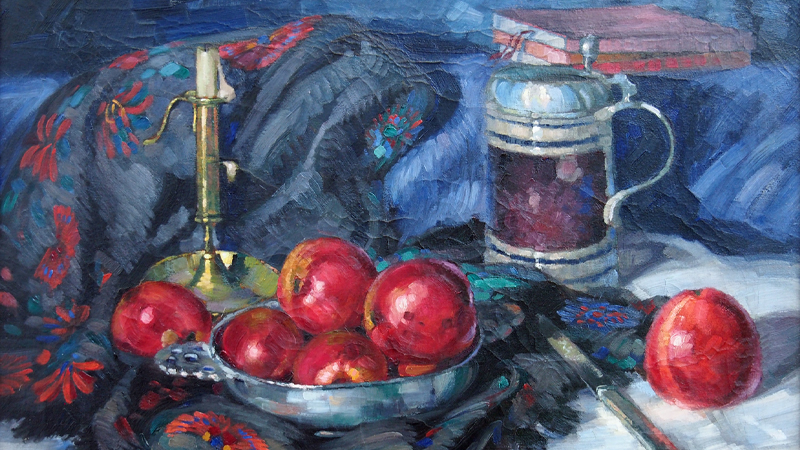
The word, the Russian equivalent—the fact and the kind of fiction that is also the fact of language, the imaginative gesture of Mansfield’s writing, turning one thing into another, seems—it really does seem in these last moments as I am reading them—to save her. “When I pass the apple stalls,” she had written to her friend Dorothy Brett back in 1917, “I cannot help stopping and staring until I feel that I, myself, am changing into an apple too—and that at any moment I may produce an apple, miraculously, out of my own being like the conjurer produces an egg,” a process, she finishes, “of becoming…so thrilling that I can hardy breathe.”
Like all writers who have left something behind them—a place or a person, a country, a home—the counterfeit, the version on the page, can become the real. I guess my mother, unknowingly, taught me that, but I don’t know that the idea would have stayed with me as powerfully and as long if she had not been taught it first by a writer she loved.
One hundred years ago today, Katherine Mansfield wrote a letter to her friend, the painter Dorothy Brett. In it, Mansfield waxed poetic on the beautiful day (it’s a cardinal rule that every letter must begin with the weather) and wrote about how deeply and instantly she connected with the subjects of her art, and how much she loved writing (including how much she loved getting positive feedback). “It’s not a case of keeping the home fire burning for me. It’s a case of keeping the home fire down to a respectable blaze and little enough. If you don’t come and see me soon there’ll be nothing but a little heap of ash and two crossed pens upon it.”
If you haven’t read her work, I think this letter might convince you to give her a try, but what I really can’t get over is how effusive she is; how in love with the world, how happy to be able to reflect it in prose. Only two months after this letter was written, when she was just barely 30 (her birthday is October 14th, by the way), Mansfield was diagnosed with tuberculosis. It would kill her before she was 35. But for now, she will write about ducks and swear she is a duck, and look at the shiny apples with such joy that she feels herself transforming. I have to admit, I feel a little bit transformed too.
My dear Brett,
It is a cold sharp day—I can see the sun flying in the sky like a faint far-away flag—My Japanese doll has gone into boots for the winter and the studio smells of quinces. I have to write all day with my feet in the fringe of the fire—and Oh Alas! it is sad to think that I shall be warm in front and cold behind from now until next June. It seems to me so extraordinarily right that you should be painting Still Lives just now. What can one do, faced with this wonderful tumble of round bright fruits, but gather them and play with them—and become them, as it were. When I pass the apple stalls I cannot help stopping and staring until I feel that I, myself, am changing into an apple, too—and that at any moment I may produce an apple, miraculously, out of my own being like the conjurer produces the egg. When you paint apples do you feel that your breasts and your knees become apples, too? Or do you think this is the greatest nonsense. I don’t. I am sure it is not. When I write about ducks I swear that I am a white duck with a round eye, floating in a pond fringed with yellow blobs and taking an occasional dart at the other duck with the round eye, which floats upside down beneath me. In fact this whole process of becoming the duck (what Lawrence would, perhaps, call this ‘consummation with the duck or the apple’) is so thrilling that I can hardly breathe, only to think about it. For although that is as far as most people can get, it is really only the ‘prelude’. There follows the moment when you are more duck, more apple or more Natasha than any of these objects could ever possibly be, and so you create them anew. Brett (switching off the instrument): ‘Katherine I beg of you to stop. You must tell us all about it at the Brotherhood Church one Sunday evening.’ K: Forgive me. But that is why I believe in technique, too (you asked me if I did.) I do, just because I don’t see how art is going to make that divine spring into the bounding outlines of things if it hasn’t passed through the process of trying to become these things before recreating them.
I have left your letter unanswered for more days than I could have wished. But don’t think it was just because I am so careless & faithless. No, really not. I enjoyed keeping silent with the letter just as one enjoys walking about in silence with another until a moment comes when one turns and puts out a hand and speaks.
I threw my darling to the wolves and they ate it and served me up so much praise in such a golden bowl that I couldn’t help feeling gratified. I did not think they would like it at all and I am still astounded that they do. What form is it? you ask. Ah. Brett, its so difficult to say. As far as I know its more or less my own invention. And how have I shaped it? This is about as much as I can say about it. You know, if the truth were known I have a perfect passion for the island where I was born. Oh, I out-Chili Chili any day! Well, in the early morning there I always remember feeling that this little island has dipped back into the dark blue sea during the night only to rise again at beam of day, all hung with bright spangles and glittering drops—(When you ran over the dewy grass you positively felt that your feet tasted salt.) I tried to catch that moment—with something of its sparkle and its flavour. And just as on those mornings white milky mists rise and uncover some beauty, then smother it again and then disclose it. I tried to lift that mist from my people and let them be seen and then to hide them again… Its so difficult to describe all this and it sounds perhaps overambitious and vain. But I don’t feel anything but intensely a longing to serve my subject as well as I can—But the unspeakable thrill of this art business. What is there to compare! And what more can one desire. It’s not a case of keeping the home fire burning for me. It’s a case of keeping the home fire down to a respectable blaze and little enough. If you don’t come and see me soon there’ll be nothing but a little heap of ash and two crossed pens upon it.
Are you coming to London soon—Let me know. Let us meet. Shall I see you float across my window upon a chariot of bright umbrellas?
Venus Laughing From the Skies. Isn’t it a beautiful title, when all is said and done—Goodbye goodbye goodbye. It is all too wonderful.
Katherine.
(From The Collected Letters of Katherine Mansfield, Volume 1: 1903-1917. Edited by Vincent O’Sullivan and Margaret Scott. London: Oxford University Press, 1984. Text via The American Reader.)
Emily Temple is the managing editor at Lit Hub. Her first novel, The Lightness, was published by William Morrow/HarperCollins in June 2020. You can buy it here.
Support sound science and smart stories Help us make scientific knowledge accessible to all Donate today
Steve Fleming’s research is definitely “meta” — a Greek prefix indicating self-reference. He’s a cognitive neuroscientist at University College London who studies metacognition: what we know about what we know, think about what we think, believe about what we believe. While this may seem quite philosophical and well-nigh impossible to study in the lab, he has made it his mission to measure and model it and understand where in the brain it manifests itself.
Fleming explored these issues in his 2021 book, Know Thyself: The Science of Self-Awareness. In the 2024 Annual Review of Psychology, he further examined the link between metacognition and confidence: our sense of whether we have made the right decision, whether we are successful at the tasks presented to us, and whether our worldview is likely correct.
CREDIT: JAMES PROVOST (CC BY-ND)
Cognitive neuroscientist Steve Fleming
University College London
Fleming’s work is casting new light on why some people seem chronically underconfident even when they’re doing just fine, and why others are entirely convinced they’re right about everything, even when there is overwhelming evidence to the contrary. In the following discussion, which has been edited for length and clarity, Fleming shared his thoughts on some of the questions that inevitably come up when our brains assess their own activity.
Metacognition is quite an uncommon research topic. How did you end up studying this?
I studied experimental psychology in Oxford, where I had the opportunity to work with psychologist Paul Azzopardi. He studies blindsight, a condition where, due to certain types of brain damage, people are subjectively blind but still able to perform various tasks using visual information. This presents a fascinating dissociation between conscious experience and actual functionality.
At that point, I hadn’t figured out how to connect the more philosophical ideas about conscious experience to something we can actually measure and study in the lab. But ever since then, my career has been inching towards achieving the original goal of using mathematical models from psychology to explain aspects of self-awareness. These are things that psychologists and philosophers have always been interested in, but that are quite difficult to pin down in practice.
How do you measure something like metacognition in the lab?
The standard approach is to measure people’s objective performance on a task as well as their subjective assessment of their own performance, usually in the form of confidence ratings. For example, we might be asking whether a visual stimulus known as a grating is tilted to the left or to the right, or to compare the brightness of two gratings shown one after the other. That would be a judgment about the outside world. We can then also ask them a metacognitive question, to evaluate their confidence in their decision about the world.
When we have lots of these kinds of judgments over time, we can observe the extent to which confidence is tracking performance, on a trial-by-trial basis. If someone has high confidence when they’re right and lower confidence when they’re wrong, they can be ascribed a high degree of what we call metacognitive efficiency. We can use that as a way of quantifying differences in metacognition between individuals or groups.
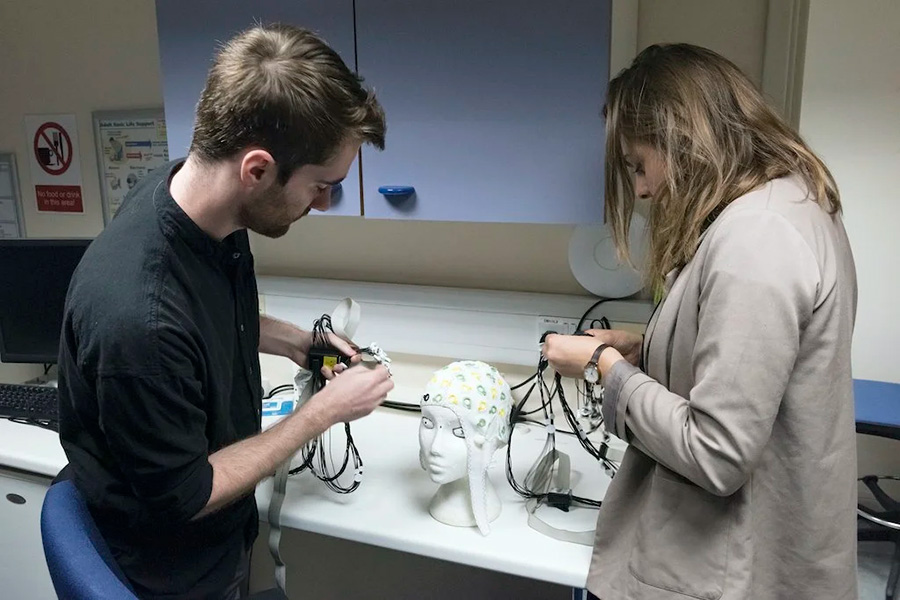
Researchers in Steve Fleming’s lab prepare an EEG cap for experiments in which brain activity is recorded while subjects are performing cognitive tasks.CREDIT: COURTESY OF STEVE FLEMING
Can you link these differences to what is happening in people’s brains?
One popular way of doing this has been to look at differences in brain activity and structure between people, using brain imaging techniques like fMRI and magnetoencephalography to try and find out what aspects of brain function gives some people better metacognition than others. But we’ve realized that approach is limited.
So the field has shifted. More recently, we’re instead looking at the relationship between patterns of brain activity and trial-by-trial variation in how confident individual people feel about decisions we ask them to make in experiments.
Essentially, what’s been found is that there are different stages of tracking uncertainty about our own performance when we’re performing a particular task.
For example, if you’re trying to discriminate the orientation of a line, neurons in the part of the brain that are sensitive to different possible line orientations will be firing to different extents, reflecting any uncertainty in what you see. Studies show that if there is conflicting information at that level, that affects people’s confidence estimates in the tests.
There are also data suggesting another higher-level stage of assessment: There are brain areas in the prefrontal cortex signaling confidence in a more general fashion, one that is not tied to the specific input we receive when conducting a particular task. This process continues after you’ve made a decision, and the brain is then also considering information that wasn’t initially available. It’s as if it is still trying to figure out whether it got it right or wrong.
That seems to happen pretty much automatically. It doesn’t require any external instruction or conscious effort. When we do ask people to consciously engage in metacognition and report how they feel about their performance, they seem to engage yet another stage of processing, which involves the frontopolar areas of the human brain: regions right towards the front of the cortex that are particularly well-developed in humans compared to other primates. These areas are activated when metacognitive estimates are used to communicate to others or to consciously control behavior, like we asked them to do in these experiments.
Steve Fleming explores some of the scans he uses to reconstruct how activity in the brain relates to different aspects of metacognition.CREDIT: COURTESY OF STEVE FLEMING
What happens if metacognition does not work the way it should?
A pervasive sense of underconfidence has been regularly linked to symptoms of anxiety and depression. We know that individuals who suffer from this general sense of underconfidence are not necessarily performing the tasks any worse than the next person. So one of the puzzles we are interested in trying to solve is why some people are not learning from their own performance. Why is it that they’re unable to realize that they’re actually doing quite well, and then update their beliefs about their skills and abilities appropriately?
What we’ve found is that at a trial-by-trial level, people with anxiety and depression are just as likely as others to show instances of high confidence. But there is an asymmetry in how they learn from these. They sometimes are very confident that they are doing well, but they don’t incorporate those signals into their more global estimates of how well they are doing in these experiments, and presumably daily life as well. At the same time, they are perfectly able to incorporate evidence from trials in which they weren’t very confident about performing well.
Interestingly, this isn’t the case when we give them explicit feedback about their performance. When we tell them that they are right, they realize that they are actually performing quite well.
How could this be applied to help people who struggle with underconfidence?
In a recent study, we’ve shown that underconfidence in people with greater anxiety symptoms is exacerbated with time. If we probe their confidence immediately after they make a decision, they’ll be a bit underconfident. But if we wait a few seconds, they’re even more underconfident about that previous decision, everything else being equal. And it only gets worse.
What we think is happening is that they’re engaging all these brain mechanisms that I talked about earlier to reflect on their own decisions and actions. Now, as time elapses, if you tend to be a more anxious person, those processes lead you to become even more underconfident than you would otherwise be. You’re spending too much time ruminating on your performance.
So one concrete piece of advice that we can extract out of those findings is that if you know that you are prone to that kind of bias, it’s better not to think too much after you’ve made a choice. If immediately after, you think, “All right, yeah, that was a reasonable thing to do,” leave it be.
What about people who are, perhaps, a bit more confident than they should be? It appears that can be quite helpful in today’s society.
It’s very interesting to think about what is adaptive, on a societal level, for future success. One hypothesis I advance in the book is that if you have a slightly overconfident worldview as well as good metacognitive sensitivity that helps you realize when you’re really wrong, that can be quite a powerful mix. Because, as you say, there is a lot of research suggesting that people who are perhaps a little overconfident do well socially. People tend to like them and want them in positions of power because they seem decisive.
At the same time, you don’t want someone without proper self-awareness to be able to bluff their way to the top and reach a position of power.
So I think there is a sweet spot where you do need to project a bit of overconfidence to be perceived as competent, yet you also want to make sure you’re not too seduced by self-confidence, whether it’s your own or someone else’s.
We’ve found that people with a more open-minded worldview, who are willing to acknowledge that their view might not be the only valid one and believe it’s important to listen to the views of people who disagree with them, also tend to have more accurate metacognition in the kinds of tasks we can study in the lab. Accurate metacognition prompts them to seek out new information and update their beliefs if they might be inaccurate. There is a solid body of evidence to suggest that in this way, these signals can help us, over time, to develop a more accurate worldview.
“There is a sweet spot where you do need to project a bit of overconfidence to be perceived as competent, yet you also want to make sure you’re not too seduced by self-confidence.”
— STEVE FLEMING
Might it be possible to train metacognition using these kinds of tasks, and do you think that might help us to reduce the societal tensions we experience today?
I think a lack of metacognition is far from the only reason we see polarization in society today. But our research does offer some tools that we could use to try and cultivate people’s ability to think critically about their own thinking, knowledge and decisions, without getting into politics.
The obvious place to do this would be in education, which I believe has a lot of potential. Parents and teachers implicitly encourage children to be more self-aware, but they rarely do so explicitly.
We don’t teach metacognition in the same way we teach math or history or physics. I think that might be a really powerful way of developing more open-minded ways of thinking.
Tim Vernimmen is a freelance science journalist based near Antwerp, Belgium. His metacognition really let him down when his laptop slipped out of his backpack on the bus on the way to this interview. It was thankfully recovered.
Fifteen years ago, Rebecca D. Costa challenged us all to address the danger we were facing. In her book, The Watchman’s Rattle: A Radical New Theory of Collapse, published in 2010, she said,
“Today, the issues that threaten human existence are clear: an intractable global recession, powerful pandemic viruses, terrorism, rising crime, climate change, rapid depletion of the earth’s resources, nuclear proliferation, failing education.”
Her mentor, the eminent biologist and naturalist Edward O. Wilson, who wrote the foreword to her book summed up our predicament this way:
“We have paleolithic emotions; medieval institutions; and God-like technology. And it is terrifically dangerous, and it is now approaching a point of crisis overall.”
The problems have gotten even more critical since then. Fortunately, Costa offered practical solutions and other experts have offered ideas about what we can do now.
When I was an undergraduate at U.C. Santa Barbara I had the good fortune to experience a class with the great philosopher Paul Tillich. His words have guided my life’s work ever since:
“Every serious thinker must ask and answer three fundamental questions:
What is wrong with us? With men? Women? Society? What is the nature of our alienation? Our dis-ease?
What would we be like if we were whole? Healed? Actualized? If our potentiality was fulfilled?
How do we move from our condition of brokenness to wholeness? What are the means of healing?”
To heal our brokenness and find our way to more vibrant, long-lasting, and satisfying relationships, we need to understand our history and where we got off track.
For most of human history humans recognized that we were fellow beings in the community of life on planet Earth. We were partners, not dominators. In their book Nurturing Our Humanity: How Domination and Partnership Shape Our Brains, Lives, and Future, Riane Eisler and Douglas P. Fry, report research demonstrating that
“for more than 99 percent of the approximately two million years since the emergence of a recognizable human animal, man has been a hunter and gatherer.” Eisler and Fry call their way of life, “The original partnership societies.”
As Riane Eisler says in her book, The Chalice & The Blade: Our History, Our Future,
“Underlying the great surface diversity of human culture are two basic models of society. The first, which I call the dominator model, is what is popularly termed either patriarchy or matriarchy—the ranking of one half of humanity over the other. The second, in which social relations are primarily based on the principle of linking, may best be described as the partnership model.”
When did domination systems come into being? Some say it began 10,000 years ago with the advent of agriculture. More recent research by environmental scientist Dr. James DeMeo and reported in his book, Saharasia: The 4000 BCE Origins of Child Abuse, Sex-Repression, Warfare and Social Violence in the Deserts of the Old World, says that it occurred around 6,000 years ago and was caused by a severe climate crisis that lasted for generations. Philosopher and psychologist Sam Keen, author of Fire in the Belly: On Being a Man, describes our situation this way:
“The simple truth, which we have conspired to forget during the last century, is that the human species is an integral part of an incomprehensible unity of being in the process of becoming: a single organ in the body of Gaia.”
Keen goes on to say:
“The radical vision of the future rests on the belief that the logic that determines either our survival or our destruction is simple:
We can only know what we touch.”
The new human vocation is to heal the earth.
We can only heal what we love.
We can only love what we know.
Clearly Keen is referring to our relationships. If humans fail to adapt, life on Earth will go on without us. It is our relationships that must change. There is good news and bad news. The good news is that we have a long history, more than 2,000,000 years, of sustainable partnership practices that can guide us.
The bad news is that many people still refuse to wake up and accept the truth. For those who can handle and embrace the present challenge, this is your time to step up and take action. It’s time for us to get back in touch with who we truly are. It’s time we woke up from the destructive disconnection from the earth, ourselves, and each other, and return to our partnership roots.
As historian Thomas Berry warned:
“We never knew enough. Nor were we sufficiently intimate with all our cousins in the great family of the earth. Nor could we listen to the various creatures of the earth, each telling their own story.The time has now come, however, when we will listen or we will die.”
The Sinking of the Ship of Civilization: What I Learned From The Vision I Was Given in 1993
In 1993, I attended a Men’s Leaders’ Conference in Indianapolis, Indiana. One of the activities offered was a traditional Native-American sweat lodge ceremony where we had the opportunity ask for guidance and support for ourselves and our communities. I had a vision where I saw the Sinking Ship of Civilization as well as Lifeboats for the Sustainable Future. I have written about the vision and what I’ve learned in numerous articles. Here is the most recent.
I continue to learn and get a better understanding of what we can do including the following:
Give “Civilization” its proper name.
As long as we accept the belief that “civilization” is the pinnacle of human achievement we will never take action that can save us. In 1999 world-renowned scientist Dr. Jared Diamond wrote an article, “The Worst Mistake in the History of the Human Race,” in which he said that the advent of agriculture, the first step toward civilization, “may have been our greatest blunder.”
A more accurate name for this stage of humanity, which we have been living during one-half of one-percent of human history would better be named the “dominator model” as described by Riane Eisler.
There is a better way of life beyond “civilization.”
In 1992, I was given the book Ishmael, by Daniel Quinn. It offered a clear vision of the two worlds that are competing for our attention: A world where hierarchy and dominance rule (Quinn calls it the world of the Takers) and a world where equality and connection rule (Quinn calls it the world of the Leavers. In his book, Beyond Civilization: Humanity’s Next Great Adventure, published in 1999, Quinn says,
“Beyond civilization isn’t a geographical space up in the mountains or on some remote isle. It’s a cultural space that opens up among people with new minds.”
Changing our minds is not easy, but there are guides that can help us.
Dr. Eric Maisel is a long-term friend and colleague. He is an internationally respected diplomat coach who specializes in creativity coaching, existential wellness coaching, and relationship coaching. He is the author of more than fifty books including Brave New Mind: The Art of Serene Readiness. Maisel begins by telling us why a brave new mind is absolutely crucial today:
“We’ve all been rushing about with no chance of catching up. We desperately need a brave new mind that can take into account our brave new world, a world at once strange and inhuman, awash with material good and loneliness, orchestrated by feckless billionaires more powerful than governments, where our conversations are with AI chat boxes and our thinking is reduced to refining the questions that we ask AI.”
“There’s a newly discovered, but little known, secret to your brain that is robbing you of y our freedom and power to live the life you long for. It is also causing you to lose your motivation to do what you know is best for you or others, leaving you stuck.”
She goes on to say, “What is this secret? The habenula, an area of the brain that has two superpowers over your behavior. First, it acts as a failure detector anytime you think you failed, even in some tiny way, even subconsciously without your knowing. Second, and more impactful, it is a kill switch for your motivation. This means that whenever you think you have failed at something, you will suddenly find yourself unmotivated to keep going.”
What I learned from my sweat-lodge vision is that most people will remain in denial and go down with the ship. We can’t change people until they are ready to change. No one articulates this wisdom better than Mel Robbins in her podcasts and #1 New York Times bestselling book, The Let Them Theory. She says,
“If you’re struggling to change your life, achieve your goals, or feel happier, I want you to hear this: The problem isn’t you. The problem is the power you unknowingly give to other people.”
There is no one who has offered greater guidance for a return to our partnership roots than Dr. Harville Hendrix and his wife Dr. Helen LaKelly Hunt. They are internationally respected couple’s therapists, speakers, and New York Times bestselling authors. Together, they have written twelve books with more than four million copies sold, including the timeless classic, Getting the Love You Want, which was on the NYTimes best seller list eleven times. The book caught the attention of Oprah Winfrey and they were guests on her show 17 times over a twenty-year period.
In their most recent book, How to Talk with Anyone About Anything: The Practice of Safe Conversations, Harville and Helen describe their audacious global social movement to shift from an individualistic civilization that embodies values like competition, control, domination and winning to a relational civilization that embodies the values of personal freedom, total equality, radical inclusiveness and celebration of diversity.
They propose that the engine of this transformation in civilization is to shift from monological talking that leads to tension, conflict, violence and war to dialogical conversations where people experience safety and connecting. In a relational civilization, the process of social interaction are collaboration, co-creation and cooperation that leads to connecting beyond difference.
Such social cohesion and cooperation transform conflict into safety and facilitates and sustains local and global peace. They estimate that by 2050, the world will contain 9.8 billion people. By then, if they can train the tipping point, which is 30% or 2.4 billion people, in dialogue, the entire world will change the way they relate and replace conflict with peace everywhere. Come join the movement.
I would like to hear from you. My articles appear every week on my website, www.MenAlive.com. Drop me a note at Jed@MenAlive.com.
Best Wishes,
Jed Diamond
Founder and VHS (Visionary Healer Scholar) of MenAlive
Julie Fogliano and Marla Frazee’s “Because of a Shoe” and Beatrice Alemagna’s “Her Muddy Majesty of Muck” address children’s anger with compassion.
From “Her Muddy Majesty of Muck.”Credit…Beatrice Alemagna
By Joshua David Stein
Joshua David Stein’s latest picture book is “Make New Friends,” illustrated by Mariachiara Di Giorgio.
Feb. 20, 2026 (NYTimes.com)
When I was 9, my divorcing parents sent me to a psychologist for a battery of tests. When I was 30, my mother, for reasons known only to her, sent me the report, a dozen pages of yellowed single-spaced type. One line jumped out at me: “While Josh’s anger may be the primary affective expression, it is a blanket for the pain.” I framed that page when I got it and it now hangs on my wall, for it was true then and it is true now.
If only I had had books like Julie Fogliano’s BECAUSE OF A SHOE (Knopf, 40 pp., $19.99, ages 2 to 5), illustrated by Marla Frazee, and Beatrice Alemagna’s HER MUDDY MAJESTY OF MUCK (Hippo Park, 56 pp., $19.99, ages 5 to 8), I might have thrown off my rage blanket sooner.
Bookstore shelves groan with “social and emotional learning” books, bought by anxious (loving) parents for their anxious (loved) children. But too often there’s a stink of fixing, an air of pedantry, to those pages. Few books in that genre treat both their subject and their readers with as much respect as Fogliano’s and Alemagna’s do. These aren’t didactic works. They are art, with soul-stirring depth and resonance.
From “Because of a Shoe.”Credit…Marla Frazee
Fogliano’s is more straightforward. It concerns a shoe. More specifically, the putting on of a shoe. More specifically, some very big feelings about the putting on of said shoe. The shoe itself, a red low top with Velcro fasteners, is harmless, but it’s the catalyst for a fierce power struggle between a mother and her young child.
On the very first spread, a red-haired child tears across the right-hand page, fleeing an unknown pursuer while clutching a pink stuffed bunny by its leg. The text reads, “even when …”
Fogliano is a champion of this type of elliptical, suspense-building opener. Her 2013 book, “If You Want to See a Whale,” uses the “if …” construction to languorously elongate whale-watching’s inherent waiting time.
From “Because of a Shoe.”Credit…Marla Frazee
In “Because of a Shoe,” she coils one very long sentence in tight loops: “even when … because of a shoe (a too-tight shoe a too-loose shoe) you are screaming and you don’t want to be screaming but you just can’t stop screaming. …” The words tumble on as the child’s (and the mother’s) anger increases.
Anyone who has flipped their lid — that is, all of us — knows the feeling: a certain claustrophobia that sets in as the world splits into good and bad, us and them. Here both the mother and her child are refreshingly and realistically dysregulated. As the tantrum increases in potency, Frazee’s illustrations do too. At the apex/nadir of the tantrum, they are literally black-and-white, like dichotomous thought.
Of course, Fogliano doesn’t abandon us in the eighth circle of toddler hell. “Even when” becomes “even then,” a resolution as cathartic as that of Beethoven’s Ninth or Queen’s “Bohemian Rhapsody”: “even then you are still you (funny sweet you) and i am still me (funny sweet me) and we are not a shoe.” The tantrum abates, color returns, the shoe is put on — and then, quickly and because this isn’t about rightness and wrongness, thrown off again.
From “Because of a Shoe.”Credit…Marla Frazee
The road from rupture to repair in Alemagna’s book is more fantastical, and yet it maintains its emotional verisimilitude. “Her Muddy Majesty of Muck,” originally published in Italian, follows its young narrator, Yuki, into a subterranean world presided over by a massive warm-brown blob of a mud princess. Cast there by the internalized critiques seeded by her older brother, Shen — “When I’m angry, I scream/and stomp on the ground./Sometimes I cry. That’s why/Shen doesn’t like me” — Yuki finds Her Majesty, rage personified, to be charming and polite, if a little menacing.
Her Majesty guides Yuki through a Dantean geography of woe. She walks her through the Wicked Woods and introduces her to a cadre of smelly little creatures called the Boogers who “love making people feel terrible.” They jump into the self-extinguishing Lake Youbegone, sort through the cluttered Museum of Cast-Away Things and visit the Grumporium, a pantry stocked with “edible anger in powders and liquids,” including “freshly squeezed juice from an argument.” Remarkably, the tour isn’t gloomy at all.
Alemagna is one of the greats, up there with Tomi Ungerer, Maurice Sendak and Leo Lionni. She belongs to the distinctly European children’s book tradition of unease and irresolution. It’s easy and neat to say anger is bad or best avoided. But what is that but a second arrow thrust into someone already suffering?
From “Her Muddy Majesty of Muck.”Credit…Beatrice Alemagna
Alemagna suggests we address our anger with compassion. Her Majesty isn’t demonic or even that unpleasant. She is muddy, yes, but we’ve been bathing in mud for eons. The woods are lovely. The Boogers are cute. The sea bunnies in Lake Youbegone are totes adorbs.
Just before Yuki ascends back into real life, she assures Her Royal Muddiness that she’ll return: “‘I’m not leaving forever,’ I say, and hug her. ‘I’ll come back to play, I promise. We’ll make mud pies.’”
Children know, after all, that anger can be, among other things, a comfort, a cozy blanket indeed.
A version of this article appears in print on Feb. 22, 2026, Page 14 of the Sunday Book Review with the headline: Anatomy of a Meltdown. Order Reprints | Today’s Paper | Subscribe
(Contributed by Michael Kelly, H.W.)
Consciousness, sexuality, androgyny, futurism, space, the arts, science, astrology, democracy, humor, books, movies and more

To our amazement, [the hypnotist] was able to get the patient “under” and then to give him a posthypnotic command:


 I saw my life branching out before me like the green fig tree in the story. From the tip of every branch, like a fat purple fig, a wonderful future beckoned and winked.