
Amrit Sandhu ???????? and Suzanne Giesemann – Messages of Hope Mar 4, 2026 Inspired Evolution Podcast ???????? Navy Commander-turned-World-Leading Psychic Phenomenon—Suzanne Giesemann — reveals the profound connection between our physical bodies and the spiritual realm—and why grounding in our “unchanging center” is the key to navigating the current global shift with clarity and peace. Suzanne Giesemann explores the power of the Three Energy Centers—the Head, the Heart, and the Hara—and why most spiritual seekers are missing the vital stabilization needed to truly anchor their light. She breaks down how to stop the “wobble” in our energetic signal, reclaim our personal power, and decode the spiritual messages hidden within our physical challenges and pain.
Monthly Archives: March 2026
John Steinbeck on the Creative Spirit and the Meaning of Life
By Maria Popova (themarginalian.org)
A decade before he won the Nobel Prize for Literature, John Steinbeck (February 27, 1902–December 20, 1968) wrote East of Eden (public library), which was eventually adapted into the 1955 film of the same title starring James Dean and which Steinbeck originally addressed to his two young sons. (The elder one, Thom, later became the recipient of Steinbeck’s magnificent letter of advice on falling in love.)
The thirteenth chapter of the novel features some of the most beautiful, poignant, and timelessly transcendent prose ever written — a gorgeous meditation on the meaning of life and the essence of the creative spirit:
Sometimes a kind of glory lights up the mind of a man. It happens to nearly everyone. You can feel it growing or preparing like a fuse burning toward dynamite. It is a feeling in the stomach, a delight of the nerves, of the forearms. The skin tastes the air, and every deep-drawn breath is sweet. Its beginning has the pleasure of a great stretching yawn; it flashes in the brain and the whole world glows outside your eyes. A man may have lived all of his life in the gray, and the land and trees of him dark and somber. The events, even the important ones, may have trooped by faceless and pale. And then — the glory — so that a cricket song sweetens his ears, the smell of the earth rises chanting to his nose, and dappling light under a tree blesses his eyes. Then a man pours outward, a torrent of him, and yet he is not diminished. And I guess a man’s importance in the world can be measured by the quality and number of his glories. It is a lonely thing but it relates us to the world. It is the mother of all creativeness, and it sets each man separate from all other men.
John Steinbeck
Writing in 1952, and writing for his two young sons, Steinbeck peers into the future, perhaps our present, with a concerned and prescient eye:
He extends a poignant reminder of what anchors us to life and what makes that life worth living:
Our species is the only creative species, and it has only one creative instrument, the individual mind and spirit of a man. Nothing was ever created by two men. There are no good collaborations, whether in music, in art, in poetry, in mathematics, in philosophy. Once the miracle of creation has taken place, the group can build and extend it, but the group never invents anything. The preciousness lies in the lonely mind of a man.
And now the forces marshaled around the concept of the group have declared a war of extermination on the preciousness, the mind of man. By disparagement, by starvation, by repressions, forced direction, and the stunning hammerblows of conditioning, the free, roving mind is being pursued, roped, blunted, drugged. It is a sad suicidal course our species seems to have taken.
And this I believe: that the free, exploring mind of the individual human is the most valuable thing in the world. And this I would fight for: the freedom of the mind to take any direction it wishes, undirected. And this I must fight against: any idea, religion, or government which limits or destroys the individual. This is what I am and what I am about. I can understand why a system built on a pattern must try to destroy the free mind, for this is one thing which can by inspection destroy such a system. Surely I can understand this, and I hate it and I will fight against it to preserve the one thing that separates us from the uncreative beasts. If the glory can be killed, we are lost.
Complement East of Eden with Steinbeck’s six tips on writing, a fine addition to the collected wisdom of great writers.
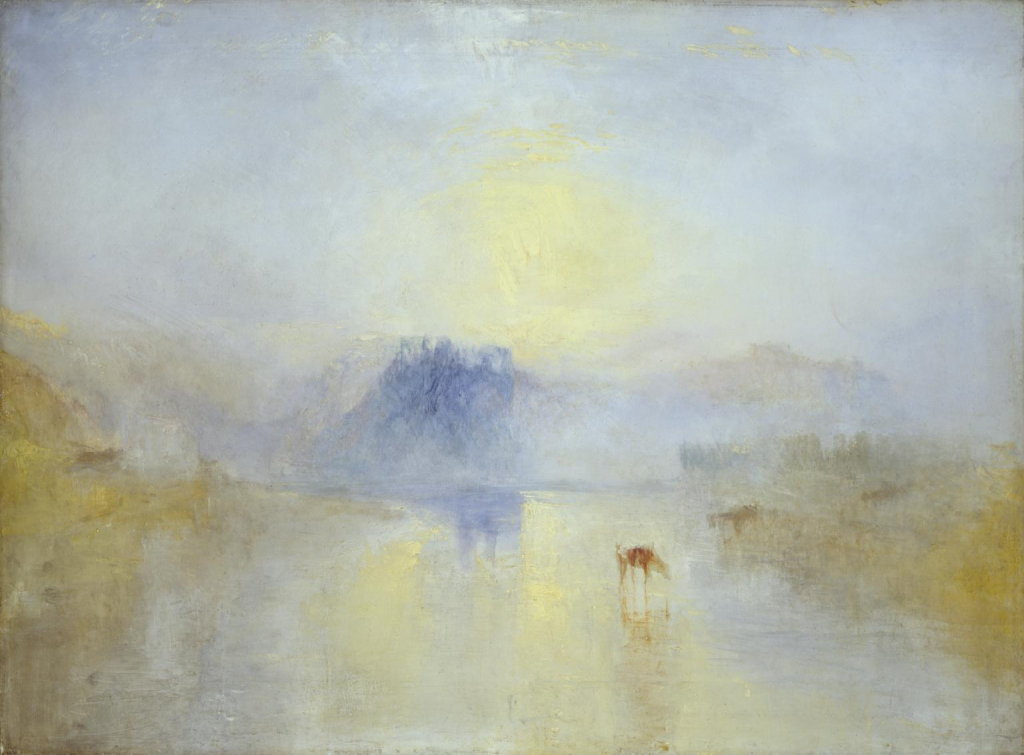
J.M.W. Turner: Norham Castle, Sunrise (1845)
Free Will Astrology: Week of March 5, 2026
by Rob Brezsny | March 3, 2026 (NewCity.com)

ARIES (March 21-April 19): Many ancient cultures had myths that explained solar eclipses as celestial creatures eating the sun. In China, the devourer was a dragon. A frog did it in Vietnam, wolves in Norse lore, and bears in several Indigenous American legends. In some places, people made loud noises during the blackout, banging drums and pots, to drive away the attacker and bring back the sun. I suspect you are now in the midst of a metaphorical eclipse of your own, Aries. But don’t worry! Just as was true centuries ago, your sun won’t actually be gobbled up. Instead, here’s the likely scenario: You will rouse an appetite for transformation that will consume outdated ideas and situations. Whatever disintegrates will become fuel for new stories. You will convert old pain and decay into vital energy. Your luminous vigor will return even stronger.
TAURUS (April 20-May 20): Maybe you have been enjoying my advice for years but still haven’t become a billionaire, grown into a potent influencer, or landed the perfect job. Does that mean I’ve failed you? Should you swap me out for a more results-oriented oracle? If rewards like those are the dreams you treasure, then yes, it may be time to search for a new guide. But if what you want most is simply to cultivate the steady gratification of feeling real and whole and authentic, then stick with me. PS: The coming days are likely to offer you abundant opportunities to feel real and whole and authentic. Take advantage!
GEMINI (May 21-June 20): In 1557, a Welsh mathematician invented the equals sign (=) to avoid repeatedly writing the words “is equal to.” Over the next centuries, this helped make algebra more convenient and efficient. The moral of the story: Some breakthroughs come not from making novel discoveries but from finding better ways to render and use what’s already known. I’m pleased to say that you Geminis are primed to devise your own equivalents of the equals sign. What strengths might you express with greater crispness and efficiency? What familiar complications could you make easier? See if you can find shortcuts that aid productivity without sacrificing precision.
CANCER (June 21-July 22): One benefit of being an astrologer is that when I need a break from being intensely myself, I can take a sabbatical. My familiarity with the zodiac frees me to escape the limits of my personal horoscope and play at being other signs. I always return from my getaway with a renewed appreciation for the unique riddle that is my identity. I think now is an excellent time for Cancerians like you and me to enjoy such a vacation. We can have maximum fun and attract inspiring educational experiences by experimenting. I plan to be like a Sagittarius and may also experiment with embodying Aries qualities.
LEO (July 23-Aug. 22): In Scandinavian folklore, there’s a phenomenon called utiseta. It involves sitting out at night in a charged place in nature, like a crossroads or border. The goal is to make oneself patiently available for visions, wisdom or contact with spirits and ancestors. I suspect you could benefit from the equivalent of a utiseta right now, Leo. Do you dare to refrain from forcing solutions through sheer will? Are you brave enough to let answers wander into your midst instead of hunting them down? I believe your strength is your willingness to be still and wait in a threshold.
VIRGO (Aug. 23-Sept. 22): You are a devotee of the sacred particular. While others traffic in vague abstractions, you understand that vitality thrives in the details. Your attention to nuance and precision is not fussiness but a form of love. I get excited to see you honor life by noticing all of its specific textures and rhythms! Now, more than ever, the world needs this superpower of yours. I hope you will express it even stronger in the coming months. May you exult in the knowledge that your refusal to treat the world carelessly or sloppily isn’t about perfectionism but about respect.
LIBRA (Sept. 23-Oct. 22): Architect Antoni Gaudí spent over forty years designing Barcelona’s Sagrada Família cathedral. He knew he wouldn’t live to see it finished. It’s still under construction today, long after his death. When he said, “My client is not in a hurry,” he meant that his client was God. I invite you to borrow this perspective, Libra. See how much fun you can have by releasing yourself from the tyranny of urgency. Grant yourself permission to concentrate on a process that might take a long time to unfold. What a generous and ultimately productive luxury it will be for you to align yourself with deep rhythms and relaxing visions! I believe your good work will require resoluteness that transcends conventional timelines.
SCORPIO (Oct. 23-Nov. 21): The ancient Chinese philosophical text known as the Tao Te Ching teaches that “the usefulness of a cup is in its emptiness.” A vessel full of itself can receive nothing. Is it possible that you are currently so crammed with opinions, strategies and righteous certainty that you’ve lost some of your capacity to receive? I suspect there are wonders and marvels trying to reach you, Scorpio: insights, inquiries and invitations. But they can’t get in if you’re full. Your assignment: Temporarily empty yourself. Create space by releasing cherished positions, a defensive stance, or stories about how things must be.
SAGITTARIUS (Nov. 22-Dec. 21): The Yoruba concept of ashe refers to the power to make things happen. It’s the life force that flows through all things, and can be accumulated, directed and shared. Right now, your ashe is strong but a bit scattered, Sagittarius. You have power, but it’s diffused across too many commitments and half-pursued desires. So your assignment is to consolidate. Choose two things that matter most and fully pour your ashe into them. As you concentrate your vitality, you’ll get more done and become a conduit for blessings larger than yourself.
CAPRICORN (Dec. 22-Jan. 19): What’s holding you back? What are you waiting for? A nudge from destiny? A breaking point when you’ll be compelled to act? A hidden clue that may or may not reveal itself? It’s my duty to tell you this: All that lingering and dallying, all that wishing and hoping, is wasted energy. As long as you’re sitting still, pining for a cosmic deliverance to handle the hard parts, the sweet intervention will keep its distance. The instant you claim the authority to act, you’ll see it clearly: the path forward that doesn’t need a perfect sign, a final push, or fate’s permission slip.
AQUARIUS (Jan. 20-Feb. 18): If you’re anything like me, you wince as you recall the lazy choices and careless passivity that speckle your past. You may wonder what you were thinking when you treated yourself so cavalierly, pushed away a steadfast ally, or let a dazzling invitation slip by. At times I feel as if my wrong turns carry more weight in my fate than the bright, grace-filled moments. Here’s good news for you, though. March is Amnesty Month for all Aquarians willing to own up to and graduate from their missteps. As you work diligently to unwind the unhelpful patterns that led you off course, life will release you from the heavy drag of those old failures and their leftover momentum.
PISCES (Feb. 19-March 20): In systems theory, “critical points” are moments when long periods of small changes gradually accumulate, and then suddenly erupt into a big shift. Nothing appears to happen for a while, and then everything happens at once. Ice becomes water, for instance. I suspect you’re nearing such a pivot, Pisces. You’ve been gathering strength, clarity and nerve in subtle ways. Soon you will be visited by what we might call a graceful, manageable explosion. The slow, persistent changes you’ve been overseeing will result in a major transition.
Homework: Experiment with this principle: Take only what you need. Newsletter.FreeWillAstrology.com
Sortition and idiotes in Ancient Greece
- Google AI Overview
In ancient Greece, particularly Athens,
sortition (selection by lot) and the concept of the idiotes (private citizen) were directly linked to the Athenian democratic ideal that governance was a duty shared by all citizens, not just an elite few. Sortition ensured a representative government of ordinary people, while the idiotes was viewed negatively as someone who shirked this civic responsibility. YouTube +4
Sortition in Ancient Greece
Sortition was considered the truly democratic method of selecting public officials, as opposed to elections, which were viewed as aristocratic because they favored the wealthy, well-known, orators, and skilled. YouTube +1
- The Kleroterion: Athenians used a specialized stone machine called a kleroterion to randomly select citizens for government positions, ensuring fairness and preventing corruption.
- The Council of 500 (Boule): The primary administrative body, which prepared legislation for the Assembly, was composed of citizens chosen by lot annually.
- Magistrates and Courts: Roughly 600 of the 700 city magistrates were chosen by lot, as were the 6,000 jurors (dikastai) who served in the courts.
- Exceptions: Positions requiring specific skills, such as military generals (strategoi), were elected rather than chosen by lot.
- Rotation: Sortition was paired with limited terms, ensuring high turnover and allowing as many citizens as possible to take their turn administering the state. YouTube +4
Idiotes in Ancient Greece
The term idiotes (ἰδιώτης) originated from idios (“private” or “one’s own”). It did not originally mean a mentally deficient person, but rather a “private individual” who did not participate in public affairs (ta politika). newDemocracy Foundation +4
- Political Obligation: In Athenian democracy, civic engagement was a duty. A citizen was expected to participate in the Assembly (Ekklesia), serve on juries, and potentially hold office.
- Social Stigma: Those who abstained from politics were considered self-centered, foolish, and potentially dangerous to the state. They were viewed as “amateurs” or “unskilled” in the art of governance compared to active citizens.
- Evolution of Meaning: Over time, particularly in the Roman era, the term evolved to mean uneducated or ignorant, eventually transforming into the modern, derogatory term “idiot”. Facebook +5
Summary: The Connection
Sortition was designed to force the idiotes out of their private lives and into public service, ensuring that the government was comprised of ordinary citizens rather than professional politicians. It represented the Greek belief that in matters of politics, the average citizen was competent to rule and be ruled in turn. Marxists Internet Archive +4
Beehive Group Dynamics?
Totally Attached

to beautiful, creative, righteous desires
| Rob Brezsny Mar 3, 2026 |

The Sacred Art of Attachment: A Manifesto for Beautiful Desires
I’m totally attached to giving all my heart and soul to the noble desires I’m moved by. I adore these desires. I want to fulfill them because they will make the world a better place and make me a more soulful source of beauty and truth and love.
This isn’t a confession or an admission of spiritual delinquency. It’s a declaration of my sacred path.
In my world, being attached to my magnificent desires is a glorious and honorable strategy for living a meaningful life. Being deeply invested in my constructive and compassionate yearnings enhances me in every imaginable way.
While some spiritual paths preach the renunciation of desire as the path to freedom, I live according to a different truth: that devotional attachment to my righteous desires is a form of sovereign emancipation. It’s a gateway to becoming more fully alive and more vividly engaged with the sublime project of being creatively incarnate as a human being on this messy and gorgeous planet.
+
Desires That Liberate
The theory that we should detach ourselves from desire makes sense in certain contexts. If we’re attached to things we can’t control, we will suffer. If we’re attached to permanence in an impermanent world, we will be disappointed. If we’re grasping at trivial forms of pleasure and desperately fleeing from difficulties, we will exhaust ourselves. I understand why these teachings arose and why they have helped many people.
But what’s too rarely acknowledged in contemporary spiritual discourse is that attachment can also be a path of liberation: when we’re attached to the right things in the right ways.
I’ll be precise: There’s a big difference between attachment rooted in fear of emptiness and attachment rooted in love of possibility. Addiction is attachment that panics. It clutches because it can’t tolerate absence and collapses when it doesn’t get what it wants.
Devotion, by contrast, is attachment that loves. It commits because it recognizes beauty and wants to collaborate with its unfolding. When disappointed, it doesn’t shrink; it deepens.
Addiction says, “Without this, I am nothing.” Devoted attachment says, “Because this matters, I will grow.” One contracts the soul around scarcity. The other expands it toward possibility—even through setback or loss.
+
And this is exactly why discernment matters. Not all desires are created equal! I don’t believe we should cling to and pursue every passing whim, petty wish, and destructive craving.
But I urge us to celebrate and embrace beautiful desires: the longings that, when pursued with zeal and devout intention, render us more magnificent and inspire us to make the world more luminous.
The spiritual teachers who advocate detachment seem to conflate all desire, as if the craving for another toke of crystal meth and the longing for social justice were the same thing. But they’re not, of course. One diminishes us; the other enhances us. One creates suffering; the other creates meaning.
The problem isn’t desire itself but unconscious desires, destructive desires, and distorted desires that serve our smaller understandings rather than our larger purpose.
+
To further understand why I make this distinction, I’ll widen the frame and ask a more radical question: What if desire isn’t an annoying and inconvenient flaw in the human psyche, but a structural principle of the cosmos?
My view: Desire isn’t a private quirk of our personal psychology. It’s evolutionary intelligence moving through everyone and everything everywhere. Evolution itself is desire unfolding: matter yearning toward complexity and consciousness pressing toward greater self-awareness.
Stars burn because gravity longs for form. The seed splits because it desires to engage with the sun. From hydrogen to hummingbird, from single cell to symphony, the cosmos advances by yearning.
In that glorious context, my rapt attachment to beautiful outcomes isn’t quirky rebellion against some particular spiritual law; it’s my buoyant participation in the engine of creation. When I devote myself to justice, beauty, healing, and love, I’m not indulging in egoic craving. I’m aligning my entire life energy with the primal thrust of existence toward richer expression. I am the universe universing itself.
+
Beautiful Desires
Here are a few of the desires I love, cultivate, and am gleefully attached to:
• A desire for beguiling riddles and enchanting challenges that excite my mind and heart.
• A desire to attract ongoing encounters with evocative, nonstandard beauty so as to always ensure a part of me remains untamed.
• A desire to keep refining and expanding my ability to learn from non-human intelligences as well as from humans: from animals, plants, and ecosystems, from the weather and the seasons, from spirits and dreams and synchronicities. The universe is crammed with teachers if I’m an eagerly curious student.
• A desire to help create a world in which everyone gets the food, housing, and health care they need. This isn’t abstract compassion. It’s a burning, churning, yearning attachment to collective abundance that motivates concrete action. I can’t and won’t rest in spiritual comfort while others suffer material deprivation.
• A desire for allies who enjoy my distinctive idiosyncrasies and eccentricities. Not people who tolerate my quirks despite them, but those who are nourished by them, who recognize in my peculiarities a splash of soulfulness that feeds their own wild authenticity.
• A desire to keep outgrowing what worked for me in the past and a desire to ceaselessly explore renewed approaches to expressing my soul’s code.
• A desire to foster and protect the health and beauty of the natural world.
• A desire for revelations and experiences that steer me away from thinking and acting like the machines I interact with so much.
• A desire to keep recreating and reinvigorating my relationships with those I love.
• A desire to replace cynical clichés with homemade spells of astonishment, composted from absurdity, reverence, and exuberant rebellion.
· A desire to regularly refresh my quest for freedom and deepen my capacity to be free.
• A desire to minimize the world’s bigotry, misogyny, oligarchy, racism, xenophobia, and militarism.
• And many more desires, too, like the desire to keep finding new desires that re-inspire my love for the world.

The Paradox of Detachment
One of the dominant narratives of alternate spirituality in America speculates that desire is the root of suffering and that liberation comes through detachment. Where do these theories come from?
They have roots in traditions of immense depth and beauty. I’m not declaring they’re wrong or bad. I’m saying they’re not my path—and perhaps not the path of other souls who are temperamentally built for fervent incarnation rather than renunciation.
Regarding the concept of non-attachment, ancient Buddhist texts in Pali mention nekkhamma, a word translated as “renunciation.” This term also conveys the meaning of “giving up the world and leading a holy life” or “freedom from lust, craving, and desires.” Here’s the central hypothesis: The path to emancipation and wisdom requires the renunciation of worldly engagement.
But my personal approach is not to lead a holy life by giving up the world. Just the opposite: To live a holy life, I give myself gladly and fervently to the world. “Renunciation” isn’t interesting or valuable to me. I don’t believe the spiritual quest requires withdrawal from the world’s complexities. My noblest vigor emerges from my passionate engagement with what life brings me. I aspire to be empathically interwoven with both its beauty and its brokenness.
Consider the Bhagavad Gita, one of Hinduism’s most influential texts. A key passage says, “You have a right to perform your actions, but you are not entitled to the fruits of your actions.”
This verse suggests that the anticipated results of our actions shouldn’t be the motivation for our performance of those actions. We should act without concern for outcomes; we should serve without expecting rewards.
I’m allergic to that principle. To cultivate optimal health and wisdom, I seek total immersion in possibilities i find exciting. I love love LOVE to be motivated by the hope of achieving my desires.
When I work to create something helpful or inspiring, I’m attached to it being thoroughly and wonderfully fulfilled. When I work in behalf of LGBTQ+ rights or immigrant protection, I am very attached to the possibility that my work will yield potent results. When I write a new song, I am deeply attached to it being lyrical and soulful.
Visions of the desired outcomes pump up my energy and focus, feeding my stamina and honing my determination to persist through obstacles.
The Hindu philosopher Madhvacharya advocated godliness through right actions: “One who is spiritually situated performs actions unattached to reward. Actions performed without desire as a matter of duty are full of wisdom.” By his measure, I am not “spiritually situated.” He wouldn’t approve of the fact that I perform actions with a spirited desire for their successful outcomes, invigorated by pleasure and joy rather than duty.
So yes, Madhvacharya would judge me harshly. But I’m OK with that. I’d much rather be vigorously engrossed in the challenges of living well on the earth than be emotionally indifferent to whether my work succeeds or fails.
Hindu philosopher Adi Shankaracharya went even further, teaching that hankering for the fruits of labor leads to entrapment in the cycle of birth, death, and rebirth—the ultimate quagmire!—thus inhibiting one’s liberation. According to this view, my attachment to outcomes keeps me trapped in terminal unease and unsatisfactoriness—and prevents me from ever reaching the highest spiritual goal.
But I’m not interested in such an accomplishment. I don’t hanker to permanently escape the Great and Mysterious Game of birth, death, and rebirth. I love it here! If liberation means ceasing to care whether beauty flourishes or justice prevails, then I choose what Shankaracharya would call entrapment. Here, in this world, in this body, working toward transformations and creations I care about deeply: That’s where I want to be.
+
I should note that both Buddhism and Hinduism are vast and internally diverse, containing some traditions where passionate attachment and worldly engagement are honored. Tantra, bhakti devotion, and engaged Buddhism are examples. Some Vajrayana practitioners are deeply committed to making our earth into more of a paradise.
My aversion isn’t to these traditions, but to the particular strains of Americanized, renunciation-centered teachings that have come to dominate so much of alternative spirituality.
+
Attachment as Fuel for Transformation
Here’s a very practical fact: I’m deeply invested in making my gorgeous, righteous desires come true because doing so fuels my motivation to attract the learning experiences, resources, and willpower I need to fulfill them. My attachment strengthens my resolve and boosts my ability to discipline myself as I pursue my high-minded and wild-hearted purposes.
When I was sick with a death-threatening illness, I was VERY attached to staying alive. That attitude was crucial in rousing the ingenuity and resilience necessary to do all the things necessary to stay alive: the difficult and excruciating treatments, the acute attention to every detail of my rigorous health regimen, and the emotional challenge of maintaining hope.
If I had been detached from the outcome, if I had adopted an attitude of “whatever happens is fine,” I’m very sure I could not have marshaled the ferocious will to live that my healing required.
In my world, attachment is another word for devotion. It’s not the grasping of addiction or the desperation of fear, but the focused zeal of knowing what I love and being joyfully driven to work for its flourishing. My attachment is my ardor, dedication, constancy, enthusiasm, resolve, zest, and tenacity. It’s my unfailing guide.

The Shadow of This Path
To be fiercely attached to beautiful desires is to risk heartbreak. Not every righteous longing blossoms and not every song finds its audience. I don’t pretend otherwise. My devotion doesn’t guarantee triumph. When I attach myself to luminous outcomes, I make myself vulnerable to grief, frustration, and humbling defeat.
But here’s a crucial distinction: I’m attached to participation, not invulnerability. If my desires are thwarted, I grieve, learn, and adapt. I let the failure compost me. My attachment doesn’t demand that the world obey me; it demands that I remain in living relationship with the world.
Addiction collapses when it doesn’t get what it wants, but devotion evolves. If a cherished outcome dissolves, I stay engaged with the larger arc of becoming, even if this particular chapter ends in partial success or even failure.
There’s another shadowy danger i must be aware of, too. Passion can harden into self-righteousness. Outcome-focus can curdle into control. My attachment could, if left unchecked, become tyranny disguised as virtue.
That’s why I rely on humor, allies, dreamwork, and regular encounters with forces larger than my will. The weather, the ocean, illness, love, and time all remind me that I’m not the sovereign of reality. I’m a collaborator. My desires are sacred, but they’re not supreme. They’ve got to stay in conversation with the Great Mystery.
+
The Path of Fervent Incarnation
One of the ultimate risks of my path is that I will feel everything. Another is that I will be pierced when beauty falters and gutted when justice fails. A third is that my devotion may sometimes overheat into self-righteousness or exhaust me with its ferocity.
But I would rather be broken open by caring than preserved by detachment. I would rather risk scorching myself in the fires of magnificent desires than cultivate a sterile coolness that never catches flame.
If loving this world so fiercely binds me to its cycles of birth and death again and again, then so be it. I am not seeking escape from the Great and Mysterious Game. I want ever-deeper participation in its dangerous, dazzling intimacy.
+
PS: What I’m declaring in this manifesto is not simply: “I defend desire.” I’m declaring, “I trust incarnation.”

Daya Mata on the Self beyond its physical and mental manifestations


Idries Shah on who you really are

“The person that you feel yourself to be, according to the Sufis, is a false person, which has no true reality.”
~ Idries Shah
–Idries Shah (June 16, 1924 – November 23, 1996) was an author and teacher in the Sufi tradition who wrote over three dozen books on topics ranging … Wikipedia