“Four score and seven years ago our fathers brought forth on this continent a new nation, conceived in liberty, and dedicated to the proposition that all men are created equal. “Now we are engaged in a great civil war, testing whether that nation, or any nation so conceived and so dedicated, can long endure. We are met on a great battlefield of that war. We have come to dedicate a portion of that field as a final resting place for those who here gave their lives that that nation might live. It is altogether fitting and proper that we should do this. “But in a larger sense we cannot dedicate, we cannot consecrate, we cannot hallow this ground. The brave men, living and dead, who struggled here have consecrated it, far above our poor power to add or detract. The world will little note, nor long remember, what we say here, but it can never forget what they did here. It is for us the living, rather, to be dedicated here to the unfinished work which they who fought here have thus far so nobly advanced. It is rather for us to be here dedicated to the great task remaining before us,that from these honored dead we take increased devotion to that cause for which they gave the last full measure of devotion, that we here highly resolve that these dead shall not have died in vain, that this nation, under God, shall have a new birth of freedom, and that government of the people, by the people, for the people, shall not perish from the earth.”
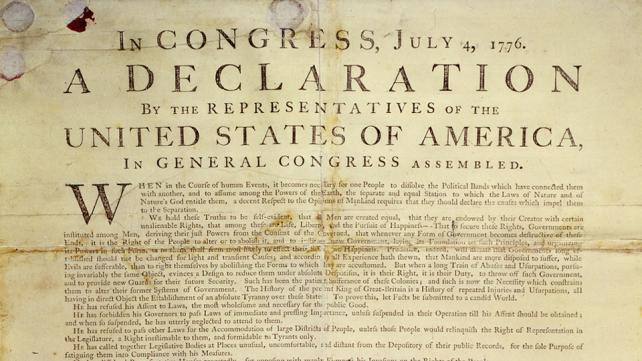
The Declaration of Independence
IN CONGRESS, July 4, 1776.
The unanimous Declaration of the thirteen united States of America.
When in the Course of human events, it becomes necessary for one people to dissolve the political bands which have connected them with another, and to assume among the powers of the earth, the separate and equal station to which the Laws of Nature and of Nature’s God entitle them, a decent respect to the opinions of mankind requires that they should declare the causes which impel them to the separation.
We hold these truths to be self-evident, that all men are created equal, that they are endowed by their Creator with certain unalienable Rights, that among these are Life, Liberty and the pursuit of Happiness.–That to secure these rights, Governments are instituted among Men, deriving their just powers from the consent of the governed, –That whenever any Form of Government becomes destructive of these ends, it is the Right of the People to alter or to abolish it, and to institute new Government, laying its foundation on such principles and organizing its powers in such form, as to them shall seem most likely to effect their Safety and Happiness. Prudence, indeed, will dictate that Governments long established should not be changed for light and transient causes; and accordingly all experience hath shewn, that mankind are more disposed to suffer, while evils are sufferable, than to right themselves by abolishing the forms to which they are accustomed. But when a long train of abuses and usurpations, pursuing invariably the same Object evinces a design to reduce them under absolute Despotism, it is their right, it is their duty, to throw off such Government, and to provide new Guards for their future security.–Such has been the patient sufferance of these Colonies; and such is now the necessity which constrains them to alter their former Systems of Government. The history of the present King of Great Britain is a history of repeated injuries and usurpations, all having in direct object the establishment of an absolute Tyranny over these States. To prove this, let Facts be submitted to a candid world.
He has refused his Assent to Laws, the most wholesome and necessary for the public good.
He has forbidden his Governors to pass Laws of immediate and pressing importance, unless suspended in their operation till his Assent should be obtained; and when so suspended, he has utterly neglected to attend to them.
He has refused to pass other Laws for the accommodation of large districts of people, unless those people would relinquish the right of Representation in the Legislature, a right inestimable to them and formidable to tyrants only.
He has called together legislative bodies at places unusual, uncomfortable, and distant from the depository of their public Records, for the sole purpose of fatiguing them into compliance with his measures.
He has dissolved Representative Houses repeatedly, for opposing with manly firmness his invasions on the rights of the people.
He has refused for a long time, after such dissolutions, to cause others to be elected; whereby the Legislative powers, incapable of Annihilation, have returned to the People at large for their exercise; the State remaining in the mean time exposed to all the dangers of invasion from without, and convulsions within.
He has endeavoured to prevent the population of these States; for that purpose obstructing the Laws for Naturalization of Foreigners; refusing to pass others to encourage their migrations hither, and raising the conditions of new Appropriations of Lands.
He has obstructed the Administration of Justice, by refusing his Assent to Laws for establishing Judiciary powers.
He has made Judges dependent on his Will alone, for the tenure of their offices, and the amount and payment of their salaries.
He has erected a multitude of New Offices, and sent hither swarms of Officers to harrass our people, and eat out their substance.
He has kept among us, in times of peace, Standing Armies without the Consent of our legislatures.
He has affected to render the Military independent of and superior to the Civil power.
He has combined with others to subject us to a jurisdiction foreign to our constitution, and unacknowledged by our laws; giving his Assent to their Acts of pretended Legislation:
For Quartering large bodies of armed troops among us:
For protecting them, by a mock Trial, from punishment for any Murders which they should commit on the Inhabitants of these States:
For cutting off our Trade with all parts of the world:
For imposing Taxes on us without our Consent:
For depriving us in many cases, of the benefits of Trial by Jury:
For transporting us beyond Seas to be tried for pretended offences
For abolishing the free System of English Laws in a neighbouring Province, establishing therein an Arbitrary government, and enlarging its Boundaries so as to render it at once an example and fit instrument for introducing the same absolute rule into these Colonies:
For taking away our Charters, abolishing our most valuable Laws, and altering fundamentally the Forms of our Governments:
For suspending our own Legislatures, and declaring themselves invested with power to legislate for us in all cases whatsoever.
He has abdicated Government here, by declaring us out of his Protection and waging War against us.
He has plundered our seas, ravaged our Coasts, burnt our towns, and destroyed the lives of our people.
He is at this time transporting large Armies of foreign Mercenaries to compleat the works of death, desolation and tyranny, already begun with circumstances of Cruelty & perfidy scarcely paralleled in the most barbarous ages, and totally unworthy the Head of a civilized nation.
He has constrained our fellow Citizens taken Captive on the high Seas to bear Arms against their Country, to become the executioners of their friends and Brethren, or to fall themselves by their Hands.
He has excited domestic insurrections amongst us, and has endeavoured to bring on the inhabitants of our frontiers, the merciless Indian Savages, whose known rule of warfare, is an undistinguished destruction of all ages, sexes and conditions.
In every stage of these Oppressions We have Petitioned for Redress in the most humble terms: Our repeated Petitions have been answered only by repeated injury. A Prince whose character is thus marked by every act which may define a Tyrant, is unfit to be the ruler of a free people.
Nor have We been wanting in attentions to our Brittish brethren. We have warned them from time to time of attempts by their legislature to extend an unwarrantable jurisdiction over us. We have reminded them of the circumstances of our emigration and settlement here. We have appealed to their native justice and magnanimity, and we have conjured them by the ties of our common kindred to disavow these usurpations, which, would inevitably interrupt our connections and correspondence. They too have been deaf to the voice of justice and of consanguinity. We must, therefore, acquiesce in the necessity, which denounces our Separation, and hold them, as we hold the rest of mankind, Enemies in War, in Peace Friends.
We, therefore, the Representatives of the united States of America, in General Congress, Assembled, appealing to the Supreme Judge of the world for the rectitude of our intentions, do, in the Name, and by Authority of the good People of these Colonies, solemnly publish and declare, That these United Colonies are, and of Right ought to be Free and Independent States; that they are Absolved from all Allegiance to the British Crown, and that all political connection between them and the State of Great Britain, is and ought to be totally dissolved; and that as Free and Independent States, they have full Power to levy War, conclude Peace, contract Alliances, establish Commerce, and to do all other Acts and Things which Independent States may of right do. And for the support of this Declaration, with a firm reliance on the protection of divine Providence, we mutually pledge to each other our Lives, our Fortunes and our sacred Honor.
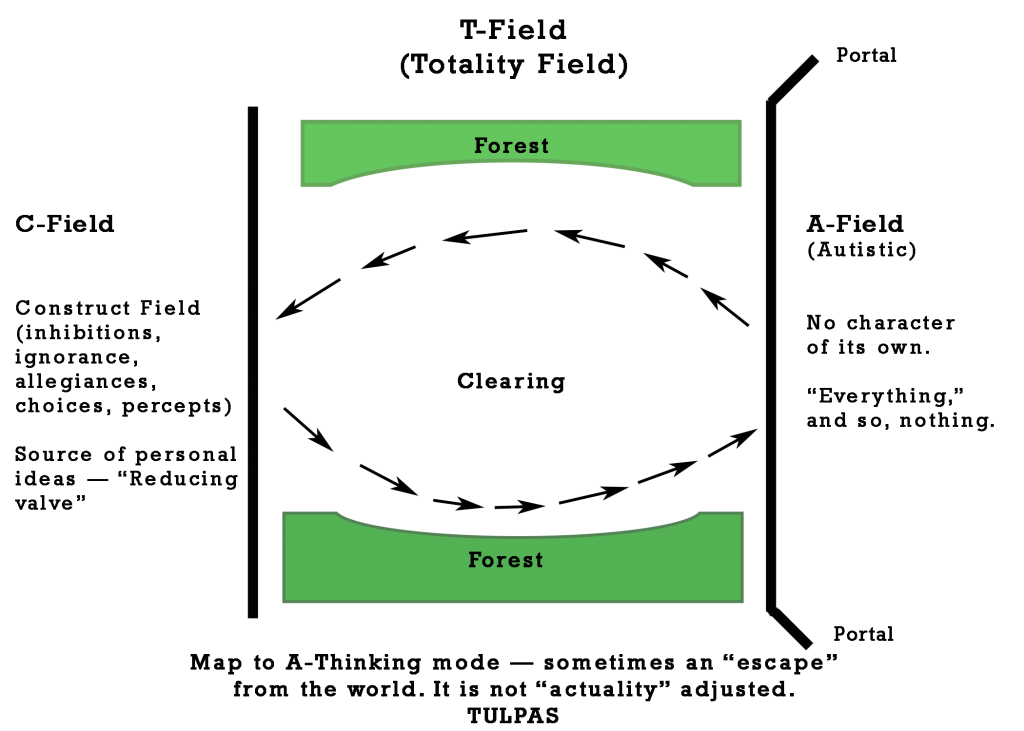
Below is an image of the T-field created by Thane Walker and The Prosperos for their foundation classes Translation and Releasing the Hidden Splendour. Go to TheProsperos.org for more information about Prosperos classes.
Samuel Taylor Coleridge (1772-1834) stands tall in the cultural pantheon for his poetry. It’s less well known that in his own lifetime, and in the decades following his death, this canonical poet had an equal reputation as a philosopher. His published works containing much of his philosophical prose span from The Statesman’s Manual (1816), which set out his theory of imagination and symbolism; Biographia Literaria (1817), one of the great and founding works of literary criticism; The Friend (1818), which includes his philosophical ‘Essays on the Principles of Method’; Aids to Reflection (1825), where he expounds his religious philosophy of transcendence; and On the Constitution of the Church and the State (1829), which presents his political philosophy.
The effect of those last two books was so impressive that John Stuart Mill named Coleridge as one of the two great British philosophers of the age – the other being Jeremy Bentham, Coleridge’s polar opposite. His thinking was also at the root of the Broad Church Anglican movement, a major influence on F D Maurice’s Christian socialism, and the main source for American Transcendentalism. Ralph Waldo Emerson visited Coleridge in 1832, and John Dewey, the leading pragmatist philosopher, called Coleridge’s Aids to Reflection ‘my first Bible’.
Yet philosophical fortunes change. The almost-total eclipse of British idealism by the rise of analytic philosophy saw a general decline in Coleridge’s philosophical stock. His philosophy languished while his verse rose. Coleridge’s poetry resonated with the psychedelia of the 1960s and a general cultural shift that emphasised the value of the imagination and a more holistic view of the human place within nature. Today, Coleridge is far more often remembered as a poet than a philosopher. But his philosophy was spectacular in its originality and syntheses.
Although Coleridge wrote poetry throughout his life, his energies increasingly channelled towards philosophy. Drawing from neo-Platonism, the ingenious but difficult transcendental idealism of Immanuel Kant, and the even obscurer intricacies of post-Kantians such as J G Fichte and F W J Schelling, his philosophy was undoubtedly of the difficult metaphysical kind, very much at odds with practically minded British empiricism. Lord Byron spoke for many when he described Coleridge:
Explaining Metaphysics to the nation – I wish he would explain his Explanation.
Yet the British empiricism of John Locke, David Hume and David Hartley was itself at odds, Coleridge pointed out, with a deeper heritage of British thought. ‘Let England be,’ he pronounced, ‘Sidney, Shakespeare, Spenser, Milton, Bacon, Harrington, Swift, Wordsworth’, who represent the idealising and proto-romantic tradition that he identified as ‘the spiritual platonic old England’. Coleridge rallied that ‘spiritual platonic’ tradition to oppose the philosophies of empiricists and hard-headed expounders of ‘common-sense’ such as Samuel Johnson, Erasmus Darwin, Hume, Joseph Priestley, William Paley and William Pitt, ‘with Locke at the head of the Philosophers and [Alexander] Pope of the Poets’.
Join more than 260,000 newsletter subscribers
Our content is 100 per cent free and you can unsubscribe anytime.
Daily: A daily dose of Essays and Videos
Weekly: A week’s worth of big ideasSign upI’m already subscribed
Without denigrating commercial and industrial success, Coleridge argued that the haste for economic improvement led to a decline in culture, tradition and spiritual wellbeing. Identifying ‘civilisation’ with the forces of economic and technological progression, and ‘cultivation’ with the deeper roots of spiritual connection, tradition and permanence, he warned of producing a society that was ‘varnished rather than polished; perilously over-civilised, and most pitiably uncultivated!’ This concern with cultivation was an important tenet in what Mill called the ‘Germano-Coleridgian’ school, which examined what the empiricists, utilitarians and materialist mechanists tended to overlook: the historical development and the socially and psychologically significant meanings embedded in religion, tradition and cultural symbolism.
Mill’s recognition of this difference foreshadows what would become the analytic-Continental divide between Anglophone philosophy, focused on discrete analysis meant to clarify problems, and the more historically and theoretically ambitious, synthesising approaches that began with those philosophers following Kant, such as Schelling and G W F Hegel. This ‘Germano-Coleridgian’ approach was in stark contrast to British utilitarianism, which reduced ethics to Bentham’s principle of utility. In the culture wars of his day, Coleridge championed cultural and spiritual concerns, and opposed the ethical elevation of sensual pleasure, and the reduction of that and everything else to base matter.
Coleridge similarly sided with the supporters of the spiritual and transcendent against those who maintained the reality of the material and immanent only. In this way, he took part in the ‘Pantheism Controversy’ that raged primarily across German philosophy in the late 18th and early 19th centuries. Coleridge argued for the transcendence of God rather than holding, with Baruch Spinoza, that God is a wholly immanent power identified with the natural world. Characteristically of Coleridge, however, he didn’t dismiss Spinozistic arguments, but adopted parts of them to fit within what he saw as a wider whole. ‘Spinoza’s is … true philosophy,’ he wrote, ‘but it is the Skeleton of the Truth.’ It needed to be fleshed out in order to let ‘the dry Bones live’.
Coleridge’s thinking provides a bridge between materialist and dynamic views in the sciences
This inclusive attitude is one of the strengths of Coleridge’s approach, which grew from his celebrated powers of synthesis. Seeing polarised debates as revealing an interdependent whole, he tried to embrace the views of his philosophical opponents, rather than simply dismiss them. He saw dichotomous or binary thinking (B versus C) as merely disputative, whereas a broader trichotomy (B versus C within a broader unity of A) presented a unified whole as the higher ideal that fierce yet dependent polar opposition imperfectly represents. The view of a higher union of opposites leads to reasoning, while binary thinking leads merely to arguing.
Beyond the ‘cultivating’ merits of Coleridgean synthesis, it’s also valuable to delve into the content of his philosophy. Over the past 15 years, philosophers have been attending to what Anna Marmodoro calls ‘the metaphysics of powers’ and, since Albert Einstein’s theories of relativity and the later quantum theory, most philosophers and physicists agree that forces and fields of force are more fundamental than matter, which is no longer held to be the atomistic ne plus ultra it was often thought to be. Notably, Isaac Newton refused to reduce the force of gravitation to something that is itself material, leaving it as one of those dark mysteries that we must simply observe and accept without fully understanding.
Without denying physical matter, Coleridge contended against what he saw as abject materialism, which reduced all qualities to quantity and collapsed physical forces into matter. On this point, history now sides with Coleridge against the materialists, and philosophers sympathetic with the intent of materialism now generally identify not with ‘materialism’ but with ‘physicalism’, or the view that the fundamental components of the Universe are whatever physics will eventually conclude they are. Current thinking in quantum physics construes these elements as fundamental forces, which Coleridge himself argued.
An understanding of Coleridge’s thinking, then, provides insight into the beginnings of the analytic-Continental divide and a bridge between materialist and dynamic (powers-based) views in the sciences. It also illuminates Coleridge’s poetry as the expression of a unified view of the world not as mere matter clumping together in happy coincidence, but as the evolution of the power of ideas in a world of dynamically forged syntheses that resound back to the powers from which these creative forces arose.
‘In Xanadu did Kubla Khan / A stately pleasure-dome decree …’ So begins Coleridge’s poem on the power of words and imagination in physical and poetic creation. Echoing how the mighty potentate creates with an imperious fiat, the inspired poet, we’re told, could ‘build that dome in air’ in an explosively constructive fusion of opposites – ‘[t]hat sunny dome! those caves of ice!’ It’s a creation with more astonishing magic than even the worldly power of the Khan could muster:
And all should cry, Beware! Beware! His flashing eyes, his floating hair! Weave a circle round him thrice, And close your eyes with holy dread, For he on honey-dew hath fed, And drank the milk of Paradise.
Though unpublished till 1816, Kubla Khan was written between 1797 and 1799, around Coleridge’s annus mirabilis of 1797-98, when he also wrote his supernatural poem The Rime of the Ancient Mariner, the daemonic Christabel, and some of the greatest of what he called his ‘Meditative Poems in Blank Verse’. One of those poems, the sublime ‘Frost at Midnight’, describes the beauties of nature – ‘lakes and shores / And mountain crags’ – as incarnations of the divine word, being ‘The lovely shapes and sounds intelligible / Of that eternal language, which thy God / Utters’. That poem ends on the achingly beautiful, mysterious note of ‘the secret ministry of frost’ that will, if the night gets colder, hang up the thaw-drops from the eaves ‘in silent icicles, / Quietly shining to the quiet Moon.’
Coleridge’s interconnecting themes are: the power of the creative word, in both worldly and poetic construction, echoing the divine word; nature as the living alphabet of God, only dimly understood in human knowledge; ideas as metaphysical essences and powers that pre-exist the physical world; and the notion of the earthly reflecting the ideal, as the icicles shine to the moon, itself reflecting the otherwise unseen light, at night, of an unseen sun. These are all themes that Coleridge developed in his philosophical writings until his death in 1834.
As a young man, Coleridge drew much from David Hartley’s associationist theory of mind. Like Hartley, young Coleridge wanted to trace the paths from root nerves and stimuli to an ever-increasing and sublime spirituality. This became entwined for him with a longer-lasting respect for the philosophy of Spinoza, who saw mind and matter as the only attributes we can perceive of the infinite being he called deus sive natura (God or nature). Aged 22, Coleridge declared:
I am a complete Necessitarian – and understand the subject as well almost as Hartley himself – but I go farther … and believe the corporeality of thought – namely, that it is motion.
Associationists viewed the mind as built up from immediate sensations, whose traces then recall and modify each other in constructing maps of experience – a kind of mental atomism. Although he’d soon give up materialistic psychology, he retained associationism as a theory of how animal and human mind begin to get organised. Coleridge accepted what he saw as its ‘half-truth’ in explaining much of mental activity at the levels of sensation, desire and the early awakenings of understanding. The essentially deterministic theory, however, left little if any room for human freedom. How could this theory of an automatic, irrational, desire-centred mind work so well at explaining the elementary functions of thought and perception yet utterly contradict the experiences, indeed the very possibility, of freedom, responsibility, and the pursuit of higher purposes? His answer would allow him to go beyond the notion of the ‘corporeality of thought’ while staying with the theory of it as ‘motion’, as he developed a view of mind as arising out of the interplay of opposed energies and functioning in a system of dynamics, or elementary forces.
It’s only when we’re self-consciously aware of ideas that we’re fully awake
Before delving deeper into Coleridge’s ‘polar philosophy’, we need a clearer picture of what he meant by ‘ideas’. For him, polar opposition derives from the energy of ideas conceived subjectively, as ‘universal ideas’, or objectively, as ‘cosmic laws’. His universal ideas relate to moral truths, history and the ‘humane sciences’, while the cosmic laws refer to the laws of nature and the physical sciences. Coleridge’s notion of ‘ideas’ is akin to the Platonic ideas, such as Goodness, Truth, Beauty, Justice and so on. From 1818 onwards, he gave a number of lists of such ideas, including:
the Ideas of Being, Form, Life, the Reason, the Law of Conscience, Freedom, Immortality, God! … ideas, (NB not images) as the theorems of a point, a line, a circle, in Mathematics; and of Justice, Holiness, Free-Will, &c in Morals.
and:
eternity … Will, Being, Intelligence, and communicative Life, Love, and Action … without change, without succession.
The ability to intuit and behold transcendent ideas, he argued, is what proves that ‘we are born with the god-like faculty of Reason’, adding that ‘it is the business of life to develop and apply it’, since these ideas:
constitute … humanity. For try to conceive a man without the ideas of God, eternity, freedom, will, absolute truth, of the good, the true, the beautiful, the infinite. An animal endowed with a memory of appearances and of facts might remain. But the man will have vanished, and you have instead a creature, ‘more subtile than any beast of the field, but likewise cursed above every beast of the field …’
Coleridge became fascinated with the notion of universal truth as a realm of ‘eternal verities’ that originate and endure in some kind of cosmic reason. This ‘reason’ he saw as underlying the fabric of the Universe and corresponding to both the universal Logos of Heraclitus and the divine Logos of St John. While Heraclitus is known for his view of a world in such constant flux that we can’t step into the same river twice, he’s also the philosopher who conceived of a universal Logos, the all-encompassing order that allows a coherent and rational reality to exist from what would otherwise be a swirling chaos. The Logos of St John is the Word that was with God in the beginning, which was and is God. It’s the spiritual heart of reality that entered into its own creation by becoming flesh, becoming the light of the world, if only the darkness could comprehend it.
To Coleridge, these notions of Logos became united as the living mind in which the ideas as truths and powers reside. In some ways similar to the grand systems of Schelling and Hegel, these ideas gradually become realised through human thoughts and actions via inspiration, imagination and contemplation. Coleridge defined the imagination in its fundamental sense as ‘the living Power and prime Agent of all human Perception, and as a repetition in the finite mind of the eternal act of creation in the infinite I Am.’ In this view, human artistic creativity, scientific discovery and philosophical insight share in an attenuated form of the original, divine power of creation by virtue of being able to attend in imagination to ideas, or symbols of ideas, of ultimate reality. Everything that exists owes its being to the ideas. Nature, though charged with ideas, is sleeping; animal life, sleepwalking; with most of human life in a slightly higher state of dreaming. It’s only when we’re self-consciously aware of ideas that we’re fully awake. As Coleridge described the sway of ideas in 1827, ‘all live in their power – the Idea working in them’, but only ‘the Fewest among the Few … live in their Light’.
All phenomena in nature and human history are symbolic appearances that reunite a clash of elementary forces
Conceiving of these ultimate and eternal powers as ‘ideas’ subjectively (as fundamental to mind) and as ‘laws’ objectively (as fundamental to world), Coleridge placed at the heart of his philosophy a theory of powers beyond the human mind but accessible to it in contemplation, imagination and in vague intuitions. These ‘living and life-producing Ideas’ were ‘essentially one with the germinal causes in Nature’. In an intriguing consequence of his theory of ideas, he didn’t dismiss physical matter as mere appearance or abstract concept with no corresponding reality beyond subjective experience. Rather, as Coleridge saw it, matter is a synthesis that arises out of the opposition of the fundamental forces of existence. It’s the elementary forces that are primal, and the matter that arises out of them is the efflorescence in which we take part, only dimly aware that we’re ‘connected with master-currents below the surface’.
Broader and deeper than any idealism that would do away with matter as an illusion or an abstraction, Coleridge retained it within his system, much as he’d done with associationism in the theory of mind. Thus, as he wrote in 1817, he saw it essential to:
consider matter as a Product – coagulum spiritûs [the coagulation of spirit], the pause, by interpenetration, of opposite energies – … while I hold no matter as real otherwise than as the copula [or synthesis] of these energies, consequently no matter without Spirit, I teach on the other hand a real existence of a spiritual World without a material.
From what Coleridge described as ‘the universal Law of Polarity’ follows the actualisation of all subsequent existence in the form of metaphysical powers and forces of nature. Coleridge’s cosmology, like Schelling’s metaphysics, was part of a post-Kantian movement of organic philosophy of nature that saw itself as opposed to atomism and associationism, and which was very much a metaphysics of powers that found deep consonance with Coleridge’s developing view of mind and the senses. From the principle of polar opposition springs not only history, but all matter and all phenomena. In 1818, Coleridge defined this law as follows:
Every Power in Nature and in Spirit must evolve an opposite, as the sole means and condition of its manifestation: and all opposition is a tendency to re-union.
In a lineage from Kant, to Fichte, then Schelling, and soon to be furthered by Hegel, the principle of polar opposition was made into a tripartite logic, which Fichte was the first to describe as the progression through thesis, antithesis and synthesis, itself becoming a new thesis, thus continuing the evolution. Coleridge developed this into a ‘pentadic’ (or five-fold) logic, with the addition of the ‘prothesis’, as the originary idea that the thesis and antithesis manifest as opposite poles, and the ‘indifference point’, the midpoint between both thesis and antithesis. For Coleridge, synthesis is the resolution of opposed forces into the material phenomena of experience. All phenomena in nature and in human history are symbolic appearances that reunite a deeper clash of elementary forces.
To Coleridge, the opposition of reason to sense was a fundamental polarity in the mind that demonstrates the polar dynamics of the cosmos. Following Kant, he construed reason as essentially free, guided by truth and higher values rather than impulses and associations. This tug-of-war between reason and sense stretches the mind both ‘up’, into abstract truths and the realm of freedom, compassion and humanity, and ‘down’, into sensuality, self-interest and the realm of nature. The lower mind is necessary for the higher, which depends on the former for nutrition, physical safety and the basics of society. Nonetheless, the dynamic is marked by a hierarchy: sense can evolve towards reason, but the truths of reason aren’t similarly transformed by sense and basic impulses. The middle position, generated by the opposed dyad of sense ‘below’ and reason ‘above’, is the understanding, which is partly a reflection in the human mind of the universal reason (or Logos) yearning after science, art and social progress, and partly the rationally self-interested schemer that sets itself to satisfy our natural desires. With this dynamic, Coleridge felt he’d eventually marshalled those half-truths of associationism by showing that they can hold sway only in the lower mind.
With no foothold in the mind’s higher levels, the main principles now switch from paths of pleasure and the mechanics of contiguity to freedom, creativity and the pursuit of ideas. This switching over happens at the crux, the crucial point in the centre of Coleridge’s model of mind, where our lives are balanced between sensation stretching down into nature and reason stretching up into the ideas. Everything that happens in human and natural history occurs between these poles, with the familiar parts of our lives clumped around the ordinary understanding at the middle, where we find comfort in concepts supported by sensations ‘below’ and stirred on by ideas ‘above’.
Coleridge’s theory of ideas led to a philosophy where the notion of matter itself was retained but reframed in a way that opposed the mechanical view that saw the Universe as nothing more than a network of mere matter. In the most thoroughgoing materialist accounts, even energy and forces are supposed to be reducible to matter. Against this, Coleridge developed a philosophy of ideas as powers that saw matter arise from opposed forces, forces arise from powers, powers and laws as the objective side of ideas, and ideas as residing eternally in cosmic reason, or Logos, the mind of God.
Coleridge’s philosophy of ideas countered the view of the Universe as ‘an immense heap of little things’
His philosophy gained a comprehensiveness beyond psychology and philosophy of mind as his enquiries progressed into cosmology and the metaphysics of matter. Throughout his life, Coleridge searched for a unified view of reality that was at once bodily and spiritual. As he wrote in a letter in October 1797:
frequently all things appear little – all the knowledge, that can be acquired, child’s play – the universe itself – what but an immense heap of little things? – I can contemplate nothing but parts, & parts are all little – ! – My mind feels as if it ached to behold & know something great – something one & indivisible – and it is only in the faith of this that rocks or waterfalls, mountains or caverns give me the sense of sublimity or majesty! – But in this faith all things counterfeit infinity!
Over the course of the next three-and-a-half decades, Coleridge developed his philosophy of ideas that countered the view of the Universe as ‘an immense heap of little things’ and replaced it with a cosmos of ideas, powers and forces that give rise to the material world. In this way, he ended up providing his alternative to the mechanistic materialism, expounded to varying degrees by Galileo, Descartes, Locke and Newton, that he saw as removing too many ‘positive properties’ from the world, which then, abstracted into mere ‘figure and mobility’, becomes ‘a lifeless Machine whirled about by the dust of its own Grinding’.
Rather than reject associationism in the mind and materialism in the cosmos, Coleridge disavowed instead their abject extremes while managing to embrace what many would have too easily dismissed outright as the ‘enemy’ perspective. Mill commended Coleridge’s ‘catholic and unsectarian … spirit’ as ‘less extreme in its opposition’ than the materialist positions because ‘it denies less of what is true in the doctrine it wars against’. The poet-philosopher was applauded for correcting what he saw as dangerous ‘half-truths’ by retaining them within a broader, balanced ambit. Coleridge didn’t even fully reject utilitarianism, because even here he sought what was true in it, and realised that it warranted a limited place within the whole. His approach, in his words, embraced inclusion, not exclusion:
Exclude Utility? No. My System of Moral Philosophy neither excludes nor rests on it: were it for this reason only that it includes it.
Coleridge corrected what he saw as dangerous half-truths – on either side of the issues he encountered – by retaining what was valuable in them within a broader, balanced overview:
My system … is the only attempt I know ever made to reduce all knowledges into harmony. It … shows … how that which was true in the particular in each … became error, because it was only half the truth.
He persuaded many of his empiricist and utilitarian British contemporaries of the dangers of understanding everything mechanistically, including mind and humanity itself. With these methods, Coleridge achieved not only an astonishingly broad and holistic philosophy of great intellectual richness and scope, but also forged a brilliant synthesis within the culture wars of his time, which we could well heed today.
Don Tagala Jun 30, 2025 NEW YORK Zohran Mamdani was treated like a rockstar at the NYC Pride March 2025! The 33-year-old New York City Democratic nominee for Mayor was greeted with a warm welcome by the Pride Parade’s spectators, marchers, and allies. Fans and supporters couldn’t get enough of NYC’s Democratic Mayoral candidate. From the moment Mamdani arrived on Fifth Avenue and 28th Street, he was surrounded by the press. Screaming fans couldn’t believe their mayoral bet was among them marching down Fifth Avenue, waving the Pride flag, shaking hands, and dancing to the thumping Pride music. NY AG Letitia James, who walked alongside Mamdani during the Pride March posted on her social media: “A joy to march in NYC Pride with the people’s champ.”
From the bestselling author of Born Survivors, a novel inspired by the powerful true story of a man who risked everything to protect children in Auschwitz.
Fredy built a wall against suffering in their hearts . . .
Amid the brutality of the Holocaust, one bright spot shone inside the Nazi death camp of Auschwitz. In the shadows of the smokestacks was a wooden hut where children sang, staged plays, wrote poetry, and learned about the world. Within those four walls, brightly adorned with hand-painted cartoons, the youngest prisoners were kept vermin-free, received better food, and were even taught to imagine having full stomachs and a day without fear. Their guiding light was a twenty-seven-year-old gay, Jewish Fredy Hirsch.
Being a teacher in a brutal concentration camp was no mean feat. Forced to beg senior SS officers for better provisions, Fredy risked his life every day to protect his beloved children from mortal danger.
But time was running out for Fredy and the hundreds in his care. Could this kind, compassionate, and brave man find a way to teach them the one lesson they really needed to how to survive?
The Teacher of Auschwitz shines a light on a truly remarkable individual and tells the inspiring story of how he fought to protect innocence and hope amid depravity and despair.
Wendy Holden, also known as Taylor Holden, is an experienced author and novelist with more than thirty books already published, including two novels. She has had numerous works transferred to radio and television.
A journalist for eighteen years, ten on the Daily Telegraph of London, her first novel THE SENSE OF PAPER was published by Random House, New York, in 2006 to widespread critical acclaim. Her non-fiction titles have chiefly chronicled the lives of remarkable subjects. The latest is BORN SURVIVORS, the incredible story of three mothers who defied death at the hands of the Nazis to give life. She has also written the memoir of the only woman in the French Foreign Legion in TOMORROW TO BE BRAVE, and about the mother of a woman killed after marrying a Sudanese warlord in TILL THE SUN GROWS COLD. She wrote A LOTUS GROWS IN THE MUD – the memoir of actress Goldie Hawn – and LADY BLUE EYES, the autobiography of Frank Sinatra’s widow Barbara, all of which were New York Times and Sunday Times bestsellers.
She also wrote the international bestseller TEN MINDFUL MINUTES, her second book with Goldie Hawn and the first in a series of books for parents and children. She wrote KILL SWITCH, the memoir of an honourable British soldier wrongly imprisoned in Afghanistan as well as BEHIND ENEMY LINES, about a young Jewish spy who repeatedly crossed German lines. Her book MEMORIES ARE MADE OF THIS, a biography of Dean Martin as seen through his daughter’s eyes has become an enduring bestseller and she worked with Billy Connolly on JOURNEY TO THE EDGE OF THE WORLD his TV-companion travel guide to the Northwest Passage screened around the world. She co-wrote American male supermodel Bruce Hulse’s explosive memoir, SEX, LOVE AND FASHION. Other works have included CENTRAL 822, the autobiography of a pioneering policewoman at Scotland Yard which was dramatised on BBC Radio, BITING THE BULLET, charting the remarkable life of an SAS wife, and FOOTPRINTS IN THE SNOW, the story of a paraplegic made into a British TV drama starring Caroline Quentin. Wendy was also responsible for the bestselling novelisations of the films THE FULL MONTY and WAKING NED. Her first book, UNLAWFUL CARNAL KNOWLEDGE the true story of the controversial Irish abortion case was banned in Ireland. SHELL SHOCK, her history of Post Traumatic Stress Disorder, went with an award-winning Channel 4 television documentary series. She lives in Suffolk, England, with her husband and two dogs and divides her time between the UK and the US.
(Goodreads.com)
GoogleAI Overview
Fredy Hirsch, also known as Alfred Hirsch, was a German-Jewish athlete, sports teacher, and Zionist youth movement leader who became known for his work protecting Jewish children during the Holocaust, including establishing a secret school within Auschwitz concentration camp. A novel, “The Teacher of Auschwitz,” by Wendy Holden, is based on his true story.
Here’s a more detailed look at Fredy Hirsch’s life and work:
Early Life and Activism:Born in Germany in 1916, Hirsch was a gifted athlete and educator who became involved in Jewish youth movements. He fled Germany for Czechoslovakia due to the rise of antisemitism and the Nuremberg Laws.
Work in Theresienstadt and Auschwitz:In Theresienstadt, a Jewish ghetto and transit camp, Hirsch dedicated himself to the well-being of children, maintaining their hygiene, providing education and recreation, and fostering hope. When he was later sent to Auschwitz, he continued this work, establishing a special children’s block within the camp.
“Kinderblock” in Auschwitz:In the heart of Auschwitz, Hirsch created a space for children where they could sing, stage plays, and receive better food and care. He even secured permission to decorate the block with Disney cartoons. Despite the grim reality of the camp, this area became a haven, with SS officers occasionally visiting to offer sweets and witness performances.
Facing the Impossible:Hirsch’s work in Auschwitz was incredibly dangerous. He had to navigate the complex and brutal realities of the camp, begging for better provisions for the children and hiding his homosexuality from his persecutors. He risked his life daily to protect the children in his care.
Legacy:Fredy Hirsch died in Auschwitz in 1944, but his story has been preserved through survivor testimonies and, more recently, through Wendy Holden’s novel. His courage and dedication to the well-being of children in the face of unimaginable horror make him a remarkable figure in Holocaust history.
The legendary journalist believed that speaking truth to power was the essential underpinning of an embattled American experiment.
JUN 30,2025 (thenationmagazine@substack.com)
by John Nichols
Bill Moyers in 2002. (Pat Carroll / NY Daily News Archive via Getty Images)
In the last months of his remarkable life, Bill Moyers spoke more frequently about the future than the past. He followed the first months of the second Trump presidency with mounting concern, warned about threats to the First Amendment, and remained as enthusiastic as ever about the fight for bold journalism and robust democracy. His step was cautious as we navigated the streets near his place on Manhattan’s Upper West Side. Yet, even on our last walk just weeks before his death on Thursday at age 91, there was nothing tentative about Bill’s vision for America. We spent several hours talking about organizing a national conference to assess the damage that was being done to the American discourse, not just by Donald Trump’s crude authoritarianism but also by corporate media conglomerates that had always been more interested in profits than the freedom of the press.
The Nation is a reader-supported publication. To receive new posts and support our work, consider becoming a free or paid subscriber.
Every now and then, however, Bill would pause to reflect. On an afternoon in April, as we left an Italian coffee shop a few blocks from Central Park, he paused our conversation about whether America was experiencing the worst of times. Bill recalled flying from Dallas to Washington on November 22, 1963, aboard the plane that transported the body of John Fitzgerald Kennedy, the assassinated president he had served as deputy director of the Peace Corps, along with Lyndon Johnson, the newly inaugurated president he would go on to serve as press secretary. The American experiment that he had come to cherish as a boy growing up in Marshall, Texas, had experienced plenty of rough days, he explained. As Bill spoke, I was reminded that few Americans had seen so much of the country’s history, and shaped so much of its public discourse, as Bill Moyers.
The “press secretary” title that he held during much of Johnson’s White House tenure never really captured the scope of Bill’s influence. He was an essential figure in a transformative presidency. Still in his early 30s, he served as a counselor, chronicler, and strategist for the 36th president, witnessing the highs and lows of an administration that delivered the Civil Rights Act, the Voting Rights Act, and the War on Poverty, and a plan for establishing the public broadcasting system now known as PBS. And as a member of the Carnegie Commission on Education Television, Bill helped craft the groundbreaking report, “Public Television: A Plan for Action,” which led to the Public Broadcasting Act of 1967 and the creation of PBS, an institution to which he remained devoted for the rest of his life.
Bill left the administration at a point when the bright shining dreams of Johnson’s early presidency were eclipsed by the nightmare that was the Vietnam War. “We had become a war government, not a reform government,” he explained, “and there was no creative role left for me under those circumstances.”
Bill turned his creative impulse toward writing and broadcasting—as the publisher of the newspaper Newsday, a senior commentator for CBS and NBC, and finally as the award-winning host of public broadcasting programs such as Bill Moyers Journal and NOW With Bill Moyers. Along the way, Bill won more than 30 Emmy Awards, wrote best-selling books, and produced documentaries and investigations that upended the lies of our times—including the groundbreaking and still-relevant 2007 report Buying the War: How the Media Failed Us, which detailed the collapse of basic journalistic skepticism on the part of the major media outlets that never seriously challenged, and at times actively encouraged, the Bush-Cheney administration’s rush to war in Iraq.
It was on the eve of that war that Bill invited Bob McChesney and myself to join him for the first of several extended conversations about media and politics on his PBS programs. Those conversations planted the seeds for the formation of a national media reform network, Free Press, and for several national conferences on media reform that Bill addressed as a keynote speaker. His objections to pro-war propaganda and corporate power, and his unflinching determination to champion independent journalism that questioned presidents and CEOs and challenged economic and racial injustice, cost him dearly. Yet Bill loved the fight—and he loved using his broadcast platform to introduce Americans to big ideas (from the left and the right) and to political outsiders, including libertarian Republicans such as Ron Paul and progressives such as Bernie Sanders and Elizabeth Warren.
Sanders and Warren would eventually become prominent members of the US Senate and candidates for the presidency. Paul, a member of the US House from Texas, would seek the presidency as a Libertarian and then as a Republican. But I always thought that it was Bill who should run for the nation’s top job.
After the 2004 election, when Democrats were struggling to find their voice and vision, my friend Molly Ivins suggested that her fellow Texan be drafted as a future presidential prospect, making the case that “Moyers is the only public figure who can take the entire discussion and shove it toward moral clarity just by being there.” Molly imagined a limited campaign that would allow Bill to teach Democrats how to stand for something—and give progressive voters an option to “vote for somebody who’s good and brave and who should win.” But she shied away from arguing that he could actually secure the Democratic nomination or the presidency.
In a friendly debate with Molly, I made the case for a more serious bid. “Why ask Democratic primary voters to send a message when they can send the best man into the November competition and, if the stars align correctly, perhaps even to the White House?” I asked in a Nation column. Yes, I acknowledged, it would be an uphill run. But, I wrote, “Moyers would enter the 2008 race with far more Washington political experience than Dwight Eisenhower had in 1952, far more national name recognition than Jimmy Carter had in 1976 and far more to offer the country than most of our recent chief executives.”
To my mind, it was not that big a stretch to suggest that someone with the government and private-sector experience, the national recognition and the broad respect that Bill Moyers had attained across so many decades of public life could make a serious run for the presidency.
Bill kept his ego in check and laughed off our presidential speculation. He knew his way around the White House as well, or better, than anyone in American media, and he was much more interested in checking and balancing our commanders in chief than in trying to become one himself. And, I suppose, he might have been savvier in his assessment of the political realities of a moment when campaign finance laws were being obliterated and horse-race politics was replacing the battle of ideas that he cherished.
Still, I can’t help but think that Bill Moyers was the best president we never had.
Our mental and ecological health are linked. Recognizing this interdependence can change how we relate to the world and to ourselves.
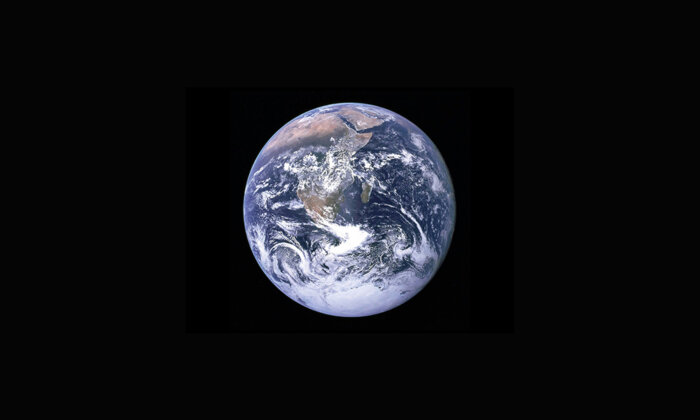
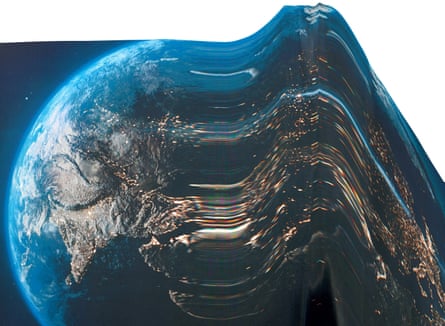
Image: View of the Earth as seen by the Apollo 17 crew traveling toward the moon. Source: NASA.
By: Timothy Morton
June 30, 2025 (thereader.mitpress.mit.edu)
There is a really deep reason why, when you examine things from an unusual (to humans) point of view, they become strange in such a way that you need to include your own perspective in your description, as if you were like Neo in “The Matrix,” touching the mirror only to find that it is sticking to your finger and pulling away from the wall as you try to withdraw your hand.
This article is excerpted from Timothy Morton’s book “Being Ecological.”
It’s like what happens in a dream. When you dream of nasty creepy-crawlies falling on you from the ceiling, you also have a certain feeling or attitude (or whatever you want to call it) toward the insects, perhaps horror or disgust, perhaps mixed with a strange detachment. This is the same as how in a story there is what’s happening (the narrative) and how it’s being told (the narrator, whether it be singular, plural, human or not, and so on). These two aspects form a manifold. When we look at a “thing,” we are forgetting that “thing” is just part of a manifold. It’s not true that there’s “me” and then there’s a “thing” I reach out to with my perception, like reaching my hand out to a can of beans in the supermarket. But perhaps we have tried to design our world to look like a supermarket, full of things we can reach out and grab.
When you analyze a nightmare, you discover that the insects and the feelings you are having about them are both aspects of your very own mind.
The result of living as though you believe in subject–object dualism, which is our usual mode of thinking about the world (even if we are doing it unconsciously), is that it becomes hard to accept what is in fact more logical and easier on the mind in the end. When you analyze a nightmare, you discover that the insects and the feelings you are having about them are both aspects of your very own mind. Perhaps the insects are unacceptable thoughts of which you’re just becoming aware. What is so powerful about psychoanalysis and some spiritual traditions such as Buddhism is that they enable you to entertain the idea that thoughts and so on are not “yours” all the way down, which can be very liberating: What matters isn’t exactly what you think, it’s how you think. You know that facts are never just “over there” like cans of soup waiting to be picked up in some neutral way.
You know ideas code for attitudes, insofar as ideas always imply a way of thinking them, an attitude, and that this explains how propaganda works. Take a very simple example: the term welfare evokes contempt for its recipients in a way that the word benefits doesn’t. Since 2010 the British Conservative Party succeeded in getting almost everyone in the media to say “welfare” and not “benefits,” with the obvious repercussions of making cuts more acceptable. Reading a poem is a wonderful exercise in learning how not to be conned by propaganda, for this very reason. That’s because a poem makes it very uncertain exactly what sort of way you are supposed to hold the idea it presents. If I say “Come here!,” it’s fairly obvious what I mean, but if I say “It is an Ancient Mariner,” you might be a bit flummoxed. Reading a poem introduces some wiggle room between ideas and ways of having them. Propaganda closes this space down.
Something fascinating occurs if you start to think how the biosphere, as a total system of interactions between lifeforms and their habitats (which are mostly just other lifeforms), is also like the inside of a dreaming head. Everything in that biosphere is a symptom of the biosphere. There is no “away” that isn’t merely relative to a certain position within it. I can’t suppress my thoughts without them popping up like nasty insects in my nightmare. I can’t get rid of nuclear waste just by hiding it in some mountain. If I widen my spatiotemporal scale enough to include the moment at which the mountain has collapsed, I didn’t really hide the waste anywhere once and for all. You can’t sweep things under the carpet in the world of ecological awareness.
And this biosphere includes all the thoughts (and nightmares) we are having too. It includes wishes and hopes and ideas about biospheres. It’s not exactly physically located precisely on Earth. It’s phenomenologically located in our projects, tasks, things we’re up to. Say, for example, we decide to move to Mars to avoid global warming. We will have to create a biosphere suitable for us from scratch — in a way we will have exactly the same problem as we have on Earth, possibly much worse, because now we have to start from the beginning. Experientially, which is a sloppy and biased way of saying the philosophical word phenomenologically, we are still on Earth. Sloppy and biased, because it implies all kinds of things that need to be proved in turn, such as the idea that there is a certain kind of “objective world” and that “subjectivity” is different from it. The phenomenology of something is the logic of how it appears, how it arises or happens. If we move to Mars, the move will appear in an Earthlike way, no matter what the coordinates on our space chart tell us.
So it’s not correct to say that the biosphere is “in” a preexisting space. The biosphere is a network of relations between beings such as waves, coral, ideas about coral, and oil-spewing tankers, a network that is an entity in its very own right.
As the systems theorist Gregory Bateson implied when he wrote about “the ecology of mind,” mental issues are somehow ecological in this sense. How your thoughts are related equals what is called “mind,” and mind is like the biosphere. Even though it’s made up of thoughts, mind is independent of those thoughts, it affects them causally. If you are scared, you will think scary things. It’s what some people call “downward causality.” Something like climate can affect something like weather. It’s not true that climate is just a graph of how weather events are related. There is something real there. You can’t reduce the biosphere to its component parts, just as you can’t reduce your mind to its component thoughts. And you can’t reduce your thoughts to what the thought is about, or to the way you are thinking about that thought: you need both, because a thought is a manifold. And this leads to a very interesting insight: maybe everything is a manifold. Or to use Bateson’s language, a “system.” The system is different from the things out of which it is made. Being mentally healthy might mean knowing that what you are thinking and how you are thinking are intertwined.
Something fascinating occurs if you start to think how the biosphere, as a total system of interactions between lifeforms and their habitats, is also like the inside of a dreaming head.
It’s not exactly what you believe but how you believe that could be causing trouble. In other words, there are beliefs about belief. Maybe if we change how we think about things such as coral and white rhinos, we might be more ecologically healthy. And maybe mental health and ecological “health” are interlinked. I believe that humans are traumatized by having severed their connections with nonhuman beings, connections that exist deep inside their bodies (in our DNA, for instance; fingers aren’t exclusively human, nor are lungs or cell metabolism). We sever these connections in social and philosophical space but they still exist, like thoughts we think of as unacceptable and that pop up in nightmares.
Part of our growing ecological awareness is a feeling of disgust that we are literally covered in and penetrated by nonhuman beings, not just by accident but in an irreducible way, a way that is crucial to our very existence. If you didn’t have a bacterial microbiome in your digestive system, you couldn’t eat. Maybe this feeling of disgust will diminish if we become used to our immersion in the biosphere, just like our neurotic feelings diminish as we become friendlier with our thoughts — perhaps through psychotherapy or meditation. There have indeed arisen forms of ecological psychotherapy, and a branch of psychological studies some call ecopsychology. And many Buddhist meditation teachers also write about ecology, as a glance at some of the readily available magazines such as Shambhala Sun will show you.
Timothy Morton is Rita Shea Guffey Chair in English at Rice University and the author of numerous books, including “Dark Ecology” (Columbia University Press), “Ecology Without Nature” (Harvard University Press), and “Being Ecological,” from which this article is excerpted.
“The Satie life contains so much murk; his music sparkles with riverine clarity.”
By: Ian Penman
June 30, 2025 (thereader.mitpress.mit.edu)
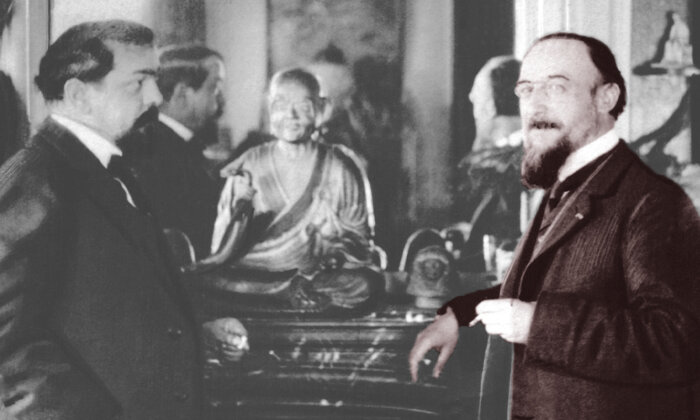
Contemplating this book, I asked a selection of young people: “Have you ever heard of Erik Satie?” Across the board, his name registered nothing. The moment I played the Gnossiennes and Gymnopédies however — “Oh, I LOVE those!” Everyone seems to know one or two, as if they’re now part of some collective audio memory. There are three Gymnopédies and six Gnossiennes, all composed between 1887 and 1895. Most people seem to know either “Gymnopédie #1” or “Gnossienne #1.” They are familiar props in TV adverts, film soundtracks, chill-out compilations. They are both just over three minutes — i.e., pop single length, not grand classical excursion.
In the Gymnopédies, Roger Shattuck writes, Satie “takes one musical idea and … regards it briefly from three different directions.” “Gymnopédie #1” is probably Satie’s best-known piece. You reach for words like stately, unhurried, spacious, melancholy, poignant … but the music’s ineluctable strangeness remains. It is like a painting by Velázquez, where everything looks correct but the perspective seems somehow subtly awry. You’re pulled in without quite knowing why. Technically, there is no better description than this, from Constant Lambert: “Melodically speaking we find the juxtaposition of short lyrical phrases of great tenderness with ostinatos of extreme and deliberate bareness …. The strangeness of Satie’s harmonic colouring is due not to the chords themselves, but to the unexpected relationships he discovers between chords.”
“Gnossienne #1” radiates a mood of … what, exactly? Lightly anxious contemplation? Oddly contented melancholy? An icy but heartwarming breeze? For the three Gymnopédies, Satie specifies sad and grave in his instructions for pianists; but the mood is softer, gentler, more wistful. Slightly bruised, but not down and out. The Gymnopédies and Gnossiennes do not sound like 19th-century concert hall music; they sound like pieces composed by someone who knew there would one day be recording studios, CDs, downloads. They feel as old as sand, but strangely contemporary. To have even a wisp of your music eternally circling people’s minds like pollen in the air or a constellation in the night — this is not nothing. Who could have predicted that these brief, evanescent, weightless solo piano pieces would have such a prolonged afterlife? Satie is a crossover artiste, his catalogue ever reviving and never out of print.
A creature of his time, he anticipates a host of things we now take for granted — a world of adverts, headphones, leisure time, music as personal soundtrack.
If you only know these few exquisite morsels, you only know a tiny fraction of Satie. Until relatively recently, I didn’t know too much more myself. Dip a toe into the Satie rock pool and you soon discover a cove, a coastline, an entire horizon. As well as his solo-piano works, he wrote a riotous avant-pop ballet (Parade); a comical Christian allegory (Uspud); an intimate drama with samplings of Greek philosophy (Socrate); and his final work was a groundbreaking movie soundtrack (Cinema). A creature of his time, he anticipates a host of things we now take for granted — a world of adverts, headphones, leisure time, music as personal soundtrack.
In some ways, Satie feels like a long-ago ornament; at the same time, more playfully modern than our own increasingly doctrinaire era. This contradictory pulse — on the one hand, on the other — can be found in all aspects of his life. He is a one-man synthesis of Catholicism and Protestantism. He reconciles counterpoints of high culture and popular song. Founder of a church, habitué of low dives. His day job — or night apprenticeship — was in small clubs, memorizing the melodies of popular songs: things that made people dance and smile and sing. He is knowledgeable about ancient forms, but never wedded to how things have always been done. He loves both raucous cabaret songs and the sacred music of Palestrina. His work rings with marches, waltzes and hymns. He makes angular ballet from popular melodies; infuses classical forms with the ribald life of popular art.
He may have been an elective celibate or madly passionate — or both. There is his five-month-long amour with the artist Suzanne Valadon, shining like a sun over stony fields. Maybe he carries her memory deep inside for the rest of his life — a personal alchemical emblem, the lush rose on his barren cross. Such things do happen.
He could snub people for apparently trivial reasons — status and worth, we should always remember, are two completely different things — but he was generous with his time, especially when it came to young people. He could be prickly if he thought he was being patronized: some of his most barbed wit is reserved for those who have power and don’t deserve it. (In today’s parlance: he always punched up, not down.) He lived most of his life in a state of near-indigence, but when money did arrive he’d spend it on a brace of velvet suits. There is copious testimony as to the utter shambles of his living space — yet the moment he steps outside this tiny cell he is a smiling dandy, spick and span, his own ambulant branch of Yohji Yamamoto.
The Satie life contains so much murk; his music sparkles with riverine clarity.
Like Magritte’s painting of a bowler-hatted gentleman standing between two creatures, one of sea and one of air: neither fish nor fowl.
Maybe what we rush to define as opposites should not always be seen that way.
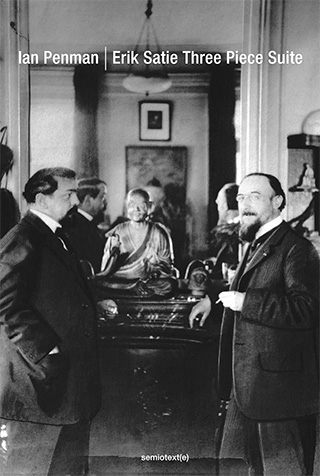
Ian Penman is a British writer, music journalist, and critic. His first original book, “Fassbinder Thousands of Mirrors” (Semiotext(e), 2023), won the RSL Ondaatje Prize for Literature and the James Tait Black Memorial Prize for Biography in 2024. This article is adapted from his book “Erik Satie Three Piece Suite” (Semiotext(e)).
For more than three decades, Brazilian climate scientist Carlos Nobre has warned that deforestation of the Amazon could push this globally important ecosystem past the point of no return. Working first at Brazil’s National Institute for Space Research and more recently at the University of São Paulo, he is a global authority on tropical forests and how they could be restored. In this interview, he explains the triple threat posed by the climate crisis, agribusiness and organised crime.
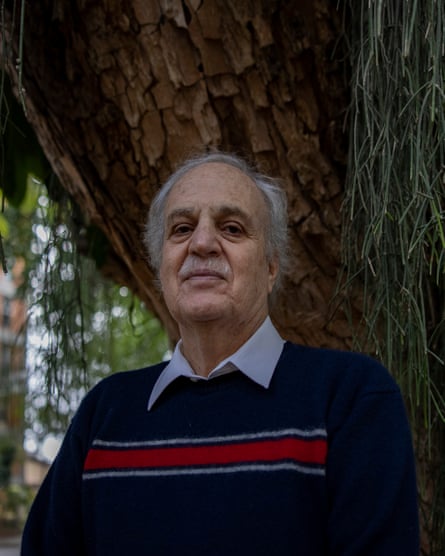
Carlos Nobre fears that the world is not acting with enough urgency. Photograph: Victor Moriyama/The Guardian
What is the importance of the Amazon? As well as being incredibly beautiful, the world’s biggest tropical rainforest is one of the pillars of the global climate system, home to more terrestrial biodiversity than anywhere else on the planet, a major influence on regional monsoon patterns and essential for agricultural production across much of South America.
You were the first scientist to warn that it could hit a tipping point. What does that mean? It is a threshold beyond which the rainforest will undergo an irreversible transformation into a degraded savannah with sparse shrubby plant cover and low biodiversity. This change would have dire consequences for local people, regional weather patterns and the global climate.
At what level will the Amazon hit a tipping point? We estimate that a tipping point could be reached if deforestation reaches 20-25% or global heating rises to 2.0-2.5C [above preindustrial levels].
What is the situation today? It is very, very serious. Today, 18% of the Amazon has been cleared and the world has warmed by 1.5C and is on course to reach 2.0-2.5C by 2050.
How is this being felt now? The rainforest suffered record droughts in 2023 and 2024, when many of the world’s biggest rivers were below the lowest point on record. That was the fourth severe drought in two decades, four times more than would have been expected in an undisrupted climate.
Every year, the dry season is becoming longer and more arid. Forty-five years ago, the annual dry season in the southern Amazon used to last three to four months and even then there would be some rain. But today, it is four to five weeks longer and there is 20% less rain. If this trend continues, we will reach a point of no return in two or three decades. Once the dry season extends to six months, there is no way to avoid self-degradation. We are perilously close to a point of no return. In some areas, it may have already been passed. In southern Pará and northern Mato Grosso, the minimum rainfall is already less than 40mm per month during the dry season.
Aren’t those the areas where the most forest has been cleared for cattle ranching and soy plantations? Yes. Livestock grazing is a form of ecological pollution. The areas that have been most degraded by pastures are at, or very close to, a tipping point. That is all of the southern Amazon – more than 2m sq km – from the Atlantic all the way to Bolivia, Colombia and Peru. Scientific studies show degraded pastures recycle only one-third or one-fourth as much water vapour as a forest during the dry season.
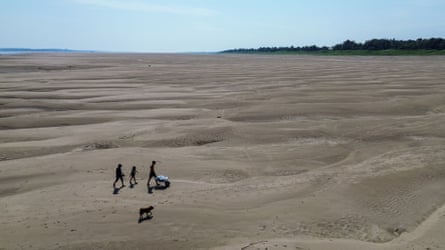
People walk along the dried up bed of the Solimões River in Brazil, which goes on to form the Amazon River. Photograph: Raphael Alves/EPA
There is so much water in the Amazonian soil. Trees with deep roots bring it up and release it into the air, mostly through transpiration by the leaves. In this way, forests recycle 4-4.5 litres of water per square metre per day during the dry season. But degraded land, like pastures, recycles only 1-1.5 litres. That helps to explain why the dry seasons are growing one week longer every decade.
Why isn’t an Amazonian savannah a good idea? It would be less humid and more vulnerable to fire. The tropical forest generally has 20-30% more annual rainfall than tropical savannahs in Venezuela, Colombia, Bolivia and Brazil. The Amazon also has fewer lightning strikes because the clouds are lower than in the savannah. But the most important difference is the fact that a rainforest has a closed canopy so only 4% of solar radiation reaches the forest floor. This means there is always very little radiated energy for the evaporation of the water so the forest floor vegetation and soil are very wet. Historically, this means that lightning strikes only start very small fires that kill only one or two trees but do not spread. In evolutionary terms, this is one reason why there is so much biodiversity in the rainforest; it is resilient to fire. But once it starts to dry and degrade, it is easier to burn.
How would an Amazon tipping point affect the global climate? The forest in the south-eastern Amazon has already become a carbon source. This is not just because of emissions from forest fires or deforestation. It is because tree mortality is increasing tremendously. If the Amazon hits a tipping point, our calculations show we are going to lose 50-70% of the forest. That would release between 200 and 250bn tonnes of carbon dioxide between 2050 and 2100, making it completely impossible to limit global warming to 1.5C.
Large areas of the Amazon have been cut down for soy plantations. Photograph: Léo Corrêa/AP
Brazil is one of the world’s biggest agricultural exporters. How would a tipping point affect global food security? Almost 50% of the water vapour that comes into the region from the Atlantic through trade winds is exported back out of the Amazon on what we call “flying rivers”. I was the first to calculate the huge volume of these flows: 200,000 cubic metres of water vapour per second. My former PhD student, Prof Marina Hirota, calculated that tropical forests and Indigenous territories account for more than 50% of the rainfall in the Paraná River basin in the far south of Brazil, which is a major food-growing area. These flying rivers also provide water for crops in the Cerrado, Mato Grosso, Mato Grosso do Sul, Goiás, Paraná, Santa Catarina, Rio Grande do Sul, Paraguay, Uruguay, and all that northern Argentina agricultural area. So if we lose the Amazon, we are going to reduce the rainfall there by more than 40%. Then you can forget agricultural production at today’s levels. And that would also contribute to converting portions of the tropical savannah south of the Amazon into semi-arid vegetation.
What would be the consequences for nature and human health? The devastation of the most biodiverse biome in the world would also affect hundreds of thousands of species and raise the risks of zoonotic diseases crossing the species barrier. For the first time since the Europeans came to the Americas, we are experiencing two epidemics: Oropouche fever, and Mayaro fever. In the future, the degradation of the Amazon forest will lead to more epidemics and even pandemics.
How can an Amazonian tipping point be prevented? In 2019, [the American ecologist] Tom Lovejoy and I recommended nature-based solutions, such as large-scale forestry restoration, zero deforestation, the elimination of monocultures, and a new bioeconomy based on social biodiversity. We argued that it is possible to build back a margin of safety through immediate and ambitious reforestation particularly in areas degraded by largely abandoned cattle ranches and croplands. This prompted a lot of research and new thinking.
Is the Brazilian government adopting these ideas? Progress fluctuates depending on who is in power. In August 2003-July 2004, we had about 27,000 sq km of deforestation – a huge number. But the first Lula government, with Marina Silva as environment minister, brought the figure down and it reached 4,600 sq km by 2012. Later, during Bolsonaro’s government, it went up to 14,000 sq km. And now, with Lula and Marina back, it is fortunately going down again and there are several beautiful new reforestation projects. This is progress, but not enough. Now I’m saying to Marina Silva, ‘Let’s get to Cop30 with the lowest deforestation in the Amazon ever, less than 4,000 sq km.’ Who knows? But anyway, Brazil is working hard.
Nobre believes that more than half of the forest fires in the Amazon were began by arsonists. Photograph: Carl de Souza/AFP/Getty Images
You have warned that criminal activity is a major new risk. Why? Last year, we had a record-breaking number of forest fires in all biomes in tropical South America – from January to November 2024, the Amazon had more than 150,000. Studies by INPE (The Brazilian Space Agency) show something very, very serious is happening. More than 98% of the forest fires were man-made. They were not lightning strikes. This is very worrying. Because even when we are reducing deforestation, organised crime is making it worse. In my opinion, more than 50% of forest fires were arson.
All Amazonian countries are trying to reduce deforestation. That is wonderful, but then what to do to combat organised crime? They control a $280bn business – drug trafficking, wildlife trafficking, people trafficking, illegal logging, illegal gold mining, illegal land grabbing. It is all connected. And these gangs are at war with the governments. That’s one of the main reasons I’m becoming concerned because I know reducing deforestation is doable, so is forestry restoration. But how to combat organised crime?
How have your feelings about this problem changed? I am worried that we are not acting with sufficient urgency. Thirty-five years ago, I thought we had plenty of time to get to zero deforestation and to combat the climate problem. Back then, deforestation was 7% and global warming was a little bit above 0.5C. I was not pessimistic because I felt we could find solutions. At the Rio Earth Summit in 1992, many people were saying that the world should aim for zero emissions by the year 2000. Unfortunately, nobody moved. Emissions continued to rise and they hit another record high last year. We now face a climate emergency. I am very, very concerned.
Tipping points: on the edge? – a series on our future
Composite: Getty / Guardian Design
Tipping points – in the Amazon, Antarctic, coral reefs and more – could cause fundamental parts of the Earth system to change dramatically, irreversibly and with devastating effects. In this series, we ask the experts about the latest science – and how it makes them feel. Tomorrow, Louise Sime talks about Antarctic tipping points
Have you ever wondered why we have wide/width, but not high/highth? The simple answer is, we used to. Highth was the original word, but over time it morphed into the height we use today.
Like rough stones tumbling down a stream, words lose their jagged edges as generations of speakers smooth them away.
But not every word gets polished. Some just get lost in the current, obscured by their more popular opposites. This week, we’re diving in and bringing five of these uncommon antonyms up for air.
malison
PRONUNCIATION:
(MAL-uh-zuhn/suhn)
MEANING:
noun: A curse.
ETYMOLOGY:
From Anglo-French maleiçun (curse), from Latin maledictio (curse), from maledicere (to curse), from mal- (bad) + dicere (to speak). Earliest documented use: 1300.
NOTES:
Today’s word has a better-known synonym, malediction, though both derived from the same Latin root. You could say they are cuss-ins. The opposite is benison, not to be confused with venison (no benison to the deer).
Consciousness, sexuality, androgyny, futurism, space, the arts, science, astrology, democracy, humor, books, movies and more