The Lord of Sorrow sometimes bring sadness in with him when he appears – and he also highlights areas of life where decisions are needed, and where we feel unable to make important choices. This indecision leads to sadness and frustration.So on a day when he rules, we need to be exploring our more unhappy feelings, and wondering if there are issues that we are feeling unable to deal with, which are causing us pain or confusion. However, it’s important not to expect ourselves to deal with conflicts or problems until we feel stronger.So, having identified our difficulties, we need to file them in the ‘to do…’ box and then treat ourselves very gently for the rest of the day. In regaining our strength we shall be much better equipped to deal with things (you might notice the connection here with the Aeon – all decisions have their moment)If the Three of Swords rules on a day when you have no particular difficulties that need dealing with, you might like to spend a little time considering the whole concept of sorrow. We have become very afraid of experiencing pain – we will often go to great lengths to fail to enter into our own pain with a generous, gentle heart.Yet having the ability to face your own pain makes it into a more tolerable event when, sadly, it happens in your life. Look at the ways in which you have dealt with past pain. Try to decide if you feel you have done the best you could for yourself – and if not, work out why not.When we get hurt, we often make our suffering much worse by barbing the pain with guilt, self-accusation and bitterness directed to both ourselves and others. Often we do this as a way of trying to avoid feeling our pain – we distract ourselves with things that are basically irrelevant, but which eventually end up fouling the pure experience of hurting.Each one of us has a right to experience our sadness without judgement, nor recriminations, nor guilt. If, rather than avoiding hurt, we engage it, sometimes it can provide a clear energy for transformation, creativity and development.I don’t advocate suffering as an efficient spiritual tool, but there are times when, since you hurt anyhow, you can direct the deep emotional experience into new insight. And in so doing, you might well find your way through your pain with fewer after-effects and dark memories.Affirmation: “I trust myself to feel my own pain”
When Sylvia Plath died, she not only left behind a prolific life but also her unpublished literary masterpiece, Ariel. Her husband, Ted Hughes, brought the collection to life in 1966, and its publication garnered worldwide acclaim. This collection showcases the beloved poet’s brilliant, provoking, and always moving poems, including “Ariel” and once again shows why readers have fallen in love with her work throughout the generations.
Sylvia Plath was an American poet, novelist, and short story writer. Known primarily for her poetry, Plath also wrote a semi-autobiographical novel, The Bell Jar, under the pseudonym Victoria Lucas. The book’s protagonist, Esther Greenwood, is a bright, ambitious student at Smith College who begins to experience a mental breakdown while interning for a fashion magazine in New York. The plot parallels Plath’s experience interning at Mademoiselle magazine and subsequent mental breakdown and suicide attempt.
What if you woke up one morning and found you’d acquired another self―a double who was almost you and yet not you at all? What if that double shared many of your preoccupations but, in a twisted, upside-down way, furthered the very causes you’d devoted your life to fighting against?
Not long ago, the celebrated activist and public intellectual Naomi Klein had just such an experience―she was confronted with a doppelganger whose views she found abhorrent but whose name and public persona were sufficiently similar to her own that many people got confused about who was who. Destabilized, she lost her bearings, until she began to understand the experience as one manifestation of a strangeness many of us have come to know but struggle to define: AI-generated text is blurring the line between genuine and spurious communication; New Age wellness entrepreneurs turned anti-vaxxers are scrambling familiar political allegiances of left and right; and liberal democracies are teetering on the edge of absurdist authoritarianism, even as the oceans rise. Under such conditions, reality itself seems to have become unmoored. Is there a cure for our moment of collective vertigo?
Naomi Klein is one of our most trenchant and influential social critics, an essential analyst of what branding, austerity, and climate profiteering have done to our societies and souls. Here she turns her gaze inward to our psychic landscapes, and outward to the possibilities for building hope amid intersecting economic, medical, and political crises. With the assistance of Sigmund Freud, Jordan Peele, Alfred Hitchcock, and bell hooks, among other accomplices, Klein uses wry humor and a keen sense of the ridiculous to face the strange doubles that haunt us―and that have come to feel as intimate and proximate as a warped reflection in the mirror.
Combining comic memoir with chilling reportage and cobweb-clearing analysis, Klein seeks to smash that mirror and chart a path beyond despair. Doppelganger What do we neglect as we polish and perfect our digital reflections? Is it possible to dispose of our doubles and overcome the pathologies of a culture of multiplication? Can we create a politics of collective care and undertake a true reckoning with historical crimes? The result is a revelatory treatment of the way many of us think and feel now―and an intellectual adventure story for our times.
Naomi Klein is a Canadian author, social activist, and filmmaker known for her political analyses; support of ecofeminism, organized labour, and leftism; and criticism of corporate globalization, fascism, ecofascism and capitalism. As of 2021, she is an associate professor, and professor of climate justice at the University of British Columbia, co-directing a Centre for Climate Justice. Klein first became known internationally for her alter-globalization book No Logo (1999). The Take (2004), a documentary film about Argentine workers’ self-managed factories, written by her and directed by her husband Avi Lewis, further increased her profile. The Shock Doctrine (2007), a critical analysis of the history of neoliberal economics, solidified her standing as a prominent activist on the international stage and was adapted into a six-minute companion film by Alfonso Cuaron and Jonás Cuarón, as well as a feature-length documentary by Michael Winterbottom. Klein’s This Changes Everything: Capitalism vs. the Climate (2014) was a New York Times nonfiction bestseller and the winner of the Hilary Weston Writers’ Trust Prize for Nonfiction. In 2016, Klein was awarded the Sydney Peace Prize for her activism on climate justice. Klein frequently appears on global and national lists of top influential thinkers, including the 2014 Thought Leaders ranking compiled by the Gottlieb Duttweiler Institute, Prospect magazine’s world thinkers 2014 poll, and Maclean’s 2014 Power List. She was formerly a member of the board of directors of the climate activist group 350.org.
Brian Josephson, after whom the Josephson effect in electronics is named, hopes to find the answer to the conundrum of consciousness in biology
DENYSE O’LEARY AUGUST 24, 2024 (mindmatters.ai)
At Closer to Truth,Robert Lawrence Kuhn interviewed Welsh physicist Brian Josephson on the topic, “Must the Universe Contain Consciousness?” (June 12, 2024, 8:39 min). Josephson won the Nobel Prize for Physics in 1973 for predicting the Josephson effect.
He sees consciousness as an aspect of the universe that we can’t ignore, even as he is not sure what to make of it:
Our universe seems fine-tuned for life, with the constants of physical laws having to be within tight boundaries. Does this mean that the universe has a goal of consciousness? Is there a directedness of the universe toward consciousness? Is consciousness entirely contingent or is it something special, even a ultimate object of universal development?
Here are a couple of selections prepared from the auto transcript at YouTube:
Kuhn asks how consciousness can underlie the universe, given that the universe has been around for billions of years but conscious life on Earth got started “just in the last few million years, even if you talk about animal consciousness.”
Josephson: But that [2:58] doesn’t tell us how universe begins. There lots of problems there. So therefore I propose that something happening beyond the universe and on a larger and possibly infinite time scale has this organization and is doing things like bringing a universe into being and setting up its laws and so on, and perhaps partly directing its evolution.
Kuhn: So those are very big [3:31] statements, which you say very calmly and very serenely — any one of which could cause, you know, nuclear wars between between scientists … you’ re introducing some radically new ideas, to claim that biology, that life and consciousness, is so fundamental and yet you don’t rely on traditional religious arguments. Your arguments basically have nothing to do with traditional religious arguments. So I find that interesting, that your arguments come from a, you know, a totally different perspective than others who made proto-consciousness or protobiological creator of the universe or, you know …
Note: Josephson seems to have stumbled on the problem of how consciousness could arise as an accident in a purely physical universe. It makes more sense, he thinks, to assume that it predates, creates, and organizes the universe. Yet, as Kuhn marvels, he reasons his way to precisely the sorts of conclusions generally accepted in major world religions.
Kuhn: How does physics get you to that place where you see biology in such a primordial role? [5:36]
Josephson: Well, it’s in a way more satisfactory [5:47] from the aesthetic point of view because conventional physics, you’re putting all your bets on one particular, rather complicated, piece of mathematics. And people got into that mathematics just by trying to follow the same route as before, postulating symmetries and dimensions. And they like it just because it’s the version which at least is not in disagreement with what we know but on is assuming lots of things that we don’t know. So that’s just as theological, in fact.
But we do know things [6:24] about the mind, that it can do mathematics, create music, and be logical and so on — which, by the way, is not really satisfactorily explained by conventional science. So if we take this biological point of view — it’ s also cognitive — then we have these general principles on which the mind develops which can partly be understood in models and they fit with how we find minds actually developing. So there’s a kind of well-defined basis on which to try and go further and put mind into understanding things like why the Universe has particular laws.
≻───── ⋆☆⋆ ─────≺
Josephson is clearly hoping that biology will explain consciousness because physics cannot, and he is unwilling to dismiss it as an illusion.
That hope — situating consciousness in biology — helps account for the growing presence of panpsychism in science. Many panpsychists see consciousness as a natural feature of life forms, contemporary with the very origin of life. As a point of view, it is more coherent than neo-Darwinian attempts to explain consciousness away.
The basic problem, of course, is that the consciousness that both panpsychists and neo-Darwinians most need to account for is the human type — and that remains an outlier. Even if we accept the panpsychist view that consciousness underlies the universe and is a basic property of all living things, we would still need an account of what used to be called the gift of reason, the gift that humans have and other life forms don’t.
Thus, Josephson is right to think he is onto something — even if he is not sure what.
You may also wish to read: Researchers: Living cells’ cognition drives evolution. “Natural selection is cognitive selection,” they say, arguing that cells exhibit meaning and purpose, contrary to Darwinian evolution theories. Cognitive selection, as present even in the earliest living cells, directs the history of life in their view, enabling meaning and purpose.
DENYSE O’LEARY
Denyse O’Leary is a freelance journalist based in Victoria, Canada. Specializing in faith and science issues, she is co-author, with neuroscientist Mario Beauregard, of The Spiritual Brain: A Neuroscientist’s Case for the Existence of the Soul; and with neurosurgeon Michael Egnor of the forthcoming The Immortal Mind: A Neurosurgeon’s Case for the Existence of the Soul (Worthy, 2025). She received her degree in honors English language and literature.Follow Denyse Twitter
BLACK ROCK CITY, Nev. — Before I went to Burning Man, I used to think I was not a person who would enjoy Burning Man.
I am the type who likes camping in nature and exploring wild places where I know I’ll run into almost no other humans. But overnighting for a week in a pop-up desert city where there are orgies and loud music at all hours, where people seemingly needed to be social at all times — no thanks! I imagined I’d need to be intoxicated for nearly the entire time to avoid getting anxious and judgy, and I was already exhausted just thinking about it.
Furthermore, in my 20s, I lived in San Francisco for years and was always creeped out when all the dust-ravaged Burners returned from the festival wearing their steampunk accessories, recounting their transformative experiences and blathering incoherently about how “the playa provides.” I did not want to look or sound like those people. So in 2016, when a former boyfriend asked me to go, and I reluctantly agreed, it seemed like chances were high that it would be a disaster.
Eight years later, I’m writing this from the playa, on my fifth burn. I almost certainly look and sound like all the other manic, dehydrated, filthy proselytizers, and it feels fantastic. I’m still amazed about how wrong I was previously about what this place is like and how many things non-Burners continue to get wrong about Black Rock City. So I went around asking Burners this year about the misconceptions they’ve also encountered about the event. Here’s what they said.
Nine-time Burner Dylan Hart (playa name: Dirty Wolf) photographed on the playa on Aug. 27, 2024. Ashley Harrell/SFGATE
The playa operates on a barter economy
“People think the gifting culture is not about gifting but about trading. That’s the most consistent one that I’m like, you guys are so off-base. They think that if I give you something, I need something else in my pocket to give you back. It was explained to me by a veteran Burner before I came — because it was a misconception I’d had as well — so it was explained to me that if anybody expects when they give you a gift anything more than a hug back, then they don’t understand the concept. And so for me, gifting is such a key feature to what we do out here, so that would be the one I would like the outside world to understand a little bit more.”
Erin Douglas (playa name: Founder) is the creator of Black! Asé, an art piece that calls to mind a barber shop, where men can reflect, heal and connect with themselves and others.Ashley Harrell/SFGATE
All Burners do is party
“There’s a misconception that [Burning Man] is mostly about partying, you know, going crazy, and that it’s relatable to other festivals. The reality is that it’s so much deeper than that. It can be all of those things. It can be none of those things. There’s something for everyone. And a lot of times, the playa meets you where you are and gives you what you need, and you don’t always know what that is. And so that could be parties. It could be being by yourself. It could be so many things.”
— Erin Douglas (playa name: Founder), artist
Charis Mills, a first-time burner from England, is photographed on the playa on Aug. 26, 2024. Ashley Harrell/SFGATE
“People think it’s just a place to party. I mean, yes, there are drugs. Yes, people are going to have sex. If that is why you come here, good for you. People are very judgmental about why people come here, but actually, you can come for any reason you want.”
— Charis Mills, first-time burner from England
Longtime burner Frank Binney (playa name: Riptide). Ashley Harrell/SFGATE
Burning Man is only for the young and beautiful
“Many people wrongly assume you have to be young, beautiful and a devotee of electronic dance music to enjoy Burning Man. In reality, the event offers positive experiences to people of all ages and walks of life. I didn’t start Burning until I was on Medicare. I keep coming back because of the amazing art and all the remarkable people I meet from all over the world.”
— Frank Binney (playa name: Riptide), longtime burner
Aaron and Karen Pugmire, who have attended Burning Man twice with their kids, are photographed with their 5-year-old and 3-year-old on the playa on Aug. 27, 2024. Ashley Harrell/SFGATE
Bringing kids is a terrible idea
“People always say, oh, [Burning Man] is so logistically difficult. It’s so hard to do. So why would you bring your kids? But when you’re a parent, everything’s hard to do. If you aren’t going to do hard things, you aren’t going to do anything. … This is actually the best place for kids.”
— Aaron Pugmire, attending Burning Man for the second time with partner Karen Pugmire (playa name: Skittles) and their 5-year-old and 3-year-old
“People think there’s a lot of things happening that kids shouldn’t see, which just isn’t true. Human beings like to do special, private things in private.”
— Karen Pugmire
Andre Williams (playa name: Dre) is the founder of Camp Cosmic Giggle. Ashley Harrell/SFGATE
Burning Man is a vacation
“I think that people think that it’s some sort of vacation. … But you have to bring your water, you have to manage how you’re going to sleep, how you’re going to dress, be prepared for the weather, etc. And I think people gloss that over. … The truth is that it’s a festival of people who choose to work in an unconventional way towards a payoff.
“If you go there and you’re not doing any work, but you’re simply running around, if you’re being a spectator and you’re not actually involved in providing any actual energy to what people are trying to create, then it can see very empty and you can feel very on the outside of what everyone is so blissed out about. But the second you put on some work gloves, or you help out someone, or you participate, you kind of get it.
“… There’s a saying that you get the burn you deserve, not the burn you want. … You have to sort of be comfortable that you will be challenged for being who you are. And there’s no easy street where everyone is just like love and rainbows. That’s just been my experience as a longtime Black Burner.”
— Andre Williams (playa name: Dre), founder of Camp Cosmic Giggle
Adria Adams, a six-time Burner and camp member at Burning Sky, was photographed on the playa on Aug. 27, 2024. Ashley Harrell/SFGATE
You can skydive into Burning Man for free
“No, you cannot skydive into Burning Man for free. Not only do you have to buy a ticket, but you also have to buy a slot in order to be able to skydive and then meet all the other skydiving requirements in order to be able to do it. You have to have at least 150 jumps. You have to be current on your equipment. You have to have at least 50 jumps in the last 12 months.”
— Adria Adams, six-time Burner and camp member at Burning Sky (the skydiver camp)
Adrienne Romo, a first-time burner from Texas, was photographed with her son Anthony Soueid on the playa on Aug. 26, 2024. Ashley Harrell/SFGATE
The lines are always terrible
“That didn’t happen to us! We had seen on the news in previous years that the lines were long, with eight lanes of traffic! But we came [Monday] night and got in pretty quick.”
— Adrienne Romo, first-time burner from Texas who came with her son, Anthony Soueid
Karina O’Connor (playa name: Lorax) is the manager of the Earth Guardians, which educates and cheerleads the “leave no trace” ethos of Burning Man. Ashley Harrell/SFGATE
There’s nothing alive on the playa
“There is very much something alive here, and there are a lot of things that are alive on the edges of the Black Rock Desert. The fairy shrimp are real, and they can be big. They come out in the winter, when the whole playa is covered with water, typically. It basically rehydrates the fairy shrimp, and they come up, and you can go out and find them. I didn’t see any myself last year [when the playa became a mud pit], but I suppose it is possible that someone did.”
— Karina O’Connor (playa name: Lorax), manager of the Earth Guardians
Ashley Harrell is a contributing editor covering California’s parks for SFGATE, where she’s worked since 2020. For the past nine years, she’s also worked as a freelance writer for Lonely Planet, reporting from 17 countries and co-authoring more than 50 travel guidebooks. Her story about tribal members protecting Yosemite National Park from wildfire won an SF Press Club award in 2021, and her story about wolf-rancher conflicts in northeastern California was listed as “notable” in the Best American Science and Nature Writing in 2022. Send story tips or comments to ashley.harrell@sfgate.com.
A phenomenon referred to as “population stereotypes” helps explain how predictable human responses create the illusion of telepathy.
By: Chris French
(thereader.mitpress.mit.edu)
There is a hidden cause behind a fun little demonstration of an ostensibly paranormal experience that I often include in public talks on anomalistic psychology, especially when I have a reasonably large audience. I explain to my audience that an important part of proper skepticism is to always be open to the possibility that you may be wrong. In that spirit, I tell the audience that I would like to do a little experiment with them to see just how psychic they are. I tell them that I am going to try to telepathically send a simple message from my mind to theirs. “I’m thinking of a number between one and ten,” I say. “Not three, because that’s too obvious. I want you to make a mental note of the first number that comes into your mind now!”
I then explain that, with such a large audience, we would expect around 10 percent of them to guess the number correctly just by chance, so we should only get ecstatically excited if considerably more than 10 percent of the audience get it right. I then, apparently somewhat nervously, ask, “Did anybody think of the number seven? If you did, raise your hand.” With a large audience, I can, in fact, be very confident that around a third of them will put up their hand.
Feigning surprise, I will try another, slightly more complicated example. “This time I’m thinking of a two-digit number between one and fifty. They are both odd digits and they are not the same. So, it could be fifteen — one and five, both odd digits, not the same — but it could not be eleven — both odd digits but they are the same. What is the first number that fits that description that comes into your mind now?”
I then ask, as if expecting no one to have got it right this time, “Did anyone think of the number thirty-seven?” Once again, about a third of the audience will put up their hand. I will then add, “Did anyone think of thirty-five?” About a further quarter of the audience will raise their hand. “Sorry, that was my fault,” I explain. “I thought of thirty-five first and then I changed my mind.”
What is going on here? Any audience members who believe in ESP may well think that it has just been demonstrated. More skeptical members may be at a loss to explain what they have seen (and possibly directly experienced). Is it possible that I had simply conspired with all those members of the audience who got it right by telling them in advance to raise their hands in response to my questions? That would seem unlikely. Was it just a coincidence that so many more people guessed correctly than would be expected on the basis of chance alone? Again, possible but extremely unlikely.
The actual explanation is a phenomenon that psychologists refer to as population stereotypes. For most people faced with this task, when they are asked to make a mental note of the first number that comes into their head, they assume this is pretty much a random process. Therefore, they expect the frequencies of response to be more or less equal across the range of response options. In fact, this is not what happens. Responses tend to cluster in reliable and predictable ways, especially with large audiences.
In the first example, about a third of people will choose seven regardless of whatever number I may be thinking of (especially as I have ruled out three as a valid response, which otherwise would also be a popular choice). In the second example, about a third will pick 37 and about a further quarter will choose 35. Note that in neither example do the response rates approach 100 percent, but that is not a problem as people do not expect telepathy to be 100 percent reliable.
There are several other examples of population stereotypes that could be used to fool (at least some of) the unwary that you possess amazing telepathic powers. Tell them your telepathic target is two simple geometric forms, one inside the other. Around 60 percent will choose circle and triangle. Tell them you are thinking of a simple line drawing. Around 10 to 12 percent will draw a little house. It makes for a fun demonstration of the fact that not everything that looks like paranormal actually is. But would anyone ever seriously try to pass off such a demonstration as really involving telepathy?
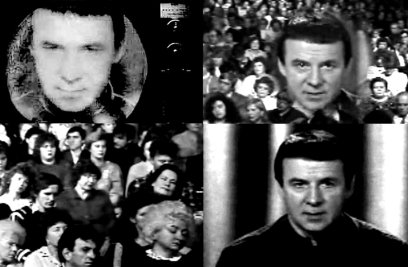
The answer is yes. For example, in the mid-1990s Uri Geller took part in a TV program called Beyond Belief, presented by David Frost, in which, it was claimed, various paranormal phenomena would be demonstrated live for the millions of viewers at home. I was one of those viewers. Uri demonstrated his alleged telepathic powers by supposedly transmitting a message to viewers. Uri had chosen one of four symbols that were presented at the bottom of the screen in the following order: square, star, circle, cross. As the camera slowly zoomed in on his face, Uri said: “I’m visualizing the symbol in my mind . . . and you people at home, millions of you, I’m actually communicating now with millions of people, maybe eleven, twelve, thirteen million people. Here goes. I’m transmitting it to you. I’m visualizing it. Open up your minds. Try to see it. Try to feel it. I’m really strongly passing it to you! One more time . . . okay.” By this point, the upper half of Uri’s face pretty much filled the screen, with the four symbols still displayed across the bottom of the screen. Viewers were instructed to phone in using one of four different numbers to indicate their guess at Uri’s choice of symbol. Over 70,000 viewers did so.
My days of believing that Uri really did possess amazing psychic abilities were long gone by this stage, and I was therefore watching from the perspective of an informed skeptic. It was pretty easy to come up with nonparanormal explanations for all of the demonstrations featured in the program. With respect to this particular demonstration, I was rather pleased with myself for not only stating in advance what Uri’s telepathic target would be but for also correctly stating the order of popularity of the remaining symbols. It was very lucky for Uri that he chose to “telepathically” transmit the star symbol. It was by far the most popular choice of the viewers, with 47 percent of them indicating that this was the symbol that they had “received.” The second most popular was the circle, with 32 percent of the “votes,” followed by the cross (12 percent) and the square (10 percent). If the guesses were completely random, we would expect about 25 percent for each option, so 47 percent choosing the same symbol as Uri is a massively statistically significant outcome. The probability that almost half of the callers chose this symbol just by chance is astronomically low. So, was this really strong evidence of Uri’s psychic powers?
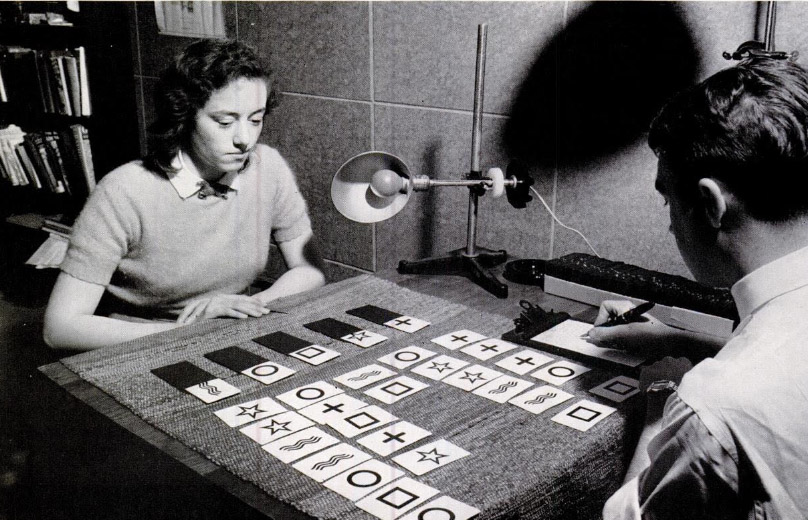
An ESP card experiment being conducted with Zener cards in 1940. Source: Wikimedia Commons
Readers who are familiar with common techniques used to test for ESP will have recognized that the four symbols used in Uri’s demonstration are taken from the five symbols used on Zener cards (the missing symbol is three wavy lines). The cards are named after the person who designed them, perceptual psychologist Karl Zener. A full deck consists of twenty-five cards, five of each design. In a test of telepathy, a “sender” would take each card from a shuffled deck in turn and attempt to telepathically transmit the image on the card to a “receiver.” The receiver would record their guess of which card the sender was looking at. By chance alone, we would expect around five of the receiver’s guesses to be correct. If the receiver scores significantly more than five, this might be taken as evidence of ESP. However, it has been known for over eight decades that people are more likely to guess certain symbols compared to others. Back in 1939, Frederick Lund asked 596 people to each generate a random sequence of five symbols from the Zener set. By far the most popular symbol was — you’ve guessed it — the star, accounting for 32 percent of the responses compared to the 20 percent that would be expected by chance alone. So, as I said, it really was lucky for Uri that he chose the star as his telepathic target (assuming that it was just luck).
Chris French is Emeritus Professor and Head of the Anomalistic Psychology Research Unit in the Psychology Department at Goldsmiths, University of London. He is a Fellow of the British Psychological Society and of the Committee for Skeptical Inquiry and a Patron of Humanists UK. He is the coauthor of “Anomalistic Psychology: Exploring Paranormal Belief and Experience” and author of “The Science of Weird Shit,” from which this article is excerpted.
The Onion: Let’s start off with an easy question. What do you think about rimming? Pope Francis: Can we please stick to the topic of religion and the papacy?
The Onion: What was your earliest sexual memory? Pope Francis: [Makes sign of the cross]
The Onion: Will the Catholic Church ever change its stance on banana-flavored condoms? Pope Francis: I’m going to give you five seconds to leave.
The Onion: What if we just stick to questions about like, piss play? Is that sacrilege? Pope Francis: Piss what?
The Onion: Where do you fall on bestiality and consent between animals? Pope Francis: [Whispering to translator] I thought you said they wrote for Catholic Digest Magazine?
The Onion: Does God endorse Furries since he created animals and people on the same day? Pope Francis: You traveled all the way to The Vatican to ask me that?
The Onion: An anonymous Onion reader asks: “My girlfriend recently asked if we could have an open relationship, but I’m nervous about expanding my horizons, especially with men. Do you have any advice for a so-called ‘threesome virgin?’” Pope Francis: Pater Nostro, qui es in caelis, sanctificetur noem tuum. Advenlat regnum tuum. Fiat voluntus tua, silcut in caelo et in terro.
The Onion: What’s the Catholic Church’s official policy on pegging? Pope Francis: [Inaudible praying over rosary beads]
The Onion: Do you have a bathroom we could use? Pope Francis: I am begging you to leave.
The Onion: Okay, we’re not really getting anywhere. How about this: Do you ever find yourself getting aroused in the confessional booth? I mean, you hear a sultry or smoky voice, and yet you can’t see them. That sounds pretty erotic, no? Pope Francis: This is absolutely not an appropriate question. A congregant’s time in the confessional is a moment of connection between them and he Lord Our God, for which the priest is merely a conduit.
The Onion: Follow-up question: do you think God gets aroused? Pope Francis: Merciful Lord, give me strength.
The Onion: Okay, time for rapid fire! You have 10 seconds to answer the following: Dom or sub? Pope Francis: [Silence]
The Onion: Missionary or doggy style? Pope Francis: [Silence]
The Onion: Turn on or turn off: uncircumcised penis. Pope Francis: [Silence]
The Onion: What is your stance on ass play? Pope Francis: [Silence]
The Onion: Professional or amateur porn? Pope Francis: [Silence]
The Onion: That’s a tough one. There’s really good amateur nowadays. Pope Francis: [Silence]
The Onion: Pick one you could never live without: dildo, vibrator, or butt plug. Pope Francis: [Silence]
The Onion: Okay. I’m just going to say butt plug. Turn on or turn off: full bush? Pope Francis: [Long silence] God help us all.
The Onion: Top or Bottom? Pope Francis: [Rolls eyes.] I suppose being on top puts me closer to God.
The Onion: Have you heard of the Mormon practice of “soaking?” It’s where you can stick your penis in a vagina but if you don’t move around, it technically doesn’t qualify as sex. Pope Francis: Listen, I—wait, really? That’s…I mean, come on. That’s obviously still sex. The P is inside the V! You can’t just pretend that’s not what is happening. Good Lord, I mean, jeez. Those people are nuts.
The Onion: Care to get real about pre-cum for a moment? Pope Francis: Disgusting! These anti-Catholic attacks from The Onion will not be tolerated! Bet you wouldn’t try this with Islam.
The Onion: Many have said that you are the most progressive pope of all time. What do you think of— Pope Francis: Please do not ask me about pegging again.
The Onion: Speaking from your own experience, do you have any advice for incels? Pope Francis: Not really. I am celibate by choice. If I weren’t a man of the cloth, I’d be knee deep in pussy.
The Onion: You pledged to end sexual abuse in the Catholic Church. How’s that going so far? Pope Francis: Let’s stick to questions about rimming, please.
The Onion: Who is your number-one hall pass celeb? Pope Francis: Gotta be St. Amalberga. A 7th-century Belgian girl who was a miracle worker and died at the age of 31. How do you do better than that?
The Onion: What are some things that turn you on? Pope Francis: Smiles. Kindness. Big naturals.
The Onion: Marry, fuck, kill the Father, the Son, and the Holy Spirit? Pope Francis: Fuck the Spirit for sure, marry God, and kill Jesus.
“Yesterday has already vanished among the shadows of the past; to-morrow has not yet emerged from the future. You have found an intermediate space,” Nathaniel Hawthorne wrote of life’s most haunting hour. But what we find in that intermediate space between past and future, between the costumed simulacrum of reality we so painstakingly construct with our waking lives and reality laid bare in the naked nocturnal mind, is not always a resting place of ease — for there dwells the self at its most elemental, which means the self most lucidly awake to its foibles and its finitude.
The disquietude this haunted hour can bring, and does bring, is what another titanic writer and rare seer into the depths of the human spirit — James Baldwin (August 2, 1924–December 1, 1987) — explored 130 years after Hawthorne in one of his least known, most insightful, and most personal essays.
Richard Avedon and James Baldwin. (Photograph courtesy of Taschen.)
In 1964, as the Harlem riots were shaking the foundation of society and selfhood, Baldwin joined talent-forces with the great photographer Richard Avedon — an old high school friend of his — to hold up an uncommonly revelatory cultural mirror with the book Nothing Personal (public library). Punctuating Avedon’s signature black-and-white portraits — of Nobel laureates and Hollywood celebrities, of the age- and ache-etched face of an elder born under slavery and the idealism-lit young faces of the Student Nonviolent Coordinating Committee in Georgia, of the mentally ill perishing in asylums and the newlyweds at City Hall ablaze with hope — are four stirring essays by Baldwin, the first of which gave us his famous sobering observation that “it has always been much easier (because it has always seemed much safer) to give a name to the evil without than to locate the terror within.”
At no time does the terror within, Baldwin argues in the third essay, bubble to the surface of our being more ferociously than in that haunting hour between past and future, between our illusions of permanence and perfection, and the glaring fact of our finitude and our fallibility, between being and non-being. He writes:
Four AM can be a devastating hour. The day, no matter what kind of day it was is indisputably over; almost instantaneously, a new day begins: and how will one bear it? Probably no better than one bore the day that is ending, possibly not as well. Moreover, a day is coming one will not recall, the last day of one’s life, and on that day one will oneself become as irrecoverable as all the days that have passed.
It is a fearful speculation — or, rather, a fearful knowledge — that, one day one’s eyes will no longer look out on the world. One will no longer be present at the universal morning roll call. The light will rise for others, but not for you.
Sometimes, at four AM, this knowledge is almost enough to force a reconciliation between oneself and all one’s pain and error. Since, anyway, it will end one day, why not try it — life — one more time?
After singing some beautiful and heartbreaking Bessie Smith lyrics into his essay — lyrics from “Long Road,” a song about reconciling the knowledge that one is ultimately alone with the irrepressible impulse to reach out for love, “to grasp again, with fearful hope, the unwilling, unloving human hand” — Baldwin continues:
I think all of our voyages drive us there; for I have always felt that a human being could only be saved by another human being. I am aware that we do not save each other very often. But I am also aware that we save each other some of the time.
That alone, Baldwin insists, is reason enough to be, as Nietzsche put it, a “yea-sayer” to life — to face the uncertainty of our lives with courage, to face the fact of our mortality with courage, and to fill this blink of existence bookended by nothingness with the courage of a bellowing aliveness.
In a passage that calls to mind Galway Kinnell’s lifeline of a poem “Wait,” composed for a young friend on the brink of suicide, Baldwin writes:
For, perhaps — perhaps — between now and the last day, something wonderful will happen, a miracle, a miracle of coherence and release. And the miracle on which one’s unsteady attention is focused is always the same, however it may be stated, or however it may remain unstated. It is the miracle of love, love strong enough to guide or drive one into the great estate of maturity, or, to put it another way, into the apprehension and acceptance of one’s own identity. For some deep and ineradicable instinct — I believe — causes us to know that it is only this passionate achievement which can outlast death, which can cause life to spring from death.
And yet, so often, we lose faith in this miracle, lose the perspective we call faith — so often it slips between the fingers fanned with despair or squeezes through the fist clenched with rage. We lose perspective most often, Baldwin argues, at four AM:
At four AM, when one feels that one has probably become simply incapable of supporting this miracle, with all one’s wounds awake and throbbing, and all one’s ghastly inadequacy staring and shouting from the walls and the floor — the entire universe having shrunk to the prison of the self — death glows like the only light on a high, dark, mountain road, where one has, forever and forever! lost one’s way. — And many of us perish then.
But if one can reach back, reach down — into oneself, into one’s life — and find there some witness, however unexpected or ambivalent, to one’s reality, one will be enabled, though perhaps not very spiritedly, to face another day… What one must be enabled to recognize, at four o’clock in the morning, is that one has no right, at least not for reasons of private anguish, to take one’s life. All lives are connected to other lives and when one man goes, much more goes than the man goes with him. One has to look on oneself as the custodian of a quantity and a quality — oneself — which is absolutely unique in the world because it has never been here before and will never be here again.
Baldwin — whom U.S. Poet Laureate Gwendolyn Brooks described as “love personified” in introducing his last public appearance before his death — wedges into this foundational structure of soul-survival the fact that in a culture of habitual separation and institutionalized otherness, such self-regard is immensely difficult. And yet, he insists with the passion of one who has proven the truth of his words with his own life, we must try — we must reach across the divides within and without, across the abysses of terror and suspicion, with a generous and largehearted trust in one another, which is at bottom trust in ourselves.
Art by from Little Man, Little Man — James Baldwin’s only children’s book, written to foment his own young nephew’s self-regard.
Echoing his contemporary and kindred visionary Leonard Bernstein’s insistence that “we must believe, without fear, in people,” Baldwin adds what has become, or must become, the most sonorous psychosocial refrain bridging his time and ours:
Where all human connections are distrusted, the human being is very quickly lost.
The Chris Hedges YouTube Channel • Aug 28, 2024 Support my independent journalism at Substack: https://chrishedges.substack.com/ Follow me on social media: https://linktr.ee/chrishedges Modern borders represent mere lines in the sand when understanding the deep history behind the forces that drew them. In the contemporary Middle East, nations such as Syria, Lebanon, Iraq, Egypt, and most notably Palestine, cannot be fully understood without delving into the region’s intricate past—especially the pivotal role of the Ottoman Empire’s influence. Eugene Rogan, the Professor of Modern Middle Eastern History at the University of Oxford, joins host Chris Hedges to discuss his book, “The Fall of the Ottomans: The Great War in the Middle East,” and explain how the modern geopolitical makeup of the region came to be.
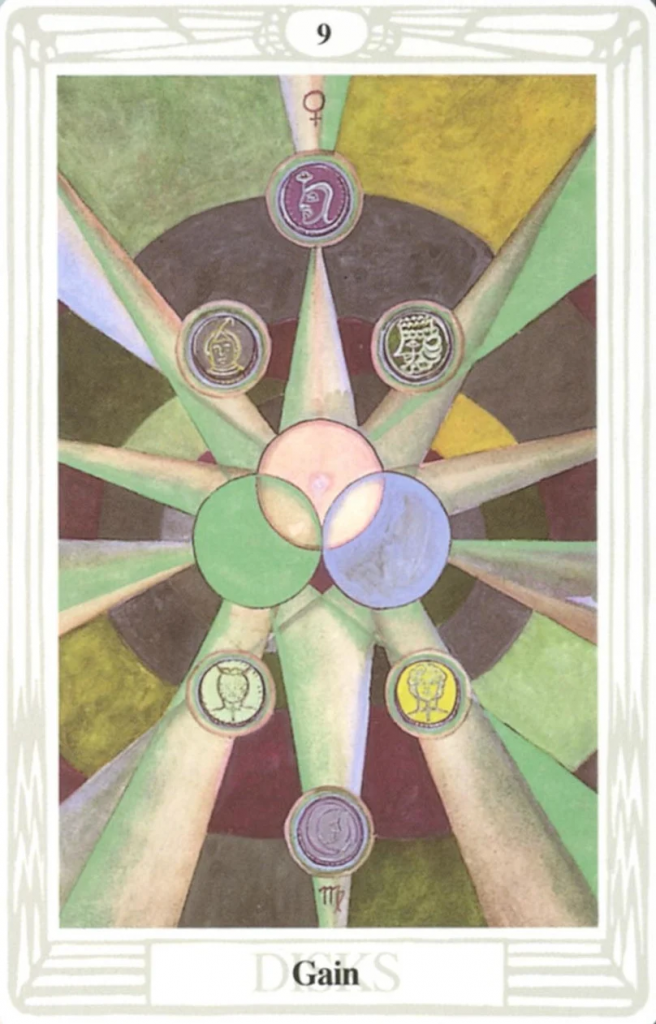
The Lord of Gain is one of the cards which usually receives a hearty welcome when it comes up in a reading. At the mundane level it indicates the financial rewards which come from working diligently and dedicatedly on an important project, so it will often mark a stage of completion. In the workplace it will show that hard work is rewarded both by appreciation and an increase of salary. Sometimes it can indicate promotion (though rarely a total change of workplace) earned as a result of loyalty and attention to detail.As you’ll remember, Disks not only deal with our financial area, but also with day-to-day security in the family environment. So sometimes the Lord of Gain can come up to indicate consolidation and achievement at home. Perhaps an emotional conflict has finally been resolved, or a long-standing problem finally dealt with.At the spiritual level, this card talks a lot about the principle that what we give to life is what we get back. And here we have confirmation that we have lived as much as we are able in the moment, appreciating the things that come our way, and celebrating the bounty we have. As a result, more abundance flows in.The card rarely indicates windfalls, or unexpected sources of income. Here we have worked hard to create something rewarding, and the Lord of Gain indicates the results of our efforts.
Consciousness, sexuality, androgyny, futurism, space, the arts, science, astrology, democracy, humor, books, movies and more













 Four AM can be a devastating hour. The day, no matter what kind of day it was is indisputably over; almost instantaneously, a new day begins: and how will one bear it? Probably no better than one bore the day that is ending, possibly not as well. Moreover, a day is coming one will not recall, the last day of one’s life, and on that day one will oneself become as irrecoverable as all the days that have passed.