
(Contributed by Gwylllm llwydd)

New Thinkin • Aug 1, 2024 Gary Lachman is the author of over twenty books about the history of esotericism and its influence on politics and society. He has written biographies of Carl Jung, Aleister Crowley, Rudolf Steiner, Helena Petrovna Blavatsky, Emanuel Swedenborg, P. D. Ouspensky, and Colin Wilson. His newest book is Maurice Nicoll: The Forgotten Teacher of the Fourth Way. His website is https://www.gary-lachman.com/ The discovery of the forgotten diary of Maurice Nicoll provides a gateway into the complex psyches of esoteric thinkers, primarily male, with an emphasis on both their conflicts and awakenings in the sexual realm. Gary also draws upon the investigations of Colin Wilson. 00:00 Introduction 02:14 Maurice Nicoll’s diary 09:21 Tantric culture and Victorian morality 17:08 Freud, Jung and sexual imagination 28:45 Natural versus perverted sex 34:38 Male and female spirituality 42:19 Mystical imagination 47:51 Guru sexual abuse 53:39 The power of the anima 55:56 Conclusion Edited subtitles for this video are available in English, French, German, Spanish, Italian, Portuguese, Russian, Polish, and Swedish. New Thinking Allowed host, Jeffrey Mishlove, PhD, is author of The Roots of Consciousness, Psi Development Systems, and The PK Man. Between 1986 and 2002 he hosted and co-produced the original Thinking Allowed public television series. He is the recipient of the only doctoral diploma in “parapsychology” ever awarded by an accredited university (University of California, Berkeley, 1980). He is also the Grand Prize winner of the 2021 Bigelow Institute essay competition regarding the best evidence for survival of human consciousness after permanent bodily death. (Recorded on July 8, 2024)

Edward Carpenter portrait, circa 1865. Photo Unknown
“We are arriving at one of the most fruitful and important turning points in the history of the race. The Self is entering into relation with the Body. For, that the individual should conceive and know himself, not a toy and a chance-product of his own bodily heredity, but as identified and continuous with the Eternal Self of which his body is a manifestation, is indeed to begin a new life and to enter a hitherto undreamed world of possibilities…”
“Men will not worry about death or a future, about the kingdom of heaven, about what may come with and after the cessation of the life of the present body. Each soul will feel and know itself to be immortal, will feel and know that the entire universe with all its good and with all its beauty is for it and belongs to it forever. The world peopled by men possessing cosmic consciousness will be as far removed from the world of today as this is from the world as it was before the advent of self consciousness.”
–Edward Carpenter
Edward Carpenter (August 29, 1844 – June 28, 1929) was an English utopian socialist, poet, philosopher, anthologist, an early activist for gay rights and prison reform whilst advocating vegetarianism and taking a stance against vivisection. As a philosopher, he was particularly known for his publication of Civilisation: Its Cause and Cure. Wikipedia
By Emil Wilbekin August 1, 2024 (queerty.com)

Call it the gay aesthetic.
It’s the perfect combination of masculine and feminine styles juxtaposed. Unapologetically. Intentionally. Dramatically.
James Baldwin—the audacious activist, auteur, and anomaly—used fashion as a form of expression to amplify his genius, his gaiety, and his gayness as a Black gender nonconformist amid intense racism, revolutionary protests, and respectability politics.
You see, a butch queen is fearless and will read you for filth, elegantly gather you, and fight for their lives (if need be) and punctuate it all with an effeminate gesture—a flick of the wrist with an enormous cocktail ring on their finger holding a cigarette with an inch long ash grasping for dear life.
Baldwin knew in a society where beauty is held at the precipice that, a brilliant Black gay man who wasn’t considered “attractive” needed to be sartorially casket sharp with a touch of savoir-faire to single-handedly gain social acceptance while engaging and expanding his audience with rigor.
For Baldwin, like many gay and queer men, our fashion statements are often our armor.
As we celebrate Baldwin’s 100th birthday—his rhetoric, activism, and critical thinking, let’s also make some commotion for his exacting, elegant, and eloquent style.


1

2

3


1
2
3


Translation is a 5-step process of “straight thinking in the abstract” comparing and contrasting what you think is the truth with what you can syllogistically, axiomatically and mathematically (using word equations) prove is the truth.
The claims in a Translation may seem outrageous, but they are always (or should always be) based on self-evident syllogistic reasoning. Here is one Translation from this week.
1) Truth is that which is so. That which is not truth is not so. Therefore Truth is all that is. Truth being all is therefore total, therefore whole, therefore complete, therefore otherless, therefore one, therefore united, therefore harmonious, therefore orderly. I think, therefore I am. Since I am and since Truth is all that is, therefore I, being, am Truth. Since I, being, am Truth, therefore I, being, have all the attributes of Truth. Therefore I, being, am total, whole, complete, otherless, one, united, harmonious, orderly. Since I, being, am Truth and since I am mind/consciousness, therefore Truth is Mind/Consciousness. (Two things being equal to a third thing are equal to each other.)
2) Idiopathic pulmonary fibrosis.
Word-tracking:
idiopathic: disease with no known cause
idio-: private, peculiar to oneself
peculiar: private, from Latin pecus meaning cattle or wealth
pathos: disease
pulmonary: lung, flow, from Latin word meaning light, breath, vocal, voice, word
breath: spirit
fibrosis: scaring of tissue due to injury, infection, or lack of air, inability to breathe
3) Truth being that which is is therefore that which lives, that which breaths. And Truth being all that is, there is nothing which can interfere with the breath of life. Therefore Truth is eternal breath free of injury, infection or lack OR Truth is fulsome, unimpeded breathing. Since Truth is one, Truth is something we all have in common, therefore Truth is effortless communication of Itself. Truth being all cannot be privatized or made peculiar, therefore Truth is public and ordinary.
4) Truth is eternal breath free of injury, infection or lack OR Truth is fulsome, unimpeded breathing.
Truth is effortless communication of Itself.
Truth is public and ordinary.
5) The spirit of Truth is unimpeded, unexceptional and automatic.
For information about Translation or other Prosperos classes go to: https://www.theprosperos.org/teaching

Illustration: Anu Garg + AI
A.Word.A.Daywith Anu Garg
PRONUNCIATION:
MEANING:
interjection: Used to express surprise, anger, irritation, annoyance, etc.
noun: Damnation; hell.
adjective: Damned.
adverb: Damnably.
ETYMOLOGY:
Alteration of darnation (influenced by tarnal) which itself is a euphemism for damnation, from Latin damnare (to condemn), from damnum (damage). Earliest documented use: 1790.
Published Wednesday 9:30AM (TheOnion.com)
ACWORTH, GA—In an effort to prepare for a “devastating” outcome, terrified conservative Clayton Hawkins told reporters Wednesday that he was planning to move to 1930s Austria if Donald Trump lost the presidential election. “I swear to god, if Kamala Harris wins in November, you can bet I’m getting a one-way ticket to Vienna circa 1937,” said Hawkins, explaining that, under the worst case scenario in which Democrats remained in control of the White House, the Austrofascist state would provide sanctuary to him and others who feared for the safety of their pure Aryan families. “I know I may sound paranoid, but the fact of the matter is that relocating to a mid-century autocratic one-party state is the only way to ensure that my fellow citizens are violently suppressed for failing to conform to a strict set of oppressive dictates.” At press time, a tearful Hawkins sobbed while imagining his sons growing up in a place and time where they were considered equal to another race or gender.
 SUNDAY MEETING AUGUST 4 |
 Richard Hartnett, H.W., M. Exploring Cosmic Intention, Part 3 (third of a three-part series) Come join Richard Hartnett as he explores the question Is there a Cosmic Intention? in the exciting conclusion of this 3-part Sunday Meeting series! Did you miss any part of the series? You can click in to listen to Exploring Cosmic Intention, Part 1 or Part 2. Click here for further information SUNDAY MEETING August 4, 2024 11:00 am Pacific/Noon Mountain/1:00 Central/2:00 Eastern Join Sunday MeetingBy contribution. Please click here to contribute: Contribute!: |
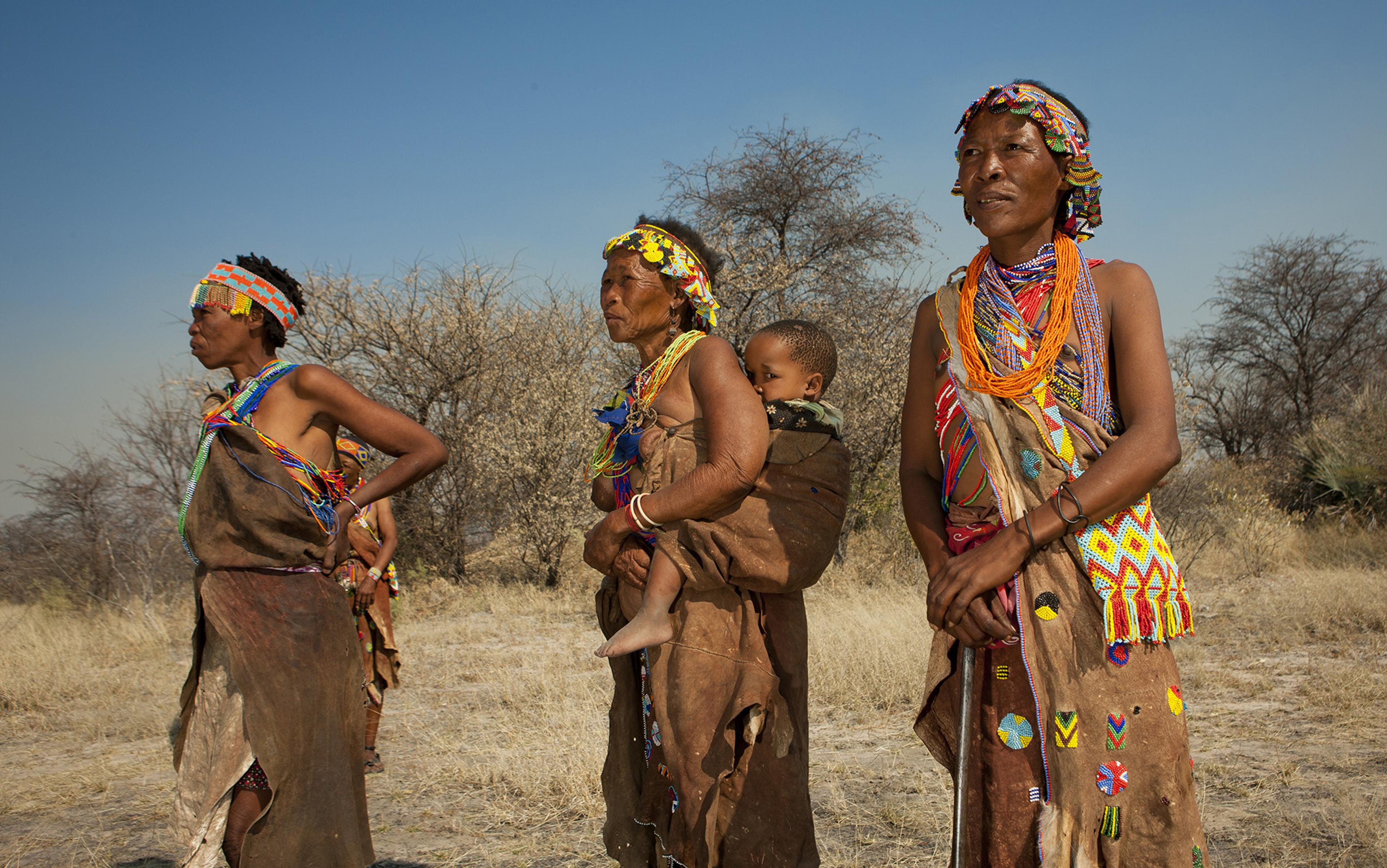
Women from the San tribe in the Kalahari Desert, Namibia, 22 August 2010. Photo by Eric Lafforgue/Gamma-Rapho/Getty
(Aeon.co)
is assistant professor in the Department of Anthropology and Archaeology at the University of Calgary, Canada. He is also assistant director of the Guassa Gelada Research Project in Ethiopia, and the co-founder and co-principal investigator of the Orang Asli Health and Lifeways Project in Peninsular Malaysia.
Edited by Sam Dresser
The Dilemma of the Deserted Husband unfolded in the late 1950s amid a band of G/wi hunter-gatherers, a subgroup of Ju/’hoansi (often known as !Kung San), dwelling in the Kalahari Desert of Southern Africa. According to the South African-born anthropologist and Bushman Survey Officer George Silberbauer, a woman named N!onag//ei had left her husband, /wikhwema, for his best friend. Few were surprised. After all, /wikhwema was a temperamental and pompous man, and a bit of a joke. In contrast, the new husband, /amg//ao, held unconventional charm. He was ‘a virtuoso dancer, a consistently successful hunter and … rumoured to be a bit of a demon as a lover.’
Deserted G/wi spouses usually move on within a few months. But not /wikhwema. Mourning the dual losses of his friend and wife, he complained endlessly. Before long, his incessant whining became a burden on everyone. After more than a year, people were at their wits’ end. Complicating matters, given his role as an ‘owner’ of the band’s territory, /wikhwema could not be expected to relocate elsewhere. The band had no choice but to stick together.
Eventually, a ‘lateral thinker’ proposed a novel solution. Why not permit a polyandrous marriage? This unconventional suggestion meant that N!onag//ei could have both /amg//ao and /wikhwema as husbands, a departure from the monogamous norms of G/wi society. After much deliberation, the innovation was accepted. The new couple’s marriage was salvaged, as was /wikhwema’s pride, and the band was relieved of his whining.
The Dilemma of the Deserted Husband was not solved by the unilateral decision of a single leader. Nor did people raise their hands in a majority vote. Instead, it was the product of long deliberation. For months, there were discussions, disagreements and compromises. The goal of the process was consensus, to find a solution that everyone could live with, even if it was imperfect (the new throuple ‘did not exactly live happily ever after’, according to Silberbauer).
For the vast majority of human history, people made group decisions through consensus. It is perhaps the most conspicuous feature of political life among recent hunter-gatherer societies, from the Ju/’hoansi to the Aboriginal peoples of Australia to the Indigenous societies of the early Americas. As an anthropologist, I have observed consensus-based decision-making myself among hunter-gatherers in the rainforests of Malaysia.
Though the small-world life of hunter-gatherers may seem far removed from our own digitalised and global world, the problems of group life have remained fundamentally the same for hundreds of thousands of years. In the face of conflict and polarisation, ancient human groups needed processes that yielded good outcomes. What can we learn from a political form shaped by hundreds of thousands of years of trial and error? By examining how hunter-gatherers achieve consensus, perhaps we can develop better strategies to solve the problems we face today.
Human prehistory was littered with poor group decisions. Whether it was an ill-timed raid or the wrong choice of watering hole, some of our would-be hunter-gatherer ancestors vanished without a trace. We know this because, among hunter-gatherers today, group decisions are matters of existential importance. As an anthropologist, I have been trying to understand how exactly hunter-gatherer groups succeed – and how they fail.
In the annals of group failure, groupthink is the most common culprit. The phrase was coined by the journalist William H Whyte Jr in 1952, but it is generally associated with the Yale psychologist Irving Janis, who argued that the pressures of social conformity can doom group performance. People may be bullied by their superiors or feel that they risk ostracism from their peers. Important information is left unspoken. By failing to weigh their options judiciously, groups consider only a fraction of the space of possible solutions. Scholars have called this an information cascade. As evidence of groupthink, they often point to famous debacles such as the Bay of Pigs, the Challenger disaster, and the 2003 invasion of Iraq.
At the other end of the spectrum, groups can fail by fragmentation. This possibility is hardly considered in Western studies of social psychology, but it looms large for hunter-gatherers. Through the centrifugal forces of disagreement, the group splinters, with subgroups or individuals going their own way, thereby forfeiting the benefits of cooperation that come from living in a bigger group. As we saw in the Dilemma of the Deserted Husband, hunter-gatherer bands recognise the benefits of staying together.
The Ju/’hoansi are careful not to entrust key decisions to single individuals or small sub-groups
A few years after Silberbauer observed the Dilemma of the Deserted Husband, the young Harvard anthropologist Megan Biesele travelled to the Kalahari to begin her PhD research. It was 1970, and Biesele was there to study ritual and folklore among a band of Ju/’hoansi in the Dobe area, an inhospitable expanse of sand and bushland seasonally flooded by rain, not far from where Silberbauer worked among the G/wi. As she became proficient in the Ju/’hoan language, Biesele observed many group discussions and decisions, taking special notice of the Ju/’hoansi’s consensus-based decision-making. Together, Biesele’s and Silberbauer’s observations show us how the Ju/’hoansi keep groupthink and fragmentation in check, navigating between what Silberbauer calls ‘the Scylla of excessive interdependence and the Charybdis of fragmenting anarchy’.
The Ju/’hoansi are careful not to entrust key decisions to single individuals or small sub-groups. Leadership is temporary and knowledge-based, shifting even within a single conversation. Leaders refrain from stating their opinions early in the conversation, which could bias the opinions of others who have yet to speak. The role of a leader in group decisions is to guide deliberation, state the group’s mood, and help finalise a decision. Leaders are respected, but they cannot coerce others. Biesele refers to this as ‘sapiential authority’.
With the goal of consensus, the group itself is the decision-maker. Decisions typically start as grassroots affairs between neighbours and friends. Only later does the community gather together for a formal meeting. During deliberation, everyone – man or woman, old or young – is encouraged to state their opinion about important matters. In the egalitarian culture of the Ju/’hoansi, people do their own thing and therefore have their own unique experiences and ways of representing problems that may be relevant to a group decision.
The Ju/’hoansi are not culturally diverse, but their permissiveness of individual differences means their groups are functionally diverse. The social norm of widespread participation ensures the free and open exchange of information, reducing the likelihood of an information cascade. Biesele documented a principle that, if each person’s opinion was not heard, trouble would follow. Repressed opinions, it was said, could cause sickness.
For the Ju/’hoansi, there is little connection between individuals and the ideas they promulgate. As Silberbauer notes in Politics and History in Band Societies (1982): ‘It often happens that the suggestion finally adopted is one which was initially voiced by somebody who has taken no further part in the proceedings, leaving it to others to take up, and “push” his or her proposal.’ No one remembers the lateral thinker who solved the Dilemma of the Deserted Husband. An idea is like a bloody antelope carcass: once in the public square, it is more or less public property. To attribute an idea to a person would contravene the egalitarian nature of the band.
Deliberation also means disagreement. Claims are sceptically evaluated based on evidence, according to the anthropologists Melvin Konner and Nicholas Blurton Jones, who investigated Ju/’hoansi knowledge of animal behaviour in the 1970s. The Ju/’hoansi are careful to distinguish between first-hand knowledge and hearsay or speculation. There was a norm that discouraged rampant speculation: when someone said that children could be killed by fires, an old man said that people should only speak when they have seen things happen. One man was laughed at for his gullibility when he said that he had heard that elephants would bury their babies up to their necks.
One day, while tagging along with two trackers, Biesele heard constant feedback as the two busily corrected each other about where animal tracks were leading. In this dialectic, they responded to evidence and explained their logic. Neither took anything personally. In an email in 2022, Biesele told me: ‘Trackers’ conversations are fully cooperative and open to both new ideas and to corrections by other trackers, specifically to ensure the best-reasoned outcomes. So democracy and science are closely allied in the people’s minds, and closely govern how decisions are made.’
Unlike in modern politics, group decisions are not something to be won or lost
The Ju/’hoansi keep their cool, recognising that anger and heated feelings can lead to impulsive decisions and misunderstandings. According to Silberbauer, ‘the band is reluctant to come to decision under the sway of strong feelings: if discussion becomes too angry or excited, debate is temporarily adjourned by the withdrawal of the attention to the calmer participants until things cool down.’ Confrontation is avoided through a variety of subtle stratagems: pretending to cook, or urgently attending to a thorn in one’s foot. When things get too heated, people disengage, signalling a lack of sympathy for the outburst. The fate of the Ju/’hoansi contrarian is neither exile nor execution. It is to be ignored.
This isn’t to say that debate never occurs. Silberbauer observed ‘a bit of cut and thrust between orators’, however he found that point-scoring ultimately played little role in the ultimate decision. In a highly interdependent band, this makes sense because one’s fate is largely tied to that of other bandmates. As a result, unlike in modern politics, group decisions are not something to be won or lost. Attentive of this, the Ju/’hoansi avoid the mistake of equating rhetorical flourish with truth. The idea of sparring orators dealing knockout blows would be anathema to the Ju/’hoansi. A knockout blow is self-defeating, like punching oneself in the face.
When it comes to finalising a course of action, the Ju/’hoansi are sceptical of voting. In small groups, Biesele has found, the Ju/’hoansi see the act of voting as polarising. As the anthropologist David Graeber explained in Possibilities (2007):
If there is no way to compel those who find a majority decision distasteful to go along with it, then the last thing one would want to do is to hold a vote: a public contest which someone will be seen to lose. Voting would be the most likely means to guarantee the sort of humiliations, resentments, and hatreds that ultimately lead the destruction of communities.
Instead, discussion continues until a consensus is reached. Everyone has to agree on the course of action because it legitimates the decision as belonging to the group. It is not merely the actual result of the decision that counts, but the process itself. Everyone must attend to what Silberbauer calls the social balance-sheet. The social balance-sheet is no less than the promise of future cooperation, perhaps the most important thing in the life of a hunter-gatherer.
Consensus is also about the creation of shared meaning. The Ju/’hoansi, according to Silberbauer, are not only exchanging facts about reality but also values, objectives and ‘logical and causal relationships between items of information’. To decide well, the band must think together.
Perhaps the best illustration of this process of cognitive convergence comes from Kenneth Liberman, who worked among Aboriginal populations of the western Australian desert. Each day starts with the Morning Discourse, in which people take turns voicing concerns, thoughts, ideas. Each comment builds on the previous. The state of affairs of the group becomes publicly available. Nothing is directed toward individuals, only the group. ‘The favoured strategy here is to depersonalise one’s remarks and tone of voice as much as possible,’ wrote Liberman in 1985. ‘The effect is something like acting as if someone else is doing the talking.’ Rather than each person expressing views as an individual, it is almost as if the group is talking through each individual. The Morning Discourse shapes the consensus, when ‘all think in the same way with the same head, not in different ways.’ Sometimes hunter-gatherers don’t even bother to articulate the decision, so clear is the consensus and the subsequent course of action.
The Ju/’hoansi style of decision-making finds echoes in the works of great thinkers. Cicero believed that conversation should be inclusive, allowing everyone a turn to speak. It should also be free of passion and gossip about people not present, and easy-going. John Dewey felt deliberation was critical to a vibrant democracy. Jurgen Habermas advocates for widespread participation of all individuals and for groups to seek ‘rational consensus’. He believes that people should pose rational arguments that are ‘in the best interest’ of all participants, thereby limiting the chances of fragmentation and inequality. These arguments are theoretical but, for the Ju/’hoansi, this philosophy is everyday life.
Understanding the Ju/’hoansi mode of communication from a modern perspective requires investigating the nature of dialogue. The word ‘dialogue’ is derived from the Greek ‘dia’ (through) and ‘logos’ (word or meaning), and is often translated as ‘a flow of meaning’. According to William Isaacs, who teaches workshops on dialogue-based approaches to communication, dialogue is ‘a shared inquiry, a way of thinking and reflecting together. It is not something you do to another person. It is something you do with people … Dialogue is a living experience of inquiry within and between people.’ Contrast this with debate, the root of which comes from the Old French word debatre – ‘to fight’.
When done correctly, dialogue could result in an extraordinary form of human cooperation
One of the most famous advocates of a dialogue-based approach to conversation was the American-born British theoretical physicist David Bohm. Alongside his seminal contributions to quantum theory, Bohm maintained interest in problems such as consciousness and creativity. In On Dialogue, a book he wrote just a few years before his death in 1992, Bohm tackled the problem of communication breakdown in society that seems similar to our current predicament of polarisation: ‘within any single nation, different social classes and economic and political groups are caught in a similar pattern of inability to understand each other.’
To Bohm, dialogue helps to establish a shared common understanding between individuals. It would mean abandoning assumptions, not clinging so tightly to our opinions, and doing a lot of listening. Yet he knew that dialogue was difficult. It required guardrails and open-mindedness. But when done correctly, dialogue could result in an extraordinary form of human cooperation with unparalleled creativity: ‘nobody is trying to win … we are not playing a game against each other, but with each other. In a dialogue, everybody wins.’
Channelling his physicist’s intuition, Bohm analogised the alignment of group sentiment with a laser: in contrast to normal light, which is scattered all about, a laser aligns light beams in the same direction, producing coherence. Bohm believed that ‘thinking together’ had the same effect. There is some empirical support for this idea. Recently, researchers at Dartmouth College in New Hampshire asked business students to watch movies and discuss their opinions. Looking at scans of brain activity before and after the discussion period, the researchers discovered that brain activity aligned after the discussion. As with the Morning Discourse, the students were thinking together.
Bohm believed that dialogue to be an ancient mode of communication, arguing that communities with coherent meaning probably existed ‘in some groups in the primitive Stone Age conditions’. Indeed, the parallels between the Ju/’hoansi mode of communication and dialogue-based methods are hard to miss. I imagine if there were a Ju/’hoansi philosopher, her description of her society’s decision-making process might read something like Bohm’s On Dialogue.
Just because hunter-gatherers do something does not make it necessarily good. But according to social psychologists, the features of Ju/’hoansi decision-making are the very ones that make for high collective intelligence. Consider a 2020 article from the Harvard Business Review outlining the best practices that optimise good decision-making in small groups: heterogeneous groups are better than homogeneous ones; dissent is crucial; people should arrive at their opinions independently; people should feel free to speak their minds; individuals should share collective responsibility.
Taken together, there is robust evidence that the Ju/’hoansi are able to avoid levels of polarisation like we see in our current political moment. This is achieved not necessarily through individual virtue but rather with cultural guardrails and prolonged deliberation. The Ju/’hoansi are well aware that their social norms around deliberation improve the quality of their decisions. As Biesele told me, Ju/’hoansi informants would say things like: ‘It’s necessary to draw on the strengths of each person, to minimise the chances that decisions will be made on the basis of the weakness of one or a few persons.’ In contrast, even though discussion generally improves group reasoning performance, people in Western society are poor at recognising this fact.
One Ju/’hoan said: ‘We never wanted to represent our communities: that was a white people’s idea’
The Ju/’hoansi’s political self-consciousness has informed their responses to jarring changes in their lives. Silberbauer conducted his work on the Ju/’hoansi political process from 1958-66. By the late 1960s, mining, cattle and development had dispossessed them of their traditional territories. The autonomous life they had lived for aeons was effectively over. Their houses, mobility, diet and society would be irrevocably changed. So too would their politics. The ‘close-knit, self-sufficient organisation of band society and the completeness of members’ control of its political processes are gone,’ Silberbauer wrote. ‘The “ethnographic present” is now the past.’
Yet Biesele has found that old habits die hard. As founder and director of the nonprofit Kalahari Peoples Fund, she has devoted her career to documenting and aiding the Ju/’hoansi’s transition to modernity. She recorded and translated meetings of the Ju/’hoan people’s organisation that would go on to become the first internationally recognised Conservancy in the new nations of Botswana and Namibia. Biesele has written eloquently about how the Ju/’hoansi have been resistant to give up their old ways of making decisions through consensus. Challenges arose when individuals or small groups were designated as representatives to act as a connection to the government. ‘This was a very foreign idea,’ Biesele said, ‘but the people could see the need for interacting in this way with the new administrations, so they debated how they could possibly do it successfully.’ This task was undertaken with considerable hesitation. One Ju/’hoan said: ‘We never wanted to represent our communities: that was a white people’s idea in the first place.’ As Biesele documents, the Ju/’hoansi have favoured cooperative institutions that tap into their deep history as decision-makers.
Many anthropologists and archaeologists believe that humans lived in nomadic egalitarian bands for much of our species’ history. If this is true, then the Ju/’hoansi and other hunter-gatherers tell us something important about what politics in the Palaeolithic might have looked like. Amid the crackle and pop of a Pleistocene campfire, under the anonymity of darkness, our ancestors began to think as one. In that moment, we became political animals, the first and only species in the history of the world to grasp how its own collective intelligence could be made and unmade.
Just like any hunter-gatherer today, our ancestors would have been self-conscious political actors. They would have realised the importance of the process to the result. And they would have actively maintained political structures that maximised their collective intelligence. Groups that failed to do so would have perished.
Recognising the self-conscious political agency of hunter-gatherers challenges 20th-century perspectives that ‘primitive’ cultures exhibited a uniformity of belief and personality. Describing Aboriginal Australians in 1915, the French sociologist Émile Durkheim wrote:
The group has an intellectual and moral conformity of which we find but rare examples in the more advanced societies. Everything is common to all. Movements are stereotyped; everybody performs the same tasks in the same circumstances, and this conformity of conduct only translates the conformity of thought.
Nothing could be further from the truth. As Liberman observed in Australia, there is just as much eccentricity and variation in a band of hunter-gatherers as there is among ourselves. This is a critical part of the recipe for high collective intelligence.
We should be gentle with ourselves about the magnitude of our challenge because hunter-gatherers have it easier
Our ancestors would have seen no necessary contradiction between seeking consensus (and compromise) and seeking truth. Yet this is a commonly held view among social scientists who focus solely on a narrow slice of human history – the present; for example, the psychologist Irving Janis, who believed that tight-knit groups were especially prone to groupthink. Or, more recently, the political scientist Jason Brennan, who wrote: ‘Human beings are wired not to seek truth and justice but to seek consensus … They cower before uniform opinion.’ On the contrary, the Ju/’hoansi boast an impressively fertile ecology of conversation that derives, ultimately, from the distinctive combination of high levels of interdependence and egalitarian social norms. With a unified approach to a common goal, along with norms that encourage free and open expression and diverse viewpoints, it is in everyone’s interest to seek the truth.
All of this calls into question our own preoccupation with debate as a form of truth-seeking. In the sphere of communication, prominent book titles include Win Every Argument: The Art of Debating, Persuading, and Public Speaking (2023), Good Arguments: How Debate Teaches Us to Listen and Be Heard (2022), How to Argue and Win Every Time (1995), and The Art of Being Right (1831). Undoubtedly, debate can be useful for presenting alternative viewpoints and hashing out logical inconsistencies. But it often results in little more than hardened views and hurt feelings. Debate is a tool designed to convince, not to solve collective problems. ‘I never yet saw an instance of one of two disputants convincing the other by argument,’ wrote Thomas Jefferson in 1808.
It may seem intractable to scale up insights from the Ju/’hoansi to modern problems of anonymous digital ecosystems and nation-states. Undoubtedly, the Ju/’hoansi style of deliberation is best suited to face-to-face interaction. Lost in the digital world are the subtle cues and gestures that help us to gauge others’ feelings, and to communicate our displeasure. We should be gentle with ourselves about the magnitude of our challenge because, in a sense, hunter-gatherers have it easier: they share similar values and conceptions of the world, their world is smaller, their range of choice narrower and less abstract than ours. Their decisions are more concrete and immediate.
On the other hand, some of our most important decisions still occur in small face-to-face groups, whether it’s in the Oval Office, the corporate boardroom, or the family dinner table. The Ju/’hoansi show us how the best outcomes can be achieved in these groups. Success comes from material interdependence, common purpose and shared meaning. Also critical are the conversational guardrails that enable us to truly think in, and as, groups. This is ancient knowledge that any of us can put into action now: don’t get heated, detach ideas from ego, put yourself in others’ shoes, listen. And always speak your mind.
(Contributed by Gwyllm Llwydd)
(Astrobutterfly.com)
August 2024 centers around one of the key transits of the year: Jupiter square Saturn.
Jupiter square Saturn is a very important transit because it involves the two largest planets in the solar system. When these titans clash, we are compelled to focus on the major themes and challenges in our lives.
While the square is a tense aspect, it also brings energy and motivation, giving us the push we need to make meaningful improvements.
This is the first square of the current Jupiter-Saturn cycle, which began in December 2020 when Jupiter and Saturn met at 0° Aquarius.
The first square of a synodic cycle is known as a “crisis in action,” meaning that whatever was initiated at the conjunction is now being tested against reality.

What makes sense, and what doesn’t? What should we continue doing, and what should we reconsider or change?
Squares are also opportunities for “market feedback,” bringing forth various possibilities.
Take a step back and observe how the world validates – or doesn’t – what you do. If your efforts yield no results, perhaps it’s time to change your strategy. On the other hand, if an opportunity keeps presenting itself, it might be time to embrace it.
Mid-month, Venus in Virgo forms a T-square with Saturn in Pisces and Jupiter and Mars in Gemini, prompting a change of heart.
Although mutable T-squares may be less dramatic than other T-squares, they can be just as effective, if not more so.
Why? Because mutable energy is inherently flexible and manages change more constructively, without the drama of cardinal signs or the resistance of fixed signs.
Venus, as the catalyst of this energy, suggests that our heart’s desires will ultimately drive the needed change.
Venus in Virgo will look at Saturn in Pisces and Jupiter in Gemini and ask the critical question: “Does this make sense?” “Is this really what I want?”. If it doesn’t, she won’t hesitate to move on.
Later this month, Venus forms a grand trine with Uranus and Pluto. When we are committed to change, good things can happen sometimes straight away. At the very least, we can achieve some quick wins to keep us encouraged on our journey.
But let’s take a look at the most important transits of the month:
On August 4th, 2024, we have a New Moon at 12° Leo.
This is an auspicious New Moon that is sextile Mars and Jupiter in Gemini. This aspect has a social, friendly vibe that encourages us to collaborate and connect with others.
The Gemini Air will fuel Leo’s fire with witty, charismatic, and versatile energy. This New Moon is great for social, intellectual, and artistic activities where spontaneity and creativity can shine.
On August 5th, 2024, Mercury goes retrograde at 4° Virgo.
It’s that time of year again. We don’t like Mercury retrogrades. But we need them. We need them because they help us integrate our experiences and lessons more thoroughly.
Imagine you’re rushing to get somewhere and you lose your phone along the way. On your way back to find it, you not only recover your phone but also notice things you missed the first time.
Retrograde planets work in a similar way: they make us slow down, pay attention, and spot opportunities we might otherwise overlook.
So, although Mercury retrogrades may feel like hard work, they are in fact unique opportunities to reassess our priorities, gain new insights, and make thoughtful adjustments that help us move forward.
On August 5th, 2024, Venus enters Virgo.
Venus in Virgo is the Cinderella of the zodiac. She’s humble, reliable, and doesn’t go out of her way to impress. She marries the prince not despite her modesty and practicality but because of them.
Venus in Virgo (and Virgo transits in general) remind us that sometimes it’s the seemingly insignificant qualities, such as attention to detail and genuine kindness, that make the biggest difference.
On August 7th, 2024, Mercury is conjunct Venus at 3° Virgo. Mercury is our thoughts and Venus is our feelings.
The reason we struggle to harmonize our thoughts and emotions is that our Mercury function (mind) doesn’t always speak the same language as our Venus function (emotions, values, subjective preferences).
Most people have Mercury and Venus in different signs, and even when they are in the same sign, aspects between them are rare. Due to their positions relative to the Sun and Earth, Mercury and Venus can only form two types of aspects: conjunctions and sextiles.
This is why getting your brain with your heart on the same page can be so challenging.
However, when these two planets DO align, they offer us a unique opportunity to find balance and translate our inner desires and thoughts into coherent actions, enabling both to come into agreement.
On August 14th, 2024, Mars is conjunct Jupiter at 16° Gemini. This is a powerhouse transit that will boost our energy levels to the max.
However, a surge in energy doesn’t mean we can suddenly run a marathon.
Firstly, since this conjunction occurs in an Air sign, the energy is more intellectual and dispersed. Instead of running marathons, we may come up with a lot of ideas for new projects.
Secondly, for this energy (Mars) to be effectively channeled, it needs to align with our highest goals and aspirations (Jupiter). If something doesn’t genuinely inspire us, we may find it challenging to take action, even with this dynamic alignment.
In fact, if you’re struggling to take action during this transit, it’s a sign to delve deeper into your motivations and check if they align with your core values and aspirations.
Wanting something but not acting on it should be a red flag.
However, a lack of motivation doesn’t necessarily mean you should overhaul your goals and priorities.
Sometimes, subtle adjustments – shifting your mindset to focus on the positives, cultivating gratitude, or realigning your actions with your core goals – can make a significant difference.
Fortunately, the conjunction occurs in Gemini, the sign of the mind, and is further supported by an introspective Mercury retrograde. This creates an ideal opportunity to rewire our thoughts and move forward with clarity and purpose.
On August 19th, 2024, Jupiter (at 17° Gemini) is square Saturn (at 17° Pisces). When we talk Jupiter and Saturn, we talk about the structure of our life.
Jupiter and Saturn are the largest planets in our solar system, so when they form an important aspect like a square (we only have a Jupiter-Saturn every 10 years), we know that we’re up for important developments.
What these developments mean to you depends on the houses in your natal chart triggered by transit Jupiter and Saturn, whether or not you have planets around 17° in mutable signs, and what houses Jupiter and Saturn rule in your chart.
But as a general influence, consider that Jupiter is your beliefs – of how you want your life to be – and Saturn is your results – or what is realistically achievable.
When Jupiter and Saturn clash in a square, this suggests there is a gap between what you believe it’s possible, and what can realistically be achieved.
This isn’t always negative. Many people dream too small, lacking the confidence or expansive mindset that Jupiter offers – so they end up with ‘goals’ that fall short of their potential.
For others, the opposite is true. They might dream too big, becoming entangled in unrealistic expectations or external influences. But if their current reality is struggling to meet basic needs, they may need a reality check.
So what’s to be done? The goal of Jupiter square Saturn is to 1) help us identify what is truly important to us and 2) recognize the gaps between our ideals and our current situation.
This clarity will then help us take practical steps forward, one step at a time.
Jupiter square Saturn is an opportunity to adjust for the best plan of action. The great thing about a square is that it leaves no room for ambiguity. A square is a very straightforward, “in your face” aspect. The universe is speaking to us directly: “This is what you need to do”.
On August 19th, 2024, we have a Full Moon at 27° Aquarius.
The Full Moon is opposite Mercury retrograde (at 26° Leo) and tightly square Uranus (at 27° Taurus). This is a super intense Full Moon, so brace yourself for quite a few surprises.
That square to Uranus is VERY tight, almost exact, and it’s guaranteed to shake things up. Shake not for the sake of destabilizing, but to help us (re)connect with our authentic self.
Uranus in Taurus asks: Is this the real YOU? Is this truly what you want? If not, get back to basics. Rediscover (Mercury retrograde in Leo) your true essence, your inner creative potential, what makes you unique, and start from there, even if it means completely re-engineering your life.
The Full Moon in Aquarius has an extra oomph also because it occurs at the same time as the already life-altering Jupiter-Saturn square. This combination of transits signals the need for a long-awaited, systemic change that will ultimately propel us forward.
On August 22nd, 2024, the Sun enters Virgo. Happy birthday to all Virgos out there!
The Virgo season is when we get back to earth, (re)anchoring in reality. The earthy, mutable energy of Virgo gives us the clarity and productivity boost we need to focus on what matters and get things done.
On August 29th, 2024, Mercury goes direct at 21° Leo.
This is great news! Having learned a thing or two from the retrograde period, we are now ready to resume our plans and start afresh.
On August 29th, 2024, Venus enters her home sign, Libra. August has been quite a month, but it’s worth it when it ends on a high note.
As Venus moves into Libra, she immediately forms a trine with Pluto at 0° Aquarius, creating a kite pattern with Pluto, Uranus, and Neptune at the apex. It’s recognizing and embracing our deepest desires that will help us manifest our greatest dreams.