How to spot a cult

Sarah Edmondson | TEDxPortland

• May 2023

Nobody joins a cult on purpose, says Sarah Edmondson, a former member of the infamous Nxivm cult and one of the three whistleblowers that led to its downfall. She explains how she got ensnared in this highly manipulative group — and then escaped it — and shares red flags to help you distinguish between a cult and a safe community.

About the speaker

Sarah Edmondson

Cult recovery advocate, podcaster, actorSee speaker profile

Sarah Edmondson gained renown for her role in exposing the NXIVM cult.

One SF Engineer Might Have Just Saved the World From a Massive Cyberattack

Photo: Hackers, United Artists, 1995

4 APRIL 2024/BUSINESS & TECH/JAY BARMANN (SFist.com)

A 38-year-old software engineer for Microsoft was apparently curious, eagle-eyed, and lucky enough to have discovered a pernicious bit of code in the widely used Linux operating system, that someone, somewhere, had gone to some lengths to hide.

His name is Andres Freund. He’s originally from Germany, lives in San Francisco, and for his job at Microsoft he works on a piece of open-source database software known as PostgreSQL. The New York Times has the story of how, over the last several months, he rooted out the cause of some odd errors he was seeing while running certain tests, which led to a discovery with massive implications.

Per the Times:

The saga began earlier this year, when Mr. Freund was flying back from a visit to his parents in Germany. While reviewing a log of automated tests, he noticed a few error messages he didn’t recognize. He was jet-lagged, and the messages didn’t seem urgent, so he filed them away in his memory.

It was a few weeks later that Freund found an application used for remotely accessing computers was using more processing power than normal, and then he discovered some odd code buried in a set of data compression tools called xz Utils. All you need to understand, as the Times explains, is that this is a part of the Linux operating system, “which is probably the most important piece of open-source software in the world.”

The operating system is updated and policed by a group of volunteers worldwide, and someone, possibly a high-level Chinese hacker, had over years gained the trust of these Linux caretakers and infiltrated their ranks. This person had then, fairly recently, inserted code that would have given them a backdoor into servers worldwide, including the backbone systems of major banks, hospitals, corporations, you name it.

Freund found enough evidence that he compiled it and sent to to a group of Linux developers last week, and his memo reportedly “set the tech world on fire,” per the Times. A fix was developed within hours and rolled out — and while the backdoor code had been recently added in an update to Linux, the update had not been widely adopted.

The culprit, according to researchers, was a hacker who went by the name Jia Tan or JiaT75, and began suggesting updates to xz Utils two years ago. This person, who could have come from China, Russia, or elsewhere, slowly worked their way into the ranks of Linux overseers known as “maintainers,” and inserted the pernicious backdoor code sometime earlier this year.

Ars Technica first covered the hack in great detail last week, reporting that the malicious code had not yet gone out to “production” version of the Linux software, but it would have eventually. It didn’t, says Will Dormann of security firm Analygence, “only because it was discovered early due to bad actor sloppiness. Had it not been discovered, it would have been catastrophic to the world.”

And, as Ars Technica reports, JiaT75 had in recent weeks gone on the developer site for Ubuntu to lobby for their updated code to be incorporated into the production versions of the software.

Alex Stamos, a former security officer at Facebook and Yahoo and now the chief trust officer at cybersecurity firm SentinelOne, spoke to the Times, saying, “This could have been the most widespread and effective backdoor ever planted in any software product,” and calling the code like “a master key to any of the hundreds of millions of computers around the world” that run this widely used remote-access software.

The code also would have enabled the person, and by extension whatever entity they’re working for, to do widespread damage without getting caught.

Freund’s employer, Microsoft, should probably be giving him a raise. And the CEO of the company, Satya Nadella, has publicly praised his “curiosity and craftsmanship.”

It is certainly scary to think that other efforts like this could be happening at any time. And the story goes to show how the modern internet is, in fact, “held together with the digital equivalent of Scotch tape and bubble gum,” as the Times puts it, and often by ragtag volunteer coders.

Biden Administration Approved More Bombs to Israel on Day of World Central Kitchen Strikes

John Hudson/The Washington Post

Biden Administration Approved More Bombs to Israel on Day of World Central Kitchen Strikesman inspects the wreckage of a World Central Kitchen vehicle after Israel’s deadly airstrike on the convoy in Deir al-Balah, central Gaza. (photo: Reuters)

04 april 24 (RSN.org)

The Biden administration signed off on thousands more bombs to Israel despite global condemnation of the IDF’s killing of seven World Central Kitchen employees

The Biden administration approved the transfer of thousands more bombs to Israel on the same day Israeli airstrikes in Gaza killed seven aid workers for the charity group World Central Kitchen, three U.S. officials told The Washington Post this week after the incident elicited global condemnation.

The transaction, which has not been previously reported, demonstrates the administration’s determination to continue its flow of lethal weaponry to Israel despite Monday’s high-profile killings and growing calls for the United States to condition such support on greater protection for civilians in the war zone. A U.S. citizen was among the dead.

The move also casts new light on the emotional statement by President Biden that he was “outraged and heartbroken” by the tragedy and was insistent that such events never happen again.

“They were providing food to hungry civilians in the middle of a war,” Biden said. “They were brave and selfless.”

The White House did not respond to a request for comment.

The Israeli government confirmed it carried out Monday’s strike but called it “unintentional,” saying the military would conduct a “transparent” investigation and make the results public.

The State Department approved the transfer of more than 1,000 MK82 500-pound bombs, over 1,000 small-diameter bombs, and fuses for MK80 bombs, all from authorizations granted by Congress several years before the latest hostilities between Israel and Hamas began, said the U.S. officials, who like others spoke on the condition of anonymity to discuss sensitive arms deals.

A State Department spokesperson confirmed the approval and said it occurred sometime “prior” to when the Israeli aircraft struck the aid convoy.

The U.S. government has the authority to suspend an arms package any time before delivery, which the spokesperson said probably would not occur until 2025 or later. It has not done so in this case.

When asked why the Biden administration did not at least pause the process after the incident or until the Israelis’ investigation was completed, the spokesperson did not provide further comment.

Officials have not publicly disclosed what type of munition struck the aid truck, but the small-diameter bombs the United States has provided to Israel are “certainly comparable,” said Josh Paul, a former State Department arms expert who resigned in protest of the administration’s Gaza policy.

Biden, in his statement following the attack, offered his most pointed criticism to date of Israel’s treatment of humanitarian workers, who have died in greater numbers than in any other recent conflict.

“Israel has not done enough to protect aid workers trying to deliver desperately needed help to civilians. Incidents like yesterday’s simply should not happen,” Biden said.

Secretary of State Antony Blinken said the slain workers, who included individuals from Australia, Britain, the Palestinian territories, Poland, and a U.S.-Canadian dual national, were “heroes.”

“They have to be protected. We shouldn’t have a situation where people who are simply trying to help their fellow human beings are themselves at grave risk,” he said.

Some Democratic supporters of the Biden administration criticized such statements, saying they result in little change when U.S. actions convey unconditional support for Israel’s military campaign in Gaza.

“Until there are substantive consequences, this outrage does nothing,” Ben Rhodes, a former foreign policy adviser to President Barak Obama, said on X.

Israeli Prime Minister Benjamin Netanyahu “obviously doesn’t care what the U.S. says, it’s about what the U.S. does,” he said.

Republicans in Congress have been broadly supportive of weapons transfers to Israel and have defended its tactics and methods in the six-month conflict. Former president Donald Trump, the presumptive GOP nominee in this year’s election, has said Hamas’s killing rampage in southern Israel on Oct. 7 was “one of the saddest things I’ve ever seen” but that Israel needs to end the war soon.

“You have to finish it up, you got to get it done,” he told an Israeli newspaper last month.

World Central Kitchen on Thursday called for a third-party investigation into the attacks and urged the home countries of the killed workers to join the charity in calling for an independent review.

The strikes hit three of the group’s vehicles as they traveled in Gaza on a route that had been coordinated and cleared with the Israeli military, the charity group said. The workers were killed shortly after overseeing the unloading of 100 tons of food brought to the enclave by sea.

José Andrés, the celebrity chef who founded World Central Kitchen, has alleged that Israel targeted the aid workers “systematically, car by car.”

“This was not just a bad luck situation where ‘oops’ we dropped the bomb in the wrong place,” he told the Reuters news agency.

“This was over a 1.5, 1.8 kilometers, with a very defined humanitarian convoy that had signs in the top, in the roof, a very colorful logo that we are obviously very proud of,” he said. It’s “very clear who we are and what we do.”

Israel launched its military assault in Gaza after Hamas-led militants rampaged across the border on Oct. 7, killing 1,200 people and taking more than 250 hostage. Israel’s ensuing assault on Gaza has killed more than 33,000 Palestinians, according to the Gaza Health Ministry, which does not distinguish between civilians and combatants and says the majority of the dead are women and children.

The Israeli siege has created a chronic shortage of food, water and medicine as the health system has collapsed and dozens of children have died of malnutrition and starvation, according to the United Nations.

The dire need has compelled humanitarian workers from around the world to help provide aid to the besieged enclave, but Monday’s killings are forcing aid groups to reassess the security environment.

U.N. relief agencies have paused night operations to make a security assessment, a spokesperson said Wednesday. At least two other aid groups have also said they would pause operations in Gaza because of safety concerns for their staff. About 200 aid workers have been killed during the war, most of them Palestinian, according to the United Nations.

The latest arms transfers represent small portions, valued in the millions of dollars, of much larger foreign military sales that were approved by Congress years ago but never fulfilled in their entirety. The use of older cases means the State Department is not required to provide a new notification to Congress, even though the geopolitical and humanitarian context has changed significantly since the sales were approved.

When asked Tuesday about the State Department’s role in continued arms transfers, Blinken cited regional threats to Israel from Iran and Hezbollah, saying the weapons “go to deterrence, trying to avoid more conflicts. They go to replenishment of their supplies and their stocks.”

But U.S. weapons are also being used in Gaza, which U.S. intelligence officials and a growing number of Democrats worry could pose a security threat to the United States from extremist groups seeking to retaliate against Washington’s policies.

“Every moment that this nightmarish humanitarian condition continues inside Gaza is a day that the United States is less safe, because we bear global responsibility side by side with Israel,” Sen. Chris Murphy (D-Conn.) told MSNBC on Wednesday.

“Until commitments can be made to open up more humanitarian access, the United States needs to stop sending military aid,” Murphy added. “It’s not only because we hope that it has some impact on decision-making inside Israel, but also because we think that actually helps insulate us from some of the blowback that is going to occur as terrorist recruitment grows.”

Morning Meditation

© Marco Bottigelli

I choose to awaken from the delusions of the world

If you want to believe that what your physical eyes can see is all that’s there, then fine, you can. Stay in that small fraction of perceptual reality if you choose. But at some point, even if that point is at the point of death, we all know better. I’ve seen cynics become mystics on their deathbed. We are here as though in a material dream from which the spiritual nature of our larger reality is calling us to awaken. The magician, the alchemist, the miracle-worker, is simply someone who has woken up to the material delusions of the world and decided to live another way. In the world gone mad, we can choose to be sane. In order to move ourselves, and our civilization, into the next phase of our evolutionary journey, it’s time for all of us to awaken.

I choose to awaken from the delusions of the world

Free Will Astrology: Week of April 4, 2024

BY ROB BREZSNY | APRIL 2, 2024

Photo: Mona Eendra

ARIES (March 21-April 19): Aries author Eric G. Wilson claims, “Darker emotional states—doubt, confusion, alienation, despair—inspire a deeper and more durable experience of the sacred than contentment does.” I disagree. I know for a fact that an exquisite embrace of life’s holiness is equally possible through luminous joy and boisterous triumph and exultant breakthroughs. Propagandists of the supposed potency of misery are stuck in a habit of mind that’s endemic to the part of civilization that’s rotting and dying. In any case, Aries, I’m pleased to tell you that in the coming weeks, you will have abundant opportunities to glide into sacred awareness on the strength of your lust for life and joie de vivre.

TAURUS (April 20-May 20): Will humans succeed in halting the decimation of the environment? Will we neutralize the power of fundamentalism as it fights to quash our imaginations and limit our freedoms? Will we outflank and outlast the authoritarians that threaten democracy? Sorry I’m asking you to think about sad realities. But now is an excellent time for you to ponder the world we are creating for our descendants—and resolve to do something in loving service to the future. Meditate on the riddle from Lewis Carroll’s book “Through the Looking Glass”: “It’s a poor sort of memory that only works backwards.”

GEMINI (May 21-June 20): The genius polymath Galileo Galilei (1564–1642) contributed much treasure to science and engineering. One encyclopedia sums up his legacy: “He was the father of observational astronomy, modern-era classical physics, the scientific method and modern science.” Unfortunately, many of Galileo’s ideas conflicted with the teachings of Catholicism. The church fathers hounded him for years, even arresting him and putting him on trial. The Vatican eventually apologized, though not until 350 years after Galileo died. I expect that you, too, will generate many new approaches and possibilities in the coming months, Gemini—not Galileo level, of course, but still: sufficiently unprecedented to rouse the resistance of conventional wisdom. I suspect you won’t have to wait long to be vindicated, however.

CANCER (June 21-July 22): Now would be a perfect time to prove your love. How? You might begin by being extra considerate, sensitive, sweet and tender. I hope you will add sublime, scintillating touches, too. Maybe you will tell your beloved allies beautiful truths about themselves—revelations that make them feel deeply understood and appreciated. Maybe you will give them gifts or blessings they have wanted for a long time but never managed to get for themselves. It’s possible you will serenade them with their favorite songs, or write a poem or story about them, or buy them a symbol that inspires their spiritual quest. To climax all your kindness, perhaps you will describe the ways they have changed your life for the better.

LEO (July 23-Aug. 22): Leo naturalist and ornithologist William Henry Hudson (1841–1922) said, “I am not a lover of lawns. Rather would I see daisies in their thousands, ground ivy, hawkweed and dandelions with splendid flowers and fairy down, than the too-well-tended lawn.” I encourage you to adopt his attitude toward everything in your life for the next few weeks. Always opt for unruly beauty over tidy regimentation. Choose lush vitality over pruned efficiency. Blend your fate with influences that exult in creative expressiveness, genial fertility, and deep feelings. (PS: Cultural critic Michael Pollan says, “A lawn is nature under totalitarian rule.”)

VIRGO (Aug. 23-Sept. 22): I praise and celebrate you for your skills at helping other people access their resources and activate their potentials. I hope you are rewarded well for your gorgeous service. If you are not, please figure out how to correct the problem in the coming months. If you are feeling extra bold, consider these two additional assignments: 1. Upgrade your skills at helping yourself access your own resources and activate your own potentials. 2. Be forthright and straightforward in asking the people you help to help you.

LIBRA (Sept. 23-Oct. 22): I don’t regard a solar eclipse as a bad omen. On the contrary, I believe it may purge and cleanse stale old karma. On some occasions, I have seen it flush away emotional debts and debris that have been accumulating for years. So how shall we interpret the total solar eclipse that will electrify your astrological house of intimate togetherness in the coming days? I think it’s a favorable time to be brave and daring as you upgrade your best relationships. What habits and patterns are you ready to reinvent and reconfigure? What new approaches are you willing to experiment with?

SCORPIO (Oct. 23-Nov. 21): At your best, you Scorpios are not invasive manipulators. Rather, you are catalysts. You are instigators of transformation, resurrectors of dead energy, awakeners of numb minds. The people you influence may not be aware that they long to draw on your influence. They may think you are somehow imposing it on them, when, in fact, you are simply being your genuine, intense self, and they are reaching out to absorb your unruly healing. In the coming weeks, please keep in mind what I’ve said here.

SAGITTARIUS (Nov. 22-Dec. 21): In my astrological opinion, it’s prime time for you to shower big wild favors on your beautiful self. Get the fun underway with a period of rigorous self-care: a physical check-up, perhaps, and visits with the dentist, therapist, hairstylist and acupuncturist. Try new healing agents and seek precise magic that enhances and uplifts your energy. I trust you will also call on luxurious indulgences like a massage, a psychic reading, gourmet meals, an emotionally potent movie, exciting new music, and long, slow love-making. Anything else, Sagittarius? Make a list and carry out these tasks with the same verve and determination you would give to any important task.

CAPRICORN (Dec. 22-Jan. 19): The coming days will be a favorable time for you to wrestle with an angel or play chess with a devil. You will have extraordinary power in any showdown or collaboration with spiritual forces. Your practical intelligence will serve you well in encounters with nonrational enigmas and supernatural riddles. Here’s a hot tip: Never assume that any being, human or divine, is holier or wiser than you. You will have a special knack for finding compassionate solutions to address even the knottiest dilemmas.

AQUARIUS (Jan. 20-Feb. 18): Your featured organ of the month is your nose. This may sound beyond the scope of predictable possibilities, but I’m serious: You will make robust decisions and discriminating choices if you get your sniffer fully involved. So I advise you to favor and explore whatever smells good. Cultivate a nuanced appreciation for what aromas can reveal. If there’s a hint of a stink or an odd tang, go elsewhere. The saying “follow your nose” is especially applicable. PS: I recommend you take steps to expose yourself to a wide array of scents that energize you and boost your mood.

PISCES (Feb. 19-March 20): When is the best time to ask for a raise or an increase in benefits? Can astrology reveal favorable periods for being aggressive about getting more of what you want? In the system I use, the time that’s thirty to sixty days after your birthday is most likely to generate good results. Another phase is 210 to 240 days after your birthday. Keep in mind that these estimates may be partly fanciful and playful and mythical. But then in my philosophy, fanciful and playful and mythical actions have an honored place. Self-fulfilling prophecies are more likely to be fulfilled if you regard them as fun experiments rather than serious, literal rules.

Homework: Imagine that everything and everyplace in your life are holy. Newsletter.FreeWillAstrology.com

Isaac Asimov’s mind-blowing method for seeing reality as it is, not as you want it to be

Put your “subjective truth” to the test

Thomas Oppong

Thomas Oppong

Published in Personal Growth

Mar 16, 2024 (Medium.com)

Photo by Caleb George on Unsplash

Objective reality won’t do us any good if we are not prepared to do anything with it. Most people are not ready to upgrade their “subjective realities” because they won’t tolerate the redefinition of what they know to be the only “truth.”

People often rearrange their beliefs when they come across something new. Even if it’s the truth they’ve been waiting for to level up, they merely reinterpret it to fit their existing mental realities. That’s why even facts don’t change lives.

American author, biochemist, and highly prolific writer of science fiction Isaac Asimov observed that our worldview is the window to the world, and updating it is the only way to see the whole truth.

“Your assumptions are your windows on the world. Scrub them off every once in a while, or the light won’t come in,” Asimov said.

The lattice of realities

A lattice of assumptions” is how we make subjective decisions that determine our experiences. These assumptions are so ingrained they become the windowpanes of our perception.

Anything else becomes a “false reality,” even when they can improve our lives. We see the world through a filter of “shoulds,” “always,” and “nevers.”

Assumptions are mental shortcuts, pre-formed filters through which we experience life. They save time, sure, but they collect over time, obscuring the objective details of reality.

We see the world not as it is but as we expect it to be.

The grumpy neighbour becomes perpetually irritable, and the shy co-worker becomes forever unapproachable. Stuck in this self-fulfilling prophecy, we miss the chance for connection and growth.

“Until we know the assumptions in which we are drenched, we cannot know ourselves.” — Adrienne Rich(1929–2012)

The world filters through our assumptions, often distorted and dimmed. We miss the nuances, the unexpected experiences, and the details that challenge our established realities. Outdated or unexamined assumptions hinder our ability to see things for what they truly are.

Asimov’s observation and advice to “scrub off” our assumptions isn’t about discarding everything we hold true. It’s about a periodic mental spring cleaning. We must question our biases, those invisible lenses that distort our perception.

Do we assume success is only achieved a certain way? Is your idea of a good life “fixed.” Challenging our subjective truth allows us to approach situations with fresh eyes, fostering empathy and understanding.

“An extremely important part of our work toward emotional growth and change will come from examining our belief systems regarding all areas of life. To gain the courage to be yourself, you need to address the beliefs that are keeping you stuck where you are. What beliefs, assumptions, and attitudes are you holding onto even though they no longer enhance your life? It is possible to free yourself from worn-out beliefs and acquire ones that bring happiness, strength, and self-esteem. What we believe we may become. — Sue Thoele

So, how do we scrub our mental windows?

The first step is brutal honesty.

We must actively seek out experiences and perspectives that contradict our own. Engage in genuine conversations, not debates, with those who hold opposing views. Embrace the discomfort of cognitive dissonance — the mental itch that arises when our assumptions are scratched.

Next is the exhilarating act of questioning.

Use why and how more often. “Why?” is humanity’s most underrated superpower. Why do I believe this? Where did this assumption come from? Is there evidence to support it? Questioning feels like mental exfoliation, revealing a smoother, more open-minded you.

What evidence supports it? Is there another way to interpret this experience? Questioning assumptions isn’t about dismantling everything we hold dear. It’s about ensuring our beliefs are reason-based and open to revision. Question the “obvious.”

Familiarity breed complacency.

Ask “why” behind seemingly self-evident truths. Is that stranger judging you or simply lost in thought? It’s okay to be wrong. It’s not a character flaw; it’s a sign of growth. New information might shatter your assumptions, but that just means you get a clearer view.

Scrubbing our assumptions isn’t about discarding everything we believe. It’s about maintaining intellectual curiosity and ensuring our perception remains clear and receptive. It’s also about letting the light in, revealing the world in all its messy, beautiful complexity.

The world’s a glorious mess — see it all.

Don’t let your assumptions dim its brilliance. With a clearer mindset, beliefs, and perceptions, you’ll see the world in all its messy, beautiful complexity. Cleaning our perception is a process.

But the payoff is huge.

It unlock the hidden brilliance everywhere. It’s the ultimate life hack — a permanent “but upgradable” filter for seeing the awesome in everything.

You’ll see opportunities others miss, connect with people on a deeper level, and ditch the drama of misinterpretations. You’ll build stronger relationships, spark unexpected creativity, and avoid unnecessary stress. You’ll absorb new, different but better ideas and perspectives in the smartest possible way. Cleaning your perception is like hitting the refresh button on your mindset, beliefs and mental models.

I like what novelist, essayist, and short story writer Scott Fitzgerald once said, “The test of a first-rate intelligence is the ability to hold two opposing ideas in mind at the same time and still retain the ability to function.”

Perception makeover = life/mindset upgrade!

Join my email list with 60K+ curious people who receive my best essays and free curated tools for better living.

Thomas Oppong

Written by Thomas Oppong

·Writer for Personal Growth

Making the wisdom of great thinkers instantly accessible. As seen on Forbes, Inc. and Business Insider. For my popular essays, go here: https://thomasoppong.com

Epictetus: The Calm Button

How to practice ataraxia

Thomas Oppong

Thomas Oppong

Published in Personal Growth

Nov 23, 2023 (Medium.com)

Illustration of Epictetus in Edward Ivie’s 1715/Public

No one can escape an emotional surge. But it’s what you do with it that determines who you are. Your approach to everything that irritates you defines your core emotional strength.

Epictetus, a Stoic philosopher who lived from 50 to 135 AD, had much to say about achieving a “monk level of calm.” For someone born into slavery, you wouldn’t expect him to write so much about staying calm.

Epictetus endured hardships from a young age. Yet, he emerged as a beacon of inner peace and resilience. His teachings are beautifully captured in his great work, The Enchiridion.

Despite his enslaved status, he showed a keen interest in intellectual pursuits, particularly philosophy. Epictetus studied under the Stoic philosopher Musonius Rufus.

Epictetus would later become a prominent Stoic philosopher himself. He is known for his teachings on ethics, self-control, resilience and the life-changing value of inner calm in times of chaos.

Despite his humble beginnings, he became an esteemed teacher, attracting students from all walks of life. His teachings resonated with people seeking guidance in a world of uncertainty and suffering.

Epictetus’ core philosophy is about the distinction between what we can control and what we cannot. “It is not events that disturb people, but rather their opinions about events,” he famously proclaimed.

He explains in “The Enchiridion of Epictetus”“Men are disturbed not by things, but by the views which they take of things. Thus death is nothing terrible, else it would have appeared so to Socrates. But the terror consists in our notion of death, that it is terrible. When, therefore, we are hindered, or disturbed, or grieved let us never impute it to others, but to ourselves; that is, to our own views. It is the action of an uninstructed person to reproach others for his own misfortunes; of one entering upon instruction, to reproach himself; and of one perfectly instructed, to reproach neither others or himself.”

Epictetus’ statement beautifully captures the wisdom of his teachings: our perception, not the external world, dictates our emotional state.

The calm life mindset

Imagine you’re stuck in traffic, running late for an important meeting. It’s frustrating, right? You’re sitting there, stuck, and getting all worked up. But that won’t make the traffic disappear.

Epictetus would say, don’t let the drivers’ actions ruin your serenity. Or the traffic you can’t influence. Instead, accept the situation, take a deep breath, and use the time to listen to music.

Or ponder a proactive action you could take when you finally make it to your meeting. Think about it. You can’t control that guy cutting you off in traffic or your colleague’s last-minute request.

But you can practice shifting your perspective. You’re stuck, but you’re also safe in your car, listening to something interesting, maybe even enjoying a moment of peace in the middle of a hectic day.

As the Stoics would say, “We cannot choose our external circumstances, but we can always choose how we respond to them.” So, don’t fume about their actions. Next time life throws traffic at you, channel your inner Stoic, embrace the moment, and remember: “We suffer more in imagination than in reality.”

You create unnecessary suffering for yourself when you choose to see events as negative or uncontrollable. However, the moment you shift focus to acceptance, you release yourself from the burden of worry and anxiety.

You assume “calm mode”. You stop trying to control external events or interpreting them in a way that makes you miserable.

He observed absolute emotional stability stems from accepting the limits of our influence. And focusing our energies on everything within our grasp — our own thoughts, perceptions, and actions.

It doesn’t mean we should suppress emotions or deny their existence. It means cultivating a conscious awareness of your thoughts and choosing how to respond to them. Epictetus observed many of our anxieties stem from irrational perceptions and self-imposed beliefs.

To assume a calm mindset, our task is to use our judgment as a guide to what is in our power. The wisdom to discern what you can control and cannot liberate you from the shackles of “uncontrollables.”

Epictetus’s teachings extend beyond merely accepting the uncontrollable; they empower us to cultivate inner peace when everything feels chaotic.

His wisdom invites us to challenge the validity of our thoughts and how we interpret life’s many experiences. Ask yourself if there is evidence to support your disturbing or distressing thoughts. Or if you are simply catastrophising.

Epictetus believed that our true freedom lies in our ability to govern our own thoughts and reactions rather than attempting to manipulate external circumstances.

Epictetus argued that a “detached perspective” changes everything in the face of setbacks. The end of all our emotional suffering lies in taming our urge to overthink things beyond our control.

Another Stoic philosopher, Marcus Aurelius, aptly stated, “You have power over your mind — not outside events. Realise this, and you will find strength in your power.”

The aim is “ataraxia”: a state of unwavering calm

If you wish to be calm, even in times of uncontrollable chaos, you must be free of the desire to dwell on the actions of others. And everything you can’t control, no matter how hard you try.

Epictetus thought freedom from emotional disturbance is not the absence of emotions but the ability to remain undisturbed by life’s ups and downs.

To achieve ataraxia, Epictetus advocated for a rigorous self-introspection. Scrutinise your judgements, thoughts and beliefs.

Identify those that are irrational or unhelpful. Start challenging your ingrained assumptions that consistently cause emotional pain. And cultivate a more rational perspective.

Stress, anxiety, and uncertainty are familiar words of our time. Epictetus’ wisdom can be your guide. You can find a new sense of calm if you dwell completely on your own actions and reactions.

Of course, it’s easier said than done. But it’s a practice we can cultivate over time. One way to do this is to remind ourselves of Epictetus’ quote:

“The chief task in life is simply this: to identify and separate matters so that I can say clearly to myself which are externals not under my control, and which have to do with the choices I actually control. Where then do I look for good and evil? Not to uncontrollable externals, but within myself to the choices that are my own…”

We can always stay calm, even in times of uncontrollable chaos. We can achieve emotional stability, no matter what life throws our way.

For more content like this, join over 70K curious subscribers who receive my best essays and free curated tools for smarter living. Join us and get a free ebook (A collection of essays on life, meaning and getting things done).

Thomas Oppong

Written by Thomas Oppong

·Writer for Personal Growth

Making the wisdom of great thinkers instantly accessible. As seen on Forbes, Inc. and Business Insider. For my popular essays, go here: https://thomasoppong.com

William Dement on dreaming

(Photo from sleepresearchsociety.org)

“Dreaming permits each and every one of us to be quietly and safely insane every night of our lives.”

― William Dement

William Charles Dement (July 29, 1928 – June 17, 2020) was an American sleep researcher and founder of the Sleep Research Center at Stanford University. He was a leading authority on sleep, sleep deprivation and the diagnosis and treatment of sleep disorders such as sleep apnea and narcolepsy. Wikipedia

Darkness in the Celestial Lighthouse: Virginia Woolf’s Arresting 1927 Account of a Total Solar Eclipse

By Maria Popova (themarginalian.org)

Two weeks after my fifteenth birthday, an otherworldly wave of darkness intercepted the sweltering August afternoon and plunged it into a surreal cool — the first total solar eclipse to sweep across Bulgaria since I was a small child. An hour earlier, the Moon’s shadow had swallowed the sun in southwest England for the first time since June 29, 1927.

On June 29, 1927, seven weeks after the publication of To the LighthouseVirginia Woolf (January 25, 1882–March 28, 1941) was smoking a cigar on a train carriage, traveling with her husband, her beloved teenage nephews, her great love turned lifelong friend Vita Sackville-West, and Vita’s husband. Woolf recorded what she saw and felt in vivid detail, with her uncommon gift for magnifying the smallest details of life into revelations about the largest questions of what it means to be human.

Virginia Woolf

Wedged in time between astronomer Maria Mitchell’s pioneering essay describing the 1869 total solar eclipse and Annie Dillard’s classic 1979 recollection of totality, Woolf’s account crowns the canon of eclipse literature with its exquisite limning of the world both exterior and interior in the midst of this celestial otherworldliness. It was later included in A Writer’s Diary (public library) — the indispensable posthumous volume that gave us Woolf on the creative benefits of keeping a diarythe consolations of growing olderthe relationship between loneliness and creativity, and what makes love last.

Writing a generation after Mabel Loomis Todd penned the world’s first popular book on the science and splendor of eclipses, Woolf begins at the beginning of the strangeness:

Before it got dark we kept looking at the sky; soft fleecy… Then we had another doze…; then here was a level crossing, at which were drawn up a long line of motor omnibuses and motors, all burning pale yellow lights. It was getting grey — still a fleecy mottled sky… All the fields were auburn with June grasses and red tasselled plants none coloured as yet, all pale. Pale and grey too were the little uncompromising Yorkshire farms. As we passed one, the farmer and his wife and sister came out, all tightly and tidily dressed in black, as if they were going to church. At another ugly square farm, two women were looking out of the upper windows. These had white blinds drawn down half across them. We were a train of 3 vast cars, one stopping to let the others go on; all very low and powerful; taking immensely steep hills… We got out and found ourselves very high, on a moor, boggy, heathery, with butts for grouse shooting. There were grass tracks here and there and people had already taken up positions. So we joined them, walking out to what seemed the highest point looking over Richmond. One light burned down there. Vales and moors stretched, slope after slope, round us. It was like the Haworth country. But over Richmond, where the sun was rising, was a soft grey cloud. We could see by a gold spot where the sun was. But it was early yet. We had to wait, stamping to keep warm… There were thin places in the clouds and some complete holes. The question was whether the sun would show through a cloud or through one of these hollow places when the time came. We began to get anxious. We saw rays coming through the bottom of the clouds. Then, for a moment, we saw the sun, sweeping — it seemed to be sailing at a great pace and clear in a gap; we had out our smoked glasses; we saw it crescent, burning red; next moment it had sailed fast into the cloud again; only the red streamers came from it; then only a golden haze, such as one has often seen. The moments were passing. We thought we were cheated; we looked at the sheep; they showed no fear; the setters were racing round; everyone was standing in long lines, rather dignified, looking out. I thought how we were like very old people, in the birth of the world — druids on Stonehenge; (this idea came more vividly in the first pale light though). At the back of us were great blue spaces in the cloud. These were still blue. But now the colour was going out. The clouds were turning pale; a reddish black colour. Down in the valley it was an extraordinary scrumble of red and black; there was the one light burning; all was cloud down there, and very beautiful, so delicately tinted. Nothing could be seen through the cloud. The 24 seconds were passing. Then one looked back again at the blue; and rapidly, very very quickly, all the colours faded; it became darker and darker as at the beginning of a violent storm; the light sank and sank; we kept saying this is the shadow; and we thought now it is over — this is the shadow; when suddenly the light went out.

Total eclipse of 1878, one of Étienne Léopold Trouvelot’s groundbreaking astronomical drawings. (Available as a print, as stationery cards, and as a face mask.)

In a sentiment Annie Dillard would echo half a century later in recounting how “the sun was going, and the world was wrong,” Woolf speaks to that profound, disquieting wrongness in which an eclipse washes our ordinary expectations of the world, our elemental givens of sensorial and perceptual reality:

We had fallen. It was extinct. There was no colour. The earth was dead. That was the astonishing moment; and the next when as if a ball had rebounded the cloud took colour on itself again, only a sparky ethereal colour and so the light came back. I had very strongly the feeling as the light went out of some vast obeisance; something kneeling down and suddenly raised up when the colours came. They came back astonishingly lightly and quickly and beautifully in the valley and over the hills — at first with a miraculous glittering and ethereality, later normally almost, but with a great sense of relief. It was like recovery. We had been much worse than we had expected. We had seen the world dead. This was within the power of nature.

My photographs of the 2017 total solar eclipse in Oregon. (Available as a print and as a face mask.)

In consonance with Rachel Carson’s assertion that “there is in us a deeply seated response to the natural universe, which is part of our humanity,” Woolf reflects on how such displays of nature’s might arrest us into an acute awareness of our fragile, complex humanity:

One felt very livid. Then — it was over till 1999. What remained was the sense of the comfort which we get used to, of plenty of light, and colour. This for some time seemed a definitely welcome thing. Yet when it became established all over the country, one rather missed the sense of its being a relief and a respite, which one had had when it came back after the darkness. How can I express the darkness? It was a sudden plunge, when one did not expect it; being at the mercy of the sky; our own nobility; the druids; Stonehenge; and the racing red dogs; all that was in one’s mind.

A Writer’s Diary is replete with Woolf’s stunning insight into phenomena across the full spectrum of existence. Complement this particular portion with Maria Mitchell’s guide to how to watch a solar eclipse, then revisit Woolf on the nature of memory and the existential value of illusion.

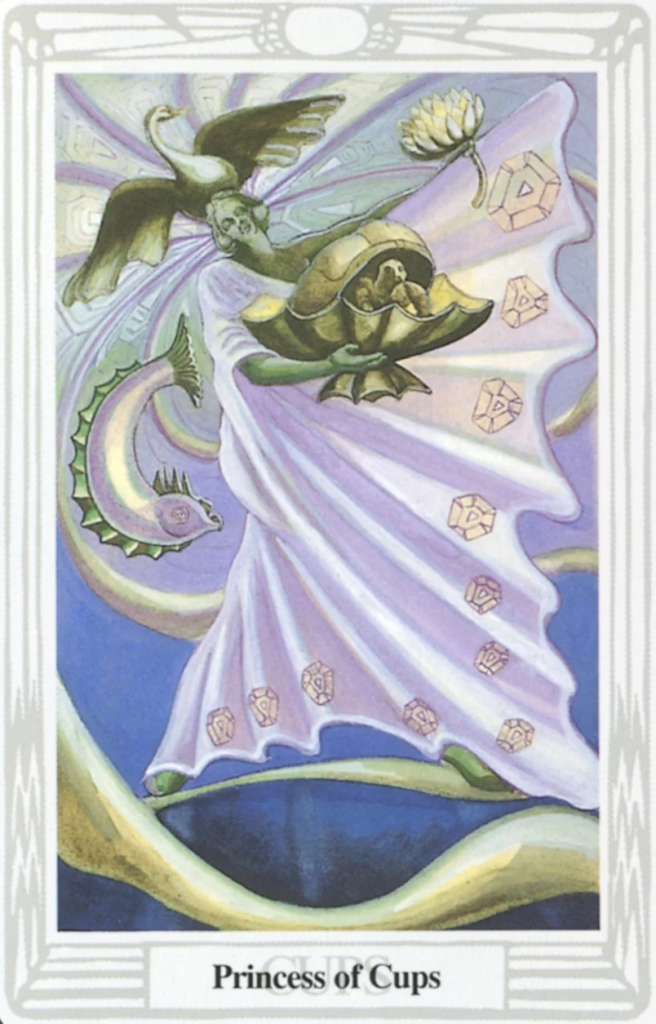
Tarot Card for April 4: The Princess of Cups

The Princess of Cups

If this card comes up to represent a person, she will be a gentle, romantic individual with high levels of intuition. The Princess of Cups is compassionate and caring, warm and responsive. She is at peace with her emotional nature, often highly creative and artistic. She has a certain fragility, particularly when coming into contact with the harsher realities of everyday life, and will not always cope well with conflict. In her world, tranquillity and harmony are highly valued.If, as often happens with the Princesses of the deck, the card comes up to represent a change in events, then the interpretation broadens out somewhat. For instance, the Princess of Cups will sometimes come up to indicate forthcoming pregnancy. The card also appears to indicate a woman falling in love.And if the card applies to a state of mind, then it will indicate heightened perception, and tells you to listen carefully to the voice of your own intuition, and to follow through on any ideas which arise from it.