The Merger Self, the Seeker Self, and the Lifelong Challenge of Balancing Intimacy and Independence

By Maria Popova (themarginalian.org)

Each time I see a sparrow inside an airport, I am seized with tenderness for the bird, for living so acutely and concretely a paradox that haunts our human lives in myriad guises — the difficulty of discerning comfort from entrapment, freedom from peril. It is a paradox rooted in the early development of the psyche and most poignantly manifested in our intimate relationships as we confront over and over the boundary between where we end and the other begins, the challenge of balancing intimacy and independence.

Pulsating beneath the paradox are two opposing forces — one tugging us toward the comfort of the known, the safety of the terminal, the other beckoning us to fly into the open sky of the unknown, with all its sunlit freedoms and its storming dangers. In her 1976 book Passages: Predictable Crises of Adult Life (public library), Gail Sheehy (November 27, 1936–August 24, 2020) explores these “two sets of forces always at loggerheads inside us over the questions of how far and how fast we shall grow,” terming them the Merger Self and the Seeker Self.

Available as a print, benefitting The Nature Conservancy

She writes:

Our Merger Self… is the universal wish to be attached to another, to restore somehow the beatific closeness with mother, for in that fusion would lie perfect harmony, absolute safety, and endless time. The Merger Self is born of the frustration with our early discovery that we are indeed separate and distinct from our caregiver. It triggers a desire to totally incorporate the other, any “other” who becomes the source of love and pleasure… The Merger Self then, in its constant effort to restore closeness, desires always a safe, tight fit.

The Seeker Self is driven by the opposite wish: to be separate, independent, to explore our capacities and become master of our own destiny. This impulse is fueled in early childhood by our delight in awakening capabilities.

But for all its problematic clinginess, the Merger Self is also crucial for the “temporary fusions” upon which empathy is founded — the ability “to reach out and empathize with others, to feel as they might feel without letting our own reality intrude” — and upon which all love rests; for all its seeming strength and self-reliance, the Seeker Self can thrust us into selfishness and solipsism. Only by balancing the two can we achieve what Carl Jung called individuation, Abraham Maslow called self-actualization, and Sheehy calls simply authenticity — “the arrival at that felicitous state of inner expansion in which we know of all our potentialities and possess the ego strength to direct their full reach.” She considers the necessary calibration at the heart of the balance:

If the Merger Self is indulged too early, it can lead us into a no-risk, no-growth position. But once we are beyond the suspicion, or the fear, of letting our distinctiveness be lost in attachments to others, it is our merger side that enables us to love intimately, share unselfishly, express tenderness, and experience empathy.

If the Seeker Self is left unbridled, it will lead us to a self-centered existence in which genuine commitments can have no place, and in which efforts to achieve individual distinction are so strenuous that they leave us emotionally impoverished.

It is only by getting the two sides to work in concert that eventually one becomes capable of both individuality and mutuality.

Art from An ABZ of Love

In the remainder of Passages (which I discovered through a sidewise mention in The Middle Passage), Sheehy goes on to explore how the balance of these two aspects of the psyche affects everything from romantic relationships to professional actualization across the various stages of life as we dismantle our projections and complexes, relinquish our compulsions and conditioning, and recover our authenticity. Observing that “the major task of midlife is to give up all our imagined safety providers and stand naked in the world, as the rehearsal for assuming full authority over ourselves,” she considers the ultimate payoff of this painful, redemptive process:

One of the great rewards of moving through the disassembling period to renewal is coming to approve of oneself ethically and morally and quite independent of other people’s standards and agenda. By giving up the wish that one’s parents were different and by navigating through various lifestyles to that point of dignity worth defending, one can achieve… arrival at that final stage of adult development, in which one can give a blessing to one’s own life.

Complement with Kahlil Gibran on the challenge of balancing intimacy and independence, the key to which Schopenhauer so poignantly captured in his parable of the porcupine dilemma, then revisit Rilke on the difficult art of giving space in love.

Can Harnessing the Power of Mindfulness Enhance Creativity in the Workforce?

SCIENCE OF BEING

Many innovative companies like Google, Cisco, P&G, & Facebook have already recognized the value of mindfulness in promoting creativity, innovation, emotional intelligence & employee well-being…

THOM HARTMANN

APR 28, 2024 (wisdomschool.com)

Let’s examine a crucial aspect of our education system and the workforce: research is telling us that when it comes to solving complex problems, creativity and innovation are absolutely vital. But here’s the catch: our traditional educational courses often fall short in emphasizing these critical skills.

As a result, we have engineers and individuals entering the workforce armed with analytical prowess but struggling to “think outside the box” when it comes to creative problem-solving.

Now comes some groundbreaking research that sheds light on a potential solution to this conundrum. The findings suggest that mindfulness can play a pivotal role in strengthening our capacity to generate fresh, innovative ideas, leading to more innovative thinking and better solutions.

Why is this so important, you might wonder? Well, in the world of technical work, whether you’re an engineer or not, you often find yourself tasked with designing devices, systems, or processes that come with conflicting objectives and numerous possible solutions. This process is known as the “engineering design process.” It involves identifying a problem, defining its scope, brainstorming various solutions, evaluating those ideas, and finally proposing a solution. Engineers use both “convergent” and “divergent” thinking in this process.

Convergent thinking is a linear approach that follows a set of steps to reach a single, “correct” answer. On the other hand, divergent thinking takes a different route. It explores various directions from an initial problem statement to generate a multitude of possible ideas. In the world of design, engineers rely heavily on divergent thinking when generating ideas because it allows them to explore a wide array of potential solutions. Convergent thinking comes into play when it’s time to evaluate those ideas and determine the optimal solution.

Now, here’s the issue: while both forms of thinking are crucial to finding the best possible solution, most science teachers tend to focus predominantly on convergent thinking. They follow a linear path, providing students with narrow, discipline-specific technical knowledge. This approach makes students adept at working individually and applying a series of formulas and rules to structured problems with a single “right” answer.

So, what happens when these people enter the workforce? They often find themselves struggling with divergent thinking, the very skill necessary for innovation. The ability to think creatively and generate fresh ideas is often underdeveloped.

But fear not: there are techniques like brainstorming and need-finding that encourage divergent thinking. They foster a mindset of curiosity, open-mindedness, and acceptance, all of which are essential for creative problem-solving.

And here’s where mindfulness enters the picture. Mindfulness is all about intentionally paying attention with openness, kindness, and curiosity. It’s a powerful tool that, as research suggests, can enhance divergent thinking. Previous studies have shown that a single mindfulness meditation session can improve idea generation in student populations.

In one study, engineering students at Stanford University participated in a 15-minute mindfulness meditation. Participants who reported higher baseline mindfulness performed better on divergent thinking tasks. While the impact of a single 15-minute session on the quantity of ideas was inconclusive, it did boost the originality of ideas.

In a second study, survey data from engineering students and graduates across the U.S. revealed that baseline mindfulness predicted their confidence in being innovative. What’s fascinating is that a particular aspect of mindfulness, known as a “mindful attitude,” emerged as the most significant predictor of innovation self-efficacy.

This attitude involves having an open, curious, and kind approach to paying attention. It’s often referred to as “beginner’s mind,” and it’s essential for exploring new perspectives and generating original ideas.

So, what can we take away from all this? While engineers certainly need analytical skills, it’s equally important for them to cultivate an open, curious, and kind attitude. This mindset allows them to consider new data and approach problems from different angles. The research here is a promising start, and it suggests that we should explore ways to incorporate mindfulness training into engineering education.

Many forward-thinking companies like Google, Cisco, P&G, and Facebook have already recognized the value of mindfulness in promoting creativity, innovation, emotional intelligence, and employee well-being. They’ve integrated mindfulness training into the workplace, and it’s making a significant impact. So, my friends, perhaps it’s time for engineering organizations to follow suit, harnessing the power of mindfulness to enhance divergent thinking and foster innovative mindsets. It’s a path toward a brighter, more creative future, and definitely one worth exploring.

Letter by Letter, Steve Gleason Typed His Memoir With His Eyes

Credit…Rebecca Clarke

BY THE BOOK

The former N.F.L. player has been living with A.L.S. for more than a decade. Sharing “the most lacerating and vulnerable times” in “A Life Impossible” was worth the physical and emotional toll, he says.

Credit…Rebecca Clarke

Describe your ideal reading experience (when, where, what, how).

I have always loved to read, and I read nearly anywhere. Journalists used to get a kick out of the fact that in the midst of the chaotic joy of the [New Orleans] Saints locker room, I would lie on the floor reading books.

These days, while I’m not so good at flipping pages, I still tear through books. I listen on Audible, or read on Kindle, and for the books I’d like to pass on, I buy the book for the shelves in our house.

The ideal reading experience? For me, there is nothing more glorious than sitting outside under the shade of an oak tree with my wife, Michel, or our 12-year-old son, Rivers, listening on Audible or hearing them read the hard copy. (Rivers and I just finished the young readers adaptation of “The Boys in the Boat,” by Daniel James Brown.) Our 5-year-old daughter, Gray, is just learning to read, so I look forward to continuing this tradition in nature, my sanctuary, for many years.

What book do you turn to during hard times?

Viktor Frankl’s “Man’s Search for Meaning.” There were a couple years, as I was losing the ability to move, talk and breathe, that I felt so lonely, ashamed and weary that I was ready to give up and die. His words helped me choose life.

What did it take to write a nearly 300-page book?

In a word … everything. I type with my eyes, letter by letter, so to write this, it took a physical toll to write for several hours each day for two years. It took patience and discipline. People often talk about “writer’s block,” but I think I experienced something of the opposite thousands of times over the past couple years. Ordinary writers may have a wonderful idea to get on the page, then they quickly write it down. But I type so slowly that the wonderful idea that was so vivid and clear eventually slipped into the fog as I trudged and typed.

It also took an emotional toll. To relive the most lacerating and vulnerable times of my life, then to share those experiences in a raw, truthful human way, rather than a heroic way, took an extraordinary amount of trust. It’s clear to me that sharing our shortcomings and weaknesses with each other is our greatest strength. Our salvation.


(Contributed by Michael Kelly, H.W.)

Morning Meditation

No matter what the problem, the solution is love

There is but one problem and one solution. All problems are a deviation from love, and all solutions are a return to it.

Whatever problems I face today, I will look for answers inside myself. I will search my heart for any lack of love… lack of forgiveness…lack of acceptance of my brother or myself. I will be lifted then to an illumined place, where wisdom and truth shall guide me. There I will find the answers that I seek.

Dear God,
May I not be tempted today 
To put blame on others.
I myself am the source of my healing,
as I allow You to change my mind.
May Your spirit guide me to a better place,
That my problems may disappear.
Amen

No matter what the problem, the solution is love

Tarot Card for April 29: The Two of Cups

The Two of Cups

And here we have the Lord of Love, a card of bliss, deep joyous love reciprocated fully and with great enthusiasm, a card of reconciliations and new growth! Here we see harmonious and contented exchanges of emotion, which vibrate with an ecstatic undercurrent of passion and heat.Because this card is a reflective and receptive one, there’s an issue that people sometimes forget when reading it – to be truly loved, deeply treasured, valued highly by others, we must first and foremost strive to feel those things for ourselves. When we work toward loving ourselves, we hold our inner nature in high regard, treating it with deference and proper respect. When we see ourselves in that light, other people cannot help but respond to our personal sense of value.Furthermore, when we work to love ourselves, we release so many areas of self-doubt and uncertainty that we become infused by a new energy – and this we can lavish on others. The Two of Cups is about engaging in a caring and tender fashion with our own needs, first and foremost.It isn’t so much about achieving self-love, as about, in every single day of our lives, striving towards self-love. That action leads us into a positive, self-supportive and accepting approach to life. And also, when we stop wasting energy telling ourselves what’s wrong with us, we have lots more energy to enjoy being who we are.When this card comes up in a reading, if it relates to the inner journey, then it tells you to put your attention in the moment, to leave the past behind, and to let yourself be free to enjoy everything that comes your way.If it relates to outer events, it may point to a forthcoming reconciliation in a relationship where there has been pain and disappointment – this need not be a love affair, it can cover many different types of loving relationship.It might point up a new relationship which has recently begun and which will grow into a deep and lasting friendship or affair.And finally, it may reassure you that the meaningful relationship in your life will strengthen and grow, developing into exactly what you need it to be!!

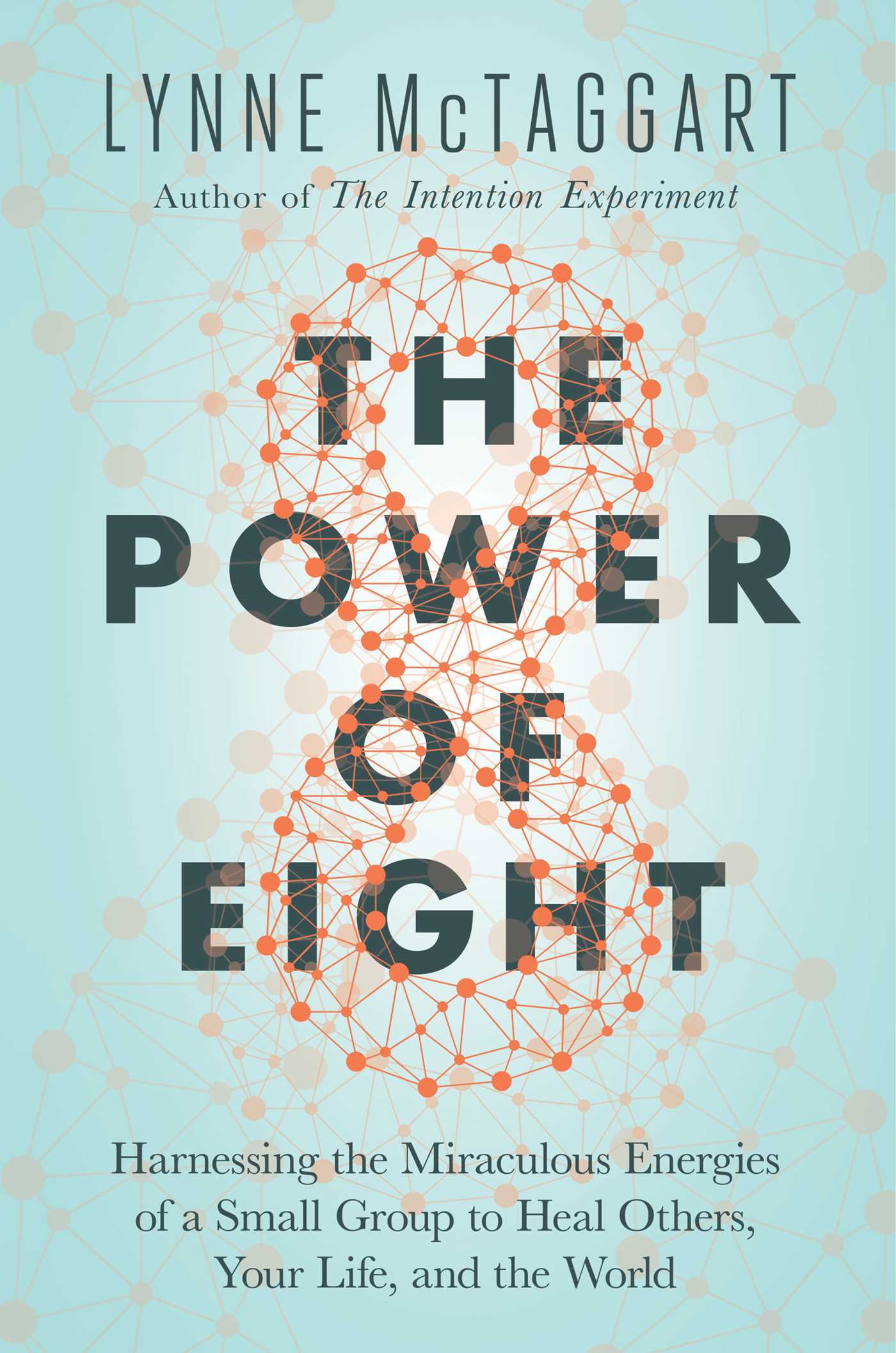
Book: “The Power of Eight: Harnessing the Miraculous Energies of a Small Group to Heal Others, Your Life, and the World”

The Power of Eight: Harnessing the Miraculous Energies of a Small Group to Heal Others, Your Life, and the World

Lynne McTaggart

“This is a monumentally significant book, a once-in-a-generation work that will turn the tide in how we unleash the power of healing for each other and for the world. Drink in its meticulous and transparent scientific method, its countless uplifting stories of vivid healing breakthroughs and its breathtakingly luminous vision. Then go manifest The Power of Eight. ” —James O’Dea, peace activist, former President of the Institute of Noetic Sciences and author of Soul Awakening Practice

Discover how to tap into your extraordinary human capacity for connection and healing, using astonishing new findings about the miraculous power of group intention and its boomerang effect, in this new book by the author of the international bestsellers The Intention Experiment and The Field .

What we send out into the universe comes back to us, magnified. Although the power of intention—the energy of positive thoughts—is widely accepted as an influential force in transforming lives, the exponential power of group intention has never been explored, until now. In The Power of Eight , Lynne McTaggart, an expert on the science of spirituality, reveals her remarkable findings from ten years of experiments about how group intention can heal our lives—and change the world for the better. Drawing on hundreds of case studies, the latest brain research, and dozens of McTaggart’s own university studies, The Power of Eight provides solid evidence showing that there is such a thing as a collective consciousness. Now you can learn to use it and unleash the power you hold inside of you to heal your own life with help from this riveting, highly accessible new book.

(Goodreads.com)

Unity in Polarizing Times with Christopher Naughton

New Thinking Allowed with Jeffrey Mishlove • Apr 28, 2024 Christopher Naughton, JD, is a former prosecutor, civil litigation attorney, and multiple Emmy Award-winning host of The American Law Journal television program. Christopher is a certified holistic life coach helping lawyers and other professionals achieve extraordinary success while maintaining work/life balance. He is a regular guest host on New Thinking Allowed. He is author of America’s Next Great Awakening: What the Convergence of Mysticism, Religion, Atheism, and Science Means for the Nation. And You. His website is americasnextgreatawakening.com. Christopher shares that history follows cyclical patterns, and the current polarization and conflict in society are part of a larger cycle. After periods of existential crisis there is usually greater unity and peace. Chaos and conflict may provide opportunities for more presence and participation that can raise us to a higher level of consciousness to embrace unity in diversity. 00:00:00 Introduction 00:02:27 Cyclical nature of history 00:08:22 Unity in diversity 00:25:53 Overcoming polarization and fundamentalism 00:33:49 Great human values 00:41:14 The other and us 01:14:25 Interconnectedness and life reviews 01:18:17 Finding a moral equivalent of war 01:21:07 Inner spiritual questing and external leadership 01:22:49 Dangers of autocracy and fascism 01:30:31 Healing of past injustices 01:36:03 Rise of feminine principle 01:40:32 America’s experiment in diversity 01:42:27 Conclusion New Thinking Allowed CoHost, Emmy Vadnais, OTR/L, is a licensed occupational therapist, intuitive healer, and health coach based in St. Paul, Minnesota. She is the author of Intuitive Development: How to Trust Your Inner Knowing for Guidance With Relationships, Health, and Spirituality. Her website is https://emmyvadnais.com/ (Recorded on March 28, 2024)

Euripedes’ Bacchae

By Unknown artist – Jastrow (2007), Public Domain, commons.wikimedia.org

“What else is Wisdom? What of man’s endeavour
Or God’s high grace, so lovely and so great?
To stand from fear set free, to breathe and wait;
To hold a hand uplifted over Hate;
And shall not Loveliness be loved for ever?”

― Euripides, The Bacchae

(Courtesy of Gwyllm Llwydd)