
New Thinking Allowed with Jeffrey Mishlove • Dec 16, 2022 This video is a special release from the original Thinking Allowed series that ran on public television from 1986 until 2002. It was recorded in about 1991. Arnold Mindell is an innovative psychological theorist and therapist. He is author of Coma: Key to Awakening as well as many other books. Here he discusses the unique methods he has developed for working with individuals in comatose states. Using the techniques of “process psychology” he is able to find channels into the minds of comatose individuals that allow him to establish communication. Now you can watch all of the programs from the original Thinking Allowed Video Collection, hosted by Jeffrey Mishlove. Subscribe to the new Streaming Channel (https://thinkingallowed.vhx.tv/) and watch more than 350 programs now, with more, previously unreleased titles added weekly. New!! Free month of the classic Thinking Allowed streaming channel for New Thinking Allowed subscribers only. Use code THINKFREELY.
Monthly Archives: December 2022
Res cogitans and res extensa
From Wikipedia, the free encyclopedia
.png)
Res extensa is one of the two substances described by René Descartes in his Cartesian ontology[1] (often referred to as “radical dualism“), alongside res cogitans. Translated from Latin, “res extensa” means “extended thing” while the latter is described as “a thinking and unextended thing”.[2] Descartes often translated res extensa as “corporeal substance” but it is something that only God can create.[3]
Res extensa vs. res cogitans
Res extensa and res cogitans are mutually exclusive and this makes it possible to conceptualize the complete intellectual independence from the body.[2] Res cogitans is also referred to as the soul and is related by thinkers such as Aristotle in his De Anima to the indefinite realm of potentiality.[4] On the other hand, res extensa, are entities described by the principles of logic and are considered in terms of definiteness. Due to the polarity of these two concepts, the natural science focused on res extensa.[4]
In the Cartesian view, the distinction between these two concepts is a methodological necessity driven by a distrust of the senses and the res extensa as it represents the entire material world.[5] The categorical separation of these two, however, caused a problem, which can be demonstrated in this question: How can a wish (a mental event), cause an arm movement (a physical event)?[6] Descartes has not provided any answer to this but Gottfried Leibniz proposed that it can be addressed by endowing each geometrical point in the res extensa with mind.[6] Each of these points is within res extensa but they are also dimensionless, making them unextended.[6]
In Descartes’ substance–attribute–mode ontology, extension is the primary attribute of corporeal substance. He describes a piece of wax in the Second Meditation (see Wax argument). A solid piece of wax has certain sensory qualities. However, when the wax is melted, it loses every single apparent quality it had in its solid form. Still, Descartes recognizes in the melted substance the idea of wax.
Descartes and the Discovery of the Mind-Body Problem
(thereader.mitpress.mit.edu)
The French philosopher René Descartes is often credited with discovering the mind-body problem, a mystery that haunts philosophers to this day. The reality is more complicated than that.
By: Jonathan Westphal
Consider the human body, with everything in it, including internal and external organs and parts — the stomach, nerves and brain, arms, legs, eyes, and all the rest. Even with all this equipment, especially the sensory organs, it is surprising that we can consciously perceive things in the world that are far away from us. For example, I can open my eyes in the morning and see a cup of coffee waiting for me on the bedside table. There it is, a foot away, and I am not touching it, yet somehow it is making itself manifest to me. How does it happen that I see it? How does the visual system convey to my awareness or mind the image of the cup of coffee?
The answer is not particularly simple. Very roughly, the physical story is that light enters my eyes from the cup of coffee, and this light impinges on the two retinas at the backs of the eyes. Then, as we have learned from physiological science, the two retinas send electrical signals past the optic chiasm down the optic nerve. These signals are conveyed to the so-called visual cortex at the back of the brain. And then there is a sort of a miracle. The visual cortex becomes active, and I see the coffee cup. I am conscious of the cup, we might even say, though it is not clear what this means and how it differs from saying that I see the cup.
One minute there are just neurons firing away, and no image of the cup of coffee. The next, there it is; I see the cup of coffee, a foot away. How did my neurons contact me or my mind or consciousness, and stamp there the image of the cup of coffee for me?
It’s a mystery. That mystery is the mind-body problem.
Our mind-body problem is not just a difficulty about how the mind and body are related and how they affect one another. It is also a difficulty about how they can be related and how they can affect one another. Their characteristic properties are very different, like oil and water, which simply won’t mix, given what they are.
There is a very common view which states that the French philosopher René Descartes discovered, or invented, this problem in the 17th century. According to Descartes, matter is essentially spatial, and it has the characteristic properties of linear dimensionality. Things in space have a position, at least, and a height, a depth, and a length, or one or more of these. Mental entities, on the other hand, do not have these characteristics. We cannot say that a mind is a two-by-two-by-two-inch cube or a sphere with a two-inch radius, for example, located in a position in space inside the skull. This is not because it has some other shape in space, but because it is not characterized by space at all.
The difficulty is not merely that mind and body are different. It is that they are different in such a way that their interaction is impossible.
What is characteristic of a mind, Descartes claims, is that it is conscious, not that it has shape or consists of physical matter. Unlike the brain, which has physical characteristics and occupies space, it does not seem to make sense to attach spatial descriptions to it. In short, our bodies are certainly in space, and our minds are not, in the very straightforward sense that the assignation of linear dimensions and locations to them or to their contents and activities is unintelligible. That this straightforward test of physicality has survived all the philosophical changes of opinion since Descartes, almost unscathed, is remarkable.
This issue aroused considerable interest following the publication of Descartes’s 1641 treatise “Meditations on First Philosophy,” the first edition of which included both Objections to Descartes, written by a group of distinguished contemporaries, and the philosopher’s own Replies. Though we do find in the “Meditations” itself the distinction between mind and body, drawn very sharply by Descartes, in fact he makes no mention of our mind-body problem. Descartes is untroubled by the fact that, as he has described them, mind and matter are very different: One is spatial and the other not, and therefore one cannot act upon the other. Descartes himself writes in his Reply to one of the Objections:
The whole problem contained in such questions arises simply from a supposition that is false and cannot in any way be proved, namely that, if the soul and the body are two substances whose nature is different, this prevents them from being able to act on each other.
Descartes is surely right about this. The “nature” of a baked Alaska pudding, for instance, is very different from that of a human being, since one is a pudding and the other is a human being — but the two can “act on each other” without difficulty, for example when the human being consumes the baked Alaska pudding and the baked Alaska in return gives the human being a stomachache.

The difficulty, however, is not merely that mind and body are different. It is that they are different in such a way that their interaction is impossible because it involves a contradiction. It is the nature of bodies to be in space, and the nature of minds not to be in space, Descartes claims. For the two to interact, what is not in space must act on what is in space. Action on a body takes place at a position in space, however, where the body is. Apparently Descartes did not see this problem. It was, however, clearly stated by two of his critics, the philosophers Princess Elisabeth of Bohemia and Pierre Gassendi. They pointed out that if the soul is to affect the body, it must make contact with the body, and to do that it must be in space and have extension. In that case, the soul is physical, by Descartes’s own criterion.
In a letter dated May 1643, Princess Elisabeth wrote to Descartes,
I beg you to tell me how the human soul can determine the movement of the animal spirits in the body so as to perform voluntary acts—being as it is merely a conscious substance. For the determination of the movement seems always to come about from the moving body’s being propelled—to depend on the kind of impulse it gets from what it sets in motion, or again, on the nature and shape of this latter thing’s surface. Now the first two conditions involve contact, and the third involves that the impelling [thing] has extension; but you utterly exclude extension from your notion of soul, and contact seems to me incompatible with a thing’s being immaterial.
Propulsion and “the kind of impulse” that set the body in motion require contact, and “the nature and shape” of the surface of the site at which contact is made with the body require extension. We need two further clarifications to grasp this passage.
The first is that when Princess Elisabeth and Descartes mention “animal spirits” (the phrase is from the ancient Greek physician and philosopher Galen) they are writing about something that plays roughly the role of signals in the nerve fibers of modern physiology. For Descartes, the animal spirits were not spirits in the sense of ghostly apparitions, but part of a theory that claimed that muscles were moved by inflation with air, the so-called balloonist theory. The animal spirits were fine streams of air that inflated the muscles. (“Animal” does not mean the beasts here, but is an adjective derived from “anima,” the soul.)
The second clarification is that when Princess Elisabeth writes that “you utterly exclude extension from your notion of soul,” she is referring to the fact that Descartes defines mind and matter in such a way that the two are mutually exclusive. Mind is consciousness, which has no extension or spatial dimension, and matter is not conscious, since it is completely defined by its spatial dimensions and location. Since mind lacks a location and spatial dimensions, Elisabeth is arguing, it cannot make contact with matter. Here we have the mind-body problem going at full throttle.
It was Descartes’ critics who discovered the problem, right in his solution to it.
Descartes himself did not yet have the mind-body problem; he had something that amounted to a solution to the problem. It was his critics who discovered the problem, right in Descartes’s solution to the problem, although it is also true that it was almost forced on them by Descartes’s sharp distinction between mind and body. The distinction involved the defining characteristics or “principal attributes,” as he called them, of mind and body, which are consciousness and extension.
Though Descartes was no doubt right that very different kinds of things can interact with one another, he was not right in his account of how such different things as mind and body do in fact interact. His proposal, in “The Passions of the Soul,” his final philosophical treatise, was that they interact through the pineal gland, which is, he writes, “the principal seat of the soul” and is moved this way and that by the soul so as to move the animal spirits or streams of air from the sacs next to it. He had his reasons for choosing this organ, as the pineal gland is small, light, not bilaterally doubled, and centrally located. Still, the whole idea is a nonstarter, because the pineal gland is as physical as any other part of the body. If there is a problem about how the mind can act on the body, the same problem will exist about how the mind can act on the pineal gland, even if there is a good story to tell about the hydraulics of the “pneumatic” (or nervous) system.
We have inherited the sharp distinction between mind and body, though not exactly in Descartes’s form, but we have not inherited Descartes’s solution to the mind-body problem. So we are left with the problem, minus a solution. We see that the experiences we have, such as experiences of color, are indeed very different from the electromagnetic radiation that ultimately produces them, or from the activity of the neurons in the brain. We are bound to wonder how the uncolored radiation can produce the color, even if its effects can be followed as far as the neurons in the visual cortex. In other words, we make a sharp distinction between physics and physiology on the one hand, and psychology on the other, without a principled way to connect them. Physics consists of a set of concepts that includes mass, velocity, electron, wave, and so on, but does not include the concepts red, yellow, black, and the like. Physiology includes the concepts neuron, glial cell, visual cortex, and so on, but does not include the concept of color. In the framework of current scientific theory, “red” is a psychological term, not a physical one. Then our problem can be very generally described as the difficulty of describing the relationship between the physical and the psychological, since, as Princess Elisabeth and Gassendi realized, they possess no common relating terms.
Was there really no mind-body problem before Descartes and his debate with his critics in 1641? Of course, long before Descartes, philosophers and religious thinkers had spoken about the body and the mind or soul, and their relationship. Plato, for example, wrote a fascinating dialogue, the Phaedo, which contains arguments for the survival of the soul after death, and for its immortality. Yet the exact sense in which the soul or mind is able to be “in” the body, and also to leave it, is apparently not something that presented itself to Plato as a problem in its own right. His interest is in the fact that the soul survives death, not how, or in what sense it can be in the body. The same is true of religious thinkers. Their concern is for the human being, and perhaps for the welfare of the body, but mainly for the welfare and future of the human soul. They do not formulate a problem with the technical precision that was forced on Princess Elisabeth and Gassendi by Descartes’s neatly formulated dualism.
Something important clearly had changed in our intellectual orientation during the mid-17th century. Mechanical explanations had become the order of the day, such as Descartes’s balloonist explanation of the nervous system, and these explanations left unanswered the question of what should be said about the human mind and human consciousness from the physical and mechanical point of view.
What happens, if anything, for example, when we decide to do even such a simple thing as to lift up a cup and take a sip of coffee? The arm moves, but it is difficult to see how the thought or desire could make that happen. It is as though a ghost were to try to lift up a coffee cup. Its ghostly arm would, one supposes, simply pass through the cup without affecting it and without being able to cause it or the physical arm to go up in the air.
It would be no less remarkable if merely by thinking about it from a few feet away we could cause an ATM to dispense cash. It is no use insisting that our minds are after all not physically connected to the ATM, and that is why it is impossible to affect the ATM’s output — for there is no sense in which they are physically connected to our bodies. Our minds are not physically connected to our bodies! How could they be, if they are nonphysical? That is the point whose importance Princess Elisabeth and Gassendi saw more clearly than anyone had before them, including Descartes himself.
Jonathan Westphal is a Permanent Member of the Senior Common Room at University College, Oxford, and the author of “The Mind-Body Problem,” from which this article is adapted.
Do Not Love Half Lovers | Khalil Gibran
The Power of Life • Sep 3, 2022 Discipline is a word that carries a lot of weight with it. It promises self control, hard work, resilience in the face of temptation, and seems to be a quality that many people in our modern day are looking for but many find elusive. Discipline is an easy thing to explain but a difficult thing to develop. It takes the slack when we lack motivation. In this video I’ve put together a guide to discipline to help you find way to develop yours and in doing so be better able to work towards your own individual goals. I hope it helps.
A Personal and Scientific Journey Through Heartbreak
December 15, 2022 (bookdreamspodcast.com)
Why, exactly, do we feel so shattered when someone we love leaves us? What is the science behind the physical changes we experience during heartbreak, such as weight loss and anxiety, and why do so many of us stop behaving rationally? In this episode of Book Dreams, we talk with acclaimed science writer Florence Williams about her latest book, Heartbreak: A Personal and Scientific Journey, in which she explores questions like these within the framework of a heartbreak of her own and its aftermath. In her conversation with Julie and Eve, Florence discusses the brain science behind our responses to this kind of loss; the potential impact of loneliness and feelings of abandonment on our immune systems; why some of us bounce back from heartbreak faster than others; what advice she gives to everyone struggling to recover from heartbreak; and so much more.
Florence Williams is a journalist, podcaster, and the author of Heartbreak: A Personal and Scientific Journey. Her first book, Breasts: A Natural and Unnatural History, won the Los Angeles Times Book Prize in Science and Technology, and was named a notable book by The New York Times. She’s also the author of The Nature Fix: Why Nature Makes us Happier, Healthier, and More Creative. Her writing has appeared in The New York Times, National Geographic, The New York Review of Books, and many other outlets, and she’s a contributing editor at Outside Magazine.

Link to podcast: https://a59a7b1c-70dd-46aa-93f7-7c666173f85b.usrfiles.com/html/db9376e69cfa487ea0fa0b912ae51a4f_v1.html
Heartbreak: A Personal and Scientific Journey
“[Readers] will learn as much from Williams’s intellectual rigor as from her fearlessness in surviving a broken heart.”
― Sebastian Modak, New York Times Book Review
“In Heartbreak [Williams] reprises [the] determined, deep-dive reporting [of The Nature Fix], this time seeking the same healing for her shattered self… This is one of the joys of reading a gifted science journalist: You learn so much stuff without having to study it yourself… [A] wise and brave book.”
― Marianne Szegedy-Maszak, Washington Post
“A masterful blend of investigative reporting and personal narrative, chock-full of fascinating insights, gorgeous nature writing and an ample helping of compassion (some of which Williams deservedly reserves for herself).”
― Alexis Burling, San Francisco Chronicle

My Year in Queer Spaces
As schools banned books and state legislatures passed anti-trans bills, bars offered something holy.
December 15, 2022 (NewYorker.com)

Illustration by Ryan Melgar
In January, near the queer bars lining Houston’s Montrose Boulevard, some white guy stood with a bullhorn. Wearing a button-down shirt under a tidy jacket, he screamed at foot traffic for hours. Sodomites wrought the end of civilization! We were all going to hell! Vaping on a patio across the street, I asked a buddy whether this was strange, and he confirmed that it was, before we flopped into Crocker to the tune of Toni Braxton.
New Yorker writers reflect on the year’s highs and lows.
A week later, around the same spot, a gaggle of folks stood with more microphones. They wore matching T-shirts, blasting fire-and-damnation into the humidity. From time to time, they’d flag down passersby to remind us of our pending eternity in flames. A handful of folks engaged with the homophobes while walking along the busted concrete, but few offered more than a brief, tired Girl.
At Ripcord, a bartender—a bearish ginger draped in leather—told me that the agitators had been more visible lately.
They’re feeling themselves, he said. But it’s fucking gross out there? They should drink some water instead.
Some porn played on the screen behind us. Patti LaBelle sang from the speakers. This was a perfect space, and I ordered more drinks to take to my friends on the patio.
All in all, 2022 has been a ghoulish year for queer folks in the United States. Lawmakers have proposed more than two hundred and fifty anti-L.G.B.T.Q. bills, more than a hundred and eighty of them directed at trans folks. Nearly half of book bannings this year have focussed on queer content. There have been more than a hundred and twenty threats, protests, and attacks against drag shows. At least thirty-four trans folks have been killed, and states across the country have revelled in targeting trans kids.
But queer spaces have been more essential than ever. They’ve served as focal points of connection and as portals for sharing information. Yet another year into the pandemic, they’ve been places to just enjoy others for a fucking minute. Or maybe play bingo. Or catch a drag show, or catch up with friends, or spin the wheel on a date. They’ve offered a way to spend time with people whom you can wear a little less armor around, who might actually be invested in your feeling O.K.
In February, I flew to Los Angeles to pretend to finish a novel, but mostly I ended up drowning myself in seolleongtang. The majority of the queer bars I haunted stood in Silver Lake, sporting a little less sheen than the WeHo circuit farther down Santa Monica Boulevard. One night, I passed through the Eagle, where a Latinx guy working at the hotel I’d been staying in flagged me down by the pool table.
He, too, was from Texas, but he’d recently relocated. He asked how things were back home, and I told him that they were suboptimal.
It’s sad, he said. Because there’s so much potential, you know? The numbers are there. My people are there. But what can you even do? Kids can’t even pull up the fucking Trevor Project at school, he added, referring to a district policy that prevents queer students from accessing resources including the suicide-prevention hotline.
We ordered another round of vodka sodas. A group of gays across the bar began to cheer for their friend, who had either just gotten married or divorced. Eventually, we joined in, too.
Ithought of my new friend, in September, when a church just outside Houston hosted a drag bingo night as a fund-raiser for young trans folks, only to be descended upon by a group of neo-Nazis and Proud Boys. Protesters and counter-protesters clashed along a road leading to the house of worship. Local police formed a line on the median. Afterward, despite everything, a pastor at the church deemed the event a success.
At a queer bar that weekend, about thirty miles away, my boyfriend, L, and I watched the usual assortment of karaoke singers cross a stage. Spectating was our tiny ritual. (I can confidently sing only songs by BLACKPINK.) Some familiar faces were perched in their corners. We smiled and nodded and touched one another’s elbows and shoulders. Eventually, a straight couple took the stage. They announced that they’d just gotten engaged, and dedicated their performance to the queer folks in attendance, swearing that “it gets better” before immediately launching into Selena’s mournful “No Me Queda Más.”
Behind us, someone asked, What the fuck?
Back in L.A. a few weeks later, I was sitting with two friends on the curb of Akbar, a gay cocktail bar, when a car swerved toward our intersection. A white guy leaned out of his window, yelling, Go get fucked, faggots.
The car honked as it passed us, nearly running the light. The three of us continued to tap at our phones. Then one friend looked up, sighed, and said, Babe, I wish.
The next month, after the fabulous collapse of a years-long project, I was feeling a little frantic, and L suggested that we take advantage of remote work. We ended up in Bangkok for a month. Our hotel, in the Silom area, sat a short walk from the subway line. A slightly longer walk brought us to a strip of queer bars tucked down an alleyway, beside an all-night American-style diner whose tuna salad made me see God.
On our first night out, we met a bespectacled guy at a drag bar. He was a local engineer, and he’d recently come out. A month beforehand, Bangkok had celebrated its first Pride march in years—which was also his first Pride march ever. So we bought him a drink to celebrate, and when I asked how he liked the city’s queer scene he grinned. If you were just looking to cruise, he said, waving at some older white guys ogling a pair of twinks wrapped in Gucci, then the bars were great. But the pandemic hadn’t been kind to many of the city’s queer establishments.
A lot of folks just hang out at home, he said. Tourist life and local queerness are different.
Another club I frequented underlined this dynamic. Tucked away on the upper floor of a nearby shopping mall, it was basically a local bear bar. The vibe felt worlds away from the evening strip’s sheen. Its clientele lounged in beach chairs. The occasional expat sipped beer from a straw. A dubbed version of the third “Transformers” movie played on a tiny television by a Jacuzzi.
One guy I met came from Indonesia. He asked whether I was Thai-Muslim (I’m not), and, when I told him I lived in the States, he asked how many of them I’d visited. He’d spent the last two years in Jakarta by himself. But he wasn’t out to his family. Indonesia was a tough place to be queer, and Bangkok was a reprieve.
I can let my guard down, he said. I can’t even tell you what that’s like.
By the time we returned to Houston, mpox—the disease often called by the harmful name “monkeypox”—had been declared a global health emergency. The epidemic had spread throughout the country, while testing remained virtually impossible. One buddy picked it up from a hookup. Another’s partner had a brush with it after an orgy. The vaccine requirements were constantly shifting: you could possibly, maybe receive one, but only if you were deemed sufficiently high-risk, and then only if you were “a man who had sex with men,” a wildly inadequate qualifier. The most accurate information I received came not from the government but by way of gay bars, sex clubs, and other queer-forward spaces hastily fortifying informal networks.
L and I spent a long Tuesday on the phone, flailing for an available shot. Two weeks later, pulling up for our appointments, we found that we were the only non-white folks in line at a predominantly Black neighborhood’s community center in South Houston. As it turned out, the government had sat on hundreds of thousands of doses. In the following month, supply strains would exacerbate racial disparities in vaccine access and medical disenfranchisement among queer folks of color.
But, at the end of July, Beyoncé released “Renaissance.” I started the album in my car the morning after its release and simply never stopped playing it. That same weekend, ducking through Houston’s queer circuit, I heard a d.j. in a packed bar start one song from the record (“Heated”) before slipping into another (“Virgo’s Groove”) and then a third (“Pure/Honey”) as the room worked itself into a pulsing huff of steam. When I finally stepped outside for air, I was enfolded into a group of folks still running through the lyrics, clapping each other on our shoulders and backs, nearly tearful, deeply euphoric.
In August, realizing that I’d either have to finish my novel or simply walk into the Gulf of Mexico, I holed up in a Vancouver studio overlooking the downtown skyline. Most mornings, I ambled down to the Vietnamese diner stationed by the building’s garage, until the matron started heading instinctively toward the coffee machine whenever I squeezed through the door. One evening, I passed through a restaurant for katsu curry and noticed that an Indian guy was the only other person eating alone. We exchanged polite smiles. A few hours later, nursing a drink at a queer bar, I spotted the same guy.
He was visiting with his family. He’d been hoping for a fun vacation, but mpox had him wary. He said that he’d just graduated university. I congratulated him, and he asked whether he could have a hug. When I gave him one, I could feel his entire body relax. He said that he’d only recently started going to the bars by himself, because he wasn’t entirely out. I told him it wasn’t a race, and he laughed.
That’s what everyone keeps saying, he added. But first there was covid? It feels like a raw deal, like it’s all one risk after another.
Afew weeks later, back in the Bay Area, I stood vaping with some folks outside a queer bar when a gray S.U.V. settled beside us. Its driver unrolled the window, unstrapped himself from a seatbelt, and yelled that he was fine with a queer bar in his neighborhood, but that we needed to keep our fag shit in the building.
He asked whether we understood. Four other smokers and I blinked at one another. None of us said anything. There were too many uncertain variables. Finally, the oldest person standing among us, a bearded Filipino guy, said, Sure, honey, and the car rolled away.
We stood in silence for another beat, puffing away, a little rattled. Then another person, a Black individual in overalls, the smallest one among us, said, He looked like his breath fucking stank.
In November, sleepwalking toward a manuscript deadline, I visited Amsterdam. The city unfurled in a moody way, guided by canals and folks meandering on bikes along brick-laden roads. Every few streets, a rain-worn building sported the Progress Pride flag.
As far as I know there’s only one gay sauna in Amsterdam. On a weekday, it was hardly populated. I ended up sitting in a hot tub between two guys, one of whom said that he was from Spain, and in the way of queers everywhere we started in on our recent grievances. The Spanish guy said that he was living in London for work. This was the first trip he’d taken since relocating. He grew up in a small town, and adolescence had been tough on him. London had been an education, and now he was furthering it.
The other guy was white and younger than both of us. We’d taken him for a local. But when we asked where he was from, he said Kyiv, and the reality of his situation—the war across the continent—sent a chill through the water.
Holy fuck, we said.
It’s all right, the guy replied. I’d never been to a gay bar. I’ve never been to a place like this, he said. I’m trying new things—hoping for the best, you know?
We nodded. But how could we possibly know?
The week before Thanksgiving, L and I lounged on the patio of our local leather spot, because I’d just finished copy edits on my novel and it was time to celebrate. Then, starting at one end of Montrose, we careened from bar to bar. I managed to stay afloat until two in the morning. A crisp chill hung over the patios. Folks huddled together as they passed, cheering on strangers, imploring them to stay safe. A few hours later, we woke up to news of the Club Q shooting in Colorado Springs. A shooter had killed five people in the queer night club and wounded at least nineteen more.
It all felt like—and it all is—entirely too much. A country that prides itself on queer progressiveness on an international stage refuses to provide safety and human rights for its residents. This month, the Respect for Marriage Act has become law, but what is the privilege of marriage to communities without the baseline necessities, who face regular violence in their attempts to secure them?
On Thanksgiving evening, after making the rounds of our assorted found families, we made our way back to the queer bars, settling into JR.’s. The atmosphere was muted. Looks of recognition passed from patron to patron. But, as the evening progressed, the room turned more crowded—never packed, but lively—until it felt like being present for each other was a gift in itself.
On the karaoke stage, a drag queen lamented the shootings. She said that things were taking a turn for the worse. But then she asked whether anyone in the room had something for us to champion. One woman noted that she’d just left a ten-year marriage. Another guy spoke about his new gig. A couple announced that they’d opened up their relationship, drawing a scattering of cheers, because this, too, was touching: to see things normally rendered invisible allowed visibility within this shared space.
And perhaps this is one function of queer spaces: to give what is deemed unworthy—by white supremacy, by stigma, by capitalism—its brightness, even if only for a few hours. Flirting at the bar is holy. Biding time on a hookup app by the pool table is holy. A sleepy evening sipping lukewarm beer with found family is holy. Chatting with the muscle-cub bartender is holy. A midnight drag show on a week night is holy. Sucking dick in a dark room is holy, and so is waiting until you’ve gotten home, and so is opting out of the meat market entirely for a lazy pecan waffle with eggs at the all-you-can-eat diner once the bars have closed. Coming out incessantly is holy. Coming together is holy. A hastily organized orgy is holy. And mundanity is holy—perhaps even the holiest, because it is worth everything to insure that the most disenfranchised among us receive the same ordinary benefit of the doubt.
With the queen’s interlude over, karaoke began again. An older Black dude sang Luther Vandross. Some Latinx folks followed with Selena Gomez. A Black woman sang Jill Scott with her white friend. And then an Asian guy took the stage for an astoundingly beautiful rendition of “Rocket Man,” which felt like the appropriate note to depart on. We finished our beers and slipped out into the rain, taking care not to trip on the concrete. ♦
The Year in Review

© 2022 Condé Nast. All rights reserved. Use of this site constitutes acceptance of our User Agreement and Privacy Policy and Cookie Statement and Your California Privacy Rights. The New Yorker may earn a portion of sales from products that are purchased through our site as part of our Affiliate Partnerships with retailers. The material on this site may not be reproduced, distributed, transmitted, cached or otherwise used, except with the prior written permission of Condé Nast. Ad Choices
(Contributed by Michael Kelly, H.W.)
Ukraine Emergency Translation Group
Translation is a 5-step process of “straight thinking in the abstract.” The first step is an ontological statement of being beginning with the syllogism: “Truth is that which is so. That which is not truth is not so. Therefore Truth is all there is.” The second step is the sense testimony (what the senses tell us about anything). The third step is the argument between the absolute abstract nature of truth from the first step and the relative specific truth of experience from the second step. The fourth step is filtering out the conclusions you have arrived at in the third step. The fifth step is your overall conclusion.
The Ukraine Emergency Translation Group meets every Friday at 11 a.m. Pacific time via Zoom. We call it the Ukraine Emergency Translation Group but we welcome Translations about anything. Here are sense testimonies (2nd steps) we translated and their corresponding conclusions: (5th steps) this week.
2) Systems can become clogged and inhibit and prevent flow that can shut down and stop the system.
5) Infinite, eternal, everpresent harmonious flow is all that is.
2) People desire control over others more than they desire Truth
5) Truth is ENERGY BEING ONE WHOLE HUMANITY.
2) I may have arthritic hips.
5) Truth is one Consciousness, ready-made, indivisible, all-inclusive and appropriate in all situations.
All Translators are welcome to join us on Fridays at 11 a.m. Pacific time. The link is: https://us06web.zoom.us/j/83608167293?pwd=cFRsckVibXMwTGJ0KzhaV0R2cWJtdz09
For information about Translation or other Prosperos classes go to: https://www.theprosperos.org/teaching
Some comments from group members about this group:
“I like the group interaction and different perspectives. Also, at least for me, it gives me a sense of accountability and keeps the practice fresh in my mind. ” –Sarah Flynn
“This group has freed me up to have more fun with my Translations.”
–Mike Zonta
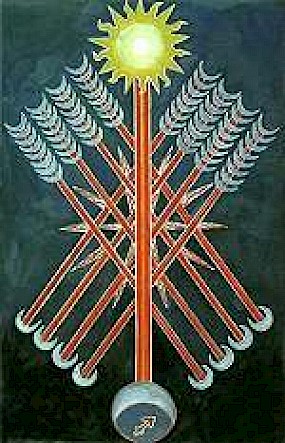
Tarot Card for December 16: The Nine of Wands
The Nine of Wands
When we reach deep inside ourselves, with a heart that is unafraid and accepting, we will discover new depths of strength and power. These deep reaches of wisdom, which lay dormant with in the subconscious until we are brave enough to search them out, will bring balance and equilibrium. And from new centredness will arise an unshakeable trust in ourselves that will carry us forward through life.
It’s true that when we travel deep inside ourselves, we will also find material that we might prefer to leave unacknowledged – but the Nine of Wands, Lord of Strength, reminds us that in being true to ourselves we release energies that will help us to deal with whatever we find within. And after all, whatever lies inside our own subconscious is, for better or for worse, a part of us.
When the Nine of Wands turns up in a reading, we can be re-assured that we have what it takes to get by. Even in times of stress and difficulty, inner strength will rise up to guide us forward toward our goals. And in the process we shall learn more about ourselves and our abilities, gaining a new all-round perspective which brings security and self-confidence.
This card tells us to trust ourselves. We have everything we need. There is no necessity to analyse nor question. And absolutely no excuse to give in to doubt!
(via angelpaths.com and Alan Blackman)
Huston Smith on being close to God

“The closer you are to God, the more meaningful everything becomes.”
–Huston Smith
Huston Cummings Smith (May 31, 1919 – December 30, 2016) was an influential scholar of religious studies in the United States, He authored at least thirteen books on world’s religions and philosophy, and his book about comparative religion, The World’s Religions sold over three million copies as of 2017. Wikipedia
Bio: Thomas Nagel

From Wikipedia, the free encyclopedia
.jpg)
Thomas Nagel (/ˈneɪɡəl/; born July 4, 1937) is an American philosopher. He is the University Professor of Philosophy and Law Emeritus at New York University,[3] where he taught from 1980 to 2016.[4] His main areas of philosophical interest are legal philosophy, political philosophy, and ethics.[5]
Nagel is known for his critique of material reductionist accounts of the mind, particularly in his essay “What Is It Like to Be a Bat?” (1974), and for his contributions to liberal moral and political theory in The Possibility of Altruism (1970) and subsequent writings. He continued the critique of reductionism in Mind and Cosmos (2012), in which he argues against the neo-Darwinian view of the emergence of consciousness.
Life and career
Nagel in 2008, teaching ethics
Nagel was born on July 4, 1937, in Belgrade, Yugoslavia (now Serbia), to German Jewish refugees Carolyn (Baer) and Walter Nagel.[6][7] He arrived in the US in 1939, and was raised in and around New York.[7] He had no religious upbringing, but regards himself as a Jew.[8]
Nagel received a Bachelor of Arts degree in philosophy from Cornell University in 1958, where he was a member of the Telluride House and was introduced to the philosophy of Ludwig Wittgenstein. He then attended the University of Oxford on a Fulbright Scholarship and received a Bachelor of Philosophy degree in 1960; there, he studied with J. L. Austin and Paul Grice. He received his Doctor of Philosophy degree in philosophy from Harvard University in 1963.[4][9] At Harvard, Nagel studied under John Rawls, whom Nagel later called “the most important political philosopher of the twentieth century.”[10]
Nagel taught at the University of California, Berkeley, (from 1963 to 1966) and at Princeton University (from 1966 to 1980), where he trained many well-known philosophers, including Susan Wolf, Shelly Kagan, and Samuel Scheffler, the last of whom is now his colleague at New York University.
Nagel is a fellow of the American Academy of Arts and Sciences and a corresponding fellow of the British Academy, and, in 2006, was elected as a member of the American Philosophical Society.[11] He has held a fellowship from the Guggenheim Foundation, the National Science Foundation, and the National Endowment for the Humanities.[11] In 2008, he was awarded a Rolf Schock Prize for his work in philosophy,[12] the Balzan prize,[13] and the honorary degree of Doctor of Letters from the University of Oxford.[14]
Philosophical work
Overview
Nagel began to publish philosophy at age 22; his career now spans over 60 years of publication. He thinks that each person, owing to their capacity to reason, instinctively seeks a unified world view, but if this aspiration leads one to believe that there is only one way to understand our intellectual commitments, whether about the external world, knowledge, or what our practical and moral reasons ought to be, one errs. For contingent, limited and finite creatures, no such unified world view is possible, because ways of understanding are not always better when they are more objective.
Like the British philosopher Bernard Williams, Nagel believes that the rise of modern science has permanently changed how people think of the world and our place in it. A modern scientific understanding is one way of thinking about the world and our place in it that is more objective than the commonsense view it replaces. It is more objective because it is less dependent on our peculiarities as the kinds of thinkers that people are. Our modern scientific understanding involves the mathematicized understanding of the world represented by modern physics. Understanding this bleached-out view of the world draws on our capacities as purely rational thinkers and fails to account for the specific nature of our perceptual sensibility. Nagel repeatedly returns to the distinction between “primary” and “secondary” qualities—that is, between primary qualities of objects like mass and shape, which are mathematically and structurally describable independent of our sensory apparatuses, and secondary qualities like taste and color, which depend on our sensory apparatuses.
Despite what may seem like skepticism about the objective claims of science, Nagel does not dispute that science describes the world that exists independently of us. His contention, rather, is that a given way of understanding a subject matter should not be regarded as better simply for being more objective. He argues that scientific understanding’s attempt at an objective viewpoint—a “view from nowhere”—necessarily leaves out something essential when applied to the mind, which inherently has a subjective point of view. As such, objective science is fundamentally unable to help people fully understand themselves. In “What Is It Like to Be a Bat?” and elsewhere, he writes that science cannot describe what it is like to be a thinker who conceives of the world from a particular subjective perspective.
Nagel argues that some phenomena are not best grasped from a more objective perspective. The standpoint of the thinker does not present itself to the thinker: they are that standpoint. One learns and uses mental concepts by being directly acquainted with one’s own mind, whereas any attempt to think more objectively about mentality would abstract away from this fact. It would, of its nature, leave out what it is to be a thinker, and that, Nagel believes, would be a falsely objectifying view. Being a thinker is to have a subjective perspective on the world; if one abstracts away from this perspective one leaves out what he sought to explain.
Nagel thinks that philosophers, over-impressed by the paradigm of the kind of objective understanding represented by modern science, tend to produce theories of the mind that are falsely objectifying in precisely this kind of way. They are right to be impressed—modern science really is objective—but wrong to take modern science to be the only paradigm of objectivity. The kind of understanding that science represents does not apply to everything people would like to understand.
As a philosophical rationalist, Nagel believes that a proper understanding of the place of mental properties in nature will involve a revolution in our understanding of both the physical and the mental, and that this is a reasonable prospect that people can anticipate in the near future. A plausible science of the mind will give an account of the stuff that underpins mental and physical properties in such a way that people will simply be able to see that it necessitates both of these aspects. Now, it seems to people that the mental and the physical are irreducibly distinct, but that is not a metaphysical insight, or an acknowledgment of an irreducible explanatory gap, but simply where people are at their present stage of understanding.
Nagel’s rationalism and tendency to present human nature as composite, structured around our capacity to reason, explains why he thinks that therapeutic or deflationary accounts of philosophy are complacent and that radical skepticism is, strictly speaking, irrefutable.[clarification needed] The therapeutic or deflationary philosopher, influenced by Wittgenstein’s later philosophy, reconciles people to the dependence of our worldview on our “form of life”. Nagel accuses Wittgenstein and American philosopher of mind and language Donald Davidson of philosophical idealism.[15] Both ask people to take up an interpretative perspective to making sense of other speakers in the context of a shared, objective world. This, for Nagel, elevates contingent conditions of our makeup into criteria for what is real. The result “cuts the world down to size” and makes what there is dependent on what there can be interpreted to be. Nagel claims this is no better than more orthodox forms of idealism in which reality is claimed to be made up of mental items or constitutively dependent on a form supplied by the mind.
Philosophy of mind
What is it like to be a something
Further information: What Is It Like to Be a Bat?
Nagel is probably most widely known in philosophy of mind as an advocate of the idea that consciousness and subjective experience cannot, at least with the contemporary understanding of physicalism, be satisfactorily explained with the concepts of physics. This position was primarily discussed by Nagel in one of his most famous articles: “What Is It Like to Be a Bat?” (1974). The article’s title question, though often attributed to Nagel, was originally asked by Timothy Sprigge. The article was originally published in 1974 in The Philosophical Review, and has been reprinted several times, including in The Mind’s I (edited by Daniel Dennett and Douglas Hofstadter), Readings in the Philosophy of Psychology (edited by Ned Block), Nagel’s Mortal Questions (1979), The Nature of Mind (edited by David M. Rosenthal), and Philosophy of Mind: Classical and Contemporary Readings (edited by David J. Chalmers).
In “What Is It Like to Be a Bat?”, Nagel argues that consciousness has essential to it a subjective character, a what it is like aspect. He writes, “an organism has conscious mental states if and only if there is something that it is like to be that organism—something it is like for the organism.”[16] His critics[who?] have objected to what they see as a misguided attempt to argue from a fact about how one represents the world (trivially, one can only do so from one’s point of view) to a false claim about the world, that it somehow has first-personal perspectives built into it. On that understanding, Nagel is a conventional dualist about the physical and the mental. This is, however, a misunderstanding[according to whom?]: Nagel’s point is that there is a constraint on what it is to possess the concept of a mental state, namely, that one be directly acquainted with it. Concepts of mental states are only made available to a thinker who can be acquainted with their own states; clearly, the possession and use of physical concepts has no corresponding constraint.
Part of the puzzlement here is because of the limitations of imagination: influenced by his Princeton colleague Saul Kripke, Nagel believes that any type identity statement that identifies a physical state type with a mental state type would be, if true, necessarily true. But Kripke argues that one can easily imagine a situation where, for example, one’s C-fibres are stimulated but one is not in pain and so refute any such psychophysical identity from the armchair. (A parallel argument does not hold for genuine theoretical identities.) This argument that there will always be an explanatory gap between an identification of a state in mental and physical terms is compounded, Nagel argues, by the fact that imagination operates in two distinct ways. When asked to imagine sensorily, one imagines C-fibres being stimulated; if asked to imagine sympathetically, one puts oneself in a conscious state resembling pain. These two ways of imagining the two terms of the identity statement are so different that there will always seem to be an explanatory gap, whether or not this is the case. (Some philosophers of mind[who?] have taken these arguments as helpful for physicalism on the grounds that it exposes a limitation that makes the existence of an explanatory gap seem compelling, while others[who?] have argued that this makes the case for physicalism even more impossible as it cannot be defended even in principle.)
Nagel is not a physicalist because he does not believe that an internal understanding of mental concepts shows them to have the kind of hidden essence that underpins a scientific identity in, say, chemistry. But his skepticism is about current physics: he envisages in his most recent work that people may be close to a scientific breakthrough in identifying an underlying essence that is neither physical (as people currently think of the physical), nor functional, nor mental, but such that it necessitates all three of these ways in which the mind “appears” to us. The difference between the kind of explanation he rejects and the kind he accepts depends on his understanding of transparency: from his earliest work to his most recent Nagel has always insisted that a prior context is required to make identity statements plausible, intelligible and transparent.