One woman’s six-word mantra that has helped to calm millions

One woman’s six-word mantra that has helped to calm millions | Psyche

No title (Supporting troops of the 1st Australian Division walking on a duckboard track) (1917), by Frank Hurley. Photo courtesy of the National Gallery of Victoria

Judith Hoareis a journalist who worked for the Australian Broadcasting Corporation and at the Australian Financial Review, where she covered politics, business and broader social issues before being appointed features editor and finally deputy editor of the newspaper, a position she held for 20 years. She is the author of The Woman Who Cracked the Anxiety Code: The Extraordinary Life of Dr Claire Weekes (2019). She lives in Sydney, Australia.

Edited by Christian Jarrett

11 OCTOBER 2021 (psyche.co)

Imagine being in a pandemic, isolated and inert. Your life feels out of control, and you are stressed, not sleeping well. Then a raft of bewildering new symptoms arrive – perhaps your heart races unexpectedly, or you feel lightheaded. Maybe your stomach churns and parts of your body seem to have an alarming life of their own, all insisting something is badly wrong. You are less afraid of the pandemic than of the person you have now become.

Most terrifying of all is the invasive flashes of fear in the absence of any specific threat.

Back in 1927, this was 24-year-old Claire Weekes. A brilliant young scholar on her way to becoming the first woman to attain a doctorate of science at the University of Sydney, Weekes had developed an infection of the tonsils, lost weight and started having heart palpitations. Her local doctor, with scant evidence, concluded that she had the dreaded disease of the day, tuberculosis, and she was shunted off to a sanatorium outside the city.

‘I thought I was dying,’ she recalled in a letter to a friend.

Enforced idleness and isolation left her ruminating on the still unexplained palpitations, amplifying her general distress. Upon discharge after six months, she felt worse than when she went in. What had become of the normal, happy young woman she was not so long ago?

Dr Claire Weekes photographed in 1977. Photo by Denver Post/Getty

Flash forward to 1962 and the 59-year-old Dr Claire Weekes was working as a general practitioner, having retrained in medicine after an earlier stellar career in science during which she earned an international reputation in evolutionary biology. That year she also wrote her first book, the global bestseller Self-Help for Your Nerves.

The book was born from the furnace of the two years of high anxiety Weekes had endured in her 20s. Back then, her saviour came in the form of a soldier friend who had fought in the First World War. He explained how shellshocked soldiers had been programmed by fear and suffered similar physical symptoms to her own. Her heart continued to race, he told her, because she was frightened of it. Don’t fight the fear, he advised her, but try to ‘float’ past it. For Weekes, this was a revelation and a huge relief. She took his advice and recovered quite quickly.

Weekes believed that fear was the driver of much nervous suffering, and that many had simply been ‘tricked by their nerves’

The bitter experience of her youth – buttressed by her studies in biology, the nervous system and medicine – contributed to her becoming a doctor deeply attentive to her anxious patients. Weekes soon found herself in huge demand. Her phone rang day and night. Other doctors came to recognise her gift for treating what she called ‘nervous illness’ and sent her more patients.

Critical of Freudian psychoanalysis with its emphasis on sex and tracking down the original cause of distress through talk therapy, Weekes boasted of getting patients off ‘the old Viennese couch … [and out] into the world’. She believed that fear was the driver of much nervous suffering, and that many had simply been ‘tricked by their nerves’. An original cause certainly needed attention if it was still fuelling distress, but Weekes discerned that often it took second place to people’s fear of ‘the state they were in’.

Weekes exposed fear’s vast menu of bewildering and distressing symptoms, and became famous for explaining the mind-body connection. People recognised themselves in the words she used, borrowed from her patients: ‘All tied up.’ ‘Headaches.’ ‘Tired and weary.’ ‘Palpitations.’ ‘Dreadful.’ ‘Nervous.’ ‘Sharp pain under the heart.’ ‘No interest.’ ‘Restless.’ ‘My heart beats like lead.’ ‘I have a heavy lump of dough in my stomach.’ ‘Heart-shakes.’ The nervous system seemed infinitely inventive. Then, bewilderment and fear of ‘what happens next’ took over.

Yet far from being possessed or crazy, Weekes explained to her readers that they were ordinary people who could cure themselves once they understood how their nerves had been ‘sensitised’ and then, by following some simple steps, learn to control the savage flame of fear. ‘It is very much an illness of your attitude to fear,’ she counselled in Peace from Nervous Suffering (1972).

Weekes was effectively treating the panic attack before it even had a name. She also believed that fear is the common thread that runs through many different psychological ‘disorders’, such as obsessive-compulsive disorder (OCD), phobias, general anxiety disorder, depression and post-traumatic stress disorder (PTSD), to use the formal diagnostic terms that had yet to be invented in her time. In this sense, Weekes anticipated contemporary ‘transdiagnostic’ approaches to mental health that acknowledge the commonalities across supposedly separate disorders. Weekes credited her scientific training with allowing her to see what she called ‘the trunk of the tree’ rather than being distracted by the branches.

A circuit-breaker was required. The one she picked was the one she learned from her friend, the soldier: don’t fight fear

In the 1930s, the US president Franklin Roosevelt memorably observed that ‘the only thing we have to fear is fear itself’. This concept is at the heart of Weekes’s unique work. ‘[Th]e nervous person must understand that when he panics, he feels not one fear, as he supposes, but two separate fears. I call these the first and second fear,’ she wrote in 1972.

Five years later, in her address to the Association for the Advancement of Psychotherapy, Weekes explained that the first fear is easy to identify. It is survival mode, that automatic instinct that means you duck a falling brick or a punch without thought. You don’t have to think. The body thinks for you. Today it would be called by its shorthand ‘fight, flight or freeze’. In what she calls a ‘sensitised’ person – someone who has been ill, burdened by worry or, say, fought in the trenches – it can come out of the blue, and be electric in its swiftness and ‘so out of proportion to the danger causing it’ that ‘it cannot be readily dismissed’.

So, shaken badly by this random jolt of first fear, the sufferer inevitably adds ‘second fear’ by worrying about this inexplicably alarming moment. Weekes said that the second fear could be recognised by its prefix ‘Oh my goodness!’ or ‘What if?’ to which any imaginings can be added. This kickstarts the fear-adrenaline-fear cycle, in which heart palpitations, among a medley of other symptoms, play such a powerful part. A circuit-breaker was required. The one she picked was the one she learned from her friend, the soldier: don’t fight fear.

Weekes distilled her understanding of ‘nervous illness’ into a six-word mantra for overcoming anxiety: face, accept, float, let time pass. In Self-Help for Your Nerves, she said that sufferers usually spent their time counterproductively:

Running away, not facing.
Fighting, not accepting.
Arresting and ‘listening in’, not floating past.
Being impatient with time, not letting time pass.

The nervously ill person usually notices each new symptom in alarm, listens-in in apprehension, and yet at the same time is afraid to examine that too closely for fear he will make it worse. He agitatedly seeks occupation to try to force forgetfulness. This is running away, not facing.

He may try to cope with the unwelcome feelings by tensing himself against them, thinking: ‘I must not let this get the better of me!’ He is fighting, not accepting and floating.

Also he keeps looking back and worrying because so much time has passed and he is not yet cured, as if there is an evil spirit which could be exorcised if only he, or the doctor knew how to do it. He is impatient with time; not willing to let time pass.

Of all those words ‘accept’ or, as she would later explain in notes in the margin, ‘don’t fight’, was fundamental. For it was only with such acceptance that this first uncontrollable fear, the primitive fight-or-flight alarm, which was now being triggered in inappropriate circumstances, could be disabled. It was not just ‘putting up with’ the distress. The objective was to yield entirely to first fear, allow it to burn itself out without adding the fuel of second fear.

Weekes set out the science behind her method. Her mantra, with its echoes of Eastern mysticism, was in fact an invitation to the parasympathetic nervous system to do its job and bring the body back into what professionals would call homeostasis, and what the rest of us would understand as peace.

Today, fear has found its way to the front of the queue as a driver of mental distress and trauma

‘There is no such thing as Dr Weekes’s method,’ she said in her second book. ‘I teach nature’s method. I am showing you what nature will do if you give her a chance.’ She found a huge grateful public, and four more books followed the first. Her advice worked for people who were suicidal as well as for over-stressed individuals.

Weekes found a hungry audience but the mental health professionals of her day were indifferent, or worse. This was painful for Weekes, who was conscious of her academic achievements. One leading Australian specialist admitted to me he had originally regarded her book as the equivalent of ‘advice from grandma’. He recanted years later, acknowledging her pioneering work. Few others conceded the point. To them, Weekes was writing about ‘nerves’ which didn’t sound very modern. Worse, she was writing popular self-help books.

However, the biology of fear and the role of the nervous system are back in fashion now. In a recent interview about emotional regulation, Allan Schore, a neuropsychologist at the University of California, Los Angeles, declared: ‘It’s all about the autonomic nervous system,’ which he noted was ignored for ‘much of the last century’. Today, fear has found its way to the front of the queue as a driver of mental distress and trauma. Brain plasticity has also gained popular currency – and what was Weekes’s emphasis on ‘acceptance’ other than a version of retraining the brain out of its habitual responses?

The notion of ‘acceptance’ has found an unassailable place in modern treatment. It even has its own banner – acceptance and commitment therapy (ACT) – recognised as part of the so-called third wave of cognitive behavioural therapy. The founder of ACT, Steven Hayes, describes acceptance as ‘facing the monster’ and ‘walking towards it’ and, like Weekes, he believes it is a necessary step on the path to freedom from distressing symptoms. The prescience of Weekes’s approach also extends to the contemporary understanding of chronic pain, in which fighting physical pain is recognised as being as counterproductive as fighting mental pain.

Weekes was convinced she was ahead of her time and, decades after her death, her approach to anxiety, grounded in an understanding of neurophysiology, remains fresh. For instance, in the 1990s, the US psychiatrist Stephen Porges coined the influential polyvagal theory, which describes the neurophysiological basis of sensitisation to fear. Later, another psychiatrist, Bessel van der Kolk in his bestseller The Body Keeps the Score (2014), recognised the physiology of trauma.

Echoes of Weekes’s approach can also be found in the writings of the US neuroscientist Joseph LeDoux, who makes a crucial distinction between the system in the brain that detects and responds to threats – the fight, flight or freeze mechanism (where evolution does the thinking, as he puts it) – and the system that generates conscious feelings of fear.

Although Weekes was largely ignored by psychiatry and psychology in her lifetime, the reading public educated the medical professionals about what worked for them. And through her books and public engagements, Weekes slowly and invisibly pioneered a change in the treatment of anxiety that continues to this day.

It wasn’t until late in her life that Weekes revealed what many had intuited from her books, that she had personal experience of high anxiety. Her public version was that she was instantly cured when her soldier friend explained to her the deranging effects of fear. It was not quite as simple as that – her ‘nerves’ returned more than once. But Weekes also wrote powerfully about the importance of not being discouraged by such ‘setbacks’ – she knew they were often part of recovery and to be embraced as a chance to practise acceptance. She practised what she preached and that rapidly beating heart, so frightening in her 20s, was to beat on for another 60 years. Just before she died aged 87 in 1990, Weekes told her eldest niece that her work would still be relevant in 50 years. To this day, her bestselling books are still in print, helping in exactly the same way as when they were first published.

Word-Built World: Panglossian

Kelsey Grammer as Dr. Pangloss in an LA Opera production of Candide
Photo: Ken Howard / LA Opera

PRONUNCIATION: (pan-GLOS-ee-uhn) 

MEANING: adjective: Blindly or unreasonably optimistic.
noun: One who is optimistic regardless of the circumstances.

ETYMOLOGY: After Dr. Pangloss, a philosopher and tutor in Voltaire’s 1759 satire Candide. Pangloss believes that, in spite of what happens — shipwreck, earthquake, hanging, flogging, and more — “All is for the best in the best of all possible worlds.” The name is coined from Greek panglossia (talkativeness). Earliest documented use: 1831. The word pangloss is used in the same manner.

Aldous Huxley and Beauty

Vanessa Able (thedewdrop.org)

“The beatific vision of divine beauty is the knowledge of Pure Interval, of harmonious relationship apart from the things related.”

– Aldous Huxley


In his essay, Heaven and Hell, Aldous Huxley recounts sitting on a beach with a friend when, “suddenly, my consciousness was lighted up from within and I saw in a vivid way how the whole universe was made up of particles of material which, no matter how dull and lifeless they might seem, were nevertheless filled with this intense and vital beauty.” Such a dynamic experience of beauty is what he is referring to in this extract from Seven Meditations, a brief exploration of being, beauty, love, peace, holiness, grace and joy. He talks about the beatific vision of divine beauty that resides in Pure Interval, or harmonious relationship. Like Galway Kinnell’s insight into the beauty of a sow, Huxley suggests we can experience the divine through architecture, music, sacred geometries and human relationships.


Beauty arises when the parts of a whole are related to one another and to the totality in a manner which we apprehend as orderly and significant. But the principle of order is God, and God is the final, deepest meaning of all that exists. God, then, is manifest in the relationship which makes things beautiful. He resides in that lovely interval which harmonizes events on all the planes, where we discover beauty. We apprehend Him in the alternate voids and fullnesses of a cathedral; in the spaces that separate the salient features of a picture; in the living geometry of a flower, a sea shell, an animal; in the pauses and intervals between the notes of music, in their differences of tone and sonority; and finally, on the plane of conduct, in the love and gentleness, the confidence and humility, which give beauty to the relationships between human beings.

Such then, is God’s beauty, as we apprehend it in the sphere of created things. But it is also possible for us to apprehend it, in some measure at least, as it is in itself. The beatific vision of divine beauty is the knowledge, so to say, of Pure Interval, of harmonious relationship apart from the things related.

“A material figure of beauty-in-itself is the cloudless evening sky, which we find inexpressibly lovely, although it possesses no orderliness of arrangement, since there are no distinguishable parts to be harmonized.”

A material figure of beauty-in-itself is the cloudless evening sky, which we find inexpressibly lovely, although it possesses no orderliness of arrangement, since there are no distinguishable parts to be harmonized. We find it beautiful because it is an emblem of the infinite Clear Light of the Void. To the knowledge of this Pure Interval we shall come only when we have learned to mortify attachment to creatures, above all to ourselves.

Moral ugliness arises when self-assertion spoils the harmonious relationship which should exist between sentient beings. Analogously, aesthetic and intellectual ugliness arise when one part in a whole excessive or deficient. Order is marred, meaning distorted, and, for the right, the divine relation between things thoughts, there is substituted a wrong relation—a relationship that manifests symbolically, not the immanent and transcendent source of all beauty, but that chaotic disorderliness which characterizes creatures when they try to live independently of God.

Aldous Huxley (1894-1963)
From: Huxley and God

Selma Blair Wants You to See Her Living With Multiple Sclerosis

Selma Blair said that ideally, the film will be meaningful to viewers because it shows “this is my human condition.”
Selma Blair said that ideally, the film will be meaningful to viewers because it shows “this is my human condition.”Credit…Magdalena Wosinska for The New York Times

The actress puts herself out there in “Introducing, Selma Blair,” an unflinching documentary that she hopes can help others.

Selma Blair said that ideally, the film will be meaningful to viewers because it shows “this is my human condition.”Credit…Magdalena Wosinska for The New York Times

Dave Itzkoff

By Dave Itzkoff

  • Published Oct. 13, 2021Updated Oct. 25, 2021 (NYTimes.com)

Leer en español

Selma Blair could only talk for a half-hour in our first session. That was as long as she trusted her brain and her body to cooperate — any longer and she feared that her focus might start to wander or her speech might begin to trail. “We’re being responsible in knowing that smaller moments will be clearer moments,” she said.

For Blair no day is free from the effects of multiple sclerosis, the autoimmune disease that she learned she had in 2018 but that she believes began attacking her central nervous system many years earlier.

This particular Friday in September had started out especially tough: She said she woke up in her Los Angeles home feeling “just bad as all get out,” but she found that talking with people helped alleviate her discomfort. Blair said she had had good conversations earlier in the day and that she had been looking forward to ours.

So, if she needed to take a break during this interview, she said with a delighted cackle, “it just means you’re boring me.”

An unparalleled lack of inhibition has always defined Blair’s best-known work. She is 49 now, with a résumé that includes seminal works of teensploitation (“Cruel Intentions”), comedy (“Legally Blonde”) and comic-book adventure (“Hellboy”).

Blair in one of her signature roles, as a fellow law student  opposite Reese Witherspoon in “Legally Blonde.”
Blair in one of her signature roles, as a fellow law student opposite Reese Witherspoon in “Legally Blonde.”Credit…Tracy Bennett/MGM

That same unbridled bluntness persists in all her interactions, whether scripted or spontaneous, with cameras on or off, even when she is sharing her account of the time she went on “The Tonight Show” wearing a strappy top she accidentally put on sideways. It is a story she told me proudly, within five minutes of our introduction on a video call, while her fingers made a maelstrom of her close-cropped, bleached-blond hair. (By way of explaining this style choice, she burst into a brassy, Ethel Merman-esque voice and sang, “I want to be a shiksa.”)

But Blair’s candor has come to mean something more in the three years since she went public about her M.S. diagnosis. Now, whether she is posting personal diaries on social media or appearing on a red carpet, she understands she is a representative with an opportunity to educate a wider audience about what she and others with M.S. are experiencing.

It is a philosophy of maximum openness that she is taking further by appearing as the subject of a new documentary, “Introducing, Selma Blair.” The film, directed by Rachel Fleit, is an unflinching account of Blair’s life with M.S. and the stem-cell transplant she underwent to treat it in 2019. (The documentary was released in theaters on Oct. 15 and began streaming Oct. 21 on Discovery+.)

As Blair explained, she was hopeful that the film would be meaningful to viewers who feel challenged and uncertain, whether or not they have a chronic illness.

“This is my human condition,” she said, “and everyone has their own, but I think we are united in feeling alone or frightened when we have a big change in our lives. This wasn’t a vanity project at all, and I’m very capable of loving vanity.”ImageBlair said that since she went public with her diagnosis, she’s been offered roles for aging or disabled characters: “I might be those things, but I’m still everything else I was before, and I shouldn’t be relegated to that.”Credit…Magdalena Wosinska for The New York Times

For Blair, the documentary is just one piece of a larger effort to understand herself — to determine how much of her identity has been shaped by her disease, and what will remain or change now that she is being treated for it.

“If this had happened in my 20s, when I’m trying to start a career and set a few shekels aside, I would have been mortified,” she said. “I’m old enough now. I’m getting to know a whole different personality, and I’m not ashamed.”

Thinking back to her upbringing in suburban Michigan, Blair described herself as a 7-year-old who toted around her own copy of the Physicians’ Desk Reference, the massive tome of information on prescription drugs, and wondered why she experienced constant pain, fatigue and unpredictable mood swings.

These difficulties persisted into adulthood: The pain got worse, particularly after the birth of her son, Arthur, in 2011; she had problems with her vision and experienced involuntary muscle contractions in her neck.

Until she received her diagnosis, Blair said, she couldn’t understand why her symptoms varied from setting to setting. “I can walk better in my house, but outside it’s like a sand pit,” she said. “With certain light, my speech becomes intermittent even though my larynx is fine.”

“It never occurred to me that there’s a traffic jam that happens in my brain,” she said.

In the flurry of attention that followed Blair’s disclosure of her diagnosis, she was introduced to Fleit, and they agreed to start shooting the documentary in the days just before Blair traveled to Chicago for her stem-cell transplant.

Fleit said that Blair exercised no editorial control over the film, adding that the endeavor would succeed only if the actress “was willing to show the world what really happened — that brutal intimacy and honesty that you just don’t see — and she was totally open to that.”

Fleit, who has alopecia universalis, an autoimmune disease that causes hair loss, said she felt a particular connection to Blair as filming proceeded.

“Being a bald lady in the world has given me unique access to a certain kind of emotional pain,” Fleit said. “It does not frighten me anymore, and I feel uniquely qualified to hold the space for another person who’s experiencing that.”

But not everyone in Blair’s life was immediately comfortable with her pursuing both the film and the stem cell transplant. Sarah Michelle Gellar, Blair’s “Cruel Intentions” co-star and longtime friend, said that she was fearful about the treatment, which was accompanied by an intensive chemotherapy regimen.

“I just felt like it was so risky,” Gellar said. “And her attitude was, yes, I’m managing right now, but in 10 years I might not be, and I won’t be a candidate for this treatment. It was now or never. And now or never is a very good definition of Selma.”ImageThe actress with her son, Arthur, in a scene from “Introducing, Selma Blair.”Credit…Discovery+

Gellar was also unsure about the film project — “I’m a very private person, I can barely share going to the supermarket,” she said — but she understood Blair’s position: She felt it was important for her son.

As Gellar recalled, “She would say, ‘God forbid, if I don’t make it, then Arthur has a whole video diary of what I went through. He’ll never have to wonder, did I give up? He’ll know how hard I fought to be there for him.’”

To Parker Posey, a friend and colleague of Blair’s for nearly 20 years, the decision to make a documentary was as much a legitimate form of expression as any other artistic enterprise.

“This is the only thing we have — your life as an actor, it’s all material, it’s all story,” Posey said. “Am I going to land in something that gives me meaning, away from the pettiness of most entertainment?”

Posey added, “Anyone who can find purpose in creating what they’re supposed to create and bravely live their life, that’s art. That’s the triumph.”

Blair, for her part, said that once shooting started on the documentary, “I don’t think I noticed. There was really no directing and I mean that in the best way.”

She added, “I don’t think I’ve realized that a film is coming out where I’m the subject of it. I haven’t really processed that.”

With our half-hour coming to its end, we said our goodbyes and I told Blair I looked forward to reconnecting with her in a few days. In a comically ethereal voice, she answered, “God willing, if I’m alive.”

Our next session, planned for that Monday, had to be delayed when Blair fell from a horse she was riding over the weekend. As she told me in a follow-up conversation — this time over the phone, as video calls were making it difficult for her to focus — she had lost her balance and hyperextended her thumb but was otherwise doing OK.

She was more embarrassed by how she felt she’d behaved in our first conversation, using her admittedly outrageous sense of humor to paper over her anxiety. “I get so spooked because there is still, even in my mind, a stigma of, you won’t bring it — you won’t be able to make this mind-body thing work,” she said. “I’ll use the defense of a shtick when I feel like I’m faltering.”

She was also bothered by a remark she had seen on her Instagram account from someone who offered support for her documentary but said, as Blair described the comment, “I wish a regular person were doing it, like a person that’s not a celebrity, because it’s not the same.”

Blair emphatically added, “I am a regular person.”Image“This wasn’t a vanity project at all, and I’m very capable of loving vanity,” Blair said.Credit…Magdalena Wosinska for The New York Times

Cynthia Zagieboylo, the president and chief executive of the National Multiple Sclerosis Society, said that Blair’s decision to share the story of her experience could be beneficial to other people who have the disease and those who want to know more about it.

“There isn’t a right way to move through something like this,” Zagieboylo said. “There are no two stories of M.S. that are the same and for people to express themselves, it’s very personal.”

When someone like Blair is open about her illness, Zagieboylo said, “people can feel less alone in facing the challenges of their own M.S. People experiencing potential symptoms might recognize something. It could lead to an earlier confirmed diagnosis of M.S., which means people could get treated faster and that leads to better outcomes.”

She added, “By her sharing her journey with the world in a really authentic way, there’s really no downside to that.”

Blair said that she had been told her M.S. was in remission, which she said meant “there is not a clear path for my disease to get worse, and that’s huge. That gives you breathing room.” There was no certain timetable for how long her stem-cell transplant might be effective but, as she said in her characteristic style, “I could get hit by a bus before that.”

One of the strange benefits of this period of relative calm is the chance to learn whether past behaviors that she considered fundamental components of her mood and personality — the outbursts, the impulsivity — might be manifestations of her disease.

Blair described a conversation with a neurologist who asked if she took medication for pseudobulbar affect, a condition that can result in sudden uncontrollable laughing, crying or anger.

“I said, ‘No, this is just me, what are you talking about?’” Blair recalled. “She’s like, ‘Or maybe it’s not.’ It never occurred to me.”

Blair added, “I don’t know if I will ever work my way out of neurological damage. I know I can find new pathways, but I’ve been scarred for so long.”ImageSarah Michelle Gellar said that she and other friends of Blair were concerned about the film project and the stem cell treatment, but that Blair had reassured them. Credit…Magdalena Wosinska for The New York Times

She continues to help raise Arthur, whose custody she shares with his father, Jason Bleick, a fashion designer and her former boyfriend. But she said her son had not been able to watch all of the documentary.

“About 20 minutes in, he wasn’t comfortable,” she said. “He was worried that people would see me this way and talk behind my back or not give me a job.”

Blair said she very much intended to keep working as an actress and, to whatever extent she’s perceived as having stepped back from the industry, it’s not because she isn’t putting herself out there for roles.

“The parts that I’m offered since I’ve had my diagnosis are the old woman, the person in the wheelchair, the person bumping into walls,” Blair said. “I might be those things, but I’m still everything else I was before, and I shouldn’t be relegated to that.”

But now that she has put herself out there in the truest way she knows how, Blair hopes that her efforts will remind others — and reinforce in herself — that there is value in this kind of transparency.

“There’s a difference it can make to people,” she said. “I don’t mean it in a flaky, soft way. I mean, really make the time to go beyond, because you never know what people are holding inside, and what a relief to know even adorable people like me” — she could not suppress one last knowing laugh — “are troubled by their own brains and bodies at times. That’s the comfort I wish I could give.”

(Contributed by Michael Kelly, H.W.)

How (Not) to Love: Unbreaking Our Hearts by Breaking Our Patterns, or, Chekhov’s Insight into the Most Disquieting and Liberating Truth about Love

By Maria Popova (brainpickings.org)

While it is true, as generations of psychologists have found, that “who we are and who we become depends, in part, on whom we love” — a process known as limbic revision — it is also true, as generations of self-aware humans have found, that whom we love depends in large part on who we already are. Our original wounds, our formative attachments, our patterned longings all shape how we engage with those we have chosen to love, to the extent that we are choosing them at all. “People can’t, unhappily, invent their mooring posts, their lovers and their friends, anymore than they can invent their parents,” James Baldwin astutely observed in contemplating the paradox of freedom. “Life gives these and also takes them away and the great difficulty is to say Yes to life.”

The great difficulty, too, is how easily those life-expanding Yeses that can open larger vistas of possibility come fear-concealed as Nos, or how those life-preserving Nos that keep us from entering into experiences too damaging or too small for us bear the momentum of pre-conditioned Yeses. And so we project who we are and what we need onto those we love, and find in them reflections of who we long to be or fear we might be, swarming them and swarming ourselves in all the blooming buzzing confusion of our unmet needs.

Illustration by Margaret C. Cook for a rare 1913 edition of Walt Whitman’s Leaves of Grass. (Available as a print.)

This is not to demean and diminish love as a mere process of projection — Stendhal’s seven-stage delusion of crystallization and decrystallization — or a mere process of reflection — Ortega’s insightful but limited and limiting theory of what our lovers reveal about us — but to honor the elemental fact that each relationship is not between two people, but between three: the two partners, each with their pre-existing patterns of love and loss, and the third presence of the relationship itself — an intersubjective co-creation that becomes the third partner, endowed with the power to deepen those patters, or to change them.

The great peril and great possibility of every love is that this third partner can be a rewounder masquerading as a healer, and equally a healer in disguise, masked beyond recognition by our own patterned way of seeing. So much of our suffering springs from this confusion and so much of our sanity is redeemed when at last we shed our own blinding masks and come to kneel at the fount of clarity.

That is what George Saunders explores in his immensely insightful and sensitive annotated reading of Chekhov’s short story “The Darling” — one of the seven classic Russian short stories he examines as “seven fastidiously constructed scale models of the world” in A Swim in a Pond in the Rain: In Which Four Russians Give a Master Class on Writing, Reading, and Life (public library), using each as a portable laboratory for the key to great storytelling.

Art by Margaret C. Cook for Leaves of Grass. (Available as a print.)

After a beautiful translation of “The Darling” — a story about a woman who loves four very different people the same patterned way, the only way she knows how, which has entirely to do with her learned understanding of love and nothing to do with its objects, and so she suffers greatly when each of these loves leaves her in the same lonely place; a story the essence of which Saunders captures perfectly as being “about a tendency, present in all of us, to misunderstand love as ‘complete absorption in,’ rather than ‘in full communication with’” — he pauses to marvel at Chekhov’s subtlety in challenging our reflex toward lazy binaries, his mastery in training our muscle of ambiguity, uncertainty, and nuance — which is, of course, the only we grasp and savor the full Yes of life. Saunders writes:

We see Olenka’s mode of loving, from one angle, as a beautiful thing: in that mode, the self disappears and all that remains is affectionate, altruistic regard for the beloved. From another angle, we see it as a terrible thing, the undiscriminating application of her one-note form of love robbing love of its particularity: Olenka, love dullard, vampirically feeding upon whomever she designates as her beloved.
We see this mode of loving as powerful, single-pointed, pure, answering all questions with its unwavering generosity. We see it as weak: her true, autonomous self is nowhere to be found as she molds herself into the image of whatever male happens to be near her (unless he’s a cat).

This puts us in an interesting state of mind. We don’t exactly know what to think of Olenka. Or, feeling so multiply about her, we don’t know how to judge her.

The story seems to be asking, “Is this trait of hers good or bad?”

Chekhov answers: “Yes.”

Elemental by Maria Popova. (Available as a print and as a face mask.)

The story, like every great work of fiction, becomes a mirror for reflection on the most intimate realities of life. Saunders writes:

We want to believe that love is singular and exclusive, and it unnerves us to think that it might actually be renewable and somewhat repetitive in its habits. Would your current partner ever call his or her new partner by the same pet name he/she uses for you, once you are dead and buried? Well, why not? There are only so many pet names. Why should that bother you? Well, because you believe it is you, in particular, who is loved (that is why dear Ed calls you “honey-bunny”), but no: love just is, and you happened to be in the path of it. When, dead and hovering above Ed, you hear him call that rat Beth, your former friend, “honey-bunny,” as she absentmindedly puts her traitorous finger into his belt loop, you, in spirit form, are going to think somewhat less of Ed, and of Beth, and maybe of love itself. Or will you?

Maybe you won’t.

Because don’t we all do some version of this, when in love? When your lover dies or leaves you, there you are, still yourself, with your particular way of loving. And there is the world, still full of people to love.

Dylan Thomas on words

“I fell in love—that is the only expression I can think of—at once, and am still at the mercy of words, though sometimes now, knowing a little of their behavior very well, I think I can influence them slightly and have even learned to beat them now and then, which they appear to enjoy.”

Dylan Thomas

–DYLAN THOMAS

Born this week in 1914

(lithub.com)

Why simplicity works

Why simplicity works | Aeon

Does the existence of a multiverse hold the key for why nature’s laws seem so simple?Detail of Measurement of the Earth (Eratosthenes) (1966), by Crockett Johnson. Courtesy Ruth Krauss in memory of Crockett Johnson/NMAHJohnjoe McFadden

is professor of molecular genetics at the University of Surrey in the UK. His books include Quantum Evolution (2011); Human Nature: Fact and Fiction (2006); Life on the Edge: The Coming of Age of Quantum Biology (2014), co-authored with Jim Al-Khalili; and Life Is Simple (2021).

Edited by Sally Davies

11 October 2021 (aeon.co)

Love Aeon?

Support our workDONATE

It’s May 1964 and, on a low hillside in New Jersey, the physicists Robert Woodrow Wilson and Arno Allan Penzias are listening in on the Universe. They are standing beneath what looks like a gargantuan ear trumpet attached to a garden shed: the Holmdel Horn Antenna, built by Bell Laboratories to investigate microwaves as an alternative to radio waves for telecommunication. When interest in microwave communication waned, Bell lent out the Holmdel horn to interested scientists.

The Holmdel Horn Antenna in New Jersey, United States. Courtesy Wikipedia

Penzias and Wilson were interested. Both aged around 30, they planned to map the sky with microwaves. But they were baffled: when they pointed the horn at a dark region beyond the galaxy and only sparsely populated with stars, instead of the silence they expected, they detected a kind of background hiss – a hiss that filled the entire sky.

Meanwhile, the physicist Robert H Dicke was working on a related puzzle. Two decades earlier, Dicke had invented the microwave detector. Now he and his lab were trying to develop sensitive instruments to test the cosmological predictions that emerged from Albert Einstein’s general theory of relativity, particularly how it related to Edwin Hubble’s astonishing discovery that the Universe is expanding. The reigning, steady-state theory claimed that the Universe had always been expanding, balanced by a continuous creation of new matter. The rival theorists, including Dicke, took expansion at its face value, running it backwards in time to propose that, about 14 billion years ago, the Universe burst into existence in a cataclysmic explosion from a very tiny point.

An exploding universe should have left a uniform faint cloud of microwave radiation, which Dicke’s team was determined to find. News of the group’s efforts reached Penzias and Wilson, prompting Penzias to give Dicke a call. Over a brownbag lunch, Dicke’s colleagues recall him picking up the receiver, repeating phrases such as ‘horn antenna’ and nodding. After hanging up, he turned to his group and said: ‘Well boys, we’ve been scooped.’ Dicke realised that Penzias and Wilson had discovered the Big Bang.

The uniformity of the cosmic microwave background (CMB) tells us that, at its birth, ‘the Universe has turned out to be stunningly simple,’ as Neil Turok, director emeritus of the Perimeter Institute for Theoretical Physics in Ontario, Canada, put it at a public lecture in 2015. ‘[W]e don’t understand how nature got away with it,’ he added. A few decades after Penzias and Wilson’s discovery, NASA’s Cosmic Background Explorer satellite measured faint ripples in the CMB, with variations in radiation intensity of less than one part in 100,000. That’s a lot less than the variation in whiteness you’d see in the cleanest, whitest sheet of paper you’ve ever seen.

Wind forward 13.8 billion years, and, with its trillions of galaxies and zillions of stars and planets, the Universe is far from simple. On at least one planet, it has even managed to generate a multitude of life forms capable of comprehending both the complexity of our Universe and the puzzle of its simple origins. Yet, despite being so rich in complexity, some of these life forms, particularly those we now call scientists, retain a fondness for that defining characteristic of our primitive Universe: simplicity.

The Franciscan friar William of Occam (1285-1347) wasn’t the first to express a preference for simplicity, though he’s most associated with its implications for reason. The principle known as Occam’s Razor insists that, given several accounts of a problem, we should choose the simplest. The razor ‘shaves off’ unnecessary explanations, and is often expressed in the form ‘entities should not be multiplied beyond necessity’. So, if you pass a house and hear barking and purring, then you should think a dog and a cat are the family pets, rather than a dog, a cat and a rabbit. Of course, a bunny might also be enjoying the family’s hospitality, but the existing data provides no support for the more complex model. Occam’s Razor says that we should keep models, theories or explanations simple until proven otherwise – in this case, perhaps until sighting a fluffy tail through the window.

Seven hundred years ago, William of Occam used his razor to dismantle medieval science or metaphysics. In subsequent centuries, the great scientists of the early modern era used it to forge modern science. The mathematician Claudius Ptolemy’s (c100-170 CE) system for calculating the motions of the planets, based on the idea that the Earth was at the centre, was a theory of byzantine complexity. So, when Copernicus (1473-1543) was confronted by it, he searched for a solution that ‘could be solved with fewer and much simpler constructions’. The solution he discovered – or rediscovered, as it had been proposed in ancient Greece by Aristarchus of Samos, but then dismissed by Aristotle – was of course the solar system, in which the planets orbit around the Sun. Yet, in Copernicus’s hands, it was no more accurate than Ptolemy’s geocentric system. Copernicus’s only argument in favour of heliocentricity was that it was simpler.

Nearly all the great scientists who followed Copernicus retained Occam’s preference for simple solutions. In the 1500s, Leonardo da Vinci insisted that human ingenuity ‘will never devise any [solutions] more beautiful, nor more simple, nor more to the purpose than Nature does’. A century or so later, his countryman Galileo claimed that ‘facts which at first seem improbable will, even on scant explanation, drop the cloak which has hidden them and stand forth in naked and simple beauty.’ Isaac Newton noted in his Principia (1687) that ‘we are to admit no more causes of natural things than such as are both true and sufficient to explain their appearances’; while in the 20th century Einstein is said to have advised that ‘Everything should be made as simple as possible, but not simpler.’ In a Universe seemingly so saturated with complexity, what work does simplicity do for us?

Simple scientific laws are preferred because, if they fit or fully explain the data, they’re more likely to be the source of it

Part of the answer is that simplicity is the defining feature of science. Alchemists were great experimenters, astrologers can do maths, and philosophers are great at logic. But only science insists on simplicity. Many advances of modern science involved a succession of simplifications, either through unifying previously disparate phenomena or by eliminating superfluous entities. Probably the greatest simplification was provided by Newton, who unified trillions of motions, both on Earth and in the heavens, into just three laws of motion and one of gravity. Then in the late 19th century, Ludwig Boltzmann extended Newton’s laws into the microscopic realm to provide an economical explanation of heat as a measure of the motion of atoms. Einstein achieved perhaps the most radical simplification by unifying space and time within a single entity, spacetime. Charles Darwin and Alfred Russel Wallace had brought the entire natural world under a single law of natural selection; while the work of Louis Pasteur, Gregor Mendel, Hugo de Vries, James Watson, Francis Crick and many others dispensed with the vital principle to extend simple scientific laws into biology. Each scientist considered their advance to deliver a simplification that eliminated superfluous complexity. As Wallace, the co-discover of natural selection, put it: ‘The theory itself is exceedingly simple.’

Just why do simpler laws work so well? The statistical approach known as Bayesian inference, after the English statistician Thomas Bayes (1702-61), can help explain simplicity’s power. Bayesian inference allows us to update our degree of belief in an explanation, theory or model based on its ability to predict data. To grasp this, imagine you have a friend who has two dice. The first is a simple six-sided cube, and the second is more complex, with 60 sides that can throw 60 different numbers. Suppose your friend throws one of the dice in secret and calls out a number, say 5. She asks you to guess which dice was thrown. Like astronomical data that either the geocentric or heliocentric system could account for, the number 5 could have been thrown by either dice. Are they equally likely? Bayesian inference says no, because it weights alternative models – the six- vs the 60-sided dice – according to the likelihood that they would have generated the data. There is a one-in-six chance of a six-sided dice throwing a 5, whereas only a one-in-60 chance of the 60-sided dice throwing a 5. Comparing likelihoods, then, the six-sided dice is 10 times more likely to be the source of the data than the 60-sided dice.

Simple scientific laws are preferred, then, because, if they fit or fully explain the data, they’re more likely to be the source of it. With more knobs to tweak, arbitrarily complex models such as Ptolemy’s astronomical system could be made to fit any dataset. As the mathematician John von Neumann once quipped: ‘with four parameters I can fit an elephant, and with five I can make him wiggle his trunk’.

Is there more to simplicity than probability? Many of the greatest scientists and philosophers were devotees of what might be called a strong version of Occam’s Razor. This claims that the world is about as simple as it can be, consistent with our existence. The theoretical physicist and Nobel Laureate Eugene Wigner’s influential paper ‘The Unreasonable Effectiveness of Mathematics in the Natural Sciences’ (1960) argued that the extraordinary ability of mathematics to make sense of the world is a puzzle. An analogous case can be made for the success of simplicity in science. Why is Occam’s Razor so unreasonably effective? Why does simplicity work so well?

Consider how, when Einstein first attempted to incorporate gravity and acceleration into relativity, he eschewed any considerations of ‘beauty and simplicity’. Instead, he favoured what is called completeness: the incorporation of the maximum amount of available information into a model. Yet a decade of struggling with complex equations met with failure. He eventually changed tack to embrace Occam’s Razor, accepting only the simplest and most elegant equations, and later testing them against physical facts. This time, Einstein struck gold, unearthing his general theory of relativity in 1915. Thereafter, he insisted that ‘equations of such complexity … can be found only through the discovery of a logically simple mathematical condition that determines the equations completely or almost completely.’

But could it be simpler still? Why are there 17 particles in the Standard Model of particle physics when we are composed of only a handful? If the Universe is maximally simple, why are trillions of almost massless and electrically neutral neutrinos passing through our bodies every second? Surely neutrinos are entities beyond our necessity? Another candidate for an entity beyond necessity is the mysterious dark matter, of which our Universe appears to be chiefly composed. Why does a simple universe harbour so much apparently superfluous stuff?

In fact, both dark matter and neutrinos are essential for our existence. Neutrinos are a necessary byproduct of the stellar nuclear-fusion reactions that fuse protons to make helium nuclei, plus the heat and light that make life possible. One of physics’ laws of conservation demands that the total number of leptons (electrons, muons, tau particles and neutrinos) must remain constant. This can be satisfied in the stellar fusion reaction only through the release of massive numbers of neutrinos. Similarly for dark matter. In the early Universe, it acted as a kind of cosmological clotting agent that helped to coalesce the diffuse gas that emerged from the Big Bang into the lumpy clouds that became galaxies, stars, planets and eventually us. Haloes of dark matter at the edge of galaxies also act as galactic guardians, deflecting high-speed supernovae remnants rich in the heavy elements essential for life, from shooting off into the vast empty reaches of intergalactic space.

In my latest book, I propose a radical, if speculative, solution for why the Universe might in fact be as simple as it’s possible to be. Its starting point is the remarkable theory of cosmological natural selection (CNS) proposed by the physicist Lee Smolin. CNS proposes that, just like living creatures, universes have evolved through a cosmological process, analogous to natural selection.

The process of mutational pruning of inessential functions is a kind of evolutionary Occam’s Razor

Smolin came up with CNS as a potential solution to what’s called the fine-tuning problem: how the fundamental constants and parameters, such as the masses of the fundamental particles or the charge of an electron, got to be the precise values needed for the creation of matter, stars, planets and life. CNS first notes the apparent symmetry between the Big Bang, in which stars and particles were spewed out of a dimensionless point at the birth of our Universe, and the Big Crunch, the scenario for the end of our Universe when a supermassive black hole swallows up stars and particles before vanishing back into a dimensionless point. This symmetry has led many cosmologists to propose that black holes in our Universe might be the ‘other side’ of Big Bangs of other universes, expanding elsewhere. In this scenario, time did not begin at the Big Bang, but continues backwards through to the death of its parent universe in a Big Crunch, through to its birth from a black hole, and so on, stretching backward in time, potentially into infinity. Not only that but, since our region of the Universe is filled with an estimated 100 billion supermassive black holes, Smolin proposes that each is the progenitor of one of 100 billion universes that have descended from our own.

The model Smolin proposed includes a kind of universal self-replication process, with black holes acting as reproductive cells. The next ingredient is heredity. Smolin proposes that each offspring universe inherits almost the same fundamental constants of its parent. The ‘almost’ is there because Smolin suggests that, in a process analogous to mutation, their values are tweaked as they pass through a black hole, so baby universes become slightly different from their parent. Lastly, he imagines a kind of cosmological ecosystem in which universes compete for matter and energy. Gradually, over a great many cosmological generations, the multiverse of universes would become dominated by the fittest and most fecund universes, through their possession of those rare values of the fundamental constants that maximise black holes, and thereby generate the maximum number of descendant universes.

Smolin’s CNS theory explains why our Universe is finely tuned to make many black holes, but it does not account for why it is simple. I have my own explanation of this, though Smolin himself is not convinced. First, I point out that natural selection carries its own Occam’s Razor that removes redundant biological features through the inevitability of mutations. While most mutations are harmless, those that impair vital functions are normally removed from the gene pool because the individuals carrying them leave fewer descendants. This process of ‘purifying selection’, as it’s known, maintains our genes, and the functions they encode, in good shape.

However, if an essential function becomes redundant, perhaps by a change of environment, then purifying selection no longer works. For example, by standing upright, our ancestors lifted their noses off the ground, so their sense of smell became less important. This means that mutations could afford to accumulate in the newly dispensable genes, until the functions they encoded were lost. For us, hundreds of smell genes accumulated mutations, so that we lost the ability to detect hundreds of odours that we no longer need to smell. This inevitable process of mutational pruning of inessential functions provides a kind of evolutionary Occam’s Razor that removes superfluous biological complexity.

Perhaps a similar process of purifying selection operates in cosmological natural selection to keep things simple. Instead of biological mutations, we have tweaks to fundamental constants of universes as they pass through black holes. Let’s imagine that our Universe contains two black holes that are the proud parents of two baby universes. When the constants (the masses of particles, the charge of an electron and so forth) pass through the first black hole, they remain unchanged. As a consequence, a universe very like our own evolves, which we will call the 17P universe, reflecting the fact that it possesses 17 fundamental particles. However, in the second black hole, a tweak (mutation) to the fundamental constants generates a universe with one extra particle. This particle plays no role in black-hole formation, nor in the formation of stars or life, but instead merely hangs around, perhaps in intergalactic clouds. The 18th particle is an entity beyond necessity in this 18P universe.

Let’s additionally suppose that 18P’s extra particle has average mass and abundance for fundamental particles, so that it accounts for about one-18th of total mass in that universe. This locking away of mass in the intergalactic clouds of particle 18 will diminish the amount of matter/energy available for black-hole formation. As a consequence, the presence of particle 18 will reduce the number of black holes by one-18th, or about 5 per cent. Since black holes are the mothers of universes, the 18P universe will generate around 5 per cent fewer progeny than its sibling, the 17P universe. This difference in fecundity will continue into succeeding generations until, by about generation 20, descendants of the 18P universe will be one-third as abundant as descendants of the more parsimonious 17P universe. In the natural world, mutations that lead to just a 1 per cent reduction in fitness are sufficient to drive a mutant into extinction, so a 5 per cent decrease in fitness is likely to eliminate, or at least drastically reduce, the abundance of 18-particle universes, relative to their more parsimonious 17-particle universes.

It’s unclear whether the kind of multiverse envisaged by Smolin’s theory is finite or infinite. If infinite, then the simplest universe capable of forming black holes will be infinitely more abundant than the next simplest universe. If instead the supply of universes is finite, then we have a similar situation to biological evolution on Earth. Universes will compete for available resources – matter and energy – and the simplest that convert more of their mass into black holes will leave the most descendants. For both scenarios, if we ask which universe we are most likely to inhabit, it will be the simplest, as they are the most abundant. When inhabitants of these universes peer into the heavens to discover their cosmic microwave background and perceive its incredible smoothness, they, like Turok, will remain baffled at how their universe has managed to do so much from such a ‘stunningly simple’ beginning.

The cosmological razor idea has one further startling implication. It suggests that the fundamental law of the Universe is not quantum mechanics, or general relativity or even the laws of mathematics. It is the law of natural selection discovered by Darwin and Wallace. As the philosopher Daniel Dennett insisted, it is ‘The single best idea anyone has ever had.’ It might also be the simplest idea that any universe has ever had.

PhysicsEvolutionPhilosophy of science

Psychedelics show religion isn’t the only route to spirituality

Psychedelics show religion isn’t the only route to spirituality | Psyche

From Brother Sun by Dennis Stock/Magnum

Chris Lethebyis a lecturer in philosophy at the University of Western Australia and a postdoctoral researcher at the University of Adelaide, working on the ARC-funded project ‘Philosophical Perspectives on Psychedelic Psychiatry’. His monograph Philosophy of Psychedelics will be published in 2021.

Edited by Sally Davies

25 November 2020 (psyche.co)

Psychedelic drugs are a hot topic right now. These controversial substances are showing promise as both psychiatric treatments and research tools in cognitive neuroscience. Even philosophers are getting in on the act, having recognised the relevance of psychedelic research to debates about selfhood, moral enhancement and existential meaning.

A particularly intriguing fact is that psychedelics can induce forms of experience that subjects consistently describe as ‘spiritual’. One participant in an ayahuasca retreat for the treatment of addiction put it like this:

I had no sense of spirituality before really … even while I was going through [Alcoholics Anonymous] and [Narcotics Anonymous]. They tell you to reach your higher power or whatever. I thought that was a bunch of bull. But after the [ayahuasca] retreats I have really opened up to spirituality big time … I pray … I say thanks to whatever is out there, you know?

This narrative proceeds from the assumption that spirituality is centrally about a belief in something transcendent ‘out there’ – but not everyone thinks this way. Indeed, psychedelics cast an important philosophical question into sharp relief: does spirituality require belief in a ‘supernatural reality’? Or are the dimensions of life we call ‘spiritual’ also accessible to philosophical naturalists – those who believe that the natural world is all that exists? While doctrinaire religion has traditionally maintained a stranglehold on practices that allow us to explore a deeper domain beyond the surface of the everyday, psychedelic evidence and philosophical reflection show that this monopoly is unnecessary.

When Michael Pollan, the journalist and self-described ‘reluctant psychonaut’, took psilocybin mushrooms, his trip ticked all the boxes for a mystical experience. Far from being a woolly notion, the ‘mystical-type’ experience is actually a well-validated concept in the psychology of religion, and seems to be important for psychedelics’ therapeutic effects. In How to Change Your Mind (2018), Pollan writes:

I could easily confirm the ‘fusion of [my] personal self into a larger whole’, as well as the ‘feeling that [I] experienced something profoundly sacred and holy’ and ‘of being at a spiritual height’ and even the ‘experience of unity with ultimate reality’. Yes, yes, yes, and yes – provided, that is, my endorsement of those loaded adjectives doesn’t imply any belief in a supernatural reality … Still, there was no question that something novel and profound had happened to me – something I am prepared to call spiritual, though only with an asterisk. I guess I’ve always assumed that spirituality implies a belief or faith I’ve never shared and from which it supposedly flows. But now I wondered, is this always or necessarily the case?

Everyone agrees that when you accept naturalism, then literal divinities, cosmic minds and supernatural beings have to go – but Pollan’s point is that perhaps spirituality doesn’t need to go with them.

Why look to psychedelic experience in particular for clues about whether spirituality is compatible with a naturalistic worldview? One answer is that because so many people with different backgrounds and assumptions find ‘spiritual’ the best or only way to describe how it feels to take psychedelics, this fact itself indicates that psychedelics exemplify something core to our understanding of what spirituality is.

The sense of increased connection is a common hallmark of psychedelic experience

‘Spirituality’, by definition, would seem to entail a literal belief in non-naturalistic entities such as ‘spirits’ or ‘the spiritual’. But what’s striking about psychedelics is that they induce experiences that subjects call ‘spiritual’ even when they had no prior interest or belief in an any such thing. As the psychedelic pioneer James Fadiman said in 2005 of his first encounter with LSD: ‘my disinterest in spiritual things was as valid as a 10-year-old’s disinterest in sex: it came out of a complete lack of awareness of what the world was built on.’

Mystical-type experiences are the phenomena that people most commonly feel to be spiritual. So, if we want to know whether spirituality is necessarily always focused on non-naturalistic ideas, one obvious approach is to ask people who’ve had such an experience what it meant to them. Qualitative researchers have done this, and the results are intriguing. Some subjects describe metaphysical visions of what the Zen writer Alan Watts called a ‘joyous cosmology’, but others do not. Instead, they emphasise changes in self-perception, feelings of connectedness, intense emotional experiences, and psychological insights. It seems that matters are not so simple as mysticism equating to non-naturalism.

Indeed, there is a lot of overlap between psychedelic subjects’ reports and existing philosophical accounts of naturalistic spirituality. Bringing together several such theories in his article ‘Spirituality for Naturalists’ (2012), the philosopher Jerome Stone extracts a core set of ideas:

We are spiritual … when our sense of connection is enlarged … when we aspire to greater things … [and] when we ask the big questions. Note that these three – connection, aspiration and reflection on profound questions – are all forms of enlarging our selves, of breaking through the narrow walls of the ego.

The sense of increased connection is a common hallmark of psychedelic experience. Sometimes this takes the form of connection to a God or metaphysical principle, but often it does not. Instead, subjects report feeling connected to their bodies, senses, feelings and values, as well as to other people and the world at large. After receiving psilocybin for treatment-resistant depression, one patient said: ‘This connection, it’s just a lovely feeling … this sense of connectedness, we are all interconnected, it’s like a miracle!’

People using psychedelics often encounter Stone’s second and third pillars of spirituality too, describing the process of rediscovering neglected or forgotten values. One patient who received psilocybin treatment for tobacco addiction commented:

I don’t know if I really learned – it was more like letting back in stuff that I had blocked out? … I don’t think I changed my values, just remembered more of them. Or just remembered to honour them more …

Psychedelic experience suggests that spiritual experience doesn’t demand adherence to any specific creed

Subjects also show an increased interest in the Big Questions. Users of psychedelics often start asking distinctively philosophical questions and espousing classic philosophical positions, even with no prior education in philosophy. Another cigarette smoker who received psilocybin put it like this:

It was all about searching for answers to questions that are age-old. Maybe we have the answer to some of it, maybe we’ll never have the answer to it. But none of it had to do with addiction to cigarettes. It all had to do with stretching space and time, and asking questions like ‘Why is there something rather than nothing?’ And ‘What happened before the Big Bang?’

Finally, psychedelic research supports the idea that connection, aspiration and reflection on profound questions are all ‘forms of … breaking through the narrow walls of the ego’, as Stone put it. Changes to the sense of self are a hallmark of the psychedelic state; they are also the central factor that unifies reports of encountering a cosmic consciousness with more naturalistic experiences of connectedness, catharsis and awe. Furthermore, psychedelics reliably disrupt brain networks that seem to underpin our sense of self. The set of brain regions known as the default mode network, for instance, has been linked to ‘mind-wandering’, daydreaming and spinning autobiographical narratives about one’s life, and several studies have found that psychedelics alter its normal functioning. They also affect the salience network, which has been linked to the moment-to-moment feeling of being an embodied, experiencing subject.

It seems that Pollan was correct: spirituality can be naturalised. The dimensions of human experience that we call ‘spiritual’ are often intertwined with belief in non-natural or supernatural realities, but they need not be. Psychedelic evidence supports the idea that spirituality is about connection, aspiration and asking the big questions; that these are all forms of enlarging the self; and that enlarging the self in this way, with or without pharmacological assistance, is compatible with a naturalistic worldview.

Another traditional assumption about spiritual practice, as the German philosopher Thomas Metzinger emphasises, is that it involves some kind of enquiry. Spirituality is not just about uplifting feelings, but about being in touch with how things really are. Does naturalised psychedelic spirituality pass this test? Well, subjects who rediscover their own neglected or forgotten values are, at least, getting in touch with something psychologically real and existentially important about their own lives. Those who begin to reflect on age-old philosophical mysteries are grasping something real about the human situation, about our epistemic limitations and the nature of our cognitive relations to reality. And those who feel their profound interconnectedness with other people and the natural world are certainly getting more deeply in touch with an undeniable objective fact – one that we ignore at our ever-increasing peril.

These ideas have obvious implications for the place of spirituality in society. Psychedelic experience suggests that spiritual experience doesn’t demand adherence to any specific creed or dogma about the fabric of reality. Connection, aspiration and reflection, and the states of consciousness that enhance them, are the common heritage of naturalists, non-naturalists and philosophical agnostics alike.

Those of us who inhabit pluralistic, secular societies therefore need to grapple with the question: can we safely and responsibly make spiritual experiences, and the potent technologies that induce them, available more widely? A starting point would be to re-examine current legislative frameworks that license exemptions for sincere, spiritual use of psychedelics only when it is tied to a formal religious institution – and, therefore, to the metaphysical dogma these institutions often bring with them. Now is the time to reflect on how we might make psychedelics available for more widespread benefit and enrichment – not just of those with a psychiatric diagnosis, but for those of us who are ‘merely’ grappling with perennial existential questions about meaning, purpose and connection.

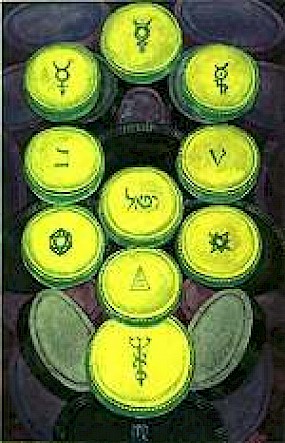
Tarot Card for October 26: The Ten of Disks

The Ten of Disks

The Lord of Wealth talks not only about material wealth and its appropriate use, but about the inner wealth and resources that we all have. This is a card that teaches us that the harvest we gather in our lives is the end result of all that we have put into living – and more importantly, how we have used the riches at our disposal.

We make our own realities with every thought, every deed, every wish. And when we direct our energies positively we shall arrive – as a perfectly natural consequence – at the Ten of Disks. Of course, if we direct our energies negatively we’ll find ourselves with the Ten of Wands, or the Ten of Swords – neither of which are happy cards!

There is a warning connected to this card though. When we have created sufficient wealth to make ourselves comfortable and contented, if we have a surplus, then we must make that surplus work. We cannot expect energy to flow freely in our lives if we hoard it, and try to hang on to it. This is as pointless as trying to save up the breeze so that it will blow on a stuffy day! There are some things in life you cannot clutch tight in the hand without crushing their value out of them.

If this card comes up in an everyday reading, it re-assures that financial and material matters are proceeding well, and that there is no cause for concern.

If it comes up in a more spiritually based reading, then we need to be applying the underlying principles to our lives – so in this case, we need to be letting our inner wealth show, in order to manifest that into our lives.

The Ten of Disks

(via angelpaths.com and Alan Blackman)