VATICAN CITY—Unable to tune out the noisy altercation coming in loud and clear through his bedroom window, Pope Francis could not sleep Monday night because a heavily intoxicated cardinal was engaged in a shouting match with his girlfriend in St. Peter’s Square, sources within the Holy See reported. “Oh, for fuck’s sake, give it a rest already,” said the reportedly irritable Supreme Pontiff, who crawled out of bed to catch a glimpse of the couple fighting in the plaza, bemoaning the thin walls inside the modest guesthouse suite he chose to make his home upon ascending to the papacy in 2013. “I have a big encyclical to finish tomorrow, and I’ll never get it done if I don’t get some shut-eye. Christ, I thought these two broke up months ago. I’m seriously about to call the Swiss Guard if they don’t put a lid on it.” According to reports, moments after the argument ended and Francis had finally fallen asleep, he was awakened by the drunk cardinal and his girlfriend having incredibly loud makeup sex in the suite just above his own.
One of the most ambitious works of paranormal investigation of our time, here is an unprecedented compendium of pre-twentieth-century UFO accounts, written with rigor and color by two of today’s leading investigators of unexplained phenomena.
In the past century, individuals, newspapers, and military agencies have recorded thousands of UFO incidents, giving rise to much speculation about flying saucers, visitors from other planets, and alien abductions. Yet the extraterrestrial phenomenon did not begin in the present era. Far from it. The authors of Wonders in the Sky reveal a thread of vividly rendered-and sometimes strikingly similar- reports of mysterious aerial phenomena from antiquity through the modern age. These accounts often share definite physical features- such as the heat felt and described by witnesses-that have not changed much over the centuries. Indeed, such similarities between ancient and modern sightings are the rule rather than the exception.
In Wonders in the Sky, respected researchers Jacques Vallee and Chris Aubeck examine more than 500 selected reports of sightings from biblical-age antiquity through the year 1879-the point at which the Industrial Revolution deeply changed the nature of human society, and the skies began to open to airplanes, dirigibles, rockets, and other opportunities for misinterpretation represented by military prototypes. Using vivid and engaging case studies, and more than seventy-five illustrations, they reveal that unidentified flying objects have had a major impact not only on popular culture but on our history, on our religion, and on the models of the world humanity has formed from deepest antiquity.
Sure to become a classic among UFO enthusiasts and other followers of unexplained phenomena, Wonders in the Sky is the most ambitious, broad-reaching, and intelligent analysis ever written on premodern aerial mysteries.
We think everyone should be treated equally. Yet we also think we are right to care most about our family, our friends and our lovers, and 82% of charitable donations in the UK are given to the causes closest to home. Should we just accept that our ethics are in practice tribal? Or is a universal concern for humanity the bedrock of a civilized culture? In which case, do we go down the Effective Altruism movement route?
The Panel
In this debate, barrister and founder of Effective Giving UK Natalie Cargill, Oxford Political Theorist and author of ‘On Nationality’ David Miller and human rights activist Peter Tatchell examine the tribal nature of morality.
“A most notable coward, an infinite and endless liar, an hourly promise breaker, the owner of no one good quality.” – Second Lord in All’s Well That Ends Well
Left unfinished by Kafka in 1922 and not published until 1926, two years after his death, The Castle is the haunting tale of K.’s relentless, unavailing struggle with an inscrutable authority in order to gain access to the Castle. Scrupulously following the fluidity and breathlessness of the sparsely punctuated original manuscript, Mark Harman’s new translation reveals levels of comedy, energy, and visual power, previously unknown to English language readers.
When Newton discovered the law of gravity, he unified the rules governing the heavens and the Earth. Since then, physicists have been placing new forces into ever-grander theories. But perhaps the ultimate challenge is achieving a monumental synthesis of the two remaining theories–relativity and the quantum theory. This would be the crowning achievement of science, a profound merging of all the forces of nature into one beautiful, magnificent equation to unlock the deepest mysteries in science: What happened before the Big Bang? What lies on the other side of a black hole? Are there other universes and dimensions? Is time travel possible? Why are we here? Kaku also explains the intense controversy swirling around this theory, with Nobel laureates taking opposite sides on this vital question.
by ALLISON PERLMAN | APRIL 12, 2021 (zocalopublicsquare.com)
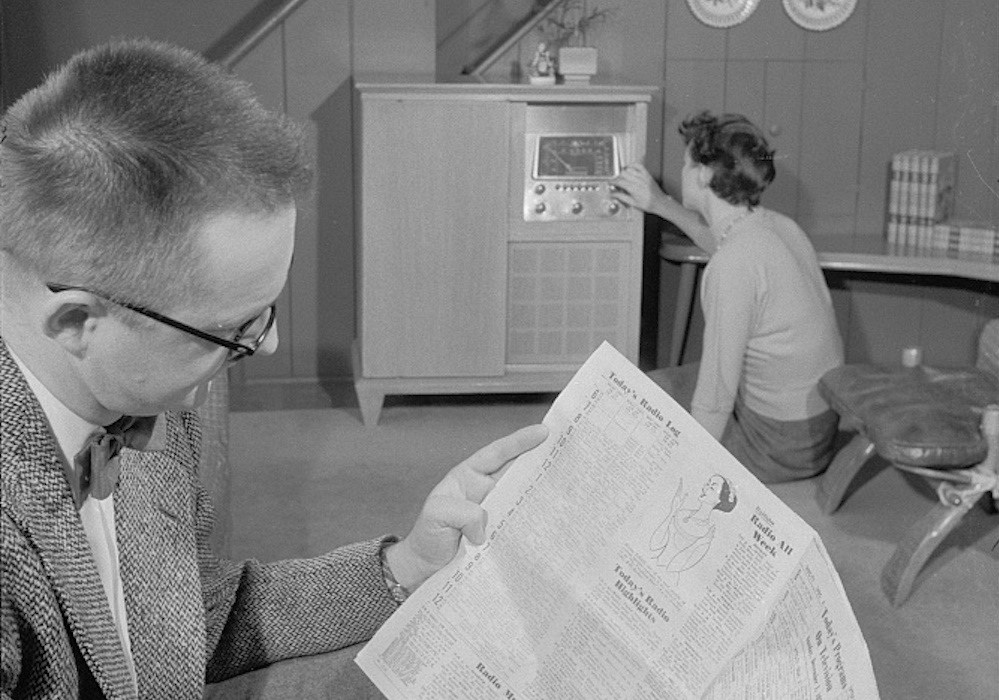
The Fairness Doctrine—the federal communications policy, in place from 1949 to 1987, that required U.S. broadcasters to address controversial issues and provide airtime to conflicting sides—is newly popular. Advocates for the policy’s return view it as a potential solution to divisive and destructive problems of our contemporary media environment, particularly as a way to mitigate disinformation in partisan media outlets. But restoring the original rule, especially with its narrow application to broadcast stations, would do no such thing.
It’s useful to understand the new interest in the Fairness Doctrine as a form of nostalgia for an era in U.S. media regulation in which the “public interest” ostensibly guided policy decisions. But this longing overlooks the actual role of the “public interest” in U.S. broadcast regulation over the first 75 years of its history. The “public interest” was always buffeted by business, political, and technological forces. The Fairness Doctrine itself was unevenly enforced, its applicability was unclear, and its effectiveness was uncertain. Its promise was always far greater than its performance.
Broadcast regulation in the United States historically faced limitations. Congress passed its first substantive regulation of radio after the tragedy of the Titanic—which had been exacerbated by the presence of a nearby ship that did not receive its distress signal, and by allegations that radio amateurs had spread false information about the scale of the disaster. The Radio Act of 1912 created a regulatory structure for the new medium that sought to assure responsible radio airwave use, reconstituting such use as a privilege to be bestowed through a license, not a right accessible to everyone. The act created a hierarchy: The Navy would get access to the best frequencies, corporations the next most valuable, and amateurs the least desirable. The law gave the Commerce Department the authority to issue licenses, but no power to deny them to qualified applicants.
Congress updated federal oversight as radio broadcasting expanded in the 1920s. The Radio Act of 1927 created the Federal Radio Commission (FRC), a temporary entity that was empowered to limit the number of radio licenses awarded, based on technical considerations, and to determine who would get them. Congress instructed the FRC to consider the “public interest, convenience, and necessity” in awarding radio licenses. Reasoning that serving the public interest required serving the largest possible number of people, the FRC favored large commercial stations, especially those owned by or affiliated with burgeoning national networks such as NBC and CBS. The agency’s policies sidelined and marginalized the non-profit stations run by educational institutions, unions, immigrant communities, and faith organizations.
In 1934, Congress created the Federal Communications Commission (FCC) to replace and expand upon the FRC. In exchange for the privilege to use an increasingly scarce public resource—the airwaves—the FCC reasoned (and federal courts concurred) that it could impose regulations in the public interest to promote competition within the broadcasting sector, assure diversity of viewpoint, and encourage local programming. Federal statutes required licensees to provide equal time to candidates seeking political office and prohibited them from airing obscene, indecent, or profane language (and, later, content). Beginning in 1941, the FCC also prohibited broadcast stations from editorializing. This policy, known as the Mayflower Rule, was adopted amidst anxieties about the use of radio as a tool of propaganda, from the virulently anti-Semitic broadcasts of Father Charles Coughlin in the U.S., which reached a domestic audience of around 40 million people, to radio’s deployment by Hitler in Germany. In an environment in which very few controlled the instruments of shared communication, the FCC held, government had an affirmative role to assure that those entities did not bend public discourse to their will.
But the regulatory structure created by Congress did not always address on-the-ground broadcast practices. Though national networks distributed a great deal of programming, federal authority primarily regulated the recipients of broadcast licenses—local stations. If a network distributed a program containing indecent content, it was the stations who aired the program who were liable for violating an FCC rule. What’s more, even though the FCC had authority to revoke or not renew a broadcasting license if a station’s programming record failed to serve the “public interest”, the agency rarely exercised this power. After World War II, the FCC signaled it would base licensing renewal decisions on the public service record of stations and issued guidelines, known as the “Blue Book,” that outlined programming expectations for local stations. But the Blue Book was never enforced; the red-baiting commercial broadcast industry successfully tarred the FCC’s interventionist approach as anti-American, akin to a communist approach to media.Symbolically, if not always in practice, the rule exemplified a view of media regulation that put the interests of the public above the editorial freedoms of media companies. It was a reminder to stations of the ostensible precarity of their licenses and their obligations to program responsibly. But the Fairness Doctrine was not a panacea.
In this context, the FCC revisited the Mayflower Rule, replacing it with the Fairness Doctrine in 1949. Broadcasters, under the new guidelines, no longer had to shun editorializing; in fact, they had an affirmative obligation to address controversial topics of interest and to provide diverse perspectives on the air. The new policy struck a middle ground between competing ideas about the editorial responsibilities of broadcasters. Some had advocated for a retention of the Mayflower Rule, seeing in it a protection from broadcasters using their stations to advocate solely for pro-corporate policies; others called for its complete repeal, arguing for the absolute editorial freedom of local stations. The Fairness Doctrine provided broadcasters editorial discretion, but mandated that they air competing views on controversial topics, not just those that reflected the perspective of the licensee.
In theory, the Fairness Doctrine was supposed to assure listeners had access to a robust marketplace of ideas. In practice, it was clunky and confusing. Enforcement relied on listeners filing complaints with the commission when a station failed to comply. Stations and complainants alike confused its provisions with the equal time rules that applied to candidates for political office. Whether broadcast addresses by elected officials required stations to provide time for responses was unclear, as was whether issues of national import, but not directly related to local communities, activated Fairness Doctrine requirements. Some stations ignored the affirmative obligation to address controversial topics and avoided tackling them altogether. Broadcast networks tightened their control over their news divisions, asserting that airing documentaries produced by independents or non-U.S. media companies could render affiliates vulnerable to Fairness Doctrine complaints. Paradoxically, the rule may have diminished the marketplace of ideas while shoring up network control over national public affairs programming.
The Fairness Doctrine, importantly, was a tool that enabled a range of communities to pressure stations to include their perspectives on the airwaves, and to program with the diversity of their publics in mind. Symbolically, if not always in practice, the rule exemplified a view of media regulation that put the interests of the public above the editorial freedoms of media companies. It was a reminder to stations of the ostensible precarity of their licenses and their obligations to program responsibly.
But the Fairness Doctrine was not a panacea. Much of the rule’s power came from activists who monitored local stations and requested time to respond to broadcasts on controversial topics. Like much of U.S. media policy, its enforcement hinged on individuals and communities equipped with the informational and social capital to level a complaint. While it required stations that discussed civil rights activities to include voices beyond segregationists, it did nothing to address the extraordinary paucity of people of color in control of or employed by local stations. While it required opposing perspectives, it gave broadcasters discretion as to what constituted a legitimate viewpoint and who was a capable spokesperson to articulate it.
In the end, the Fairness Doctrine’s impact was questionable. The FCC jettisoned it in 1987, as part of a broader sweep of media deregulation championed by broadcasters, the Reagan administration, and their allies in Congress. Regulators abandoned the scarcity rationale for broadcast regulation, as the commission asserted that the expansion of cable, an increase in local stations, and the availability of the VCR portended an abundant and diverse media ecology. The end of the Fairness Doctrine also marked the end an interpretation of speech rights that understood the First Amendment as enabling democratic self-governance and that required, in the words of education reformer and philosopher Alexander Meiklejohn, “not that everyone shall speak, but that everything worth saying shall be said.”
In its place, U.S. regulators have adopted a view of speech rights that prohibits the government from restricting anyone’s speech, corporations and people alike. The result is a media environment defined by fragmentation, misinformation, and informational siloes. It is an arena in which the greatest threat to free speech is understood not as the wide distribution of disinformation, the prevalence of corrosive hate speech and threats, the disproportionate power of corporations and the wealthy in political campaigns, or the escalation of conspiracy theories that threaten democratic institutions—but rather, any government action to curb them.
It is logical that some Americans desire a return to a perceived simpler era, in which media companies operated in the public interest and produced shared knowledge about the world we collectively inhabit. The call for a revitalized Fairness Doctrine perhaps speaks more to a desire not for the reinstatement of a sometimes ineffective and insufficient rule that emerged in a very different media environment, but to a nostalgia for an imagined regulatory system that was responsive, in policy prescription if not always in practice, to the public interest; one devoted to making media enable, rather than dismantle, the capacities for democratic processes.
The author has a neurological difference that enhances sound and diminishes visual imagery. Yet she has achieved success with a philosophy PHD. And has a concept of sound that is meaningful and informative.
–Michael Kelly, HW
From the Big Bang to a heartbeat in utero, sounds are a scaffold for thought when logic and imagery elude us
Christina Rawls is professor of philosophy at Roger Williams University in Bristol, Rhode Island. She is the co-editor of the essay collection Philosophy and Film: Bridging Divides (2019) and a regular contributor to the American Philosophical Association blog, with an interview series on the philosophy of time.
When John Lennon was asked in 1975 why so many adults disliked rock and roll, calling it the ‘devil’s music’, he replied: ‘I always thought that it’s because it came from Black music.’ Reflecting on the past 400 years of white supremacy in the United States, including the recent attempted insurrection at the US Capitol in January 2021, I often wonder what Lennon would say of us today. Would he tell us to ‘Imagine there’s no heaven’ or would he sing ‘Stand by me’? Would he cry ‘Mother’ or remind us that love really ‘is the answer’?
I am a professor of philosophy, and I have always thought in sound. Allow me to fine-tune, in my own way. One of the distinctive features of my cognition is that not only do I think with sound and music; I also don’t think in images during my waking hours (although I dream vividly and visually at night). This lack of visual imagery is known as aphantasia, partial in my case. Along with another condition known as mild auditory processing disorder, my learning differences have resulted in tremendous difficulty and inconsistencies in reading, writing and, sadly, even speaking at times. I specialise in the thought of the 17th-century philosopher Baruch Spinoza, and I often wonder what he would have done with the aphantasiacs. He understood that the working of the imagination – often believed to be the source of mental imagery – can either enhance or weaken one’s ability to thrive, depending on which ideas of reason they were paired with. Indeed, I completed my doctorate only because of patient teachers who care deeply.
It’s an odd thing to try to explain to others what it means to have the experience of an empty head while I’m awake. Experts in aphantasia call this a trouble with one’s ‘mind’s eye’. I disagree. Not only is consciousness irreducible to mere brain matter – as our ideas are not actual objects I can put into your hands – but my neurological particularities might also explain my connections to thinking in sound. We humans are not only made of words, as the music historian, jazz enthusiast and former graduate student in philosophy Ted Gioia demonstrates in Music: A Subversive History (2019). Gioia’s book has set the rhythm for my own thoughts on music and sound. The point is, if I can teach and work with challenging philosophical systems without the use of images in my mind’s eye, not to mention struggling with the words, then imaginative pictures (even imagining language) might not be as important to reasoning as some people think. Spinoza might agree: rational ideas have laws of nature uniquely their own.
I can’t spell or follow correct grammatical rules. Just ask my editor. Yet I can pick up and identify the sounds of almost any language easily, even if remembering the words is the problem. This ability has something to do with memory, but it’s been the case ever since my brain has been forced to arrange the words I heard into a semi-acceptable and then mostly acceptable communicating language. Memory experts understand that song and story together can enhance memory. Gioia writes in support of these auditory aids, noting the cross-cultural history of the use of rhythm and sound since the beginning of the human species. I can’t read music or do upper-level mathematics, but music certainly helped me to learn Spinoza’s Ethics, one of the most logically challenging systems ever devised in Western philosophy – a system that became quite obvious to me in its logical beauty and creative, affirmative force.
Even if I find language to be a challenge, music and sound can assist. I am an avid music experiencer, a sound adventurer, and a lover of almost every genre of music – although, like all of us, I do press repeat on some of my favourite songs and sounds. The pandemic has me reaching toward those I care for most, which at present concern the head and the heart. That’s also the name of the musicians featured here – and their songs serve as a hug, a thread of connection and a musical love letter to a dear friend and muse, far away.
As a child, I used to stare at the keys on my grandmother’s piano, teaching myself about sound and thought, often when I couldn’t find the right words to express myself or explain my experience. When I was very young, I heard words backwards by syllable. Perhaps it’s not surprising, then, that I had my own language when learning how to speak? This ‘problem’ corrected itself within those first few years of life but, to this day, my 92-year-young ‘Grandma’ still signs some of her letters ‘Love, Magra’.
On my second piano lesson in my early 20s, right after graduating with a psychology degree and a few classes short of a double philosophy major, my gentle piano instructor said: ‘You’re a natural! Do you want a piano?’ He was offering me an upright baby grand from a 1960s commune. All I had to do was transport it. (Helpful hint: you can easily slide a large piano across the floor on pillows.) Now I had my own piano and I tried to learn how to play by ear. But, to this day, I still can’t read sheet music, and most piano teachers won’t teach you if you can’t ‘read’ music.
Not all sounds need to or can have names, and yet we both experience them and also learn from them
This attention to notation perhaps dates back to the ancient Greek philosopher and mathematician Pythagoras, who tried to make a measured metre from the magic and power of the sounds he heard: of ironsmiths in the marketplace, of good company and conversation, of falling pebbles. (Pythagoras once held up a stone before one of his students and declared: ‘This is frozen music.’) Before Pythagoras, Gioia notes, ‘women played a central role in music – especially the drumming that we have come to associate with trance states.’ However, once Pythagoras hit the scene, everything became about the more male domains of mathematics and logos (reason) – that is, measurement and language, instead of the aulos (a pan-pipe made of reeds) and song. As Gioia writes:
Once [logos] went mainstream, it would punish and censor in turn, so much so that almost all of our subsequent sanctioned narratives about music, both its history and theoretical underpinnings, are distorted to some degree by Pythagorean biases … In other words, the very practice of legitimisation is an act of distortion.
Such interference with the immediacy and power of music and sound remains in force to this day. Gioia goes on to describe a story from a specialist in avant-garde classical composition, who told the author that he’d been attacked at a conference recently for focusing on how the work ‘sounded’: ‘He was told repeatedly by his peers that he should ignore such banal considerations, and focus instead on the compositional strategies employed.’ Yet the mystic Eckhart Tolle has also noted that some of our most profound moments are those we encounter without description – such as any new (positive) experience in a place we’ve never visited before, or delicious meals we’ve never tasted before, or beautiful sounds and instruments we’ve never heard before. The unnameable and the unfathomable can be striking, affective; not all sounds need to or can have names, and yet we both experience them and also learn from them. New research on binaural music – where the frequency of sound is slightly different in both ears – suggests that such noises can alter our brainwaves and mental processes for the better. Gioia notes that in ‘the heart of the atom’ particles move at extraordinary speeds of up to 100 trillion times per second, ‘creating a tone some 20 octaves above the range of our hearing’.
Along with touch, sound is one of the first senses to develop – long before sight or smell. Developing human foetuses can hear their mother’s heartbeats (and voices) in utero. We hear gentle, albeit muffled sounds while developing, less muffled and more acute sounds when we’re born, definitely all kinds of muffled and acute sounds while alive – and according to many spiritual traditions, we might hear the most perfect music when we die. Perhaps this is another reason why sound and rhythm are such universal forces: they’re some of the founding experiences of all human beings. Gioia opens his work on music by noting that, in Hindu iconography, Shiva is holding a drum at the moment of creation; an apt image, given that contemporary science dubs the beginning of the Universe ‘the Big Bang’.
Ikept that piano for several years, and then for a few years more in storage. It helped me dream of those days when one of the great loves of my life used to play for me. We would break into our university auditorium at midnight and rush the stage. With one light bulb hanging above our heads in the rafters, I lay under the keys, closed my eyes, and felt his vibrations and energy radiating through my body and mind as he played those keys well into the night, anything by the Beatles or Billy Joel from memory.
Spinoza understood the power of the imagination when coupled with the force of rational ideas. Together, they make what we might call a kind of music – something that transcends any one narrative, description or formal use of language altogether. For Spinoza, reason is something distinct from imaginative knowledge, but language resides within the imagination. Yet while some believe that music and sound exist in a domain apart from reason, I hold that they can still enhance deep thinking and reflective thought. Perhaps even more importantly, sound and music can be felt. For Spinoza, all sensations are partial and imaginative, and must be converted into knowledge. As Gioia notes, singing releases oxytocin into the brain and body, which in turn creates a feeling of unity, collaboration and cooperation with those around us.
This felt dimension of knowledge can be a problem for those who prefer instead to measure and track. You can’t feel what another is feeling; often, the only way to measure the experience of another is through language, logical reasoning and, perhaps, various forms of technology, but these aren’t the only ways. If I think in sound, and even if I can send only a virtual hug to your ears in song – if they act as a kind of glue for my memories, or simply reduce my anxiety with language itself – then there’s even more that can’t be measured. Perhaps it can only be felt first and then legitimated later?
‘Both the length of respirations and the total breaths per minute are locked in to a spooky symmetry’
If sound and music transcend language and logic, how can they assist anyone to do something as complex as philosophy? Plato might have understood this paradox, but in a hidden way. He might have even coded the Republic using Pythagorean ideas to hide his theory of just how powerful music and sound actually are for human beings (something that shamans and some indigenous cultures have always understood). Citing research by the musicologist J B Kennedy, Gioia writes:
If you break down the 12,000 lines of Plato’s Republic into 12 sections of 1,000 lines each, each equivalent to a note on a scale, you will find explicit references to harmony, music, pitch and song recurring at precisely the most consonant intervals. Darker themes, relating to war and death, emerge at dissonant intervals.
Gioia observes that even Socrates, Plato’s mentor, grasped the value of concealed meanings and withholding the kind of information that could get you killed – although I’m not sure how successful he was at that practice in the end. Socrates was unjustly put to death for proving that freedom of thought is distinctly human, and that it might be connected to our souls, including their possible afterlife. The idea of sound and rhythm, especially as it links to breathing and health, is a much more significant connection than many today believe. In Breath (2020), the journalist James Nestor emphasises that modern biomedical science is beginning to verify certain rhythmic and ancient Eastern breathing practices that lead to significantly better health: ‘the most efficient breathing rhythm occurs when both the length of respirations and the total breaths per minute are locked in to a spooky symmetry – 5.5-second inhales followed by 5.5-second exhales, which works out almost exactly to 5.5 breaths a minute.’ Moreover, Nestor observes that these techniques are of the same rhythms as acts of prayer:
When Buddhist monks chant their most popular mantra Om Mani Padme Hum, each spoken phrase lasts six seconds … The traditional chant of Om … takes six seconds to sing, with a pause of about six seconds to inhale. The sa ta na ma chant, one of the best-known techniques in Kundalini yoga, also takes about six seconds to vocalise, followed by six seconds to inhale … Japanese, African, Hawaiian, Native American, Buddhist, Taoist, Christian – these cultures and religions all had somehow developed the same prayer techniques, requiring the same breathing patterns. And they all likely benefited from the same calming effect.
The idea of harmony and rhythm, musically and physically, has been the subject of careful attention from philosophers. In Book III of the Republic, Plato is careful to distinguish between the concept of language on the one hand, and the concept of harmony and rhythm on the other – although he needed both to better articulate the meaning of the human soul. He claimed that there is a natural rhythm, grace and harmony for all things: ‘weaving, embroidery, architecture, and every kind of manufacture; also nature, animal and vegetable. In all of them there is grace or the absence of grace.’ This extends to acts in service of the community. I often think Plato might not get enough credit for his communally oriented thinking; but, then again, he might have borrowed some of this from indigenous cultures before him too. For Plato, if the youth are to do what they’re good at – to add their individual, natural talents to the collective – they must also make harmony and grace ‘their perpetual aim’. Nonetheless, they can’t get lost in mystical chants or sad songs. Aristotle thought that the aulos made a disgusting sound, and Socrates and Plato frowned upon it too.
We can debate what Plato intends by the concept of grace, and many have for thousands of years. But his identification of the role of harmony in promoting cohesion and cooperation – of sound and music, or at the very least of singing together – is surely right. It even created some actual magic. As Gioia demonstrates, singing was a vital collective activity for the earliest humans, and remained the way of many shamanistic cultures for centuries, up to and including today. Plato was worried about those darn flute players; they couldn’t speak while playing, and flutes were known to be used by those he believed to be less well-educated. But he might have realised his error upon his death bed: in a moment of irony that’s not lost on philosophers, and after having written and spoken so many words, Plato requested a flute player to ease him into death, and perhaps into the next life too.
‘Music of the right kind can serve to orient and anchor a patient when almost nothing else can’
To Plato’s credit, his scepticism of music flowed from the idea that we can’t get lost in a trance all day – not if we’re going to get work done for ourselves and our neighbours in a democratic, free, educated and creative society. Plato understood that music and sound had the power to transform humans and elicit profound emotions; he desired that great poets and artists create certain rhythms and sounds for times of war, and other songs for times of peace. I too make love not war, but so many haven’t truly heard me. Perhaps, with the mild auditory processing disorder and more, it was not their fault either. This is the challenge of learning differences. I am differently abled and the more music playing the better!
Music, then, can be a form of healing. The late neurologist Oliver Sacks studied the phenomena of music and sound, being able to bring forth seemingly lost memories in his patients. In Musicophilia (2007), Sacks writes that music therapy with those with dementia ‘is possible because musical perception, musical sensibility, musical emotion, and musical memory can survive long after other forms of memory have disappeared. Music of the right kind can serve to orient and anchor a patient when almost nothing else can.’
These healing properties apply to our bodies as well. The neurosurgeon Bernie Siegel often played music to his patients in the operating room. While they were under anaesthesia, Siegel whispered into their ears that they could relax, enjoy their favourite music or sounds and, while doing so, he would appreciate it if they would also bleed less during surgery. To his colleagues’ surprise, this appeared to work: according to Siegel, his patients made incredible recoveries in very short periods of time, and bled much less than the average patient during surgery too. Measurable effects following metaphysical suggestions.
Throughout the global pandemic, I’ve noticed how much we need our favourite sounds – sounds that comfort, sounds that heal; the sounds of sports fans, the sounds of lovers, friends, family; the sounds of our pets, of nature. That’s also how sound heals. It’s both individual and communal, a collective of individual sounds. Sound includes rhythm, as we noted above, and rhythm is about timing. The philosopher Thomas Nail has developed a new philosophical ontology – a theory of what it means ‘to be’ – which is something we don’t get very often in philosophy. In Being and Motion (2018), he builds on the ancient philosophy of Lucretius, who argued that all of nature (including space and time) is composed of flows, folds and fields – that is, entropic arrangements and unfolding processes always in motion. When you go to measure anything, you need space and time to do it. But, as Nail convincingly argues, such practices wouldn’t be possible if the flows, folds and fields of motion and movement itself were not already in play. Consciousness never stops moving.
So while some words might be lost on me, motion and rhythm are not. If motion comes first for some philosophers, then our bodies, at least for both Gioia and Nail, were the first instruments for the first humans, hundreds of thousands of years ago. ‘Kinetic sounds did not emerge ex nihilo from the speaking body; they were gathered from elsewhere,’ Nail writes. ‘All human phonemes already existed in natural and animal sounds before the human ear ever heard them.’
Each major shift in technology changes the way people sing
We certainly need a lot of healing right now. Art therapists, not to mention musicians and music therapists, have a nuanced understanding of how music and sound can soothe and regenerate the body and mind. Recall that, in philosophy, the mind is not the brain. Sound can serve to stimulate the other senses too, including provoking images and sensations of certain scents or colours, such as for those who have synaesthesia. Sound is also about vibration, and music is also about energy. As the inventor Nikola Tesla said in the 1940s: ‘If you wish to understand the Universe, think of energy, frequency and vibration.’
What will the new sounds of our world feel like, I wonder? Gioia writes: ‘Each major shift in technology changes the way people sing.’ More importantly perhaps, he prophesies that, if authorities don’t interfere, ‘music tends to expand personal autonomy and human freedom’. I’ll be leaving academia soon after 15 years or so of successful teaching. I’ll miss the students and classroom tremendously, but I need a break from all the monitored words and background authority figures. They’ve missed a few notes, and I can sing from anywhere. I’ve been ‘in college’ since 1994, on and off. My writing has improved, but barely. Reading is still very challenging and yet I do it daily. As for speaking? That depends on who I’m talking with and how I feel when I’m with them. I have new notes to play now. I’ve made my small contribution to the history of philosophy, often because of the caring heartbeats and ideas I’ve shared with others.
As fellow travellers in the balancing of our souls, humans can strive to maintain their artistic and scientific guardianship over truth, beauty and goodness. But nature is so much more than what humans can guard, name or define. As Gioia sings: ‘Music is always more than notes. It is made out of sounds. Confusing these two is not a small matter … music does not happen in the brain. Music takes place in the world … Songs still possess magic, even for those who have forgotten how to tap into it.’
Carl Gustav Jung was a prominent Swiss psychologist in the 19th century who made a name for himself by studying old myths and religions. In doing so, he coupled his findings with experiences from his patients and formed his own branch of psychology — analytical psychology.
His ideas of the archetypes and the collective unconscious are often celebrated in contemporary western culture. However, one of his deeper and less recognized ideas seems nonetheless unbelievably impactful — that is the idea of synchronicity.
Synchronicity is defined as a meaningful coincidence. But we must make no mistake, the idea is far deeper than it sounds. The origination of instances of synchronicity and its relation to our lives makes it an invaluable idea that deserves attention.
The Duality of Our World
Before diving directly into synchronicity, it is important to lay the contextual groundwork for a richer explanation.
The first idea to note that our reality is not singular, but dual. The idea of a dual reality was first developed by Plato in his theory of forms. Specifically, there are two worlds — a world of being and a world of becoming.
The world of becoming is very familiar to us. It is the external, physical world that can be recognized by our senses and conscious state. It is called the world of becoming because the physical world is a world of constant flux. The phrase ‘the only constant is change’ rings true in this reality.
The world of being, on the other hand, is a reality that transcends the world of becoming. It transcends the external world and even the more superficial aspects of our consciousness. Plato attributes the world of being to an unchanging, absolute realm of what he called forms — these were essentially the ideals of everything that exists in the physical world.
The world of being for Jung seems most accessible from the mind as it’s conception since Plato was primarily psychical as well. This duality can also be compared quite closely to the duality of psyche and matter, or the dichotomy between physical and spiritual reality (also present in Buddhist philosophy).
Interestingly, contemporary culture is less aware of this world of being because the advent of Aristotelian philosophy early in the day has killed it. To provide historical context, Aristotle believed that there was nothing in the intellect that was not previously in the senses. This idea essentially meant that only the world of becoming exists and all ideas in the psyche only originate from the physical world. Nowhere else.
The physical world operates on the concept of cause and effect. The idea of causality is so interwoven into our lives that anything other than that is so ambiguous and foreign that we reject it immediately. If an event occurs absent of a cause, we are completely baffled.
Yet, the world of being does not operate within the boundaries of causality. It transcends this element of the physical world and does not follow the laws of classical Newtonian physics (although it must be made clear that this world cannot be conceptualized similarly to the physical world).
Dreams clearly highlight the absence of causation. Although it may be the case that there are noticeable contents in your dreams that correlate with real life, dreams are often incomprehensible and odd. This is because dreams do not operate on the basis of causation. Things do not happen because of something, they just happen.
Time
The physical world operates on the concept of time as well. Happenings in this realm are sequential, and it is also why the physical world is called the world of becoming. The element of time is the element that facilitates change.
The world of being also does not operate within the boundaries of time. Again, it transcends the temporal element present in the physical world, which is why it is called the world of being since it is not in a state of constant change. Like Plato’s idea, the world of being is unchanging and absolute.
This can be proved with a personal thought experiment. Try to remember something you did when you were a young child, it can be immensely meaningful or immensely stupid (take your pick). And now think, is that person still you? The rational conclusion would be yes.
Although the event itself has been subjected to the element of time, your relation to it has transcended time. Your deeper sense of self does not subject itself to the change that comes with time, and this reflects itself on the world of becoming. This shows that certain areas of consciousness are bereft of time.
The Golden Scarab Beetle
Now that we know of the duality of both worlds and the distinction between them, synchronicity can be better explained. Synchronicity itself does not operate on the principle of causality, which is why it is often termed a meaningful coincidence. The world of being itself, being primarily psychic and bereft of time, also lays the foundation for a meaningful occurrence between the time-bound and the timeless.
An instance of synchronicity arises when there is a meaningful and usually symbolic alignment between the world of becoming and the world of being, between psyche and matter, between the physical and the spiritual.
When a coincidence occurs between certain psychic content and objective, external events, that is an instance of synchronicity. A potent example to illustrate such an instance would be a personal anecdote from Carl Jung on his experience with one of his patients.
He had a client who came to him for therapy and she was a very rational, intellectual, and well-educated person. She was not in touch with her feelings at all and Jung felt that he was struggling in helping her get in touch with her feelings, her natural being.
“A young woman I was treating had, at a critical moment, a dream in which she was given a golden scarab. While she was telling me this dream, I sat with my back to the closed window. Suddenly I heard a noise behind me, like a gentle tapping. I turned round and saw a flying insect knocking against the window-pane from the outside. I opened the window and caught the creature in the air as it flew in. It was the nearest analogy to a golden scarab one finds in our latitudes, a scarabaeid beetle, the common rose-chafer (Cetonia aurata), which, contrary to its usual habits had evidently felt the urge to get into a dark room at this particular moment. I must admit that nothing like it ever happened to me before or since.”
Jung then took the beetle and presented it to his client, saying “Here is your scarab”. From then onwards, her therapy changed and she became more in touch with her inner self. As Jung put it,
“The dream alone was enough to disturb ever so slightly the rationalistic attitude of my patient. But when the “scarab” came flying in through the window in actual fact, her natural being could burst through the armor of her animus possession and the process of transformation could at last begin to move.”
This was a beautiful illustration of synchronicity. The golden beetle itself held symbolic value, especially in Egyptian mythology. It represented existence, manifestation, development, and growth. This instance of synchronicity arguably changed the life of Jung’s patient, allowing her to continue to grow as she developed her relationship with her emotions and inner self.
The alignment between the psychic contents and external occurrences can prove to be symbolically meaningful and life-changing. Such is the nature and importance of synchronicity.
What Makes Synchronicity So Special?
Probability
An instance of synchronicity is not a coincidence in the common sense of the word. If you were to think of a coincidence as the simultaneous happening of occurrences only in the physical world, the notion of probability is still at play.
However, when the coincidence is between the psyche and matter, the notion of probability is eliminated. This is because a form of foretelling would be at play. When the symbols or signs appear in dreams, it becomes less of a coincidence and more towards the activity of unconscious processes on the external world.
Even coincidences that occurred outside of dreams may not be completely probabilistic.
For example, if you noticed that the first numbers on an unknown phone call were 676 and then continued noticing that sequence of numbers throughout your day, it is not simply probability. You get unknown phone calls all the time, but what was it in your mind that made you receptive to remembering this very one?
Jung argued that such instances were not simply coincidences, but products of important unconscious processes that were meaningful and impactful to our lives. The elimination of probability in such arguably ‘miraculous’ occurrences contribute to the significance of synchronicity.
Meaning
The example with Jung and his patient should have given you an idea of the power of synchronicity in our lives. An instance of synchronicity could change one’s entire temperament.
Since ynchronicity is an alignment of psyche and matter, Jung claimed that it was an unbelievably meaningful occurrence as he believed in an underlying order to the universe. Oftentimes, such instances hold ancient symbolic meanings that have been present in myths and religions for centuries.
Like the scarab beetle, other symbols as well can be present. Another example from Jung would be his personal experience with the symbol of a fish. After he finished an inscription of an image that was half-man, half-fish, Jung went out for lunch and was served fish. While eating, someone at the meal had a slip of the tongue and mentioned making an “April fish” of someone.
Later on, a patient whom he has not seen in months showed up and showed him some pictures of fish. In the evening, someone showed him an embroidery filled with fish. The next day, another patient he has not seen in ten years came to him and described a dream she had about a large fish. A few months later, he took a stroll at the bank of a lake and found there was a substantial amount of fish laying on the sea wall with little explanation for how it got there.
The fish symbolized the idea of redemption as it is often compared with Christ and the serpent symbol. Nonetheless, such occurrences are already so off-putting that when they are coupled with old, symbolic, and sometimes religious meaning, one cannot doubt their significance and power in our lives.
Final Thoughts
The idea of synchronicity is a very complex one and this article only served as an introduction. Then again, even with the primary knowledge of the nature of synchronicity, we cannot doubt that, if true, it plays an important role in our lives.
The elimination of probability and symbolic meaning add to its significance, but the simple idea that our psyche and matter can align to produce impactful and life-changing events shows that there is more to us than we know.
The unconscious processes at work are intricate and interesting. What we can do is not merely focus on one world, but the other as well. We can give credit to reason and rationality, but we have to also keep in mind that the world of becoming is not all there is.
Sometimes, our emotions, longings, and even dreams can give us invaluable information that cannot be otherwise substituted by rationality — so listen to them. Sometimes your heart knows better than your head.
Finally, as we continue to live our lives with reason and emotion, we can keep a lookout for those instances. The instances where being and becoming intertwine, where science and spirit meet, where the internal and external align. Look out for those instances, because synchronicity is worth looking out for.
The Apeiron Blog — Big Questions, Made Simple.
We know that Philosophy can seem complicated at times. To make things simple, we compile together the best articles, news, reading lists — and other free resources to guide you on your journey. To continue with us, follow us on Medium and sign up to our free mailing list.