Translators: Mike Zonta, Melissa Goodnight, Richard Branam, Hanz Bolen
SENSE TESTIMONY: Excessive divergence of belief causes discordance that is insurmountable.
5th Step Conclusions:
1) There is no divergence of belief in Mind: Mind is the one Cause, the one Heart, insurmountably harmonious. OR: Mind is of one Mind.
2) Truth is Unusually Creative of Necessity, this Conduction/ Induction is the Ultimate Reservoir Being the Supra Beyondness, Limitless Sensualness of Consciousness Awareness, this Reasonableness in Action, and Conduct, never cedes, accept to it’s own Bending resonation, this vibration is the Sound of Universal Principle, I AM THOU.
3) Mind Truth I Am is the Core, the Heart, radiant, powerful, well and self-evident, instantaneously and universally, the only possession, only possibility, only love there is. The Truth is the Heart, expressing all there is.
4) Infinite Mind is knowing Itself in infinite variety — always re-membering and re-cognizing the perfectly harmonious ONE, in limitlessly expressing the splendidly bounteous many.
All Translators are welcome to join this group. See Weekly Groups page/tab.
AwakenTheWorldFilm All of our films, teachings and guided meditations are available for free at http://www.awakentheworld.com in many languages. Support us by purchasing high quality versions of the films for download, or physical products on DVD/blu-ray. The Awaken the World Initiative was created for the purpose of humbly serving the awakening of humanity by bringing the perennial wisdom back into the world for free in every language.
Most cultures have their mythologies centered around heroes who are not like other people. They don’t always have to be born from a meaningful family, although often are (e.g. half god, royal family, etc.), but even if they are from common people those are always exceptional individuals, either stronger or wiser or have some unnatural talent that others don’t. They can therefore overcome struggles that would not be possible for everyone else and lead towards success in whatever way it is needed for given community.
It became so ingrained into our culture, that in form of Joseph Campbell’s “The Hero’s Journey” it is considered pretty much copy paste for a good storytelling and also is being taught in film schools, which results in further teaching us that whatever problem we might have as a society, in order to overcome it we need those exceptional individuals, some hero, messiah or a leader. Even if the underlying issue is systemic, there is always need for a special person to do the hard work, or at least show direction and be the symbol of a struggle that others can follow.
I know that Campbell based his research on many different cultures around the world, so it would seem this is the way it always worked for pretty much every culture ever, but what I’m really interested is if there ever was any alternative?
Do you know of any culture that did not praise exceptional individuals over group effort? Or at least taught in their tales that you don’t need to be special in order to make a meaningful change, that it can come from regular people working hard, together?
I’d gladly take any example I could further read about, be it a culture, specific myth/tale, or anything at all, since I don’t really have any clue right now. Thanks!
Comment:
IANAA so this might be a bit vague. I think it was an account from Noah Harari’s Sapiens, but I’ll try to track down the source if someone else can’t clarify.
An anthropologist bought a cow for a group of hunter-gatherers to thank them for helping with his research. He got the biggest fastest cow he could find, but when he presented it to them they seemed indifferent. Saying things along the lines of; it’s a scrawny thing but it will have to do.
Confused and a little hurt he asked one of them what was wrong with his gift. They explained that if they gave anyone too much praise for their contribution to the tribe they might get a big head. Since gathering food was a group effort that could end badly.
In a society without a ruling class, the best hunter might try to lord their skills over the rest. So to avoid a break down of social cohesion individual achievements were downplayed. Seems like as soon as big men, like kings, gain a foothold that concept has been replaced by one of extraordinary individuals.
The story is told in Eating Christmas in the Kalahari, by Richard Lee.
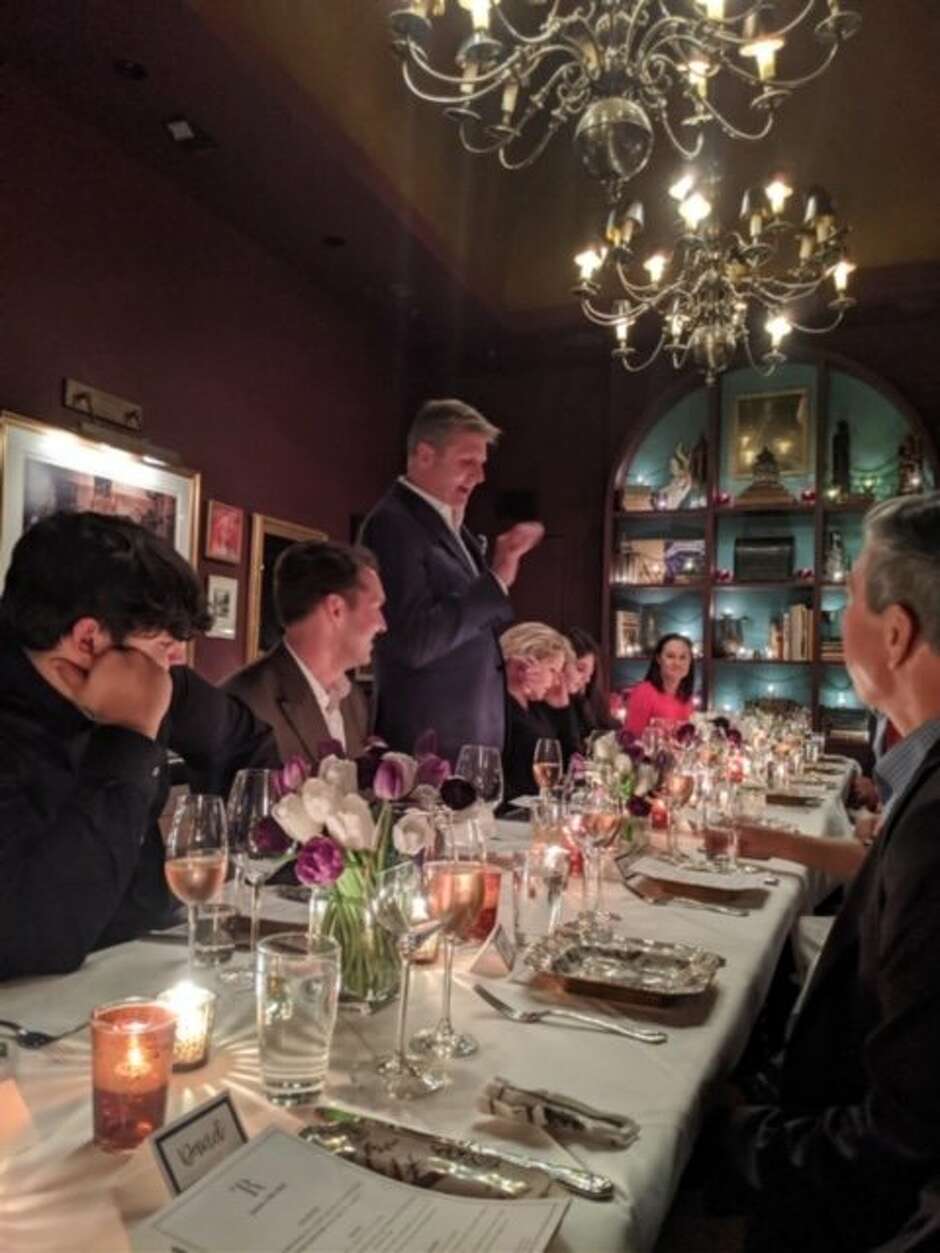
1of5Golden State Warriors president Rick Welts and Todd Gage and their families on the steps of City Hall on their wedding day.Photo: Noah Graham2of5Golden State Warriors president Rick Welts addresses a group of friends and family at Marianne’s, a salon in the Cavalier restaurant. Welts married his partner, Todd Gage, at City Hall earlier that day.Photo: Noah Graham3of5Golden State Warriors President Rick Welts (left) and Todd Gage may have made history with their wedding day at S.F. City Hall.Photo: Noah Graham
Couples marry under the breathtakingly beautiful City Hall dome every day. Straight couples. Same-sex couples. I once saw two men, one dressed as Superman and the other as Aquaman, marry at the top of the grand staircase before embracing under the former’s red cape.
It’s San Francisco. Rightly, when it comes to love, anything goes.
But one wedding this month garnered attention for breaking one of the last barriers in this country’s long fight for marriage equality. Rick Welts, president of the Golden State Warriors, married Todd Gage, a Southwest flight attendant, in Room 200.
It is believed to be the first time an executive for a professional men’s sports team married his same-sex partner. According to the Advocate, there are no out players in professional male sports and just a smattering of out executives and coaches. Same-sex weddings in the macho world of men’s pro sports were unheard of — until now.
Mayor London Breed officiated the wedding of Welts, who turns 67 Tuesday, and Gage, 44, at 11 a.m. Jan. 10. She pronounced them “spouses for life,” popped Champagne and served macaroons in the team’s colors, blue and gold.
National Basketball Association Commissioner Adam Silver quipped at the league’s subsequent annual sales meeting in Miami that Welts was there on his honeymoon, garnering good-natured laughs from other team executives.
“Never in my lifetime could I have imagined this,” Welts told me in a surprisingly personal interview. “It’s been a really perfect, perfect experience.”
The happiness is a far cry from the decades Welts spent hiding his sexuality, fearing that coming out would endanger his career. He didn’t ask his colleagues questions about their personal lives because he didn’t want them to ask him the same questions.
When his longtime partner Arnie died of complications related to AIDS in 1994, he took just a day or two off work. His secretary explained to callers that he’d lost a good friend; she didn’t know the truth about Arnie either.
A subsequent relationship of 14 years ended over Welts’ refusal to bring his partner out of the shadows.
But his compartmentalized life began to crack open in the summer of 2009. Welts, then the president of the Phoenix Suns, boarded a Southwest flight back to Arizona from Burbank. Passengers walked up one of those old-school rolling staircases to board the plane — and waiting at the top to greet them was Gage.
“You pick your own seat on Southwest, and as luck would have it, I sat myself in the section of the plane that he was serving,” Welts recalled. “Our eyes met a couple of times. It does confirm that there is such a thing as love at first sight. For me, anyway.”
“He was Mr. 8-F,” Gage told me, still recalling the seat his now-husband selected. “I tried to buy him a drink, but he just had Diet Coke. He swears that when I handed him his drink, I rubbed his hand, which I did not!”
The flight was short and packed, and the men didn’t have much time to interact. But Welts was determined to see Gage again.
“I did what any red-blooded American boy would do, which is write my number on a Southwest napkin,” Welts said with a laugh.
Gage called the number, but was scared off when he learned Mr. 8-F was not only 23 years older than him, but also the president of a professional basketball team. Gage explained that he lived a quiet life in Sacramento with two children from a previous marriage to a woman and didn’t think their lives would mesh.
He said he finally emailed Welts a year later, apologizing for not giving him the benefit of the doubt and asking him out for a glass of wine. They clicked immediately.
But after several months of dating, Gage still wasn’t included at major professional events that Welts attended. Welts said he’d already lost one partner over not coming out and “didn’t want to make that mistake again.” He also secured the blessing to come out publicly from his elderly mother, who was dying of cancer.
“He went through that journey with me, which was quite harrowing, the whole New York media tour and the Times article and everything involved with that,” Welts said of Gage. “He was by my side.”
The coming out went smoothly, and Welts was relieved. The Golden State Warriors hired him as president later that year.
He and Gage now split their time between a home in Sacramento, where Gage’s 15-year-old son is in high school, and a condo that’s walking distance from the team’s gleaming new Chase Center. They decided over dinner last year to marry. It was mutual, with neither one popping the question.
“There was no on-the-knee moment,” Welts explained.
Welts wanted a big wedding, but Gage wanted something small. Welts found a date last fall when the Warriors were at home but had a day off, and the Fairmont Hotel was available. They started compiling a guest list, but it soon grew to an unwieldy 400 people.
“It was me who finally said, ‘Yeah, this is starting to feel more like a work function than a personal moment,’” Welts said. “We revised the date and the plan.”
They chose Jan. 10, a date Gage’s son and 18-year-old daughter, a college freshman in Chicago, were free. And Welts’ younger sister, Nancy Schulte, and his niece were free, too. Breed, a longtime friend of the couple’s, was available to officiate.
Breed met the men as a supervisor when they all traveled to China on a Warriors trip in 2013. She has joked to the couple over the years that the first time she saw the handsome Gage, not knowing he was paired up with Welts, she thought, “That’s it — that’s my future.”
“She decided that if she couldn’t have him, it would be great if I did,” Welts said with a laugh.
Breed said in a statement, “I was proud to perform the nuptials for two amazing San Franciscans, Rick and Todd. Rick has also been an incredible leader in a sports world which hasn’t always been a welcoming place for LGBT people to do something so simple as be open about who they love, and I’m happy to have played a small part in celebrating his marriage.”
It was just the family of six, the mayor and a photographer in the wood-paneled room under the seal of San Francisco as the men said, “I do.” The family had lunch at Boulevard afterward and celebrated with 20 friends that evening at Cavalier. Welts and Gage are planning a honeymoon in Spain after the Warriors’ season is over, which, let’s face it, is likely to be much sooner than in previous years.
Welts’ sister warned me she’d start crying as she talked about her brother getting married, and she was right.
“Twenty-five years ago, Rick stood up for me at my wedding,” she said through tears. “I was just so thrilled that now he can experience that same type of love in his life.”
Back in the 1980s, when the siblings were in their 20s, Welts sat his sister down on a bench in Central Park in New York City and told her he was losing friends to AIDS, she recalled.
“He said, ‘Do you understand what I’m trying to tell you?’ Of course I knew. It was a difficult thing to tell his little sister,” she said, adding that coming out publicly has made her brother happier and more carefree. “It’s something he wished he could have done years and years ago. It just has been a sea change in his life.”
The wedding made a splash in the gay media, with a photo Welts shared on Twitter appearing on several LGBTQ news sites. Out magazine ran it under the headline “This History-Making Gay NBA Executive Just Married His Partner.”
In San Francisco, it seems like no big deal. But it is.
“I was just marrying the man I love,” Gage said. “But I guess we made history. How cool is that?”San Francisco Chronicle columnist Heather Knight appears Sundays and Tuesdays. Email: hknight@sfchronicle.com Twitter: @hknightsf Instagram: @heatherknightsf
People get angry for all sorts of reasons, from the trivial ones (someone cut me off on the highway) to the really serious ones (people keep dying in Syria and nobody is doing anything about it). But, mostly, anger arises for trivial reasons. That’s why the American Psychological Association has a section of its website devoted to anger management. Interestingly, it reads very much like one of the oldest treatises on the subject, On Anger, written by the Stoic philosopher Lucius Annaeus Seneca back in the first century CE.
Seneca thought that anger is a temporary madness, and that even when justified, we should never act on the basis of it because, though ‘other vices affect our judgment, anger affects our sanity: others come in mild attacks and grow unnoticed, but men’s minds plunge abruptly into anger. … Its intensity is in no way regulated by its origin: for it rises to the greatest heights from the most trivial beginnings.’
The perfect modern milieu for anger management is the internet. If you have a Twitter or Facebook account, or write, read or comment on a blog, you know what I mean. Heck, Twitter anger has been brought up to new heights (or lows, depending on your point of view) by the current president of the United States, Donald Trump.
I too write quite a bit on online forums. It’s part of my job as an educator, as well as, I think, my duty as a member of the human polis. The conversations I have with people from all over the world tend to be cordial and mutually instructive, but occasionally it gets nasty. A prominent author who recently disagreed with me on a technical matter quickly labelled me as belonging to a ‘department of bullshit.’ Ouch! How is it possible not to get offended by this sort of thing, especially when it’s coming not from an anonymous troll, but from a famous guy with more than 200,000 followers? By implementing the advice of another Stoic philosopher, the second-century slave-turned-teacher Epictetus, who admonished his students in this way: ‘Remember that it is we who torment, we who make difficulties for ourselves – that is, our opinions do. What, for instance, does it mean to be insulted? Stand by a rock and insult it, and what have you accomplished? If someone responds to insult like a rock, what has the abuser gained with his invective?’
Indeed. Of course, to develop the attitude of a rock toward insults takes time and practice, but I’m getting better at it. So what did I do in response to the above-mentioned rant? I behaved like a rock. I simply ignored it, focusing my energy instead on answering genuine questions from others, doing my best to engage them in constructive conversations. As a result, said prominent author, I’m told, is livid with rage, while I retained my serenity.
***
Now, some people say that anger is the right response to certain circumstances, in reaction to injustice, for instance, and that – in moderation – it can be a motivating force for action. But Seneca would respond that to talk of moderate anger is to talk of flying pigs: there simply isn’t such a thing in the Universe. As for motivation, the Stoic take is that we are moved to action by positive emotions, such as a sense of indignation at having witnessed an injustice, or a desire to make the world a better place for everyone. Anger just isn’t necessary, and in fact it usually gets in the way.
The philosopher Martha Nussbaum gave a famous modern example of this in her Aeon essay on Nelson Mandela. As she tells the story, when Mandela was sent to prison – for 27 years – by the Apartheid government of South Africa, he was very, very angry. And for good reasons: not only was a grave injustice being perpetrated against him personally, but against his people more generally. Yet, at some point Mandela realised that nurturing his anger, and insisting in thinking of his political opponents as sub-human monsters, would lead nowhere. He needed to overcome that destructive emotion, to reach out to the other side, to build trust, if not friendship. He befriended his own guard, and eventually his gamble paid off: he was able to oversee one of those peaceful transitions to a better society that are unfortunately very rare in history.
Interestingly, one of the pivotal moments in his transformation came when a fellow prisoner smuggled in and circulated among the inmates a copy of a book by yet another Stoic philosopher: the Meditations of Marcus Aurelius. Marcus thought that if people are doing wrong, what you need to do instead is to ‘teach them then, and show them without being angry.’ Which is exactly what Mandela did so effectively.
So, here is my modern Stoic guide to anger management, inspired by Seneca’s advice:
Engage in preemptive meditation: think about what situations trigger your anger, and decide ahead of time how to deal with them.
Check anger as soon as you feel its symptoms. Don’t wait, or it will get out of control.
Associate with serene people, as much as possible; avoid irritable or angry ones. Moods are infective.
Play a musical instrument, or purposefully engage in whatever activity relaxes your mind. A relaxed mind does not get angry.
Seek environments with pleasing, not irritating, colours. Manipulating external circumstances actually has an effect on our moods.
Don’t engage in discussions when you are tired, you will be more prone to irritation, which can then escalate into anger.
Don’t start discussions when you are thirsty or hungry, for the same reason.
Deploy self-deprecating humour, our main weapon against the unpredictability of the Universe, and the predictable nastiness of some of our fellow human beings.
Practise cognitive distancing – what Seneca calls ‘delaying’ your response – by going for a walk, or retire to the bathroom, anything that will allow you a breather from a tense situation.
Change your body to change your mind: deliberately slow down your steps, lower the tone of your voice, impose on your body the demeanour of a calm person.
Above all, be charitable toward others as a path to good living. Seneca’s advice on anger has stood the test of time, and we would all do well to heed it.
WILMER, TX—Fretting over what such a display of weakness would do to his reputation, local man Neil Rockfield told sources Thursday he was afraid of seeming vulnerable if he reached out to the fire department for help with an out-of-control blaze. “I always learned growing up that a real man puts out his own house fire, and I’ll just feel so lame letting them know I can’t deal with this,” said Rockfield, adding that just the idea of putting himself out there and admitting he couldn’t handle a raging fire in his living room and kitchen made him feel sick to his stomach. “The awkwardness of talking to a complete stranger on the phone and saying, ‘Hey, can you help me?’ is too much. They’ll probably want to know how bad it is, too. I don’t know if I can humiliate myself by asking another grown adult to drive a fire truck over here. My dad would have never done something like this.” At press time, Rockfield decided to go to bed and see how he felt about the situation in the morning.
One of the possible definitions for the word Prometheus is forethought — to look ahead, to imagine. And if we are liberal with this definition, then, perhaps, it’s also about taking what’s in that imagination and bringing it down to the realm of mortals, the material world we occupy.
In Greek mythology, the story goes, that Prometheus was the great Titan who created humanity from clay and inspired the birth of civilization. Using his forethought — or maybe his imagination — he defied the Gods, stealing their fire and giving it to us so we could use it for our collective good.
This act, however, didn’t go unpunished. Zeus, the king of the Olympian Gods, was harsh with his sentence. He bound Prometheus to a rock for this daring transgression, where one of his eagles would fly over to eat Prometheus’ liver. This liver would then grow back the next day, so that it could be eaten again and again, over and over for eternity.
In the literal sense, the story is what it is — a myth. In the metaphorical sense, however, it can be seen as a warning. If we replace the idea of literally stealing fire from the Gods with the idea of creatively imagining new ways of harnessing the power of our environment in our mind and then using that to build technology in the world, we paint a different picture. If we then consider Prometheus’ punishment (having his liver eaten) for doing this and realize that, in ancient Greece, the liver was thought to be the seat of human emotions and that his punishment was metaphorically to have his emotions destroyed for this transgression, we, again, paint a different picture.
One of the most important questions of the 21st century is the question of technology. We all know that we now live in a technological age, unlike anything we have ever seen before. The computer, the internet, and the smartphone revolutionized everything about how we interact with one another, and by historical standards, they did so incredibly fast. And by all visible evidence, it doesn’t look like this movement is done. That said, the same technology that allows us to talk to our loved ones across miles of space is also using algorithms to manipulate our behavior. We are more liberated, more powerful, than ever before, but in other ways, we are also more exposed, more vulnerable, than we have ever been.
But at its core, what exactly is technology? Today, we think of a computer as technology, but in the time of the Promethean myth, fire was a technology. Writing was a technology. In a sense, technology is anything that augments the power of the human body. With fire, instead of using our body’s internal mechanisms to establish homeostasis in the cold, we could do so by manipulating the energy sources of the Earth. With writing, instead of using our voice to talk to one person, or a group of people, through books, we could talk to millions of people, in different places, at different times.
We forget that these things are technologies because we have a historically myopic viewpoint. They are so embedded into the reality we are born into, and we function so fluidly with them, that they feel natural. A computer and a smartphone are too new for that. That said, perhaps, they are indeed different from those old technologies, and perhaps they are leading us down a road that will be hard to come back from.
One of the differences between today’s technologies and older technologies is that we are interconnected as a whole species in a way today that we weren’t before. Whereas a fire could only affect someone within a say, five-foot radius, the internet has connected us into a whole in which every cause and every effect ripples and impacts things far away from the original source. Not only that, but our technologies are also more powerful. A fire might be able to scare away a predator in the wild in a hunter and gatherer society, but a nuclear bomb has the potential to blow up the whole of civilization.
With all of this considered, over time, it’s apparent that technology is about leverage and power. It is about overcoming the constraints of the physical environment with increasingly sophisticated tools. But like any tool of power, the more it is engaged without the right leadership, the right stories, the harder it becomes, the more devoid of life it becomes — the more it acts for the sake of acting rather than for a meaningful outcome.
If technology is about augmenting the human body so that we can overcome the challenges of the physical environment, then culture — our network of interconnected selves — is about the stories of why we should overcome the challenges of the physical environment. Technology is a tool of thought and imagination. Culture is a product of emotion and memory.
With the slow decline in religious belief since the Age of Enlightenment (at least in the Western world), technology and its power have finally decoupled from the hold of culture and its stories. That was likely the indirect catalyst of the industrial revolution, and indeed the computer revolution, that has improved our material well-being so substantially. Without stories to contain its power, technology can grow unchecked. That said, there will inevitably come a point when this kind of growth outdoes itself, without the right checks and balances in place, without the right stories to guide it.
As the late culture and media critic Neil Postman wrote in his book Technopoly: “Stated in the most dramatic terms, the accusation can be made that the uncontrolled growth of technology destroys the vital sources of our humanity.” Culture, its stories, the emotions contained within, are what make us human — they capture our aches and our yearnings.
Technology can be a wonderful tool for the betterment of our species and our civilization, but technology itself can’t be the guide for too long because power, though unbiased in its most elementary form, inherently leans towards domination and harm rather than liberty when it doesn’t have the right kind of people, or the right kind of stories, in charge of managing it.
For stealing away the first great technology, the fire that gave us civilization, Prometheus suffered deeply by giving up his liver (or his emotional core) every single day of his life. He wanted more with his foresight, so he took it, and then he paid a steep price for that. By no means does the myth tell a story of Prometheus having any bad intentions, and yet, the consequences were inevitable, and they were harmful and damaging.
There is a lesson here: Technology can be a tool for harm even if we don’t intend for it to be, but it can only be a tool for good if we meaningfully direct it with our humanity, our emotions, and our stories. In the modern, interconnected world of the 21st century, this asymmetry means that the downside is far more accessible than the upside. The downside doesn’t need encouragement, whereas the upside does.
Just as the internet has tangled our actions and behaviors across space and time, so it has also interconnected our selves, our collective culture. Right now, this collective culture is confused. It’s not sure what to believe. There are factions everywhere, each with their own belief systems, each with their own values. In some places, these are encouraging and optimistic. In others, they are tearing themselves apart with their own pessimism. In either case, we have lost touch with the broader stories, with the broader visions, that once united us in spite of our differences.
Fortunately, if we are to model ourselves after a great Greek myth, we have to consider that the story of Prometheus didn’t end with him laying there, having his liver chewed up for eternity. Prometheus was eventually freed by someone else in the story: the divine hero Heracles.
What we need in our modern technological world today isn’t more of the same — a mindless kind of walk towards a better material future without any consideration of the context surrounding that future. That is important, and it is useful, and it has a place. But it can also lead us down a path that we would have a hard time turning back from if we don’t stop to think a little deeper about who we really are and what we are really yearning for, first, individually, and then, relationally and collectively.
On its own, technology is agnostic — it simply provides a function with some kind of utility. That function can just as well cause harm as it can liberate. The stakes, however, have never been higher. And if we want to point it in the direction of mass flourishing rather than towards the Promethean curse, then we are going to need something more than just a tool with a function. We are going to need stories — about who we are beyond the surface of our differences, and perhaps more importantly, why we do this.The Startup
Playing at the intersection of science, art, and philosophy. Trying to be less wrong. I share my more intimate thoughts at www.designluck.com/community.
Love is synchronicity. Agency (or power) is asynchronicity. Time is the spread over which they harmonize into a complex dance that brings out the aliveness that makes us human. In this sense, meaning is something we create in balance. Love without agency is a selfless delusion. Agency without love paves the road to psychopathy.
–Zat Rana
Playing at the intersection of science, art, and philosophy. Trying to be less wrong. I share my more intimate thoughts at www.designluck.com/community.
A new NASA video combines visible, infrared and X-ray views of the famous Crab Nebula, a star that exploded into view in our sky 1,000 years ago.Sharing is caring!
NASA released the video above on January 5, 2020, saying it was created by astronomers and visualization specialists from its Universe of Learning program. These experts combined visible, infrared and X-ray vision of the famous Crab Nebula, the remains of a star that exploded into view in Earth’s sky in the year 1054. The video shows images from the Chandra X-ray Observatory and the Hubble and Spitzer space telescopes. It shows the pulsar at the heart of the Crab Nebula – the rapidly spinning, super-dense crushed core of the exploded star – which sends high-energy jets in either direction into the nebula, and which serve as what NASA calls the powerhouse “engine” of the entire system. In a statement, NASA said:
The tiny dynamo [the pulsar] is blasting out blistering pulses of radiation 30 times a second with unbelievable clockwork precision.
The visualization was produced by a team at the Space Telescope Science Institute (STScI) in Baltimore, Maryland; the Caltech/IPAC in Pasadena, California; and the Center for Astrophysics | Harvard & Smithsonian (CfA) in Cambridge, Massachusetts. It debuted earlier this month at the American Astronomical Society meetingin Honolulu, Hawaii.
X-ray view of the Crab Nebula from Chandra X-Ray Observatory. Image via NASA/ CfA/ J. DePasquale.
STScI’s visualization scientist Frank Summers led the team that developed the video. He said:
Seeing two-dimensional images of an object, especially of a complex structure like the Crab Nebula, doesn’t give you a good idea of its three-dimensional nature. With this scientific interpretation, we want to help people understand the Crab Nebula’s nested and interconnected geometry. The interplay of the multiwavelength observations illuminate all of these structures. Without combining X-ray, infrared, and visible light, you don’t get the full picture.
NASA described the video this way:
The movie begins by showing the Crab Nebula in context, pinpointing its location in the constellation Taurus. This view zooms in to present the Hubble, Spitzer, and Chandra images of the Crab Nebula, each highlighting one of the nested structures in the system. The video then begins a slow buildup of the three-dimensional X-ray structure, showing the pulsar and a ringed disk of energized material, and adding jets of particles firing off from opposite sides of the energetic dynamo.
Appearing next is a rotating infrared view of a cloud enveloping the pulsar system, and glowing from synchrotron radiation. This distinctive form of radiation occurs when streams of charged particles spiral around magnetic field lines. There is also infrared emission from dust and gas.
The visible-light outer shell of the Crab Nebula appears next. Looking like a cage around the entire system, this shell of glowing gas consists of tentacle-shaped filaments of ionized oxygen (oxygen missing one or more electrons). The tsunami of particles unleashed by the pulsar is pushing on this expanding debris cloud like an animal rattling its cage.
The X-ray, infrared, and visible-light models are combined at the end of the movie to reveal both a rotating three-dimensional multiwavelength view and the corresponding two-dimensional multiwavelength image of the Crab Nebula.
Summers commented:
The three-dimensional views of each nested structure give you an idea of its true dimensions. To enable viewers to develop a complete mental model, we wanted to show each structure separately, from the ringed disk and jets in stark relief, to the synchrotron radiation as a cloud around that, and then the visible light as a cage structure surrounding the entire system.
These nested structures are peculiar to the Crab Nebula. They reveal that the nebula is not a classic supernova remnant as once commonly thought. Instead, the system is better classified as a pulsar wind nebula. NASA explained:
A traditional supernova remnant consists of a blast wave and debris from the supernova that has been heated to millions of degrees. In a pulsar wind nebula, the system’s inner region consists of lower-temperature gas that is heated up to thousands of degrees by the high-energy synchrotron radiation.
Isn’t this a cool image? It’s the famous Crab Nebula – the remnant of a star that exploded 1,000 years ago – as seen by the Hubble Space Telescope. Superimposed on the visible light image from Hubble is an X-ray image from the Chandra X-Ray Observatory (in lavender), revealing the nebula’s high-energy heart. Image via NASA/ ESA/ J. DePasquale (STScI)/ R. Hurt (Caltech/IPAC).
Bottom line: A new NASA video combines visible, infrared and X-ray views of the famous Crab Nebula, a star that exploded into view in our sky 1,000 years ago.