HEAVEN–God confirmed Monday that He has misplaced His special decision-making coin. “I have no idea where I put it,” a visibly distraught God said of the coin, which He has used for more than four billion years to determine everything from the direction of breezes to genocides. “I remember flipping it last night for [Monroe, MI, couple Mark and Patti Brenton’s] attempt at conception, but I haven’t seen it since.” God said He hopes to locate the coin before 7:15 a.m. Thursday, when United Flight 251 takes off from Seattle with actress Dixie Carter on board.
The Institute of Art and Ideas Oct 30, 2025Rupert Sheldrake explores the concept of God as the consciousness that exists not only within humans, but within the entire cosmos. Are we all fragments of the same, greater consciousness? With a free trial, you can watch the full talk NOW at https://iai.tv/video/discovering-the-… The modern world’s faith in science has made the idea of the supernatural seem like a silly child’s fantasy, at least in the minds of many. Yet, 50% of people do still believe, or suspend disbelief, in the supernatural. Join radical scientist and spiritualist, Rupert Sheldrake, to explore a reality that lies beyond the scientific view of reality. #consciousness#panpsychism#spirituality#spiritual#god Rupert Sheldrake is an English scientist whose research into parapsychology and evolution led to the theory of morphic resonance. Other topics he has written and spoken on include precognition, the relationships between spirituality and science and the psychic staring effect. Sheldrake’s most recent book is ‘Science and Spiritual Practices’. The Institute of Art and Ideas features videos and articles from cutting edge thinkers discussing the ideas that are shaping the world, from metaphysics to string theory, technology to democracy, aesthetics to genetics. Subscribe today! https://iai.tv/subscribe?utm_source=Y…00:00 We all share the same consciousness 00:26 God, angels, and the supernatural split 02:03 The sacred in Hindu culture 03:30 Mystical encounters and near-death experiences 06:45 The benefits of meditation 08:37 The ground of consciousness of the whole universe 10:40 The varieties of spiritual practice 14:52 Psychedelics, morphic resonance, and the natural world For debates and talks: https://iai.tv For articles: https://iai.tv/articles For courses: https://iai.tv/iai-academy/courses
One September dawn on the verge of a significant life change, sitting on my poet friend’s dock, I watched a great blue heron rise slow and prehistoric through the morning mist, carrying the sky on her back. In the years since, the heron has become the closest thing I have to what native traditions call a spirit animal. It has appeared at auspicious moments in my life, when I have most yearned for assurance. It became the first bird I worked with in my almanac of divinations. At times of harrowing uncertainty and longing for resolution, I have found in the long stillness of the hunting bird, waiting for the right moment to do the next right thing, a living divination — a great blue reminder that patience respects the possible.
It is naïve, of course, to believe that this immense and impartial universe is sending us, transient specks of stardust, personalized signs about how to live the cosmic accident of our lives. Still, it is as foolish to ask the meaning of a bird as it is to see it as a random assemblage of feather and bone. Reality lives somewhere between matter and meaning. One makes us, the other we make to bear our mortality and the confusions of being alive. Meaning arises from what we believe to be true, reality is the truth that endures whether or not we believe in it. That is the difference between signs and omens. Signs disrespect the nature of reality, while omens betoken our search for meaning, reverent of the majesty and mystery of the universe — they are a conversation between consciousness and reality in the poetic language of belief.
A bird is never a sign, but it can become an omen if our attention and intention entwine about it in that golden thread of personal significance and purpose that gives life meaning.
Jarod Anderson also turns to the great blue heron as a lens on our search for meaning in Something in the Woods Loves You (public library) — his poignant meditation on surviving the darkest recesses of human nature, the strange fusion of shame and sadness that gives depression its devastating power, by turning to the luminous and numinous in nature. Emerging from the pages is a lyrical love letter to how “imaginative empathy” heals and harmonizes our relationship to ourselves, to each other, to the wonder of being alive.
Reflecting on the difficulty of interpreting his own life and on the myriad symbologies of the great blue heron — among them an ancient myth in which the bird dusts the surface of the water with golden starlight to attract bluegill — Anderson writes:
The heron is exactly what the heron is to you in the moment you choose to give it meaning. It will be that meaning until you decide it means something else. That’s how meaning works. It’s a subjective act of interpretation.
You might get the impression that I’m saying herons are meaningless, but that’s not what I’m saying at all. When I see a heron and interpret its behavior as a reminder for me to slow down and think about what actually matters in my life, that is what that heron means. Meaning, like many crafts, happens in collaboration between maker and materials.
[…]
The heron allows me to build the meaning I need for the moment I need it. Making meaning in this way is like creating harmony with two voices… The trouble starts when we forget about our participation in the creation of harmony, of meaning. When we remove our agency in meaning-making, we start to think in absolutes.
Whenever we think in absolutes, we ossify. Our freedom always lies in our flexibility, and because concepts like meaning and identity are not fixed, because, as Anderson observes, they “require our intentional participation,” they are “mercifully flexible.” They take the shape of our beliefs about who we are and what we deserve, they abide by the messages we send ourselves through the omens we make of reality.
Watching the herons walking his local shoreline, feeling like they are sending him “an overt message” about the power of “quiet contemplation and self-determination,” Anderson writes:
The heron only represents self-determination when I need her to. That doesn’t diminish the heron’s power. It simply highlights my own.
There are objective facts in the world. Of course there are. But our concept of self, our significance, our sense of whether or not we deserve to take up space in the universe or experience joy and contentment — these are not questions of fact, they are questions of meaning.
For those of us who find consolation in the natural world, the sense of meaning has to do with contacting the numinous quality of sea and sky and songbird, of everything that makes this planet a world. You may call that contact wonder. You may call it magic. “If you don’t think herons are magic,” Anderson writes, “you need to broaden your definition of that word.”
Looking back on the bleak period when depression swept away the herons from the sky of his mind and voided the world of wonder, he reflects:
There are two paths to magic: Imagination and paying attention. Imagination is the fiction we love, the truths built of falsehoods, glowing dust on the water’s surface. Paying attention is about intentional noticing, participating in making meaning to lend new weight to our world. An acorn. The geometry of a beehive. The complexity of whale song. The perfect slowness of a heron.
Real magic requires your intention, your choice to harmonize. Of course it does. The heron cannot cast starlight onto the dark shallows to entrance the bluegills. Not unless you do your part. You must choose to meet her halfway. And when you do, you may find that magic isn’t a dismissal of what is real. It’s a synthesis of it, the nectar of fact becoming the honey of meaning.
13 If I speak in the tongues of men and of angels, but have not love, I am a noisy gong or a clanging cymbal. 2 And if I have prophetic powers, and understand all mysteries and all knowledge, and if I have all faith, so as to remove mountains, but have not love, I am nothing. 3 If I give away all I have, and if I deliver up my body to be burned,[a] but have not love, I gain nothing.
4 Love is patient and kind; love does not envy or boast; it is not arrogant 5 or rude. It does not insist on its own way; it is not irritable or resentful;[b]6 it does not rejoice at wrongdoing, but rejoices with the truth. 7 Love bears all things, believes all things, hopes all things, endures all things.
8 Love never ends. As for prophecies, they will pass away; as for tongues, they will cease; as for knowledge, it will pass away. 9 For we know in part and we prophesy in part, 10 but when the perfect comes, the partial will pass away. 11 When I was a child, I spoke like a child, I thought like a child, I reasoned like a child. When I became a man, I gave up childish ways. 12 For now we see in a mirror dimly, but then face to face. Now I know in part; then I shall know fully, even as I have been fully known.
13 So now faith, hope, and love abide, these three; but the greatest of these is love.
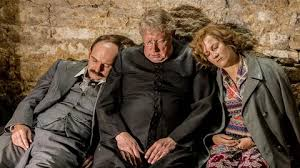
“And I will lead the blind in the ways which they know not, and in the paths which they were ignorant of, I will make them walk. I will make darkness light before them, and crooked things straight.”
—Father Brown, Season 7, Episode 5, paraphrasing Isaiah 42:16
“I longed to teach, but I had to wait until the desire had left me before I could really do so.”
~ Idries Shaw
Idries Shah, also known as Idris Shah, Indries Shah, né Sayed Idries el-Hashimi and by the pen name Arkon Daraul, was an Afghan author, thinker and teacher in the Sufi tradition. Shah wrote over three dozen books on topics ranging from psychology and spirituality to travelogues and culture studies. Wikipedia
Do you have a soul? Is there even such a thing? If so, what is it exactly? Where does it live, how does it move, and what does it need? How do you grow more of it? And is it really, as some of the wisest humans who ever lived have insisted, the most valuable thing in the universe?
I invite you to sit with these questions. Meditate on the soul, dream about the soul, and turn the soul over in your imagination as if you were exploring a luminous treasure.
To start the inquiry, I’ll tell you about a woman I met who had arrived at a devastating answer to these questions.
She told me she firmly believes she is no more than the sum total of the influences of all the people she has ever known. The way she talked about herself was as if she were a machine, a passive assemblage of other people’s programming.
She lives her life as if she has no essential core, but is merely what others have shaped her into: a reflection of her parents’ and teachers’ and friends’ and enemies’ expectations of her: a mirror that has forgotten it also generates its own light.
I understood the cultural currents that had carried her to this diminished self-concept. And I agree that each of us is partly a creation of forces beyond our control. Most people have no idea how thoroughly they are shaped by the zeitgeist, by ancestral patterns, by the collective unconscious, by advertising and propaganda and the relentless pressure of consensus reality.
But I am quite sure that each of us also has an essential core, a diamond nature and irreducible YOU-ness that isn’t entirely manufactured by outside forces.
I believe our souls are ancient entities that exist both outside of time and space and very much inside it. They are both eternal and urgently present, both transcendent and gloriously incarnate in this particular body at this particular moment in history.
So I will ask you to do you and me a favor. Even if you’ve been taught that consciousness is merely the result of brain chemistry and the soul is a metaphor at best and a hallucination at worst: Imagine, just for now, that you do have a soul—not as an article of religious faith but as an experiential reality you can actually feel.
Relax the frenzied activity of what the Zen Buddhists call the monkey mind. And try to feel the quality of that deep, indivisible part of you.
This part of you knows itself and loves itself with clarity and grace. It’s so utterly unique that no other soul in the history of this planet has ever been quite like it, and no other soul ever will be. It’s the gorgeous, humming center of you, quietly broadcasting its singular frequency beneath all the noise and distraction and performance and anxiety.
This essential core is NOT merely a creation of your parents. Does NOT measure its worth against anyone else’s. Is NOT a slave to other people’s opinions of who you should be.
It’s who you were before you were born into this body, and who you will be after you leave it. It’s the part of you that chose this particular incarnation, with its particular set of challenges and gifts, and decided to arrive at this precise moment in history to do your singular work.
Your soul can never be completely understood. It will always be partly mystery. And yet it’s your sweetest, most reliable source: the wellspring of your authentic creativity and your deepest compassion. No matter how lost you may become in the maze of conditioning and fear and self-doubt, your soul will always be there at your center, emanating its signal, inviting you to remember, ready to guide you home.
In this era of manufactured confusion and artificial intelligence and deepfake everything, that authentic signal is more precious than ever. It’s the one thing that can’t be corrupted. It holds the blueprint of your most luminous becoming, and it loves you with an unconditional devotion that asks nothing except that you trust the wild, beautiful truth of who you really are.
So tune in. Its tender guidance has never been more available to you—or more necessary.
You might feel moved to explore the nature of the soul with rare companions who take the soul seriously. They won’t flinch when the conversation goes deep.
Of course, you don’t want to get into the trap of debating the soul’s existence with people who snicker and reach reflexively for their skepticism. Conversations like those are useless. Save your energy for something more alive.
You may also decide that the fact you have encountered this essay means that now is an excellent time to go out in active search of experiences that will expand and deepen your soul. How might you attune yourself to the synchronicities and encounters and recognitions that will teach you more about what your soul is and why it matters?
Below are some navigational hints.
Anything or anyone you find truly beautiful will lead you toward soul. And by beautiful I don’t mean pretty packaging or pleasing surfaces. I mean beautiful in the older, stranger sense: glowing with intelligence and intensity and mystery and depth. Beautiful as in made by hand, close to the earth, energizing to your body, and impossible to reduce to a price tag.
Anything that awakens your reverence will lead you to soul. Anyone who is acutely alive to the flow of life, who spills over with vitality and genuine responsiveness, will lead you there, too.
Feelings of gratitude will lead you there. So will adventures that catch you off guard. Unpredictability stirs the soul, and surprising truths. Deeply felt traditions with real roots can awaken or feed the soul.
But you know more than I do about what will lead you, specifically, to soul. You have your own particular hungers and your own telltale signals. You know those moments when some mystery in you suddenly leans forward, alert and awake.
Pay close attention to those signals. Write about them. Make a list of the experiences, the people, the landscapes, the works of art, and the conversations that have awakened the deepest stirrings in you. Let that list become a kind of map.
+
Now here are three questions with tentative answers to open your imagination further.
Question 1: Was there a time, once upon a time, when star-crossed romance wounded your capacity for love? Left a scar across the very place in you that most wants to give and receive tenderness?
Answer: Yes. Almost certainly yes. But there has never been a better moment than now to begin healing that wound.
Question 2: Is it possible you are finally willing to relinquish your long-held addiction to a certain tragic magic? That exquisite, melancholy story you’ve been telling yourself, beautiful in its way but also keeping you smaller and sadder than you need to be?
Answer: Yes. Your urge to genuinely love your life is growing stronger than your attachment to ancient sorrow. Your need for clarity is quietly overwhelming the melodrama that once felt essential but is now, if you’re honest, becoming increasingly beside the point.
Question 3: Has there ever been a better time than right now to perform quietly courageous acts—small, steady, unglamorous acts of integrity—that turn you away from the seductions of shallowness and toward the deeper allure of the soul?
Answer: You already know the answer. You’ve known it for a while.
Art by Wassily Kandinsky
Consciousness, spirituality, biography, sexuality, androgyny, futurism, space, the arts, science, astrology, democracy, humor, books, movies and more


 The heron is exactly what the heron is to you in the moment you choose to give it meaning. It will be that meaning until you decide it means something else. That’s how meaning works. It’s a subjective act of interpretation.